
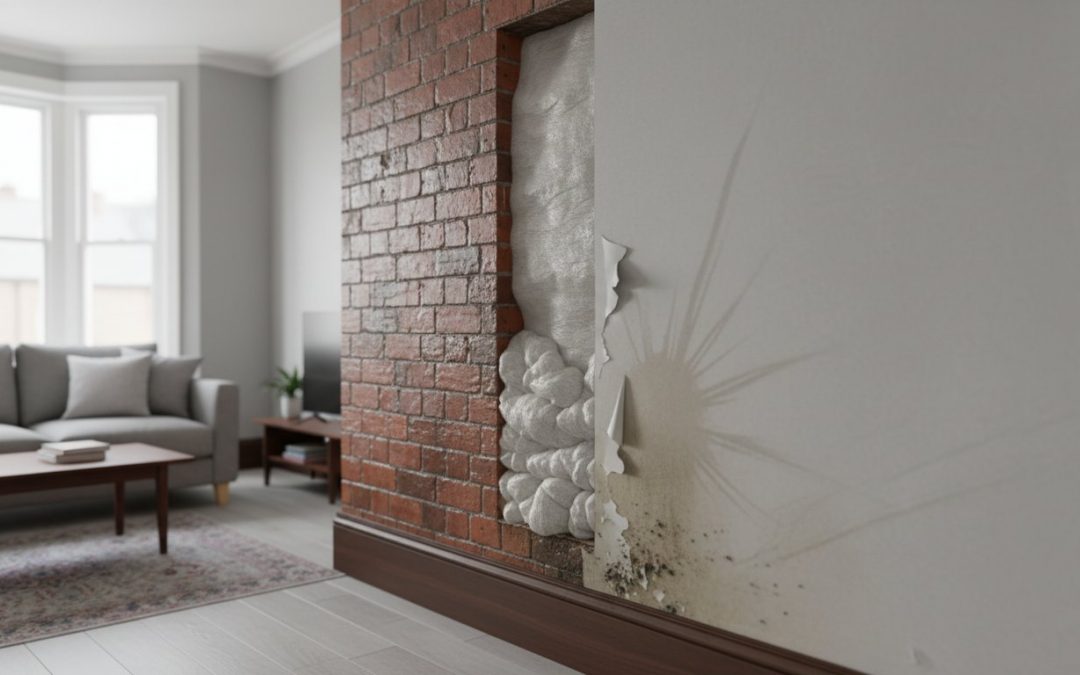
According to a 2022 report by the Building Research Establishment (BRE), up to two million homes in the United Kingdom with retrofitted cavity wall insulation may be experiencing moisture-related issues. You made a responsible choice to improve your home’s thermal efficiency, so it’s a stressful situation when that investment leads to musty smells, stubborn black mold, and a property that still feels cold. The very material meant to protect your home could now be the source of damp and escalating energy bills, a problem that won’t resolve itself.
This diagnostic guide is designed to give you clarity and peace of mind. We will help you confidently identify the critical signs of failing cavity wall insulation before they can cause permanent structural damage. You will learn precisely how saturated material creates a ‘thermal bridge’ for damp to penetrate your internal walls and understand the guaranteed steps for finding an accredited specialist to extract the defective insulation and restore your home’s health.
Key Takeaways
-
Learn to identify the most common signs of failing cavity wall insulation, from persistent damp patches on internal walls to localised black mold growth.
-
Understand the science of ‘moisture bridging’-the process where saturated insulation carries rainwater directly from the outer wall to your internal plaster.
-
Discover the correct diagnostic steps, including why a professional borescope survey is essential to accurately assess the condition of your insulation.
-
Find out why specialist extraction is the only guaranteed method to permanently resolve damp issues and restore your home’s protective air gap.
Table of Contents
-
The science of failure: How moisture bridging destroys walls
-
Specialist cavity wall insulation removal: The permanent fix
What is failing cavity wall insulation?
Failing cavity wall insulation occurs when the material installed between your property’s inner and outer walls no longer performs its two critical functions: providing consistent thermal resistance and preventing moisture transfer. Instead of saving you money on heating bills and keeping your home dry, the degraded material can become a direct cause of damp, mould, and structural damage. It ceases to be an asset and becomes a liability within your walls.
To understand why it fails, you must first understand the original purpose of the cavity itself. For over a century, UK homes have been built with a gap between the two layers of brickwork. This gap acts as a physical barrier, or ‘break’, ensuring that rainwater penetrating the outer leaf cannot reach the inner leaf, keeping the internal structure dry. You can learn more about the fundamental principles by reading this guide on what is a cavity wall? When insulation is introduced, it must fill this space without compromising its primary function. Failure happens when the insulation material itself creates a ‘bridge’ for moisture, effectively nullifying the cavity’s purpose.
The primary causes of failure fall into three distinct categories: substandard installation, the use of inappropriate materials for the property’s condition, or external building defects that allow water to enter the cavity and saturate the insulation. Ignoring the initial signs of failing cavity wall insulation is a serious risk. Over time, persistent dampness can lead to the corrosion of steel wall ties, rot in timber elements like floor joists, and a significant decline in your home’s structural integrity and value.
The ‘Golden Age’ of bad installations
Between the 1990s and the late 2010s, government-backed energy schemes led to a massive push for retrofitting cavity wall insulation. While the intention was good, the promise of ‘expert’ or heavily subsidised installations created a high-pressure environment where speed often took priority over quality. Many properties were insulated without proper assessment, leading to a legacy of problems we are rectifying today. Unsuitable properties are typically those located in high wind and driving rain exposure zones, such as coastal areas or regions like the North West of England.
Common materials that fail
Different insulation materials fail in different ways. Our specialist extraction teams regularly encounter three types that are known to cause significant issues once they become compromised by moisture or age:
-
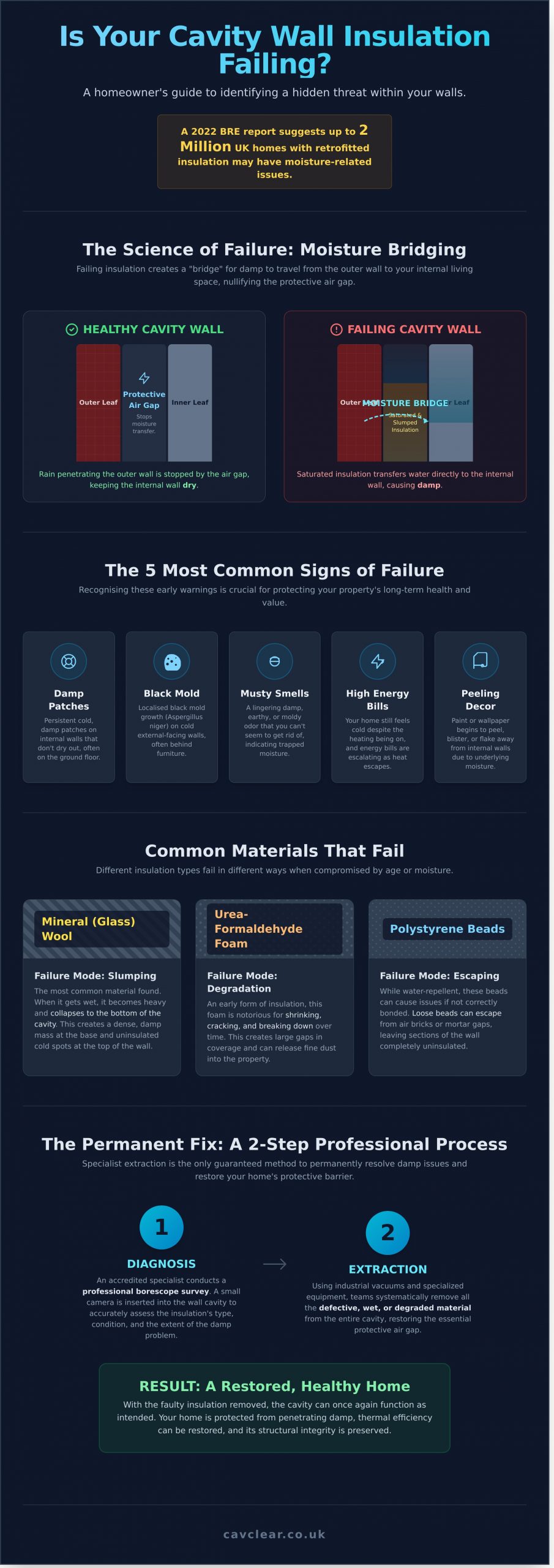
Mineral Wool (Glass Fibre): This is the most common material found in UK homes. When dry, it’s effective. However, once it becomes wet, it can ‘slump’ or collapse to the bottom of the cavity. This creates cold spots at the top of the wall and a dense, saturated mass at the bottom that holds moisture against the brickwork.
-
Urea-Formaldehyde Foam: An early form of insulation, this foam is notorious for shrinking, cracking, and breaking down over time. As it degrades, it creates significant gaps in the insulation coverage and can release fine dust and, in some cases, formaldehyde gas into the property.
-
Polystyrene Beads: While these beads are water-repellent, they can cause problems if not correctly bonded with an adhesive during installation. Loose beads can escape from air bricks or gaps in the mortar, settling unevenly and leaving sections of the wall uninsulated.
Identifying which material you have and understanding its specific failure points is the first step toward a guaranteed, long-term solution. A professional survey is essential to correctly diagnose the problem and prescribe the right extraction method, restoring your home’s health and your peace of mind.
The 5 most common signs of failing cavity wall insulation
When correctly installed in a suitable property, cavity wall insulation is an effective way to improve thermal efficiency. However, when it fails, it can lead to significant structural and cosmetic damage. The initial indicators are often subtle, but they point towards a serious underlying issue. Recognising these early warnings is crucial for protecting your property’s long-term health and value. Here are the five most common signs of failing cavity wall insulation that every homeowner should know.
-
Persistent damp patches on internal walls. These patches often appear on the ground floor or at high levels on upper floors. They feel cold and damp to the touch and won’t disappear, even in warmer weather. This is caused by moisture tracking across the wall cavity through saturated insulation material, a process known as water ingress.
-
Black mold growth. Concentrated patches of black mold (Aspergillus niger) on external-facing walls, particularly in corners or behind furniture, are a serious red flag. The mold thrives on the persistent moisture and cold surfaces created by ineffective, wet insulation.
-
Noticeable cold spots. If you can feel a distinct chill coming from specific areas of an external wall, it’s a clear sign of a thermal bridge. This occurs where the insulation has slumped, leaving voids in the cavity, or has become so wet that it actively conducts cold from the outer brickwork.
-
Peeling wallpaper or bubbling paint. When moisture becomes trapped within your walls, it will try to escape inwards. This process forces wallpaper away from the plaster and causes paint to blister and bubble. If there is no obvious plumbing leak, failing insulation is a primary suspect.
-
A persistent musty or earthy smell. A damp, musty odour that lingers despite ventilation and cleaning often indicates moisture and mold growth hidden within the wall cavity itself. You may smell the problem long before you can see it.
Beyond these cosmetic and structural indicators, damp wall cavities can also attract pests that thrive in high-humidity environments. While this guide focuses on UK-specific insulation issues, homeowners can find expert advice on managing the resulting pest risks from international specialists like Vanish Canada Inc..
Identifying damp patches and cold spots
Damp from failing insulation often manifests first around weak points in the building’s exterior, such as window reveals and chimney breasts, where rainwater penetration is more common. You can detect cold spots simply by running the back of your hand over the wall surface. For a more accurate reading, a basic thermal leak detector, available from most hardware stores for under £50, can pinpoint the exact location of these ‘cold bridges’. Also, look for visible ‘tide marks’-faint, horizontal stains on the lower 12-18 inches of an internal wall-which show where moisture has wicked up from the saturated cavity and then evaporated.
Is it condensation or insulation failure?
Distinguishing between surface condensation and penetrating damp is key. Perform a simple ‘wipe test’: condensation is surface moisture that can be wiped away, while damp from the cavity will leave the wall itself feeling cold and damp. The patterns are also different. General condensation appears in multiple cold spots, whereas the common problems with cavity wall insulation create distinct, localised patches. Crucially, failing insulation makes the internal wall colder, which lowers its surface temperature and actively encourages condensation to form. This means the insulation failure itself is often the root cause of what appears to be a simple condensation issue. For a definitive diagnosis, a professional cavity assessment is the only way to confirm the condition of your insulation and protect your home.
The science of failure: How moisture bridging destroys walls
A correctly functioning cavity wall relies on a simple principle: a clear, empty gap of air separates the outer brickwork from your internal walls. This gap stops rainwater that penetrates the outer leaf from reaching the inside of your home. When cavity wall insulation fails, it compromises this fundamental design, creating pathways for moisture to travel where it should not.
The primary mechanism of failure is known as ‘moisture bridging’. When insulation material becomes saturated with water, it stops being an insulator and becomes a conductor. It acts like a sponge, creating a continuous wet bridge that transports rainwater directly from the outer wall to the inner wall. This process is often accelerated by pre-existing issues within the cavity. Debris left during construction, such as dropped mortar (often called ‘snots’), can form initial contact points. Once the insulation becomes damp, these small bridges become major routes for water ingress. The official Building Research Establishment guidance highlights rain penetration as a principal technical risk, confirming that a saturated cavity is the root cause of many damp problems.
As the material becomes waterlogged, it compacts and slumps under its own weight, creating voids at the top of the wall. These empty pockets cause ‘thermal bridging’, where sections of the wall have no insulation. This results in significant temperature differentials on your internal walls, leading to cold spots where condensation forms, creating the ideal environment for black mould to grow. The appearance of such mould is one of the most visible signs of failing cavity wall insulation.
Finally, the moisture travelling through the brickwork and insulation carries dissolved minerals. These ‘hygroscopic salts’ are deposited into your internal plasterwork as the water evaporates. Because these salts naturally attract and absorb moisture from the air, they keep your walls feeling damp to the touch, even in dry weather. This explains why damp patches can persist long after the rain has stopped.
The impact of external property defects
Even the highest quality insulation cannot perform if the building’s exterior is compromised. Water must first enter the cavity to cause a problem, and this often happens due to poor property maintenance. Failed pointing in the brickwork, cracks in the external render, or leaking gutters and downpipes all provide a direct path for rainwater to saturate the insulation material. Blocked air bricks, designed to ventilate the sub-floor void, can also contribute to damp if they allow water to pool and enter the cavity at a low level.
Structural consequences: Wall ties and timber rot
Persistent dampness inside a wall cavity does more than just cause cosmetic issues; it actively damages your home’s structural components. Your cavity walls are held together by metal wall ties. When surrounded by wet insulation, these ties are exposed to a constantly corrosive environment, which can accelerate rusting and reduce their structural lifespan by more than 50%. As the ties corrode, they expand, which can cause horizontal cracking in your brickwork. In extreme cases, widespread wall tie failure can lead to the collapse of the outer leaf of the wall. Furthermore, any timber elements in contact with the damp inner wall, such as floor joists or timber frames, are at high risk of developing wet rot, which can lead to costly structural repairs.
What to do if you suspect your insulation is defective
Identifying potential problems is the first step. Taking decisive, correct action is the next. If you see any of the common signs of failing cavity wall insulation, you must resist the temptation for a quick fix. The health of your property’s structure depends on a methodical and professional approach to diagnosis and remediation. Simply papering over a damp patch or ‘topping up’ the cavity will only trap moisture and accelerate decay.
The first action should always be to arrange a professional inspection. A borescope survey is the only method that provides a definitive look inside your property’s walls. This involves drilling a small, discreet hole (typically the size of a 10p coin) and inserting a specialised camera. This allows a surveyor to see the condition of the insulation, check for slumping, identify debris, and assess the extent of any damp. Attempting to solve the problem without this crucial diagnostic step is pure guesswork.
A common misconception is that failing insulation can be ‘topped up’. This is almost never an effective solution. Adding new material on top of old, wet, or slumped insulation traps moisture against the inner leaf of brickwork, worsening damp and cold bridging. The only guaranteed, long-term solution for widespread failure is a full extraction of the defective material, allowing the cavity to dry out completely before any new insulation is considered.
The professional survey process
An accredited surveyor doesn’t just look for damp; they diagnose its root cause. During a comprehensive inspection, they will use a borescope to visually assess the cavity’s condition. They also employ calibrated moisture meters to get precise readings from internal walls and timbers, with readings above 20% WME (Wood Moisture Equivalent) indicating a significant problem. A thermal imaging camera can also be used to non-invasively identify cold spots where insulation has slumped or is saturated, providing a clear map of the problem areas without any disruption.
To get a definitive diagnosis of your property’s cavity walls and understand the best course of action, book a specialist borescope survey today.
Specialist cavity wall insulation removal: The permanent fix
Once you’ve identified the critical issues, you must understand that patching over damp spots or repainting will not solve the underlying problem. Failed cavity wall insulation requires a definitive solution. The only way to permanently stop moisture transfer and restore your property’s protective barrier is through a complete extraction of the damaged material. This process reinstates the original, clear air gap between the brickwork leaves, a fundamental design feature of most UK homes built after 1920, which is essential for preventing penetrating damp.
At Cav Clear Ltd, our specialist extraction service is not just about removal; it’s about restoration. We employ a technically rigorous and non-invasive process designed to return your walls to their intended state. By removing the sodden, clumped insulation, we eliminate the ‘damp bridge’ that allows water to seep into your home. This immediately allows the property’s structure to ‘breathe’ and begin the natural drying-out process. The long-term benefits are significant: improved internal air quality, enhanced structural safety by protecting wall ties from corrosion, and the full restoration of your home’s thermal efficiency once the masonry is dry.
How the extraction process works
Our accredited technicians follow a meticulous, clean procedure. We drill a precise pattern of small holes into the external mortar joints, causing minimal disruption to your brickwork. Compressed air is then introduced into the cavity to dislodge all insulation material, which is simultaneously removed by a high-powered industrial vacuum system. Our commitment is to a 100% extraction, as leaving even small amounts of debris can lead to future damp bridging and cold spots, undoing the remedial work.
Following the removal, we conduct a thorough inspection. A borescope camera is used to visually verify that the entire cavity is clear and that all rubble has been removed from the base of the wall. Crucially, we also ensure all air bricks are unblocked and fully functional, restoring the essential sub-floor ventilation that protects your property’s timber joists. This attention to detail guarantees a permanent fix for the signs of failing cavity wall insulation you’ve experienced.
Restoring your home’s comfort
After the extraction is complete, your home begins its recovery. The drying-out phase can take between 6 and 18 months, depending on the level of water saturation and the wall’s construction. During our initial survey, we also assess the condition of your wall ties and brickwork pointing. If corrosion or degradation is identified, we can advise on necessary follow-up works to ensure your home’s complete structural integrity is restored for the long term.
Taking decisive action is the first step toward reclaiming a warm, dry, and healthy living environment. If you are concerned about your property, don’t wait for the damage to worsen. Book a professional cavity wall survey with Cav Clear Ltd today and secure the peace of mind that comes with a guaranteed, specialist solution.
Take Control of Your Home’s Health and Comfort
Recognizing damp patches, persistent mould, and unexplained cold spots is the first critical step for any homeowner. These are not minor issues; they are the primary signs of failing cavity wall insulation. Left unaddressed, the moisture bridging caused by saturated material will continue to damage your property’s structural integrity and drive up your heating costs. A professional assessment is the only way to be certain of the cause and the correct remedy.
CavClear’s accredited technicians provide the permanent fix. With nationwide UK coverage, we use specialist extraction equipment to safely remove all damp debris from your walls. You receive a comprehensive structural report detailing the health of your cavity, giving you a clear path forward. This isn’t a temporary patch; it’s a guaranteed solution to restore your home’s comfort and thermal efficiency.
Protect your investment and your peace of mind. Book your professional damp and insulation survey with CavClear and secure a definitive, expert verdict on your property’s condition.
Frequently Asked Questions
Can failing cavity wall insulation cause black mold?
Yes, failing cavity wall insulation is a direct cause of black mold growth. When insulation becomes saturated with water, it creates a persistent damp patch on the internal wall. This moisture provides the ideal environment for mold spores, such as Stachybotrys chartarum, to thrive. This not only damages your decor but also poses a health risk. A specialist extraction is the only way to permanently resolve the underlying damp source and prevent mold from returning.
How much does it cost to remove defective cavity wall insulation in 2026?
We project the cost to remove defective cavity wall insulation in 2026 will range from £2,200 to £3,500 for a typical three-bedroom semi-detached house in the UK. This estimate accounts for inflation and is based on a wall area of approximately 80-100 square metres. The final price depends on the type of insulation material, property access, and the extent of the debris. Reputable extraction specialists provide a firm quotation after a detailed survey.
Will my house be colder if I remove the insulation?
No, your house will not be colder after a professional extraction; it will actually become warmer and more energy-efficient. Wet or slumped insulation has a negligible thermal value and often creates cold spots where it has collapsed. Removing this defective material allows the cavity to function as it was designed, preventing damp from bridging to the inner wall. This restores your home’s thermal performance and ultimately lowers your energy bills, making your home more comfortable.
How long does it take for walls to dry out after insulation extraction?
Walls typically take between four to twelve weeks to dry out completely after cavity wall insulation has been extracted. The exact timeframe depends on several factors, including the wall’s construction, the level of saturation, and ambient weather conditions. Proper ventilation is crucial to accelerate the process. A professional survey can provide a more precise drying-time estimate for your specific property, ensuring the structure can return to its intended thermal efficiency without trapped moisture.
Can I tell if my insulation has slumped without drilling holes?
Yes, you can often identify slumped insulation without invasive methods by using a thermal imaging camera. A thermal survey conducted during colder months will reveal distinct cold spots on your internal walls where the insulation has collapsed, creating voids in the cavity. These are clear signs of failing cavity wall insulation that a trained technician can interpret accurately. This non-destructive diagnostic technique provides definitive evidence before any extraction work begins, ensuring a targeted and effective solution.
Is cavity wall insulation removal a messy process?
No, when performed by accredited specialists, cavity wall insulation removal is a clean and controlled process. We use industrial-grade vacuums with specialised filtration systems that feed the extracted material directly into sealed bags for disposal. Bricks are carefully removed at planned intervals and then replaced, with the mortar colour-matched to your existing brickwork. Our techniques are designed to minimise disruption and leave your property exactly as we found it.
What happens if I leave wet insulation in my walls?
Leaving wet insulation in your walls will lead to progressive structural and internal damage. The trapped moisture will cause persistent damp patches, black mold growth, and damage to plaster and decorations. Over time, it can corrode wall ties, compromising the structural integrity of your property. It also eliminates any thermal benefit, increasing your heating costs. Ignoring these issues will result in more extensive and expensive repairs in the future.
Recent Comments