
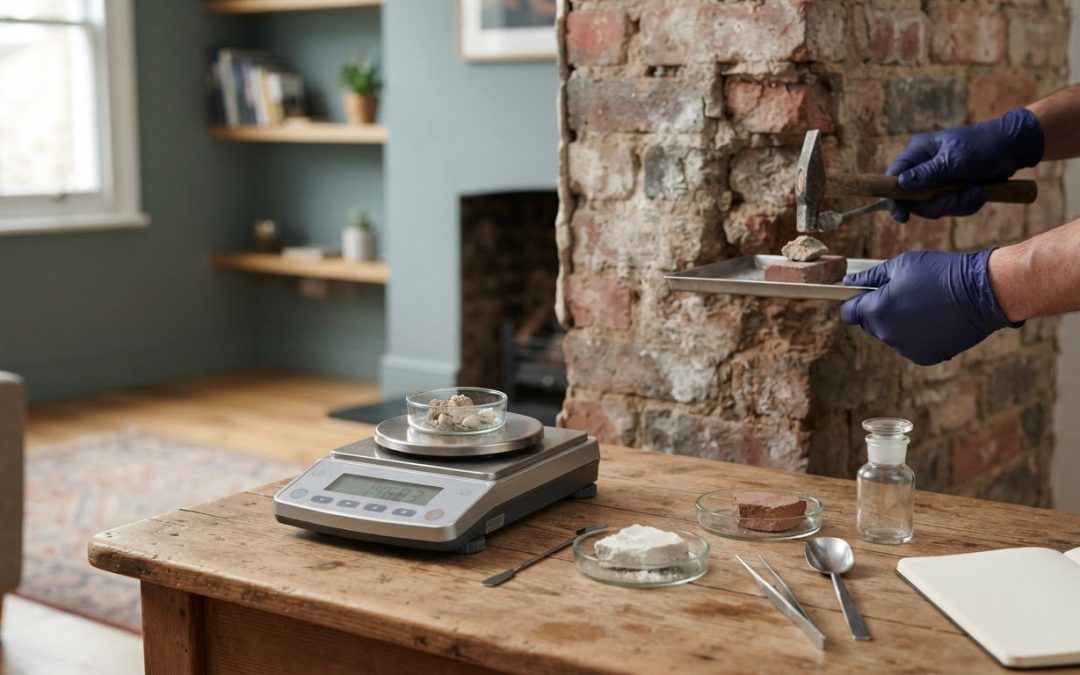
A damp meter reading doesn’t prove that the wall itself is wet. Gravimetric testing for damp, explained for homeowners, means weighing samples of plaster and masonry to compare their moisture content; the samples are also assessed against a 75% relative humidity benchmark. This can help show whether moisture is in the masonry or whether salts in the plaster are affecting the picture.
If you’ve seen a high meter reading, it’s understandable to wonder whether damp is present throughout the wall. Electrical meters measure conductivity, which can be affected by salts and other materials. A reading alone cannot show where moisture is coming from or whether the plaster is the main issue.
This guide explains how samples are collected and weighed, what the results can reveal about moisture in plaster and masonry, and why the wider condition of the property matters. Gravimetric testing can help clarify a confusing meter reading, but the cause still needs to be identified before deciding what to do next.
Key Takeaways
- Compare plaster and masonry samples to help identify where moisture is present, rather than relying on a single wall reading.
- Read meter results as indicators, since salts and material differences can affect what they show.
- Sample position matters: recorded locations help reveal how moisture varies across a wall.
- Gravimetric results are most useful when interpreted alongside the building’s construction and visible condition.
- If damp may relate to a cavity-wall problem, a specialist cavity wall survey can help identify whether further investigation is needed.
So how can Gravimetry be useful to damp analysis?
Gravimetry measures moisture by weighing plaster or masonry samples before and after controlled drying. Comparing the results helps show whether moisture is present in the masonry or associated with salts in the plaster.
Moisture Measurement in Masonry and Plaster
Gravimetric analysis calculates moisture content from the change in a sample’s weight during testing. A surveyor takes a drilled masonry sample, seals it, and sends it to a laboratory for weighing and drying. Plaster and masonry can be assessed separately, helping distinguish moisture in the surface finish from moisture deeper in the wall. Sample locations matter: recording positions at different heights helps map how moisture varies across the area.
Active Moisture and Salt-Held Moisture
Active, or capillary, moisture fills material pores and can indicate an ongoing source. Hygroscopic moisture is held by salts that draw water from the surrounding air. Gravimetric analysis helps distinguish these conditions by comparing moisture measurements before and after samples are exposed to controlled humidity and dried. This matters when a wall reading is high: salts in plaster can retain moisture even when the masonry does not show the same pattern of active wetting.
Total and Hygroscopic Moisture Calculations
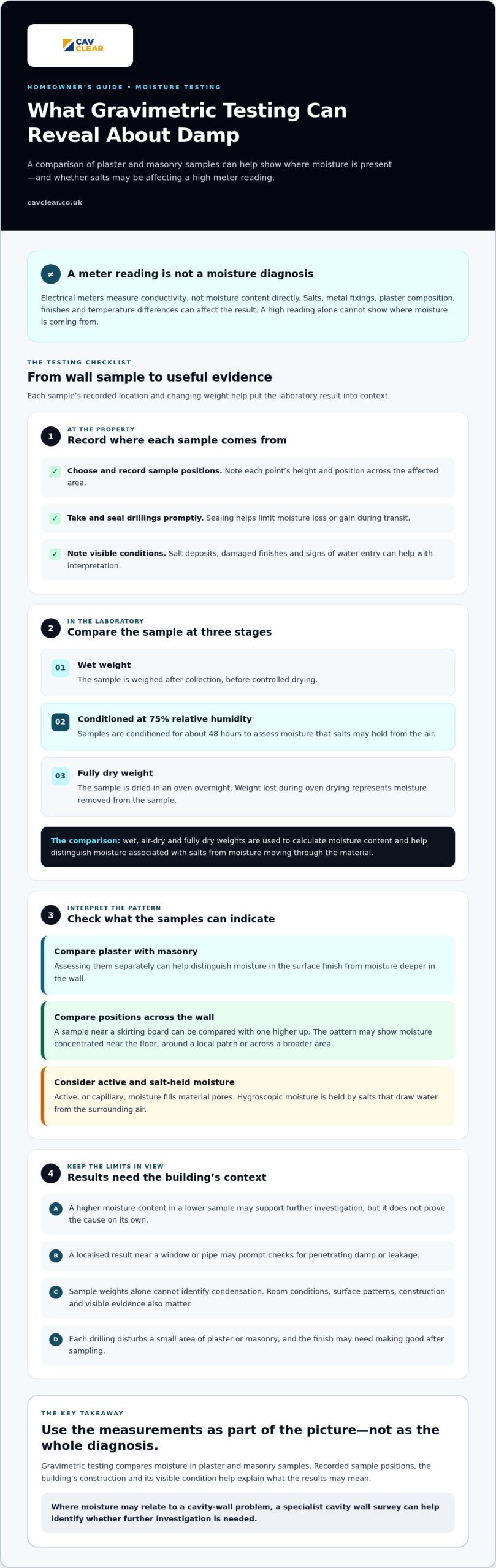
Testing compares a sample’s wet weight, air-dry weight and fully dry weight to calculate its moisture content. The weight lost during oven drying represents moisture removed from the sample. A separate conditioning stage at 75% relative humidity helps assess hygroscopic moisture retained by salts. Comparing these measurements helps separate the moisture associated with salts from moisture that may indicate water moving through the material, such as ground moisture.
Electronic moisture meters measure electrical conductivity, not moisture content directly. Salts, metal fixings, plaster composition, decorative finishes and temperature differences can affect readings, so a high result alone cannot establish whether rising damp is present. Gravimetric analysis measures samples for comparison, while the wall’s construction and moisture pattern help put the figures in context.
How much does gravimetric damp testing cost in the UK? Costs vary according to the survey scope, number of samples and laboratory analysis. The price is provided by quotation.
What happens during a gravimetric damp survey in a UK home? The surveyor records sample locations, takes and seals drillings from the affected wall, then sends them to a laboratory for weighing and drying. The results are interpreted alongside the sample positions and building conditions.
How can homeowners find an independent damp surveyor in the UK? Look for a surveyor whose work focuses on diagnosing moisture behaviour and who reports findings and recommendations separately from remedial work.
Weighing samples in wet, air-dry and dry conditions
Gravimetric testing for damp, explained for homeowners, follows a sample from the wall to laboratory analysis. Comparing its weight after collection, conditioning and drying helps show how moisture behaves within the material, rather than relying on a single surface reading.
At the property, samples are taken from selected points and sealed promptly to limit moisture loss or gain during transit. The surveyor records each location, including its height and position across the affected area. In the laboratory, samples are conditioned at 75% relative humidity for about 48 hours, then dried fully in an oven overnight. The wet, conditioned and dry weights each contribute to the moisture assessment.
Sample location gives the results meaning. Samples taken at different levels can show whether moisture is concentrated near the floor, follows a local patch or appears across a broader area. For example, a sample near a skirting board can be compared with one higher up on the same wall. Recorded positions let the surveyor interpret the results as a wall profile, rather than as isolated figures.
An on-site inspection also records visible details, such as salt deposits, damaged finishes and signs of water entry. Salt can affect electrical readings, but deposits alone do not establish whether moisture is active or held by salts. The material is sent for controlled testing, and any salt analysis can then be considered alongside its measured moisture content.
How does gravimetric testing distinguish rising damp from condensation or leaks? It compares moisture measurements across samples and their recorded positions, helping identify patterns consistent with ground moisture or localised wetting. The laboratory measures the samples; the building’s condition and evidence of leaks or condensation help establish the likely cause.
Results need context. A higher moisture content in a lower sample may support further investigation of rising damp, but does not prove the cause on its own. A localised result near a window or pipe may prompt checks for penetrating damp or leakage. Condensation is assessed through room conditions and surface patterns, since sample weights alone cannot identify it.
Drilling removes a small amount of plaster or masonry, so each test spot is disturbed. The openings and damaged finish may need making good after sampling, where a specialist service like Pro Finish Plastering can help re-skim and repair the affected wall areas. Ask how sample positions will be recorded and how the disturbed areas will be left. These practical details help you understand the survey process and the evidence behind its findings.
A clear explanation of gravimetric testing for damp should connect each sample’s result to its location and the property’s condition. This context helps homeowners understand what the analysis can show and what it cannot establish on its own.
BRE guidance for gravimetric analysis
BRE Digest 245 sets out a detailed approach to diagnosing moisture in walls, with gravimetric analysis providing quantitative evidence from building materials. Its value is not simply a laboratory percentage. The findings need to be interpreted against the material tested, its position in the wall and other signs of moisture. That distinction helps prevent a laboratory result from being treated as a complete diagnosis on its own.
Salt analysis provides a separate line of evidence. Gravimetric samples can be analysed for chlorides and nitrates, which may indicate a soil-borne source. Their presence does not establish the source by itself. A surveyor considers the salt findings alongside the moisture distribution and the building’s construction. For example, a chemical result from one point should be compared with other samples before drawing conclusions about the wider wall.
Chlorides tend to stay soluble above 30% relative humidity. This matters because the form and behaviour of salts can change with surrounding humidity, affecting how a result should be understood. A laboratory report should therefore be read in relation to the conditions and material involved. Salt identification is useful evidence, but it does not independently prove active ground moisture or determine which treatment is appropriate.
BRE Digest 245 is especially relevant when the question concerns whether plaster is affected by hygroscopic salts or whether moisture is present within the masonry. Chemical testing can identify salt types, while gravimetric results quantify moisture in the sampled material. If plastering or salt contamination is disputed, gravimetric testing can provide more accurate quantitative information than chemical testing alone. The methods answer related, but different, questions.
There is no single analysis turnaround that applies to every investigation. Timing depends on the laboratory work required, including whether chloride and nitrate analysis accompanies the moisture assessment. Clear sample identification is essential, so each result can be linked to the correct material and position. Homeowners can use this information to understand what was tested and how the findings relate to the concern.
The practical takeaway is to read a BRE-based report as a set of connected findings, not as a verdict based on a single salt or moisture figure. For example, an indication of a soil-borne source should be weighed against the moisture profile and the wall’s condition. This measured interpretation helps focus any later treatment on the cause suggested by the combined evidence, rather than on one laboratory result.
Is the wall damp or is the plaster the issue?
Meter readings can be useful as part of assessing a wall, but they do not provide a complete diagnosis on their own. The depth and position of a reading, along with the property’s visible condition, shape what it can tell you.
Combining Meters with Other Observations
Combining meter results with a visual inspection means comparing each reading’s location with the pattern of visible damage. This matters because a patch beside a window calls for different investigation from a band near the floor. Note whether the finish is blistered, stained or intact, and compare readings at similar points. A surveyor can then relate the measurements to features such as external walls, room use and nearby openings.
Limitations of Electronic Damp Meters
Electronic meters are screening tools, not stand-alone diagnostic instruments. Their readings do not establish whether moisture comes from rising damp, penetrating water, a leak or condensation. Nor does one high reading describe the whole wall. Treat it as a prompt to inspect the area and compare nearby points, not as a basis for deciding on damp proofing or repairs.
Meter design also affects how deeply it measures. A capacitance meter typically assesses material approximately 20-40 mm into the wall, so it provides information about a limited zone rather than the entire wall thickness. This can help compare areas near the surface, but it cannot show whether deeper masonry has the same moisture condition.
That is an equipment cost, not a survey or treatment fee. Some microwave meters can detect moisture as far as 800 mm into a wall, giving a deeper reading. Greater reach still doesn’t identify the source.
Look for patterns in the measurements. For instance, compare points around a visible patch with a nearby unaffected section, and note whether the wall is internal or external. A damp-looking area beneath a window may warrant examining the surrounding surface and external details for penetrating moisture. Room humidity and signs of condensation provide further context, particularly where dampness appears on cold surfaces.
The practical distinction is between a meter indicating an area for attention and a diagnosis explaining why it is damp. Do not choose damp proofing solely from a number on a display. A surveyor weighs readings alongside the construction, visible condition and moisture patterns before recommending a response.
Gravimetric testing of plaster and masonry
Gravimetric testing examines plaster and masonry separately, helping show whether moisture is within the wall or concentrated in its finish. BRE 245 describes gravimetry as the most accurate process for establishing a sample’s true moisture content. The result is a measured value for the material collected, not a reading inferred from its surface.
A surveyor takes samples from selected positions, seals them and records their locations. The laboratory weighs each sample, conditions it at a controlled humidity, then dries it to establish its dry weight. The difference between the relevant weights is calculated as a percentage. Keeping plaster and masonry samples separate helps avoid treating the two materials as though they behave identically.
For masonry, the benchmark described for gravimetric analysis is 75% relative humidity. This helps assess moisture retained by hygroscopic salts, which absorb water from the air. A test can compare that result with moisture released during oven drying. Together, the measurements help distinguish salt-held moisture from water that may be moving through the masonry.
Sample figures show why context matters. An uncontaminated dried masonry sample can gain a small amount of mass when exposed to humid conditions. Salt contamination can cause a sample to gain moisture under controlled conditions. Salt contamination can therefore affect how a sample gains moisture.
Distribution across the wall adds another layer of interpretation. One reported profile showed hygroscopic moisture at 8.5% at 0.6 m, then 7.9% at 1 m, with the spike attributed to salts. Such a pattern cautions against reading a high value as simple proof of active rising damp. The surveyor needs to consider sample material, height and nearby conditions together.
Laboratory figures help answer whether plaster alone is affected, but they don’t identify every possible source by themselves. The building’s construction, external condition and moisture pattern still inform the diagnosis. If results point towards a cavity-wall issue, a cavity wall survey can help investigate the wall system. The practical takeaway is to interpret sample readings by material and location before deciding on treatment.
CavClear: Cavity Wall Insulation Removal
CavClear helps homeowners investigate cavity-wall problems when damp findings occur alongside signs of insulation failure or wall defects. If gravimetric results identify moisture in masonry, a cavity wall survey can assess whether the cavity may be contributing to the issue. Where defective cavity wall insulation is identified, cavity wall insulation removal addresses that specific problem. Wall tie surveys can also investigate concerns such as cracking or possible wall tie deterioration.
Gravimetric testing measures samples, while a cavity-wall investigation considers the wider wall system. These approaches answer different questions, and the appropriate next step depends on the findings and visible condition of the property. If you’re concerned about damp linked to a cavity wall, contact CavClear to discuss your property.
Turn the findings into a clear next step
After receiving a gravimetric report, keep it with photographs and notes showing where each sample came from. This provides a useful record if the wall is inspected again or its condition changes. A homeowner’s guide to gravimetric testing for damp should lead to a practical decision: whether the evidence points to a cavity-wall concern that needs further investigation.
If damp occurs alongside signs of cavity-wall trouble, such as persistent moisture or cracking, discuss those observations with CavClear. Its services include cavity wall insulation removal, wall tie surveys and wall tie replacement. This keeps the discussion focused on the relevant wall issue, rather than assuming every damp reading has the same cause.
Contact CavClear about your damp concerns and explain what you’ve observed. A measured, evidence-led next step can help you make a more informed decision about your property.
Frequently Asked Questions
Does this mean my wall doesn’t have damp at all?
No. A result suggesting little moisture in one sample does not establish that the entire wall is dry. It describes the material collected from a particular place and depth. For example, plaster and masonry may have different moisture conditions, or readings may vary between lower and higher samples. Interpret the result alongside the sample locations, visible condition and other evidence of moisture around the property.
How long does the analysis take?
The laboratory stages take several days: samples are conditioned for about 48 hours, then dried overnight. Transport, any additional salt analysis and preparation of the report add time beyond those stages. Ask how the laboratory will report results for each material and location, since separate samples may need separate analysis. The time needed for the laboratory process is distinct from the time taken to arrange a survey.
Is taking samples damaging to my property?
Sampling involves drilling into the selected plaster or masonry, leaving small openings at the test points. The surveyor should record where each sample was taken and explain how those spots will be left afterwards. Before sampling, move nearby furniture and protect belongings from dust. If a wall has a delicate finish, discuss the sampling position so its condition can be considered during the investigation.
Is this test recognised by mortgage lenders and insurers?
A gravimetric report records laboratory measurements from the materials sampled, which can help explain a damp concern. It is not itself a mortgage or insurance decision, and its relevance depends on the information being assessed. Keep the findings with any property inspection documents, including sample locations and material descriptions. This gives a lender or insurer clear evidence to consider alongside the wider condition of the building.
What is gravimetric testing for damp and how does it work?
Gravimetric testing measures moisture in a building material by weighing samples through laboratory conditioning and drying. A surveyor collects plaster or masonry, labels each sample by location, and sends it for analysis. The laboratory compares the weights at different stages to assess moisture content. Because the test measures sampled material, interpret the result in light of the sample’s position and the wall’s construction.
How accurate is gravimetric testing compared with an electronic damp meter?
Gravimetric analysis directly measures moisture in the tested sample, while an electronic meter measures electrical response. BRE 245 describes gravimetry as the most accurate process for establishing a material sample’s true moisture content. However, a sample represents only its specific material and location. An electronic meter can help screen an area, while laboratory analysis offers a more direct measurement when precise moisture assessment matters.
How long do gravimetric damp test results take?
Allow for laboratory conditioning, overnight drying, sample transport and report preparation; the conditioning stage alone takes about 48 hours. The total time therefore includes more than the period samples spend in the laboratory. If chloride or nitrate analysis is also requested, that adds another analytical step. Keep the survey date and sampling record with the eventual report so you can connect each finding to the relevant wall area.
What moisture readings or thresholds indicate damp in building materials?
There isn’t one universal percentage that diagnoses damp in every plaster or masonry type. Material composition, salts, sample depth and test conditions affect how a result should be interpreted. The 75% relative humidity used for gravimetric conditioning is a laboratory benchmark, not a household damp threshold. Compare results from like materials and locations, then consider whether the pattern fits the building’s observed condition.
Recent Comments