

A remortgage can sometimes cover damp-proofing work if you have sufficient equity and the lender approves the extra borrowing. Whether you can add the cost of damp proofing to a remortgage depends on the lender’s assessment of your finances and property. The additional borrowing becomes part of your mortgage, so missed repayments can put your home at risk.
Spreading the cost rather than paying from savings can be appealing. But damp is a symptom, not a diagnosis: the moisture source needs to be identified so the proposed work addresses the underlying problem.
This article explains how borrowing through a remortgage may work, what lenders can ask for when assessing repair costs, and how damp may affect a valuation or mortgage decision. It also covers factors to weigh against alternatives, including total interest payable and the effect of extending borrowing over your mortgage term.
Key Takeaways
- Remortgaging may provide funds for damp repairs when your equity and lender’s affordability assessment support the additional borrowing.
- Compare the total amount repayable, fees and repayment terms before choosing between mortgage borrowing and monthly-payment finance.
- A lender may ask for a clear survey and contractor quote to understand the proposed work and its cost.
- Damp can affect a valuation or mortgage decision, so identifying the moisture source helps clarify what remedial work is needed.
- Where damp may relate to cavity wall insulation or wall-tie problems, CavClear’s cavity wall surveys and cavity wall insulation removal can help address the underlying cavity-wall issue.
Financing damp repairs through monthly payments
UK damp-repair finance can spread payments over an agreed term instead of requiring the full amount upfront. There is no single arrangement for every repair: terms depend on the work, lender and agreement. UK support schemes also don’t automatically cover damp repairs; eligibility and covered work depend on the particular scheme and household circumstances.
Some UK damp-proofing finance offers 0% APR over 12 months. That rate applies only to the stated agreement terms, so compare the total repayment amount, interest and fees before committing. A missed payment can trigger retrospective interest and additional charges under some agreements. Read the payment conditions carefully, including what happens if a payment is late.
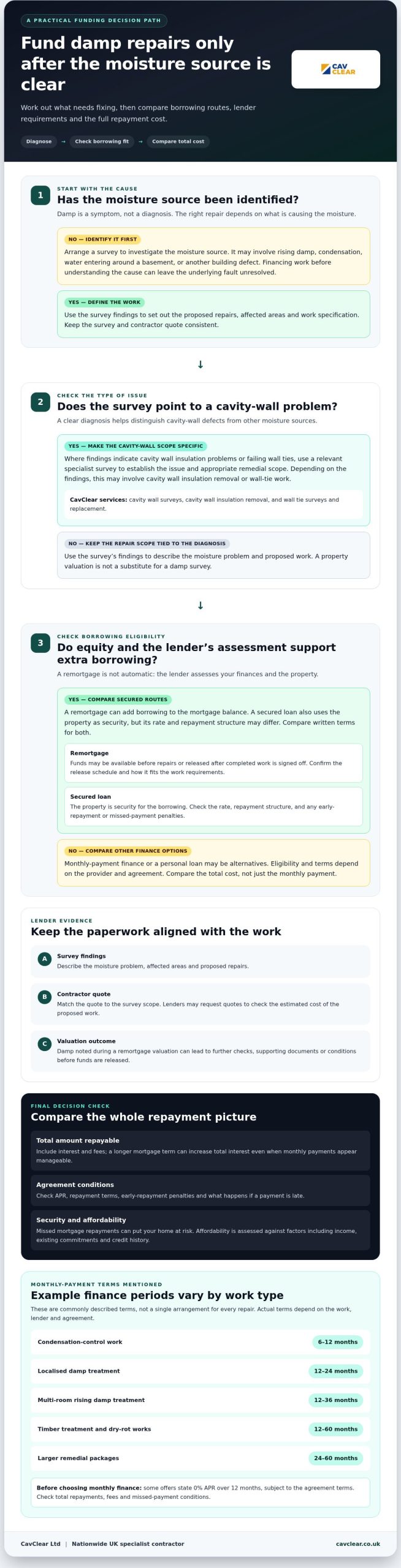
Typical finance periods vary with the job. Condensation-control work commonly has a term of 6 to 12 months, while localised damp treatment commonly runs for 12 to 24 months. Multi-room rising damp treatment commonly has a 12 to 36-month term. Timber treatment and dry-rot works commonly run for 12 to 60 months, while larger remedial packages commonly use 24 to 60 months.
- Match the repayment period to the repair type and the household budget.
- Compare APR, fees, total repayments and missed-payment conditions.
- Keep documentation, including the survey findings and written work specification.
Monthly payments do not identify the source of moisture. A survey can help distinguish rising damp from other issues, such as condensation or water entering around a basement. That diagnosis matters: financing treatment before understanding the cause can leave the underlying fault unresolved. A guarantee applies to the work it covers; it does not set the finance agreement’s repayment terms.
Before applying, budget realistically for repayments and regular household expenses. Passing affordability checks depends on the lender’s assessment of income, existing commitments and credit history. A personal loan is another option; banks and credit unions commonly offer fixed interest rates and structured repayment plans. Compare its total cost with other finance, rather than judging options by the monthly payment alone.
Keep the paperwork consistent. The survey should describe the moisture problem, proposed repairs and affected areas. A contractor’s quote should match that scope, including any relevant room or basement work. If further investigation changes the quote, update your budget before agreeing to a finance plan. This gives you a clearer basis for comparing repayments and helps establish whether the proposed work addresses the diagnosed problem. A property valuation serves a different purpose from a damp survey, so do not treat one as a substitute for the other.
Secured loans and remortgaging
Homeowners with sufficient equity may borrow for damp repairs through a remortgage or secured loan. The choice affects repayment costs, access to funds and the risk attached to the property.
Using Remortgage Funds for Damp Proofing
Remortgaging can increase your mortgage balance, using available equity to fund work such as damp treatment. Lenders assess affordability and the property, then set the amount and any conditions for releasing funds. The money may be available before repairs begin, or released after completion if the lender requires signed-off work. Confirm how funds will be handled before arranging work or paying a deposit.
For example, one lending arrangement uses a £200,000 mortgage and £10,000 of damp works: £190,000 is advanced initially, with the final £10,000 released after repairs are signed off. This staged approach means the full amount may not be present at the outset. Check the payment schedule against the specialist’s completion requirements and your available funds.
Valuation and Mortgage Approval Effects
A remortgage valuation assesses the property and can affect the lender’s decision or the amount it will advance. Damp noted during that assessment can prompt further checks, supporting documents or conditions before funds are released. A lender may withhold £5,000-£10,000 when damp is identified until a valid insurance-backed guarantee is provided.
A valuation is not a damp diagnosis. Moisture can result from different faults, including condensation or a building defect, and the appropriate repair depends on the source. A clear survey and matching work specification help explain the proposed treatment. Lenders may request contractor quotes to verify the estimated cost, so consistent documentation can support their assessment.
Risks of Adding Repair Costs to a Mortgage
The main risk is securing additional borrowing against your home: missed mortgage repayments can put the property at risk. Mortgage borrowing can also spread repayment over a longer period, increasing total interest even when monthly payments seem manageable. Compare the full repayment amount, fees and mortgage term, not just the monthly figure.
A secured loan also uses your property as security, but its rate and repayment structure may differ from a remortgage. Your credit score and financial history can affect eligibility and interest rates. Ask lenders or brokers for comparable written terms, then check for early-repayment or missed-payment penalties before accepting an offer.
Allow time for the process. Damp-finance applications typically require proof of identity, income and details of the property needing work. Some lenders provide decisions within minutes, while further checks can take longer; others may take a few days. Comparing quotes from at least three lenders can show differences in rates, fees and conditions. Include the survey, diagnosis and proposed repairs in the information you present, especially if condensation or another moisture source remains under review.
Do UK mortgage lenders allow remortgage funds to pay for damp proofing?
Homeowners may use additional remortgage borrowing for damp repairs if they have sufficient equity and meet the lender’s criteria. If you’re asking whether you can add the cost of damp proofing to a remortgage, the answer depends on the lender’s assessment of your finances, property and requested borrowing. Approval is not automatic, so explain the purpose clearly in your application.
Equity is the difference between the property’s value and the mortgage balance secured against it. A lender’s valuation therefore matters: it informs how much borrowing the property may support alongside affordability checks. If the requested amount exceeds available equity or your household budget, the lender may offer less or decline the application. The decision depends on the combined financial and property assessment, not simply the repair quote.
Be precise about the work’s purpose. “Damp proofing” can describe different treatments, but moisture may also relate to condensation, a leak or a cavity-wall defect. A survey that identifies the likely cause gives the lender a clearer explanation than a general estimate. For example, a report identifying moisture associated with a cavity wall, alongside a quote for proposed remedial work, sets out a defined scope.
Lenders may request contractor quotes to verify the estimated cost of the work. Keep the quote consistent with the survey findings: the affected areas, proposed repairs and stated amount should align. If further investigation changes the diagnosis or work specification, provide updated documents instead of relying on an earlier estimate. This helps the lender assess what the requested borrowing is intended to fund.
Approval and release of funds are separate matters. Some arrangements make funds available with the remortgage, while others may attach conditions to their release. Ask the lender how it will handle the money, what documents it needs and whether it requires evidence of completed work. The timing can affect deposits, contractor scheduling and how you manage payments during repairs.
Before accepting an offer, compare the new mortgage’s overall terms with your existing arrangement. Consider the interest rate, fees, repayment period and total amount repayable, rather than focusing only on the monthly payment. Additional borrowing can extend debt over the mortgage term, increasing overall interest. A secured or personal loan may have a different repayment structure, so compare the written terms and the consequences of missed payments.
A clear application file can bring the key information together:
- The current mortgage balance and the amount of additional borrowing requested.
- The property details and valuation information required by the lender.
- A damp survey, proposed repairs and a matching contractor quote.
- Household income and existing commitments for affordability assessment.
Whether you can add the cost of damp proofing to a remortgage depends on how your equity, affordability and repair evidence fit together. Presenting those details consistently gives lenders a clearer basis for assessing your request.
What evidence or quotes do mortgage lenders require for damp proofing costs?
Mortgage lenders may request contractor quotes to verify the estimated cost of damp proofing work. A quote is more useful when it clearly describes the proposed repairs, rather than giving only a general figure. Pair it with survey findings so the lender can see how the recommended work relates to the damp identified at the property.
Start by gathering the survey report, a written quote and relevant property details. Check that the documents describe the same affected rooms or walls. If a survey identifies moisture in one area but the quote covers others, explain the difference in scope. Clear documentation helps the lender understand what the requested borrowing would pay for.
A damp report should explain the observed problem and the surveyor’s reasoning. Moisture readings alone do not identify the source, so the report should distinguish the suspected cause from other possibilities. For example, rising damp, condensation, leaks and cavity-wall issues can require different responses. Proposed treatment should follow the diagnosis, not simply repeat a reading or describe visible staining.
The quote should set out the work in practical terms. It can identify the affected areas, proposed method, relevant preparation and any follow-on repairs included in the scope. If the contractor revises the work after further inspection, use the updated quote. Avoid sending an outdated estimate alongside a different survey recommendation, as conflicting documents can prompt questions or further checks.
Some lenders may also request a guarantee connected with the proposed work. Requirements can differ by lender and property circumstances. As a general industry standard, many lenders prefer or require an insurance-backed guarantee for specialist damp proofing work, particularly on mortgaged or listed properties. Always check specific lender guidelines rather than relying on general assumptions.
That information illustrates how a survey may link findings to a defined scope, but it is not a standard cost or a guide to work at another property. The lender assesses the evidence for each application, and your quote should reflect the diagnosis and repairs proposed for your home.
Before submitting documents, use this simple check:
- Match the property address and affected areas across the survey and quote.
- Make sure the quote describes the repairs recommended in the report.
- Include any requested guarantee or supporting paperwork.
- Keep revised estimates together with the latest survey documentation.
A consistent set of documents gives the lender a clearer basis for assessing the requested amount. It also helps you understand whether the proposed work addresses the reported moisture source, rather than treating a symptom without a clear diagnosis.
Does damp affect a remortgage valuation or mortgage approval?
Damp can affect a remortgage if the valuation records visible moisture damage or concerns about the property’s condition. The lender uses valuation information when assessing the property and requested borrowing. A damp observation does not explain its cause by itself, so the effect depends on the reported condition, supporting evidence and proposed repairs.
A mortgage valuation inspection may take under twenty minutes and produce a report of two to three pages. It is not the same as a detailed damp survey. The valuation may flag visible concerns without identifying whether moisture comes from condensation, a leak, rising damp or a cavity-wall defect. Treating the valuation as a diagnosis can therefore lead to the wrong repair being considered.
RICS warns that a damp meter alone should not be relied on to diagnose the source of moisture. RICS also says failure of an original damp-proof course is extremely rare. These points matter because a high meter reading or damp patch does not, on its own, establish rising damp. A sound assessment considers the property’s condition and possible moisture sources before recommending remedial work.
The lender’s next steps depend on what the valuation reports. A concern may lead to a request for further evidence, a reassessment of the property or conditions attached to the borrowing. Clear findings can help explain whether the issue affects one room or a wider area. Proposed work should correspond to the identified cause, rather than rely on a general damp-treatment label.
Keep the valuation and any specialist survey distinct. The valuation helps the lender assess the property; a survey investigates the damp and its likely source. If a report points to a cavity-wall problem, the evidence should describe that finding and the proposed remedial work. If it identifies condensation, the supporting information should address that diagnosis instead. This distinction gives the lender a clearer basis for considering the property and the work.
Before a valuation, note where moisture or staining appears and when you notice it. For example, condensation on a bedroom window differs from damp staining low on a wall, but neither observation proves the cause. Share relevant survey findings and repair documents with the lender when requested. Keep dates and property details consistent across the valuation, survey and quote.
- Separate the lender’s valuation from a specialist damp diagnosis.
- Use survey findings to explain the moisture source and affected areas.
- Match repair documentation to the diagnosis, whether it concerns condensation, rising damp or cavity walls.
A remortgage assessment depends on the property evidence and the lender’s criteria. A concise, consistent record helps show what the valuation observed and what further investigation concluded.
CavClear: Cavity Wall Insulation Removal
CavClear provides cavity wall insulation removal when defective or incorrectly installed insulation may be contributing to damp or moisture problems. Removing the material can address a cavity-wall issue, while a cavity wall survey can help identify concerns within the wall system. If cracks or signs of movement accompany damp, a wall tie survey can assess whether wall ties may also need attention.
The right next step depends on the property findings. Understanding the cavity’s condition helps distinguish insulation-related moisture from other causes and supports informed decisions about suitable remedial work. CavClear also carries out Wall Tie Replacement when failing ties are identified.
To discuss a cavity-wall concern, contact CavClear.
Make the repair decision with confidence
Before committing to extra borrowing, focus on the condition you want the work to resolve. A damp patch is a visible symptom; identifying whether the underlying issue lies within the cavity wall, the wall ties or elsewhere helps keep the repair plan relevant. That distinction also gives you a clearer basis for deciding what work to discuss with your lender.
Whether you can add the cost of damp proofing to a remortgage is only one part of the decision. Consider the proposed repair alongside your wider borrowing plans, and keep the property’s long-term condition in view. Whether borrowing suits your circumstances depends on your finances and the lender’s assessment.
If cavity-wall moisture or signs of wall-tie movement remain a concern, CavClear can help assess the issue through its specialist cavity-wall services. Discuss your cavity-wall concerns with CavClear and take a considered next step towards a sound repair plan.
Frequently Asked Questions
Can damp proofing costs be added to a UK remortgage?
Yes, a UK homeowner may borrow extra through a remortgage to pay for damp repairs if the lender approves the application. The lender considers available equity and affordability, alongside information about the property and proposed borrowing. For example, if the work affects only one room, make sure the requested amount reflects that defined project rather than unrelated decorating. Compare the revised mortgage terms with your current arrangement before deciding.
Can you borrow extra on a remortgage for home repairs or improvements?
Yes, additional borrowing may fund home repairs or improvements when the lender’s assessment supports it. Explain the purpose clearly, whether you’re addressing moisture damage, repairing a fault or upgrading a room. Keep repair spending separate from optional improvements when planning the amount requested. Your income, existing commitments, credit history and property equity all inform the assessment, so borrowing capacity is not determined by the quote alone.
Is it better to remortgage or use a home improvement loan for damp proofing?
Neither option is automatically better; compare the total repayment, interest, fees and term for each. A remortgage may add borrowing to your mortgage, while a personal loan from a bank or credit union commonly offers a fixed interest rate and structured repayments. Also compare any fees or early-repayment costs associated with changing your mortgage. Choose based on the overall cost and repayment structure, not just the monthly payment.
How much additional borrowing can you get on a UK remortgage?
There is no fixed amount: it depends on your available equity, the lender’s valuation of the property and its affordability assessment of your finances and requested borrowing.
Recent Comments