
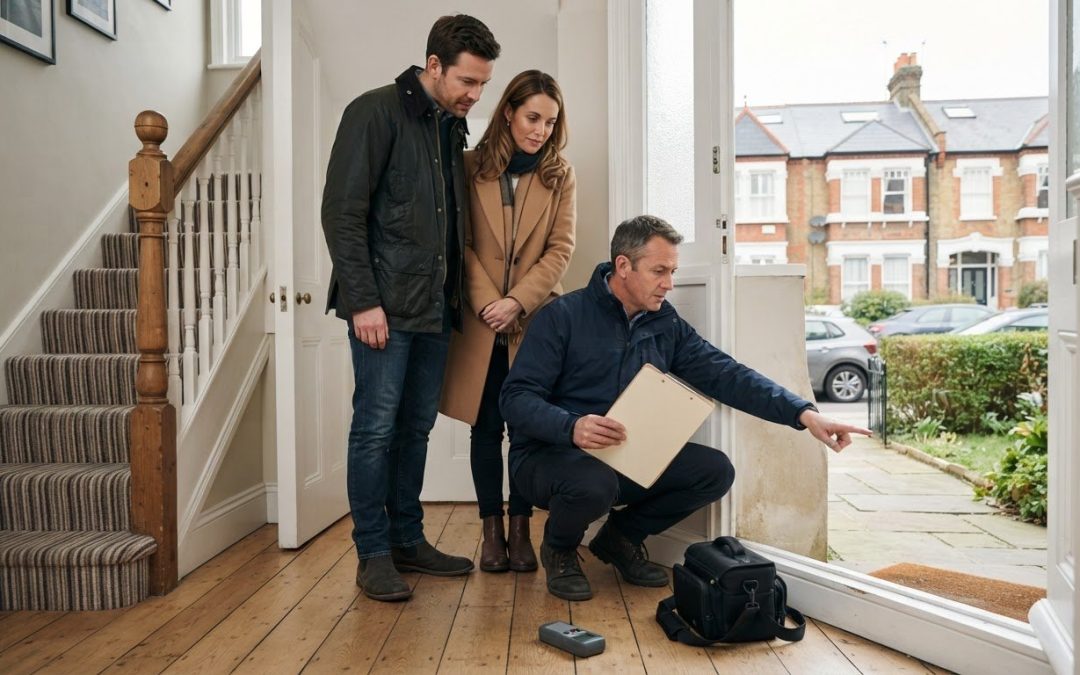
A damp report can identify a concern without confirming its cause or full extent. That distinction matters when you’re negotiating house price after damp report findings: asking for a reduction before the issue is properly understood could leave you negotiating on assumptions rather than evidence.
It’s reasonable to want clarity before committing to a property, especially when the report doesn’t say whether damp is linked to condensation, water entering from outside or a cavity-wall problem. Your next step may be further investigation, a request for the seller to arrange remedial work, or a price discussion based on documented findings. Each option has different trade-offs.
This guide explains how to read the report, identify what it establishes and decide whether more investigation is appropriate before approaching the seller. It also covers how specialist cavity-wall or wall-tie inspections can clarify relevant concerns, and how to weigh a proposed reduction against the work that may actually be needed. The aim is a measured decision grounded in the property’s evidence, not a guess about the cause or scope of repairs.
Key Takeaways
- Separate visible damp, survey observations and confirmed causes before deciding what the report means for your purchase.
- Identify unanswered questions and consider whether a specialist cavity-wall or wall-tie inspection could clarify the findings.
- When negotiating house price after damp report findings, base your request on documented evidence rather than an assumed cause or repair scope.
- Compare renegotiating, asking the seller to arrange investigation or work, and proceeding unchanged by weighing certainty and control.
- Use clear inspection findings, photographs and practical recommendations to make a more informed decision about your next step.
What a damp report can, and cannot, tell you about a house price
Finding damp mentioned in a survey can be unsettling, particularly when you’re deciding whether to proceed, ask for more information or revisit your offer. The report is evidence about the property, but its wording matters. A visible mark, a moisture reading, a suspected explanation and a confirmed cause are not interchangeable findings.
An evidence-led damp negotiation uses documented observations and recommendations to frame a fair discussion, while keeping unresolved causes and repair scope clearly identified. This helps you avoid treating every patch as proof of a particular defect or assuming that one suggested remedy is definitely required.
Does a damp finding automatically mean the asking price should change?
No. A finding may justify further investigation, but it doesn’t set a reduction by itself. A surveyor might record a damp patch or elevated readings without establishing why moisture is present or what work would address it. The report’s scope, access and limitations all affect how much certainty it provides.
For example, a note about a marked wall is different from a specialist conclusion identifying a cause and recommending a defined remedy. When negotiating house price after damp report findings, distinguish what the report directly observed from what it suggests may be happening. The property’s overall condition also matters: the same observation may carry different weight depending on its location and context.
Which details in the report should a buyer clarify first?
Start with the exact locations and extent recorded. Check what the surveyor observed, which tests were used and whether the report explains any limits, such as areas that could not be accessed. Look for careful wording: does it confirm a cause, describe one as likely, or recommend further investigation before reaching a conclusion?
Damp can have different causes, including condensation, water entering from outside or issues within a cavity wall. The range of damp proofing methods and types reflects why a symptom alone shouldn’t determine the remedy. A professional damp survey guide can help explain what a survey may cover and how to interpret its findings.
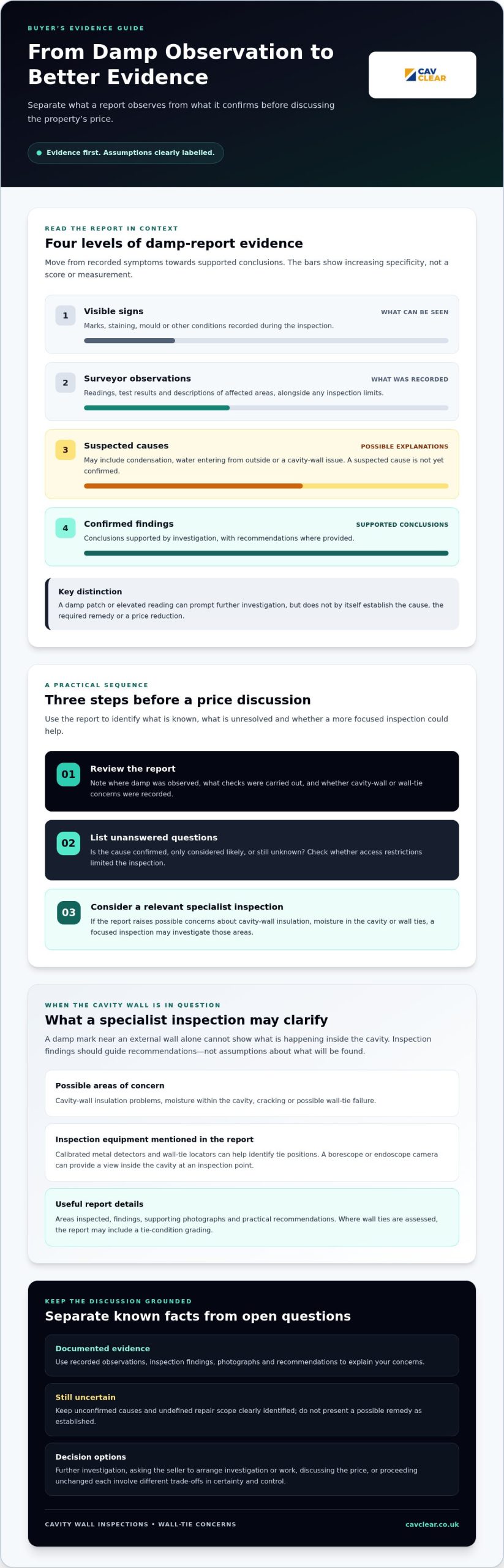
Before discussing the property’s price, sort the report’s statements into four practical categories:
- Visible signs: marks, staining, mould or other conditions recorded at the inspection.
- Surveyor observations: readings, test results and descriptions of the affected areas.
- Suspected causes: possible explanations that the report hasn’t confirmed.
- Confirmed findings: conclusions supported by the investigation, with recommendations where provided.
If the report leaves the cause or extent unresolved, don’t treat an assumed repair as an established fact. First consider whether a relevant specialist inspection could clarify the issue, particularly where cavity-wall insulation or wall ties may be involved. A price discussion is stronger when it reflects what is known, explains what remains uncertain and avoids presenting a possible remedy as a confirmed requirement.
Investigating cavity wall damp before negotiating
A damp mark near an external wall doesn’t, by itself, show what is happening inside the cavity. Moisture can have several causes, and symptoms alone can’t confirm whether cavity wall insulation, a wall tie or another factor is involved. Before negotiating house price after damp report findings, establish what the report says and whether a cavity-wall concern needs separate investigation.
Use this sequence to move from a general observation to useful, property-specific evidence:
- Review the report. Note where damp was observed, what tests or visual checks were carried out, and whether the surveyor recorded cavity-wall or wall-tie concerns.
- List unanswered questions. Identify whether the cause is confirmed, described as likely or still unknown. Check whether access restrictions or other limitations affected the inspection.
- Arrange relevant specialist inspection. If the report points to possible cavity-wall insulation problems, moisture within the cavity or wall-tie concerns, a specialist inspection can investigate those specific areas.
Inspection findings, not a damp label alone, should guide recommendations and help define what remains uncertain. Further investigation may clarify the evidence, but it should not be treated as proof of a fault before the property has been inspected.
When could a cavity-wall inspection add useful evidence?
A cavity-wall inspection may be relevant when the report raises concerns about insulation, moisture in the cavity, cracking or possible wall-tie failure. Calibrated metal detectors and wall-tie locators can help identify tie positions, while a borescope or endoscope camera can provide a view inside the cavity at an inspection point. The purpose is to assess the property, not predict what the inspection will find.
What should a specialist report give a buyer?
A clear report can set out the areas inspected, findings and supporting photographs. Where wall ties are assessed, it may include a tie-condition grading and practical recommendations. The report should help you distinguish what the inspection found from what remains uncertain, giving you a firmer basis for deciding whether to seek more information or discuss the findings with the seller.
If the report specifically raises insulation concerns, the cavity wall insulation removal guide explains the service and relevant considerations. Insulation in a cavity does not, on its own, establish that it is defective or needs removal. Any recommendation should follow inspection findings.
Where the reported concern relates to a cavity wall, a specialist inspection can help turn an uncertain observation into documented findings. CavClear carries out cavity-wall inspections using calibrated metal detectors, wall-tie locators and camera equipment, with reports that include photographs and practical recommendations. A CavClear cavity-wall inspection can provide relevant evidence for your next decision without assuming the cause in advance.
Compare your options after a damp report: renegotiate, investigate, or proceed
A damp report doesn’t leave you with only one route. You can discuss a price adjustment based on what’s documented, seek more information or work before deciding, or proceed on the current terms. The right choice depends on how clearly the report defines the issue and how comfortable you are with what remains uncertain.
You and the seller may read the same report differently. Keep the conversation calm and specific: refer to the recorded observations, distinguish them from possible causes, and explain what decision you’re asking to discuss. The comparison below shows the practical trade-offs.
| Option | Certainty | Control over the work | What may remain unresolved |
|---|---|---|---|
| Renegotiate the price | Depends on how clearly the report documents the finding and any recommended work. | You can plan the next steps after purchase, subject to the agreed terms. | If the cause or scope is still unknown, the eventual work may differ from your assumptions. |
| Ask for seller-arranged investigation or work | Further investigation may clarify the cause; completed work may address an identified issue. | The seller arranges the investigation or work, so you have less direct control over its process. | You may still need to understand the findings, recommendations and any remaining work before deciding. |
| Proceed unchanged | No additional certainty is gained unless the report already provides enough information for you. | You can decide how to manage any follow-up after purchase. | The reported concern and any unknown cause or remedial scope remain for you to consider. |
When might further investigation come before a price discussion?
Consider this route if the report records damp but doesn’t establish its cause or extent. Additional findings can help define what the discussion should cover, rather than using a broad label as a stand-in for a repair plan. The appropriate inspection depends on the report: a cavity-wall survey may be relevant where cavity concerns are raised, but it isn’t necessary for every damp finding.
When might a buyer discuss a price adjustment or seller-led work?
A price discussion may suit you if the evidence already documents a concern and you prefer to manage any follow-up yourself. Seller-arranged investigation or work may suit you if you want more information or a defined issue addressed before proceeding, though you’ll have less control over how that work is arranged. Neither option is automatically better; weigh the evidence against the level of certainty you need.
For either route, write a short, factual summary: identify the report finding, state what remains unclear and set out the next step you’re proposing. When negotiating house price after damp report findings, avoid assigning a reduction to work the report hasn’t established. A clear request gives both parties something specific to consider while keeping the discussion grounded in the property’s documented condition.
How to negotiate house price after a damp report: an evidence-led process
A clear request is easier to assess than a general concern about damp. Before approaching the seller, organise the report’s findings and decide what outcome you’re asking to discuss. Keep confirmed observations separate from suspected causes and investigations that haven’t yet taken place.
Anchor your negotiation in what the inspection report records, and state plainly which questions about cause or scope remain open. This keeps the discussion proportionate: don’t present a possible repair as confirmed, or base an adjustment on work that hasn’t been identified.
- Extract the relevant findings. Record the affected locations, observed condition, tests described, limitations and any recommendations. Keep the report’s own wording close at hand.
- Sort certainty from uncertainty. Note what the surveyor directly observed, what cause is only suspected, and whether further investigation is recommended. If a cavity-wall issue is mentioned, distinguish that concern from a confirmed finding about insulation or wall ties.
- Choose the request. Decide whether you want to discuss the price, arrange an investigation or consider seller-led work. Each asks for a different response, so avoid combining them into a vague demand.
- Make the request specific. Refer to the relevant report finding, explain why it affects your decision and state the next step you’re proposing. Keep any price discussion proportionate to documented scope, not an assumed repair.
How should you prepare the evidence and request?
Prepare a short summary that identifies the report date, affected area, observations and recommendations, along with any stated limits to the inspection. Attach or refer to the relevant report section so the seller can see the basis for your request. For example, say the report records moisture in a named area and recommends further investigation, rather than stating that a particular defect has been proven.
Then state your preferred next step: a discussion about price, further investigation, or work arranged by the seller. Keep the tone measured and the wording factual. When negotiating house price after damp report findings, a precise request makes it easier to respond to the evidence without overstating what it establishes.
How can you respond if the seller disagrees?
Return to the report and identify the exact point of difference. Is the disagreement about what was observed, the possible cause, or what further work may be needed? Keep those questions separate. If the report leaves the scope unresolved, consider whether property-specific investigation could clarify it before either side treats a possible remedy as certain.
Summarise any agreed next step in writing, including what finding prompted it and what remains unknown. A calm, clear record can keep the discussion focused on the property rather than competing assumptions. If the report raises cavity-wall concerns, CavClear’s specialist cavity-wall inspections can provide property-specific findings to inform your decision.
Use a specialist damp or cavity-wall survey to decide your next step
A specialist cavity-wall survey may help if the report raises a concern about moisture within the wall, cavity wall insulation or wall ties. It can add property-specific evidence where a general survey has identified a symptom but hasn’t established what is happening inside the cavity. It won’t assume that every damp finding is caused by a cavity-wall defect.
That distinction matters when negotiating house price after damp report findings. A focused inspection can help clarify what was found and what recommendations may be appropriate, giving you a more reliable basis for deciding whether to seek further investigation, discuss the findings or proceed.
What happens during a cavity-wall survey?
The inspection is tailored to the reported concern and the property. It may include an external inspection and, where relevant, locating wall ties with calibrated metal detectors or wall-tie locators. A borescope or endoscope camera can provide a view within the cavity at an inspection point. These tools support assessment; they don’t predetermine the result.
After inspection, the written report sets out the findings and includes photographs. Where wall ties are assessed, it can include a tie-condition grading and practical recommendations based on what the inspection identifies. Any recommended remedial work depends on the property and inspection findings. An inspection cannot guarantee a particular outcome.
How can a buyer arrange a relevant next step?
If your report records possible cavity-wall insulation concerns, damp related to the cavity or wall-tie issues, a specialist survey can help establish what applies to that property. CavClear provides cavity-wall inspections nationwide across the UK. The survey and any remedial work are scoped to the property, access and requirements. Recommendations follow the inspection findings rather than being assumed from a damp description alone.
If the report specifically identifies wall-tie concerns, understanding the inspection findings can help you decide whether to discuss the issue further. The wall tie replacement guide explains the subject in more detail, while a survey can establish the condition recorded at the property.
Use the report to identify the areas of concern and any unanswered questions before arranging an inspection. This gives the survey a clear focus and helps keep your next decision grounded in evidence. To arrange a specialist survey with CavClear, contact CavClear about a cavity-wall inspection.
Make your next move with confidence
A property decision reaches beyond the immediate purchase. The aim is to understand what you’re taking on and make a choice that supports the home’s long-term condition. Keep your next step tied to the evidence available, and allow new inspection findings to inform any change in your position.
For buyers considering a cavity-wall inspection, CavClear is a Wall Tie Installers Federation member and TrustMark registered for cavity wall insulation removal. The website displays 46 Google reviews. These details provide context about the specialist service available.
Negotiating house price after damp report findings doesn’t mean you need to decide before the facts are clear. If a cavity-wall concern needs closer assessment, use a property-specific survey to inform your decision.
Arrange a specialist survey with CavClear and move forward with greater clarity about the property.
Frequently Asked Questions
Can I negotiate the house price after a damp report?
Yes, you can raise a price discussion after a survey records damp, but the finding alone doesn’t determine a reduction. When negotiating house price after damp report findings, identify what the survey actually observed and whether it recommends more checks. For example, a recorded patch with an unclear cause is different from a report that defines the affected area and remedial scope. Explain what you’re asking to discuss and why.
Should I get a specialist damp survey before negotiating?
It may help if the first report notes damp but gives limited detail about its cause, extent or next steps. Before arranging more investigation, check what the original inspection covered and what it couldn’t access. A specialist survey can focus on a particular concern, such as possible moisture within a cavity, rather than repeat checks that don’t answer your question. Use the findings to decide whether further discussion is needed.
What should I ask the seller to do after a damp report?
You could ask to discuss a price adjustment, request further investigation, or explore seller-arranged work. Choose the request that matches the evidence and the level of certainty you want before proceeding. If work is proposed, refer to the report’s recommendation and clarify what part of the finding it is intended to address. Avoid describing a suspected cause as confirmed, or treating a possible remedy as a settled requirement.
Can damp in cavity walls affect a house purchase?
It can influence how you assess the property, especially if the report records damp alongside a specific cavity-wall concern. The finding still needs context: a damp patch doesn’t establish that insulation is defective or that wall ties have failed. Review whether the report recommends a cavity-wall inspection and what question it should answer. That can help you decide whether the issue changes your view of the property or simply needs clarification.
How do I negotiate if the cause of damp is unclear?
Be open that the cause hasn’t been established. You can refer to the surveyor’s observations and ask whether further investigation should happen before discussing a revised offer. If you choose to raise price first, explain that your concern relates to unresolved scope, not a confirmed diagnosis. Keep notes of which details are established and which remain unknown, so your next conversation responds to evidence rather than assumptions.
Is a damp report enough evidence to request a price reduction?
A report can support starting a discussion, but the detail matters. A useful record identifies the affected area, describes what was observed and explains any inspection limits or recommended follow-up. If it only notes a symptom, it may not establish the work needed. Avoid basing your request on a general repair estimate or assumed remedy. Consider what additional property-specific information would make the scope clearer before deciding how to proceed.
Can a seller arrange damp repairs instead of changing the price?
Yes, seller-arranged investigation or work may be discussed as an alternative to a price change or proceeding unchanged. Consider whether you need clearer findings first, or whether the report already describes a defined action. Seller-led work gives you less direct control over how the work is arranged than managing follow-up yourself. Keep the proposed action tied to the reported concern, and clarify what information will be available afterwards.
What happens if a damp survey finds a cavity-wall problem?
The next step depends on the inspection findings. A cavity-wall concern doesn’t automatically mean insulation removal or wall-tie replacement is needed. CavClear’s specialist inspections use calibrated equipment and can provide written findings with photographs, tie-condition grading where ties are assessed, and practical recommendations. These details help distinguish a confirmed issue from one needing more investigation, so you can decide what information is relevant to your purchase decision.
Recent Comments