
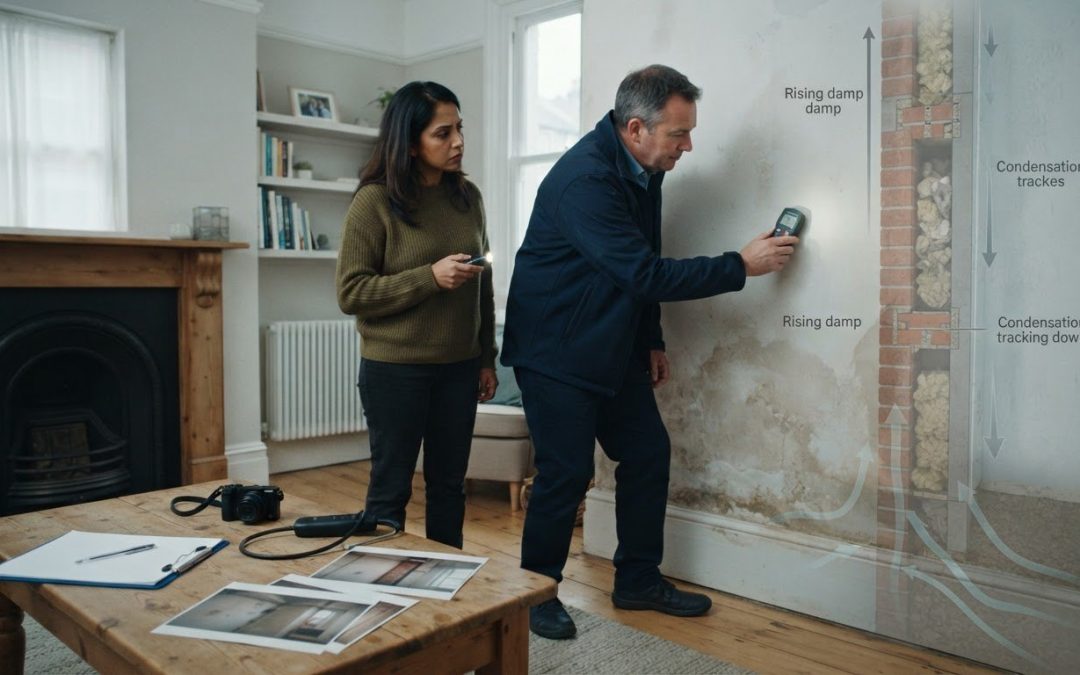
What if damp returning after remedial work points to a different moisture source, rather than proving the original treatment failed? It is understandable to feel frustrated when staining, mould or a musty smell persists, especially when the cause is still unclear. Visible damp alone cannot show whether moisture is rising, entering through the wall, linked to condensation or associated with a cavity wall problem.
A useful assessment starts with what you can observe. Note where symptoms appear, when they worsen and whether they change with the weather or everyday activities. Dated photographs and clear records can help build a more complete picture. This guide explains how to document damp symptoms, why different moisture sources can look similar and when a cavity wall inspection may help investigate the cause. Where cavity wall insulation or wall ties could be involved, a specialist survey can provide findings and recommendations before remedial work is considered. CavClear carries out cavity wall inspections nationwide across the UK, helping property owners understand what may be affecting their home.
- Recurring damp can be frustrating, but visible symptoms alone cannot establish their cause or show whether previous work addressed the moisture source.
- Record where damp appears, its extent and pattern, and when it changes to give an assessor a clearer picture.
- Compare dated photographs and observations with inspection findings and work records. Keep confirmed facts separate from possible explanations.
- Use an assessment to identify what remains unclear and which technical questions need investigation before deciding on next steps.
- A cavity wall inspection may help investigate damp where a cavity wall problem could be involved. A written report can set out findings and relevant recommendations.
Damp Proofing Problems: Why Persistent Symptoms Do Not Prove One Cause
Recurring damp after remedial work can be frustrating, particularly when you expected the problem to be resolved. But staining or mould does not, by itself, show that the work was defective or identify where moisture is coming from. A useful assessment considers the visible symptoms, the building’s context and the possible routes moisture could be taking.
A damp patch is an observation, not proof of its source. Staining, peeling paint and mould are signs to investigate, not a technical diagnosis. Similar-looking marks can have different explanations, and more than one factor may be involved. A surface reading or photograph can help record a concern, but neither should be treated on its own as confirmation of the moisture source. For background on damp proofing methods and types, it helps to distinguish general information from an assessment of a specific building.
What does it mean when damp returns after treatment?
Symptoms may continue if the original moisture source remains, or return because another source is also affecting the area. For example, moisture entering through an external wall and condensation inside a room can produce overlapping signs. A cavity wall issue may also warrant investigation where the location and building details make it relevant, but insulation or wall ties should not be assumed to be the cause without an inspection.
Timing and location offer clues, not conclusions. A mark that becomes more noticeable after wet weather may prompt questions about water entering from outside. Mould in a colder corner may lead an assessor to consider room conditions and ventilation alongside other possibilities. Neither pattern confirms a cause on its own. The fact that symptoms appeared after treatment does not establish that the earlier work was at fault. Work records and the property’s condition need to be considered together.
Which observations are useful to record?
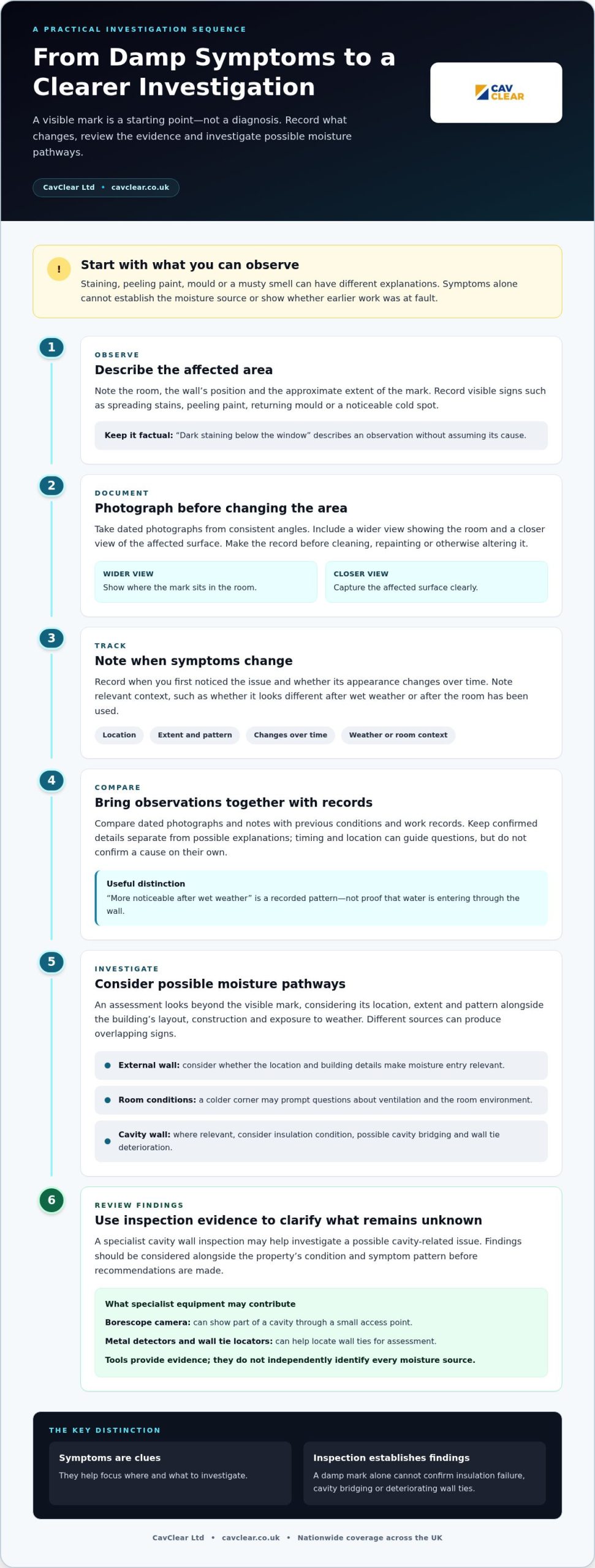
Make a simple record before cleaning, repainting or otherwise changing the affected area. Note the room, the wall’s position, the approximate extent of the mark and when you first noticed it. Record whether symptoms change, such as staining spreading, paint peeling further, mould returning or a cold spot becoming more apparent. These details describe what is happening without presenting an explanation as fact.
- Take dated photographs from consistent angles, including a wider view showing the room and a closer view of the affected surface.
- Note relevant changes over time, such as whether the area looks different after wet weather or after the room has been used.
- Keep observations separate from explanations. Write “dark staining below the window” rather than “rain is getting through the wall” unless an inspection has established that.
This record gives an assessor a clearer starting point and helps compare visible changes with previous conditions and work carried out. It will not diagnose the problem on its own, but it can make the next inspection more focused and help identify which moisture pathways need closer examination.
How a Damp Investigation Traces Moisture Through the Building
A sound damp investigation looks beyond the visible mark. It considers where moisture appears, how far it extends and whether its pattern relates to the building’s layout, construction or exposure to weather. The assessor can then consider possible moisture pathways rather than treating one symptom as a confirmed diagnosis.
A moisture pathway is the route water takes as it enters or moves through building materials. Tracing that route means considering how moisture might reach the affected area and what evidence supports each possibility. Penetrating damp, condensation and cavity wall problems may all be relevant in some cases, but none should be assumed from staining or mould alone.
Building context helps narrow the questions. An assessor may consider whether the affected surface is an external wall, how damp is distributed and whether nearby building details could influence moisture movement. Poor cavity wall insulation conditions can contribute to moisture problems in some properties, but this does not mean every insulated wall is defective or that insulation is the cause in a particular home.
When might a cavity-wall issue be relevant?
Damp on or near an external wall may justify looking at the cavity, especially when the location and building details suggest moisture could be passing through the wall construction. An inspection can consider insulation condition, possible cavity bridging and wall tie deterioration. These are different matters and require suitable investigation. Symptoms alone cannot confirm that insulation has failed, that bridging is present or that wall ties are deteriorating.
That distinction matters. A damp patch can guide where an assessor looks, but it cannot show what is happening inside a cavity. Findings should be interpreted alongside the building’s condition and the pattern of symptoms, with recommendations based on what the inspection establishes.
What can specialist inspection equipment show?
A borescope camera can examine part of a cavity through a small access point, giving the assessor a view of conditions that are not visible from the room or the outside wall. Metal detectors and wall tie locators can help locate wall ties for assessment. These tools provide useful evidence, but they do not independently identify every moisture source or explain how a damp patch formed.
Equipment results need skilled interpretation. Locating a tie, for example, does not by itself establish that the tie has deteriorated. The assessor needs to consider the wider evidence and explain what the inspection can and cannot establish. Written findings, supported by photographs where relevant, can help distinguish observations from possible causes and recommended next steps.
- Position: Is the damp on an internal partition or an external wall?
- Pattern: Is it localised, spreading or appearing in several areas?
- Context: Could cavity conditions, internal moisture or water entering from outside merit investigation?
If the evidence points towards a cavity wall concern, a specialist cavity wall inspection can help clarify what is present before relevant remedial work is considered. CavClear carries out cavity wall inspections and surveys across the UK.
Compare the Symptoms, Inspection Findings and Work Records
Once you have gathered observations, place them alongside relevant inspection findings and records of the work. A side-by-side comparison can show what was present before treatment, what changed afterwards and which questions remain open. Keep the categories distinct: a symptom is something observed, an inspection finding is something recorded during an assessment, and a recommendation is a proposed next step.
| Symptom | Location | Date | Previous condition | Relevant inspection finding |
|---|---|---|---|---|
| Staining | External-facing wall in a named room | Date first seen or photographed | Record whether it was present before the work | Enter the finding, or note that this area was not inspected |
| Peeling finish | Describe the wall position and extent | Date observed | Compare with earlier photographs or notes | Record relevant observations separately from recommendations |
| Mould or cold spot | Note the precise area | Date and any later change | Describe the earlier condition, if known | Include relevant findings or state that the cause remains undetermined |
Use the table as a record, not as a diagnosis. A smaller stain may indicate a visible change, but it does not confirm that the moisture source has been resolved. Likewise, recurrence does not establish why the damp returned. The professional damp survey guide offers further context on what a survey process and written report may cover.
How to organise photographs and written records
Keep dated photographs, work descriptions, inspection reports and follow-up notes together, ideally in date order. Photograph the same area from a consistent viewpoint so changes are easier to compare. Label each image with the room, wall position and date. If a detail is uncertain, say so plainly, for example, “possible increase in staining”, rather than recording an assumption as fact.
Include relevant records of the previous condition and any work completed, but distinguish what a document states from your own interpretation. This makes it easier to identify gaps and discuss them clearly during an assessment.
What makes an inspection report useful?
A useful report identifies the areas inspected and sets out the observations clearly. Where relevant, it may include photographs, wall tie condition grading and practical recommendations. It should also make clear which areas or elements were not examined, so its findings are not applied beyond their scope.
Read each finding in context. A report about wall ties, for example, does not automatically establish the source of damp elsewhere in the property. Recommendations should relate to recorded findings, while other possible moisture sources remain separate questions unless the inspection addressed them.
Comparing the records this way helps you see what is documented, what changed and what still needs investigation. That gives any further assessment a clearer starting point without treating either improvement or recurrence as conclusive proof of cause.
Practical Next Steps When Damp Persists After Remedial Work
Take a measured approach before arranging more treatment. The aim is to establish what is happening now, what work has already been completed and which technical questions remain unanswered. A clear sequence can help avoid treating the same visible symptom repeatedly while its source is still uncertain.
- Document the symptoms. Record affected areas, visible changes and the dates you notice them. Keep dated photographs from consistent viewpoints.
- Review relevant records. Gather work descriptions, previous inspection reports and recommendations relating to the affected areas.
- Note what has changed. Compare current conditions with earlier records, distinguishing visible improvement or recurrence from a confirmed explanation.
- List unanswered questions. For example, note whether the external wall or cavity has been inspected and what the available findings establish.
Avoid covering damp marks with fresh paint or repeatedly applying surface treatments before the source is understood. These steps can obscure changes that would otherwise help an assessment. They do not resolve every underlying moisture issue, and further work should follow relevant findings because causes and suitable remedies differ between properties.
When should cavity-wall inspection be considered?
Persistent damp on or near an external wall may make cavity conditions relevant to investigate, depending on the building and the pattern of symptoms. A suitable inspection can assess cavity insulation and wall ties without presuming either is defective. Cavity wall insulation removal should only be considered where an inspection identifies insulation that is defective, damp or causing issues, not simply because damp is visible.
If an inspection identifies a relevant insulation concern, the cavity wall insulation removal guide explains the process in more detail. An inspection can help establish whether this is appropriate to consider, rather than treating removal as a default response.
How can wall-tie findings affect the next step?
Damp alone cannot show whether wall ties are sound or deteriorating. Their condition needs to be assessed through an appropriate inspection, with findings interpreted alongside the wall’s condition and any relevant signs of movement or cracking. If inspection findings support remedial work, stainless steel replacement ties may be recommended. The wall tie replacement guide gives further information about that process.
A written cavity wall survey can help clarify what was inspected, what was found and which remedial steps are relevant. CavClear provides specialist cavity wall inspections and surveys across the UK. Arrange a cavity wall inspection to investigate whether cavity conditions may be contributing to persistent damp.
How CavClear Helps Investigate Damp Linked to Cavity-Wall Problems
Persistent damp can leave you unsure whether the original moisture source was identified or whether a separate cavity wall issue needs attention. CavClear focuses on cavity wall inspections, surveys and relevant remedial work for properties across the UK. An inspection establishes what can be observed in the wall construction and provides clear findings to help guide appropriate next steps.
What happens during a cavity-wall inspection?
CavClear’s specialists use calibrated equipment, including borescope cameras, wall tie locators and metal detectors, as appropriate to the property and inspection. A borescope camera can provide a view into part of the cavity through a small access point. Wall tie locators and metal detectors help identify tie positions for assessment. Equipment supports the inspection, but findings still need to be interpreted in the context of the building and the areas examined.
A survey may include an external inspection and examination of wall ties where relevant. The scope depends on the property and the questions being investigated. A written report sets out findings and recommendations, with photographs and tie condition grading where relevant. It can help distinguish what was observed from what may need further attention and clarify which parts of the wall were inspected.
How do findings guide suitable remedial work?
Recommendations depend on the survey findings and the property’s condition. A damp mark alone is not a reason to remove cavity wall insulation. Cavity wall insulation removal is considered where an inspection identifies insulation that is defective, damp or causing issues. An insulated cavity with no identified problem should not be treated as defective by assumption.
Wall tie replacement is also guided by inspection findings. If the survey identifies ties that need remedial attention, the report can set out appropriate recommendations. Any additional remedial work is considered separately and should relate to the evidence found. An inspection can clarify cavity wall conditions, but it cannot guarantee a particular outcome for damp, especially where other moisture sources may also be involved.
A written survey gives you a clearer basis for deciding what to investigate or address next. It can also help you compare the findings with your dated observations and existing work records, without treating a symptom as proof of a specific defect. For further context, the professional damp survey guide explains how reports can support a structured assessment.
If cavity wall conditions may be contributing to persistent damp, CavClear’s nationwide specialists can investigate the wall and explain relevant findings. Book a CavClear survey when you are ready to explore whether a cavity wall inspection may help.
Take the Next Step Towards a Clearer Assessment
Before arranging further remedial work, focus on the unanswered technical question: could a cavity wall condition be contributing to the moisture? A targeted inspection can help establish whether that part of the building needs attention, so decisions can be based on property-specific findings rather than assumptions about visible symptoms.
CavClear is a member of the Wall Tie Installers Federation and is TrustMark registered for cavity wall insulation removal. These credentials sit alongside its specialist focus on cavity wall inspection and remedial work. Recommendations should reflect the survey findings, not a standard remedy applied to every property.
If cavity wall conditions may be relevant to your home, take the next step at a pace that feels right for you. Book a CavClear survey to investigate relevant cavity wall concerns. To discuss a survey, call 0333 220 2463 or email info@cavclear.co.uk.
Frequently Asked Questions
Can damp return after remedial work even if the work was completed?
Yes, damp symptoms can return after work is finished if the moisture source remains or another source develops. Marks may also remain after conditions change. For example, staining that becomes more noticeable during wet weather may raise different questions from mould that appears in a poorly ventilated corner. Timing can guide an investigation, but it cannot identify the cause on its own.
How can I tell whether damp-proofing work has addressed the moisture source?
You cannot establish this from the wall’s appearance alone. Compare the areas and causes the work was intended to address with inspection findings and follow-up observations. If a report describes work to one section but symptoms persist elsewhere, note that distinction for any further assessment. An inspection may be needed to establish whether the original moisture route has changed or whether another source should be investigated.
Can cavity wall insulation contribute to damp?
Yes, in some properties, defective, damp or unsuitable cavity wall insulation may contribute to moisture problems. Its condition and the way the cavity is performing need to be assessed in the context of the building. Damp symptoms alone do not establish that insulation is involved. A cavity wall inspection can help determine whether the insulation or another cavity condition is relevant to the moisture affecting the property.
What does a borescope camera show during a cavity-wall inspection?
A borescope camera lets an inspector view part of the cavity through a small access point. It can show visible conditions in the area examined, helping the specialist assess the wall construction beyond its surface. The view is limited, so it may not represent the whole cavity. Findings need to be interpreted alongside other inspection evidence and the building’s construction before deciding what they indicate.
Can damp patches prove that wall ties have failed?
No. Damp patches do not prove wall ties have failed. Wall ties connect the inner and outer leaves of a cavity wall, and their condition needs suitable assessment. A specialist may investigate ties where other relevant signs, such as masonry movement or cracking, are present. Damp alone cannot establish whether ties are deteriorating or explain a moisture source. A cavity wall tie inspection provides more relevant evidence about tie condition.
What information should I keep if damp symptoms continue?
Keep dated notes about each affected area, including when you first noticed a change and whether it coincided with particular weather or room use. Store photographs alongside inspection reports and descriptions of completed work. Separate details recorded by an inspector from your own observations. This gives an assessor a clearer timeline and helps show what is known, what has changed and which questions still need investigation.
Does cavity wall insulation always need to be removed when a home is damp?
No. Damp in a home does not automatically mean cavity wall insulation needs removal. Cavity wall insulation removal is considered when an inspection finds insulation that is defective, damp or causing issues. If the inspection does not identify insulation as a problem, other moisture sources may need consideration. A property-specific assessment helps ensure that any recommendation reflects the findings rather than assuming all insulation is responsible for damp.
Recent Comments