
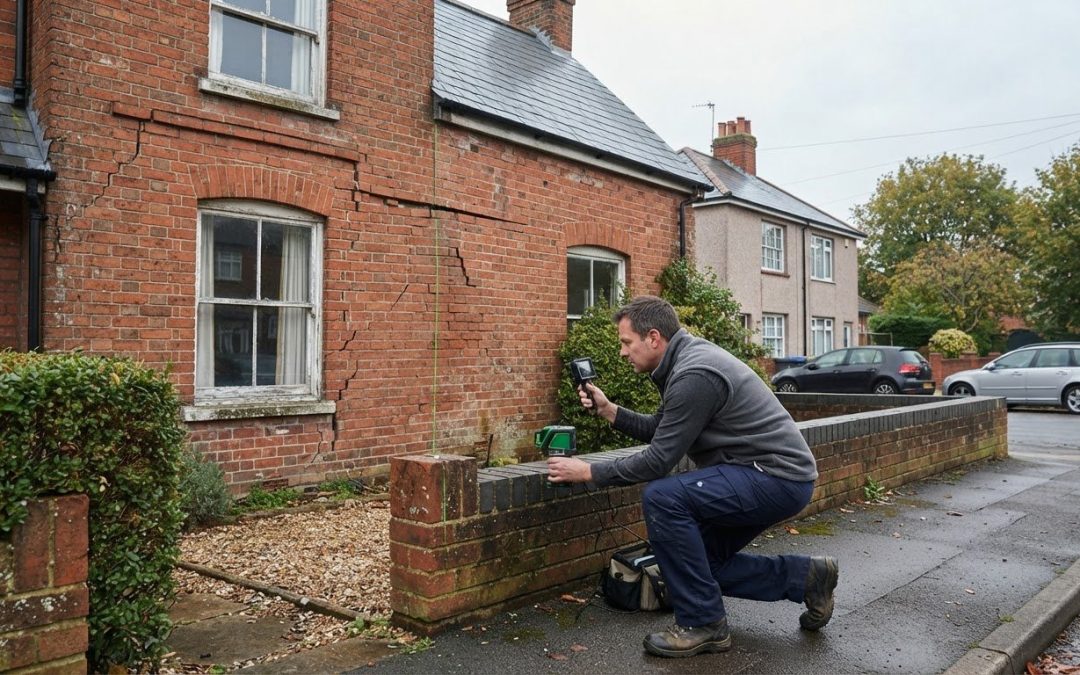
Could a wall that has looked unchanged for months still be moving? The long-term damage caused by ignoring bulging brickwork can include widening cracks, water ingress and damage to internal finishes. However, a bulge alone cannot show what is causing it or whether movement is continuing.
Cracks, damp and changes in a wall can have more than one explanation. In cavity walls, corroded or failed wall ties may reduce the restraint holding the outer leaf in place, but other structural or moisture-related factors may also contribute. Assuming the cause from appearance alone can lead to repairs that do not address the underlying issue.
This article explains why investigation matters, what signs to record and how a specialist assessment can help distinguish wall-tie concerns from other possible causes. An assessment may use calibrated equipment and inspection cameras where appropriate. Its findings can guide the next step, which may include wall tie replacement or crack stitching, depending on the property.
Key Takeaways
- A curved wall face, displaced brick courses or widening cracks are worth documenting, but they do not identify the cause on their own.
- Wall tie deterioration is one possible reason for movement. Other causes may also need investigation.
- The long-term damage caused by ignoring bulging brickwork can include worsening cracks and damage around openings, but a visible bulge does not automatically mean imminent failure.
- Record where cracks appear and whether the bulge, damp or other signs change over time. These observations can help inform a specialist assessment.
- Inspection findings guide the next step, which may involve a wall tie survey, replacement or another specialist repair approach.
Bulging brickwork: why visible movement deserves attention
A wall that appears to bow outwards can be unsettling, particularly if cracks or damp are also visible. Bulging brickwork describes an apparent outward displacement from the wall’s usual plane. It describes what you can see, not why it has happened or how serious it is.
Brickwork consists of bricks and the mortar joints between them, arranged in courses. This guide to brickwork explains these components and their role. On a property, a change in the wall’s alignment is worth observing, but appearance alone cannot confirm whether the masonry is actively moving.
What does bulging brickwork look like?
From outside, part of a wall may seem to project or curve away from the rest of the elevation. The change may be easier to notice when you look along the wall rather than straight at it. Perspective, surface finishes and the building’s original shape can all affect what you see, so treat a visual impression as a reason to record the concern, not proof of structural movement.
Look for other changes alongside the apparent curve. Brick courses may look uneven or displaced, mortar joints may appear wider or cracked, and cracks may run horizontally, vertically or in a stepped pattern. Note whether cracking is near a window or door, where openings interrupt the masonry. These details provide useful context for an assessment, but none identifies the cause on its own.
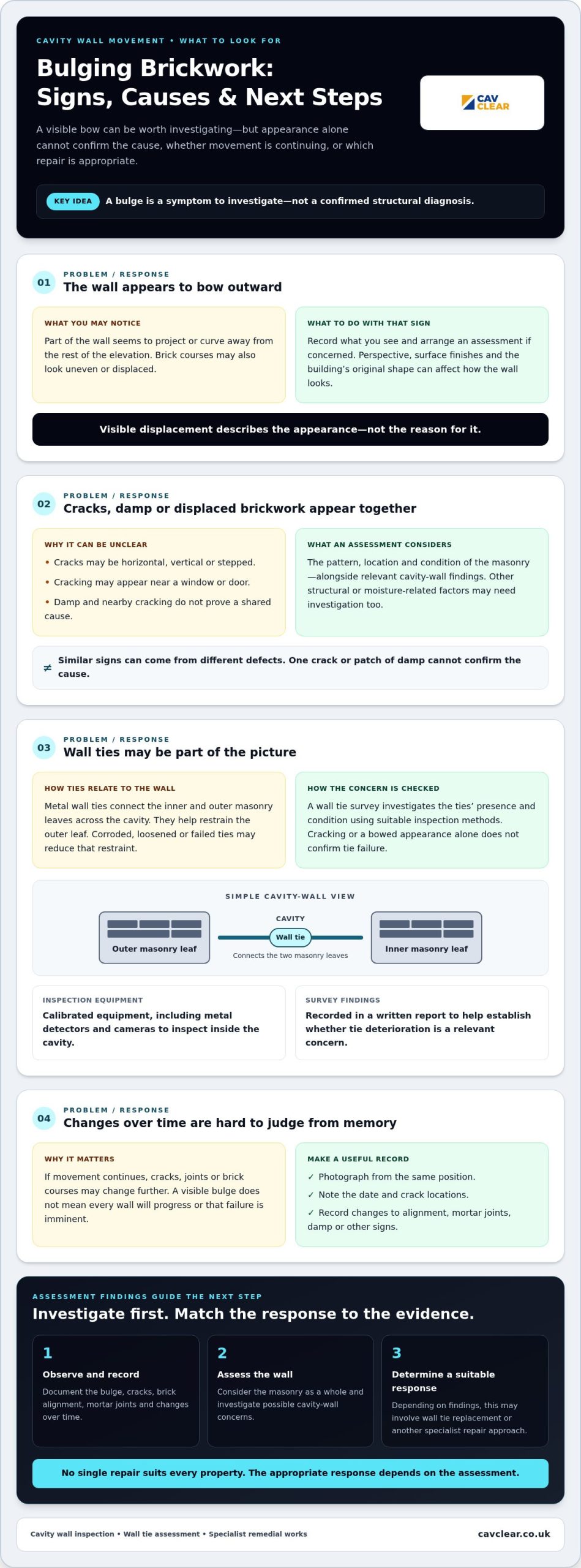
A visible bulge is a symptom to investigate, not a confirmed structural diagnosis. Its appearance cannot establish the extent of movement, the underlying cause or the appropriate repair. A specialist assessment considers the wall as a whole and may use inspection equipment to investigate possible cavity-wall concerns.
Why can ignoring a change make decisions harder?
A clear record helps an assessor understand whether the wall’s appearance seems stable or has changed. Take photographs from the same position and make a note of the date, the location of cracks and any changes to brick alignment or mortar joints. Record damp or other movement observations too, without assuming they share the same cause.
If movement continues, it may affect nearby masonry or areas around openings, depending on its cause and extent. Cracks may become more noticeable, or joints and brick courses may change further. This does not mean every bulge will progress or that failure is imminent. It does explain why monitoring and timely investigation are more useful than relying on memory or waiting for a more dramatic change.
The long-term damage caused by ignoring bulging brickwork can be harder to address if movement continues, but the right response depends on the assessment findings. Recording what you see gives a specialist practical information and helps guide proportionate next steps.
What can cause brickwork to bulge, and how can movement develop?
An outward bow is a visible change, but it does not reveal what is happening within the wall. Different defects can produce similar signs, and more than one factor may be present. Similar brickwork symptoms can arise from different defects, so appearance alone cannot confirm the cause. Investigation helps distinguish a possible cavity-wall issue from other sources of movement before a repair is recommended.
How can wall-tie deterioration contribute to outward movement?
In a cavity wall, metal wall ties connect the inner and outer masonry leaves across the cavity. They help restrain the outer leaf and maintain the connection between the two parts of the wall. If ties corrode, loosen or fail, that restraint may be reduced. Depending on the ties’ condition and arrangement, the outer masonry may become more vulnerable to movement.
Cracking or a bowed appearance can prompt questions about wall ties, but neither confirms that the ties are responsible. A wall tie survey investigates their presence and condition using suitable inspection methods. CavClear’s surveys use calibrated equipment, including metal detectors and cameras to inspect inside the cavity. Findings are recorded in a written report to help establish whether tie deterioration is a relevant concern at the property.
What other factors may need investigation?
Wall ties are one possibility, not the only one. A wall may have inadequate restraint, meaning it is not sufficiently held in position by the surrounding structure. Moisture can also contribute to deterioration in masonry or metal components, while wider structural movement may affect the wall’s alignment. Each possibility needs to be considered in context rather than inferred from one crack or patch of damp.
These signs can occur together without sharing a single cause. Damp may be associated with a moisture pathway, for example, while a nearby crack may relate to movement. Their proximity does not prove that one caused the other. Cracking around an opening can provide useful context, but it does not identify a defect by itself. An assessor considers the pattern, location and condition of the masonry alongside relevant cavity-wall findings.
The distinction matters because the appropriate response depends on the defect identified. If an assessment finds deteriorated wall ties, a wall tie survey can help inform whether replacement is suitable. If the evidence points elsewhere, tie replacement alone may not address the issue. The long-term damage caused by ignoring bulging brickwork may be harder to limit if the cause remains unresolved, but no single repair suits every property.
For property owners concerned about wall ties, a specialist wall tie assessment can help clarify the evidence and guide appropriate next steps.
What long-term damage could follow if bulging brickwork is ignored?
A bulge can look alarming, but it does not automatically mean a wall is about to fail. The risk depends on what is causing the displacement, how extensive it is, where it occurs and whether movement is continuing. Some visible changes may remain stable, while others may progress if an underlying defect is left unresolved. A visual check alone cannot reliably tell which situation applies.
Possible long-term damage caused by ignoring bulging brickwork includes worsening cracks, further displacement of masonry and damage around nearby windows or doors. These are potential outcomes, not a prediction for every property. Understanding the pattern and cause of movement helps establish what needs attention and how urgently.
Can bulging brickwork lead to more extensive masonry damage?
If movement continues, cracks may extend through mortar joints or into adjoining areas of brickwork. The masonry around an opening may also be affected, with cracking near a window or door frame. The location and pattern matter: they help an assessor consider how the surrounding wall is behaving, but do not identify the cause by themselves.
In some cases, ongoing movement could loosen or displace more masonry. If gaps or cracks allow water to enter, damp may develop and internal finishes could be affected. The extent of any resulting damage depends on the wall’s condition and the source of moisture, so damp should not automatically be treated as proof that the bulge caused it.
Compare dated photographs taken from the same position and note changes to cracks, mortar joints or the wall’s shape. This record can help an assessor distinguish a longstanding appearance from signs that may be changing. Investigation assesses risk by examining the evidence, not by predicting a specific outcome from one visible symptom.
Does a bulging wall always mean immediate structural failure?
No. Visible bulging alone does not establish imminent structural failure. A shallow-looking curve may have a different significance from pronounced displacement, and the location, pattern and suspected cause all affect how the wall should be assessed. The apparent size of a bulge is not enough to determine whether movement is active or what remedial work may be suitable.
Avoid both extremes: do not assume the wall is about to fail, but do not dismiss a change that appears to be developing. If the bulge or cracking seems to be worsening, or the wall appears unstable, arrange a prompt specialist assessment. Note when you first observed the change and any differences since then. Clear observations can help focus the inspection on the areas that matter.
A specialist investigation can assess whether cavity-wall defects, including deteriorated wall ties, may be involved and help distinguish them from other possible causes. The findings guide the next step. Early clarity supports decisions based on the property’s condition rather than fear or guesswork.
How do repair approaches differ when brickwork is bulging?
There is no standard repair for every bulging wall. The appropriate approach depends on the defect identified during assessment, not simply on how the wall looks. A wall tie survey may be relevant if the connection between the masonry leaves is in question. Crack stitching or helical bar installation may be considered for specific masonry cracking or restraint needs. These methods address different issues, so choosing a repair before understanding the cause may leave the underlying problem unresolved.
When might wall-tie work be considered?
A cavity wall tie survey can investigate whether ties are present and assess their condition. If findings indicate that ties have deteriorated and no longer provide suitable restraint, wall tie replacement may be considered. CavClear uses corrosion-resistant stainless-steel replacement ties. Survey findings guide the recommended work for the property, rather than assuming every bulge is tie-related. For more detail on this approach, see Wall Tie Replacement: The Essential Guide to Structural Stability in 2026.
When might crack stitching or helical bars be considered?
Crack stitching and helical bar installation may be suitable specialist options where an assessment identifies a particular masonry crack or restraint issue they can address. They are targeted remedial methods, not a default treatment for any bowed wall. If movement has another underlying cause, reinforcing a visible crack alone may not resolve it. Assessment helps establish whether these methods are suitable and whether the suspected cause needs attention first.
The comparison below shows how suspected issues lead to different investigation priorities. It is a guide to the decision-making process, not a diagnosis of an individual property.
| Suspected issue | Investigation focus | Possible approach | Reason for assessment |
|---|---|---|---|
| Deteriorated or failed wall ties | Inspect tie presence and condition within the cavity | Wall tie replacement, if findings support it | To establish whether the ties are contributing to reduced restraint |
| Localised masonry cracking | Consider the crack’s location and pattern in the context of the wall | Crack stitching or helical bar installation, where suitable | To determine whether targeted reinforcement addresses the identified defect |
| Movement with an unclear cause | Assess the available evidence and investigate relevant cavity-wall concerns | Remedial work guided by the findings | To avoid treating a visible symptom as though it confirms a cause |
The long-term damage caused by ignoring bulging brickwork may become harder to address if movement continues. Choosing a repair without identifying the defect can also miss the mark. CavClear’s wall tie surveys and inspections help establish whether cavity-wall tie issues are involved and inform appropriate next steps. Arrange a specialist wall tie survey to investigate a concern with your cavity wall.
Next steps: specialist assessment of bulging brickwork
A structured inspection can replace guesswork with evidence. Before it takes place, make a simple record of what you have noticed. You do not need to decide why the wall has changed. Clear observations help a specialist focus on relevant areas and compare what you have seen with the inspection findings.
What information should you record before an inspection?
Note where the bulge appears, which wall it affects and how much of the surface seems involved. Record visible cracks and whether they follow mortar joints, cross bricks or appear near a window or door. If possible, take photographs from the same position on different dates. They may help show whether the appearance is stable or has changed, though photographs cannot confirm the cause.
Write down when you first noticed the change and anything relevant that happened around that time, without assuming it explains the movement. Include observations about damp, water ingress or changes to nearby finishes. If you know of previous cavity-wall work, such as repairs or insulation removal, share that history with the surveyor. These details provide useful context alongside the physical inspection.
What can a CavClear cavity-wall inspection provide?
CavClear’s cavity-wall surveys use calibrated equipment to investigate relevant wall-tie concerns. Depending on the assessment, this can include metal detectors or wall-tie locators to help locate ties, and borescope or endoscope cameras to inspect inside the cavity. A borescope is a small camera used to view areas that cannot be seen from the wall surface. The equipment supports the investigation, while the findings need to be considered in the context of the property.
A written report can set out the survey findings, include photographs and provide tie-condition grading, along with recommended remedial options based on the assessment. This helps distinguish observed signs from inspection findings and gives homeowners and property professionals a clearer basis for considering next steps. For a useful explanation of cavity-wall structure, see What is a Wall Cavity? The Complete Guide to UK Property Structure.
Recommendations depend on what the inspection identifies. If wall-tie deterioration is found, the report can help explain whether wall tie replacement should be considered. If the findings point to another issue, the appropriate next step may differ. A specialist survey clarifies the evidence rather than assuming every bulge has the same cause or requires the same work.
Investigating a visible change can help you make informed decisions about the property’s long-term condition. CavClear provides specialist cavity-wall surveys nationwide across the UK. Arrange a specialist cavity-wall survey to discuss an assessment for your property.
Take the next step towards informed decisions
A visible change in a wall is a reason to seek clarity, not to assume the worst. The long-term damage caused by ignoring bulging brickwork depends on what is driving the movement and whether it continues. Timely investigation gives you a sounder basis for deciding what to do next.
CavClear is accredited by the Wall Tie Installers Federation. Its specialist surveys use calibrated equipment and provide written findings, with photographs and tie-condition grading to explain what was observed. Recommended remedial work is guided by the property assessment, so the next step can reflect the evidence rather than guesswork.
If you have noticed a bulge or changing cracks, arrange an assessment and discuss the concerns you have recorded. Arrange a specialist cavity-wall survey with CavClear. A measured, informed approach can help you make decisions about your property’s long-term care.
Frequently Asked Questions
Is bulging brickwork always a sign of wall-tie failure?
No. Wall-tie deterioration is one possible cause, but outward movement can also relate to inadequate restraint, moisture-related masonry deterioration or wider structural movement. Similar signs can have different explanations, so do not assume that replacing ties will address the issue. A cavity-wall inspection can investigate tie condition, while the surveyor considers the visible pattern and other relevant evidence before recommending next steps.
Can brickwork bulge without visible cracks?
Yes. A wall may appear uneven or bowed even when there are no obvious surface cracks. Cracking is not required for a bulge to merit investigation, and a lack of cracks does not confirm that the wall is stable. Look at the wall from different angles and note any changes in its outline, but do not use appearance alone to judge the cause or severity.
How can I tell whether a bulge in a brick wall is getting worse?
Compare dated photographs taken from the same position and note changes in the wall’s outline, brick alignment or nearby openings. Record whether cracks have lengthened or new ones have appeared. These observations may help a specialist understand the pattern, but cannot confirm structural movement or measure its extent. The long-term damage caused by ignoring bulging brickwork depends on the cause and whether movement continues.
What should I do if bulging brickwork appears to be changing quickly?
Arrange a prompt specialist assessment and describe what has changed and when you noticed it. If the wall appears unstable, keep people away from the affected area and do not touch, lean on or try to brace the masonry yourself. Take photographs only from a safe position. A specialist can assess the visible movement and relevant cavity-wall concerns, then explain appropriate next steps based on the findings.
Can damp and bulging brickwork have the same underlying cause?
They can be related, but damp and bulging do not automatically share one cause. Moisture may contribute to deterioration of masonry or metal components, while wall movement may have another explanation. Note where damp appears, whether it changes with weather and how its location relates to the bulge. This context can help an assessor investigate possible cavity-wall issues without treating coincidence as proof of cause.
Can a specialist inspect wall ties without opening up the whole wall?
Yes. A specialist can use calibrated equipment, such as metal detectors or wall-tie locators, to locate ties, then use a borescope or endoscope camera to view conditions inside the cavity. This allows wall ties to be investigated without taking down the whole wall. The survey method depends on the property, and the findings help determine whether tie deterioration may be relevant.
Can bulging brickwork be repaired without rebuilding the wall?
In some cases, a specialist remedy may be possible without rebuilding, but suitability depends on the defect and assessment findings. If deteriorated ties are identified, replacement may be considered. Specific masonry cracks may be suitable for crack stitching or helical bar installation. These approaches are not interchangeable or right for every wall. The assessment should establish what needs addressing before a repair method is selected.
Recent Comments