

Why is your brand-new home already showing signs of mould when the developer insists it’s simply your lifestyle? It’s a common frustration for modern homeowners to be told that condensation is the culprit, especially when you suspect a deeper structural fault. You bought a new property for its efficiency and safety; however, visible damp and the risk of structural decay are now causing significant anxiety about your investment’s future.
Navigating an NHBC warranty claim for damp in a new build requires moving beyond anecdotal complaints and providing technical evidence of a defect. This 2026 guide explains how to identify structural moisture issues that builders often overlook, such as defective cavity wall insulation or failing wall ties. We’ll detail the specific coverage provided under the Buildmark policy and how independent surveys can validate your concerns with professional rigor. By understanding the technical standards required for a professional remedy, you can ensure your property is restored to its intended condition, protecting both your health and the long-term asset health of your home.
Key Takeaways
- Learn to differentiate between natural drying-out moisture and genuine structural defects that compromise your property’s weatherproofing.
- Understand the transition from the builder’s initial two-year warranty to the long-term insurance phase for major structural faults.
- Secure the technical evidence required for an NHBC warranty claim for damp in a new build by identifying internal issues like saturated cavity insulation.
- Discover how independent borescope inspections provide the visual proof needed to validate structural concerns that developers often overlook.
Identifying the Root Causes of Damp in New Build Homes
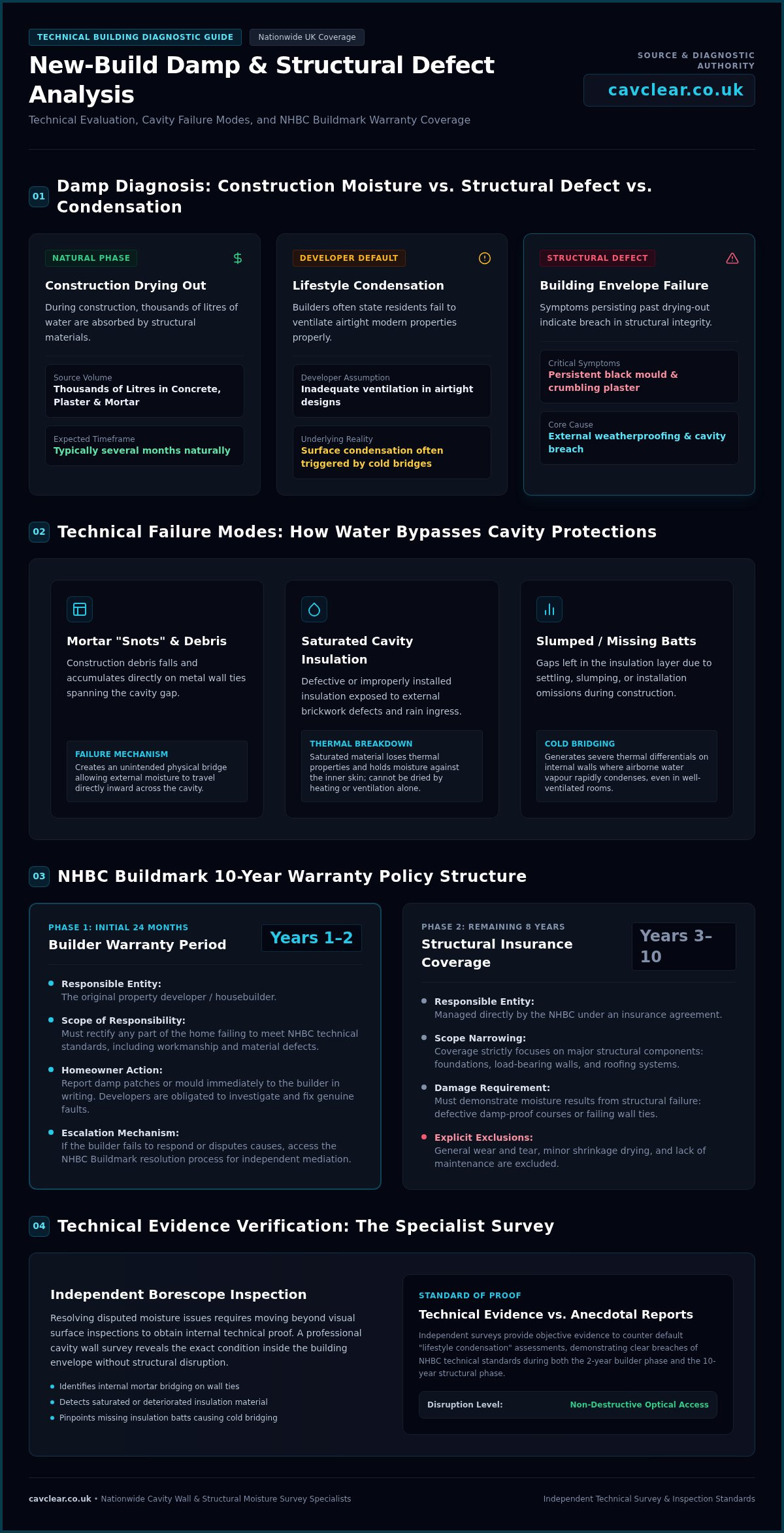
Modern UK building regulations mandate strict thermal efficiency. Despite these high standards, moisture remains a significant threat to new properties. During the construction phase, thousands of litres of water are used in materials like concrete, plaster, and mortar. This moisture must evaporate through a natural “drying out” process, which typically takes several months. When damp symptoms persist beyond this period, it’s often necessary to investigate an NHBC warranty claim for damp in a new build to address underlying faults. Persistent black mould growth or crumbling plaster are clear indicators that the building’s envelope is failing to manage moisture correctly. These symptoms often point to a breach in the property’s structural integrity.
Penetrating Damp and Cavity Wall Issues
Penetrating damp occurs when external moisture bypasses the outer leaf of a wall. In properties using cavity wall construction and insulation, the gap between the brickwork is designed to prevent water transfer. Construction debris like mortar “snots” can accumulate on wall ties, creating a physical bridge for water to travel inward. Defective or incorrectly installed cavity insulation also poses a high risk. If the material becomes saturated due to external brickwork faults or poor weatherproofing, it loses its thermal properties and holds moisture against the inner skin. This leads to internal dampness that can’t be resolved through heating or ventilation alone. Specialists identify these issues during a cavity wall survey, which reveals the internal condition of the wall structure without causing unnecessary disruption.
The Condensation vs. Structural Defect Debate
Property owners often face resistance when reporting dampness to developers. Builders frequently default to “lifestyle” explanations, suggesting that residents are failing to ventilate the home properly. While modern homes are designed to be airtight, structural defects are often the true cause of moisture accumulation. Missing or slumped insulation creates cold spots on internal walls. These temperature variances cause water vapour to condense rapidly, even in well-ventilated rooms. Identifying these cold bridges is essential when preparing an NHBC warranty claim for damp in a new build. Professional surveys can distinguish between surface condensation and deep-seated structural faults, providing the technical evidence needed to secure a permanent fix. This diagnostic approach ensures that the root cause is addressed, protecting the long-term asset health and structural stability of your home.
Understanding NHBC Buildmark Coverage for Damp Issues
The NHBC Buildmark policy is the standard protection for most new homes in the UK. It’s a 10-year agreement, but the nature of the coverage changes significantly over time. Understanding these shifts is vital for homeowners who discover moisture issues. If you’re preparing an NHBC warranty claim for damp in a new build, you must first identify which phase of the policy your property is currently in. The requirements for evidence and the responsible party for repairs depend entirely on the age of the building. Technical proof is essential.
The First Two Years: Builder Responsibility
The initial 24 months after the “legal completion” date are known as the Builder Warranty Period. During this time, the developer is responsible for rectifying any part of the home that doesn’t meet NHBC technical standards. This includes defects in workmanship or materials. If you notice damp patches or mould, you should report them to the builder immediately in writing. They’re obligated to investigate and fix genuine faults. If the builder fails to respond or disputes the cause, you can refer to the NHBC Buildmark resolution process to access their mediation service. It’s often helpful to provide a professional cavity wall survey at this stage to prove that the issue isn’t caused by lifestyle factors like condensation.
Years 3-10: Structural Insurance Coverage
From the third year until the end of the tenth, the policy functions as an insurance agreement managed directly by the NHBC. The scope of cover narrows during this phase to focus on major structural components. This includes foundations, load-bearing walls, and roofing systems. To succeed with an NHBC warranty claim for damp in a new build during these years, you must demonstrate that the damp is caused by a failure in one of these protected elements. The policy typically covers “damage” to the structure, such as water ingress resulting from a defective damp-proof course or failing wall ties. General wear and tear, minor shrinkage, and lack of maintenance are usually excluded from this phase.
Proving a structural defect years after construction requires technical precision. The NHBC looks for evidence that the original construction didn’t meet their standards at the time of build. This is why a detailed technical report is essential. It provides the objective data needed to move beyond the “lifestyle” debate and secure a professional rectification that ensures the long-term health of your property. This proactive approach safeguards your investment.
Technical Failures: Cavity Insulation and Wall Ties
While builders often cite lifestyle factors, technical failures within the wall structure are frequently the primary cause of moisture ingress. In modern construction, the cavity is intended to be a clear break between the external environment and the internal living space. When this space is compromised by saturated insulation or failing components, the property’s thermal and structural performance declines. Providing evidence of these specific failures is the most effective way to progress an NHBC warranty claim for damp in a new build. It transforms a subjective debate into a technical discussion based on structural facts.
Defective Cavity Wall Insulation Extraction
Saturated insulation acts as a thermal bridge, drawing moisture across the cavity and into your home. You might notice persistent mould in corners or damp patches that appear after heavy rain. These are classic signs of insulation failure. According to the RICS guidance on damp and mould, identifying the precise source of moisture is critical before any remedial work begins. Professional cavity wall insulation extraction restores the essential airflow required for the building to breathe. At CavClear, we never recommend retrospective cavity wall insulation because of the high risk of dampness and corrosion it poses to the wall structure. Instead, we focus on removing defective materials to protect the long-term asset health of the property and ensure the structure remains dry and efficient.
Wall Tie Integrity and Surveys
Wall ties are the invisible anchors that hold your home together. In some new builds, poor installation or the use of sub-standard materials can lead to premature corrosion or failure. When ties fail, the external leaf can bulge or crack, allowing water to penetrate the cavity and saturate any insulation present. A specialist wall tie survey is the only way to inspect these components without invasive deconstruction. If defects are found, wall tie replacement becomes a necessary investment in the building’s future stability. This technical proof is often the required evidence needed to satisfy warranty providers that the damp is a structural issue rather than a maintenance one. By documenting these faults, you move the conversation away from lifestyle and toward a professional, permanent resolution that safeguards your property’s value.
The Resolution Process for New Build Damp Issues
Resolving moisture issues in a modern property requires a methodical, evidence-based approach. If you intend to pursue an NHBC warranty claim for damp in a new build, you must follow a specific sequence of actions. This process moves the discussion away from anecdotal complaints and toward a technical resolution. Following these steps ensures your case is handled with the professional rigor required by warranty providers.
The resolution process typically follows five critical stages:
- Step 1: Document every instance of moisture, mould, or damp patches as they appear.
- Step 2: Review your Buildmark policy documents to confirm if you’re in the builder warranty or insurance phase.
- Step 3: Submit a formal notification of the defect to your builder in writing, keeping a copy for your records.
- Step 4: Commission an independent technical survey to provide objective evidence of structural failure.
- Step 5: Escalate the matter to the NHBC resolution service if the builder refuses to perform the necessary repairs.
Gathering Evidence for Your Application
Visual evidence is vital for a successful outcome. Take high-quality photographs of mould growth, peeling paint, or tide marks. Capturing these images over several weeks demonstrates that the problem is persistent. You should also use hygrometers to track humidity levels and moisture meters to record the saturation of internal walls. However, surface-level data only tells part of the story. A professional damp survey is your most powerful tool. It provides a technical diagnostic report that identifies exactly where the building envelope has failed. Preparing a robust NHBC warranty claim for damp in a new build requires this level of technical precision to override any suggestions that the issue is caused by your lifestyle.
Navigating the Resolution Service
If the builder fails to rectify the fault within a reasonable timeframe, the NHBC resolution service can mediate the dispute. They’ll typically arrange a site inspection by one of their own surveyors to determine if the builder has met technical standards. During this visit, you must present your independent findings. An NHBC surveyor is more likely to acknowledge a structural defect if you provide borescope footage or moisture mapping data that clearly shows internal cavity failures. Ensuring your independent findings are included in the review prevents the process from stalling and forces a focus on the property’s structural integrity.
To secure the technical evidence needed for a permanent fix, you can book a professional cavity wall survey today. This proactive step ensures your home is returned to a safe and dry condition while protecting its long-term asset health.
The Importance of Independent Specialist Surveys
Builders and warranty providers often rely on visual inspections that only scratch the surface of a moisture problem. While an NHBC surveyor’s assessment is a standard part of the process, these internal reviews can sometimes be conservative or attribute structural faults to occupant behaviour. To successfully progress an NHBC warranty claim for damp in a new build, you need objective, third-party evidence that looks inside the building’s fabric. Independent specialist surveys provide this transparency, using advanced diagnostic tools to identify exactly where a developer has failed to meet technical standards.
Borescope inspections are particularly vital in this context. By inserting a small camera into the wall cavity, technicians can see the internal state of the structure without causing damage. This process often reveals hidden issues like mortar snots on wall ties or slumped insulation that a standard walk-through would miss. A CavClear survey transforms these observations into a definitive action plan, providing the technical weight needed to ensure your home receives the professional rectification it requires. This evidence-based approach is the most effective way to protect your property’s value and secure your family’s comfort.
What a Specialist Damp Survey Covers
A comprehensive survey goes far beyond a simple moisture meter reading. Our technicians use detailed moisture mapping and thermal imaging to identify cold spots where insulation is missing or defective. These temperature variances are often the underlying cause of black mould, as they create the perfect conditions for condensation to form on internal surfaces. The survey also includes a rigorous inspection of the cavity wall ties and the current state of the insulation. By documenting these structural failures, we provide the technical proof required to satisfy warranty providers that the issue isn’t a result of lifestyle choices, but a failure of the building envelope itself.
Securing Your Property’s Future
Accepting “quick fixes” like anti-mould paint or surface-level patches is insufficient for long-term property health. These methods only mask the symptoms while the underlying structural decay continues. A professional technical report ensures that remedial work addresses the root cause, such as removing saturated insulation or replacing corroded wall ties. Understanding what is a cavity wall and how its components must function together is essential for any homeowner facing these challenges. By insisting on a full structural assessment, you ensure that your NHBC warranty claim for damp in a new build leads to a permanent solution. This investment in professional diagnostics safeguards your property’s future, ensuring it remains a dry, safe, and efficient asset for years to come.
Securing Your Home’s Structural Integrity and Value
Persistent dampness in a new property is more than a cosmetic annoyance; it’s a direct threat to your home’s structural integrity and your family’s health. While builders often default to lifestyle explanations, the technical reality usually involves saturated insulation or compromised wall ties. Successfully navigating an NHBC warranty claim for damp in a new build requires moving beyond visual observations and providing definitive, technical proof of a structural defect.
By commissioning a specialist survey, you gain the objective data needed to challenge conservative assessments and secure a professional rectification. These reports focus on long-term asset health, ensuring that remedial work addresses the source of the moisture rather than just the symptoms. Our nationwide technical experts provide the comprehensive borescope and moisture reports essential for property preservation.
Book an Independent Specialist Survey with CavClear Today to protect your investment and restore the comfort of your home. You don’t have to accept a damp property as the standard for modern living.
Frequently Asked Questions
Does NHBC cover damp and mould in new build houses?
NHBC covers damp and mould when these issues result from a failure to meet their technical construction standards. During the first two years, the builder is responsible for rectifying such defects. From years three to ten, the Buildmark policy provides insurance against major structural damage. This includes issues like water ingress caused by a defective damp-proof course or failing wall ties. It’s essential to prove the moisture is structural rather than a surface issue.
How long is the builder responsible for damp issues in a new home?
The builder is typically responsible for all defects in workmanship and materials during the initial two-year Builder Warranty Period. If you identify damp or mould within this timeframe, the developer is legally obligated to investigate and fix the root cause. After this period expires, the property enters the insurance phase, where coverage is limited to specific structural failures. Maintaining a written record of all reports made during these first twenty-four months is vital.
What should I do if my builder says the damp is just condensation?
When a builder dismisses moisture as condensation, you should obtain an independent specialist survey to verify the building’s performance. Developers often use “lifestyle” as a default explanation to avoid structural investigations. Technical inspections using borescopes can identify internal faults like blocked cavities or missing insulation. This evidence is vital for an NHBC warranty claim for damp in a new build, as it provides objective data that overrides subjective opinions about how you live in your home.
Can defective cavity wall insulation be covered by my warranty?
Defective cavity wall insulation is covered if it results in water ingress that damages the property’s structure. If insulation was installed incorrectly or has become saturated due to a construction fault, it fails to meet NHBC technical requirements. Saturated material acts as a bridge for moisture to travel from the outer leaf to the inner walls. In such cases, professional cavity wall insulation extraction is the only permanent solution to restore the building’s thermal performance.
What is a structural defect according to NHBC Buildmark?
A structural defect is a failure in a specific load-bearing or weatherproofing element of the home. This includes foundations, external walls, roofs, and the damp-proof course. Under NHBC guidelines, the fault must be significant enough to cause damage or compromise the building’s stability. For damp issues, this usually means proving that the moisture is penetrating through a defective wall structure or a failing cavity system rather than forming on the surface due to humidity levels.
Why do I need an independent damp survey for a new build?
An independent damp survey provides the technical evidence required to secure a professional rectification. Builders often overlook internal cavity issues during standard visual inspections because they don’t use diagnostic tools like borescopes. Specialist surveys look inside the walls to identify hidden faults like mortar snots or wall tie corrosion. Providing a detailed technical report ensures that your NHBC warranty claim for damp in a new build is based on structural facts rather than assumptions made by the developer.
What happens if the NHBC resolution service cannot fix the issue?
If the NHBC resolution service doesn’t resolve the dispute, your technical evidence remains the foundation for any further action. The resolution service mediates based on the technical standards established at the time of construction. If their surveyor’s findings differ from your reality, an independent report provides the necessary counter-evidence. This professional documentation ensures that the focus remains on structural integrity and the long-term health of your property, rather than surface-level symptoms that builders might dismiss.
Are wall tie failures covered by the 10-year warranty?
Wall tie failures are generally covered under the structural insurance phase of the 10-year warranty. Because wall ties are essential for the stability of the external leaf, their failure is considered a major structural defect. If corrosion or incorrect installation leads to water ingress or wall movement, the NHBC should provide support for the necessary repairs. A specialist wall tie survey is required to document the condition of these components and provide a clear remedial action plan.
Recent Comments