
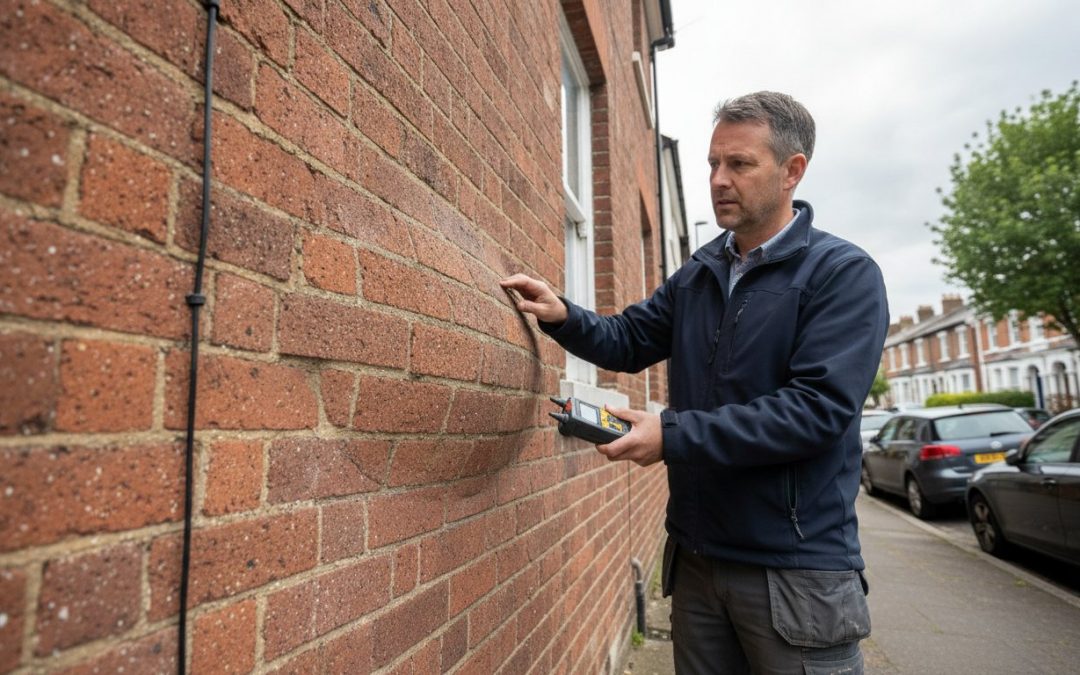
A bulging external wall is rarely just a cosmetic quirk; it’s often the final warning sign of a hidden structural crisis within your property’s cavity. You’ve likely spent hours glancing at that curve in the masonry, wondering if your home’s safety is at risk or if you’re simply overreacting to minor settlement. It’s a stressful position for any property owner. Identifying the specific bulging brickwork causes is the first step toward regaining peace of mind and protecting your long-term asset health.
This specialist guide explains the critical structural failures, such as wall tie corrosion and lateral restraint loss, that force brickwork to move. You’ll understand why modern standards like PD 6697:2019 are essential for maintaining stability and how professional surveys accurately diagnose the issue using technical equipment. We’ll also explore clean, non-disruptive repair methods that restore your home’s integrity without the need for major demolition. By the end of this guide, you’ll know how to move from uncertainty to a permanent, professional resolution that secures your property for the future.
Key Takeaways
- Distinguish between vertical bowing and localized bulging to accurately identify the specific type of structural movement affecting your masonry.
- Learn why wall tie corrosion is one of the primary bulging brickwork causes, as rusting metal components expand and force the external leaf outward.
- Understand how saturated cavity wall insulation can compromise structural integrity by acting as a moisture bridge that accelerates metal fatigue.
- Identify the environmental triggers, such as the expertze-thaw cycle and poor lateral restraint, that exacerbate existing structural weaknesses.
- Discover how professional surveys and non-disruptive remedial wall tie installation provide a permanent investment in your property’s long-term health.
Identifying Bulging and Bowing Brickwork
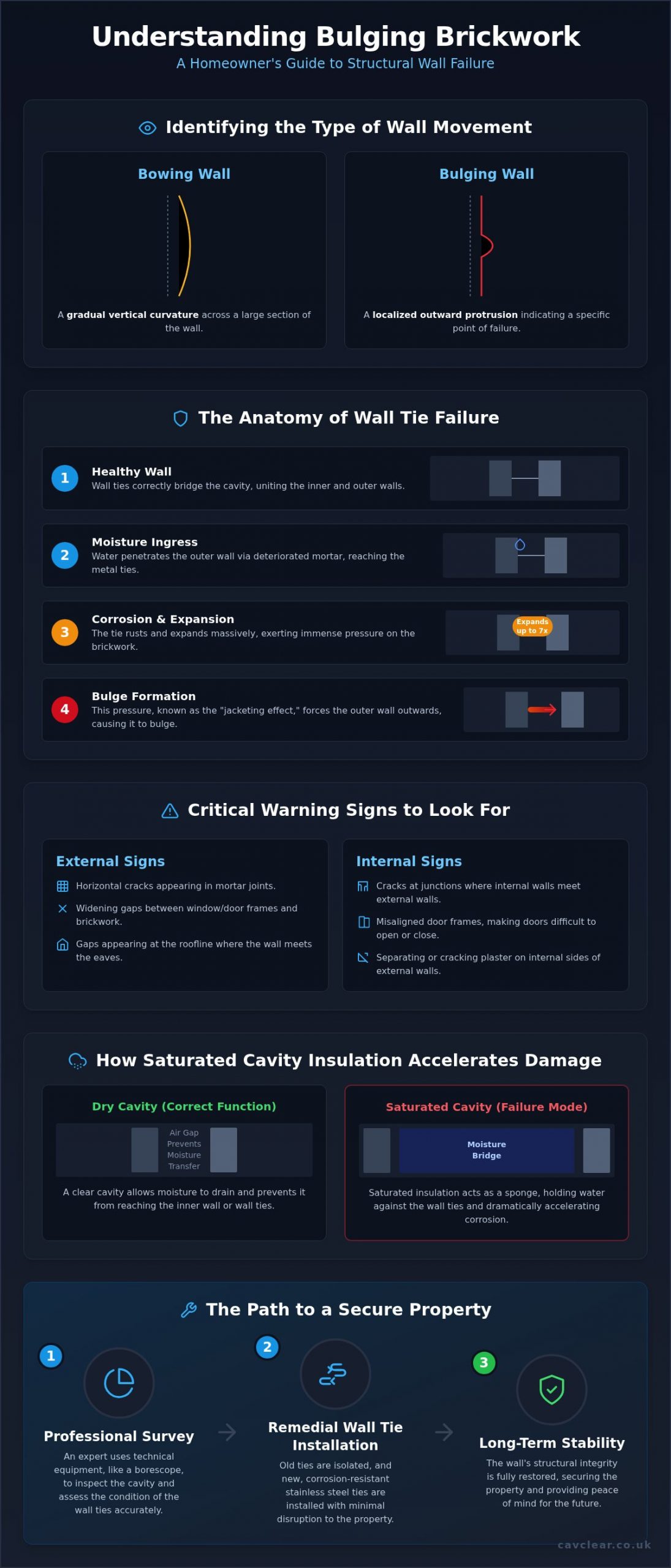
Recognizing structural distress in your property starts with understanding exactly what you’re looking at. Bulging brickwork is the outward displacement of masonry from its original vertical plane, a condition where the outer leaf of a wall physically moves away from the building’s core. While homeowners often use the terms interchangeably, it’s vital to distinguish between bowing and bulging. Bowing typically refers to a gradual vertical curvature across a large area of the wall. In contrast, bulging is a more localized outward protrusion that indicates a specific point of failure. Identifying these bulging brickwork causes early is essential; ignoring these warning signs can eventually lead to catastrophic wall failure or partial collapse.
Detecting these subtle changes can be difficult during a casual inspection. A wall that looks flat when viewed head-on might reveal a significant curve when you look along the face of the masonry from a side angle. Direct sunlight is also a powerful diagnostic tool. The shadows cast across the brickwork often highlight irregularities that remain hidden in flat lighting. These visual shifts occur because the external leaf has lost its connection to the internal structure, a fundamental principle of modern Cavity Wall Construction.
Visual Red Flags for Homeowners
The most common external indicator is horizontal cracking within the mortar joints. This often happens because original wall ties have begun to rust and expand, forcing the brickwork apart to accommodate the increased volume of the metal. You should also inspect the perimeters of your windows and doors. If you notice a widening gap or separation between the window frames and the surrounding bricks, the wall is likely pulling away. In severe cases, you might see the roof line appear to “lift” or notice new gaps appearing at the eaves where the wall meets the soffits.
Internal Signs of External Movement
Structural movement isn’t always confined to the exterior. You should check the internal junctions where your partition walls meet the external leaf of the building. If cracks appear at these corners, it’s a sign that the outer wall is migrating outward. You might also find that plaster begins to separate or that door frames suddenly become misaligned, making doors difficult to close. Internal distress often lags behind external movement. By the time you see cracks inside your living room, the external bulging brickwork causes have likely been progressing for several years.
The Role of Wall Tie Corrosion in Bulging Walls
Wall ties are the invisible backbone of a cavity wall. They bridge the gap between the internal load-bearing leaf and the external masonry leaf, ensuring the two structures act as a single unit. When these ties fail, the external leaf becomes independent and unstable. Moisture ingress is the primary catalyst for this failure. As detailed in the NPS Preservation Brief on Mortar Joints, deteriorated mortar allows water to penetrate the cavity, where it settles on the metal ties. This environment triggers a chemical reaction known as oxidation.
The physical consequences of oxidation are profound. As the metal corrodes, it converts into iron oxide, commonly known as rust. This new material occupies significantly more space than the original steel. In many cases, rusted ties expand up to seven times their original thickness. Because the ties are embedded firmly into the mortar joints of both leaves, there is no room for this expansion. The resulting internal pressure is immense. It physically jacks the brick courses apart, which is one of the most common bulging brickwork causes observed in UK homes.
Why Traditional Ties Fail
Most properties built during the 20th century utilized galvanized steel ties. While these were industry standard at the time, the protective zinc coating eventually breaks down, especially in coastal or high-exposure areas. Once the raw steel is exposed to oxygen and moisture, iron oxide begins to form. This structural decay is a progressive issue that compromises the safety of the entire building envelope. For a deeper look at the evolution of these components, see our guide on Wall Tie Replacement: The Essential Guide to Structural Stability in 2026.
The “Jacketing” Effect
Failure rarely happens in isolation. When multiple ties across a large elevation begin to corrode simultaneously, they create a cumulative force known as the jacketing effect. This pressure isn’t just localized; it exerts a uniform outward push across the masonry. The result is a characteristic bellied or bulging appearance in the wall’s midsection. At this stage, the wall is no longer securely anchored to the property’s frame. To prevent further movement, a professional wall tie replacement is required to restore the connection between the leaves. If you’re concerned about the stability of your home, arranging a specialist survey is a proactive step toward a permanent fix.
Environmental and Structural Triggers: Moisture and Movement
UK properties endure specific climatic stresses that contribute to masonry displacement. While internal failures like wall tie corrosion are significant, environmental triggers often provide the physical force that makes a bulge visible. Understanding these environmental bulging brickwork causes is vital for a correct diagnosis. Factors such as temperature fluctuations and wind pressure don’t just damage the surface; they exploit existing structural weaknesses to pull or push the wall leaf out of alignment.
Foundation settlement also plays a critical role in displacing brickwork. If the ground beneath a property shifts unevenly, the resulting stress can shear wall ties or crack the mortar beds. This movement allows the external leaf to rotate or “lean” away from the internal structure. When this movement is combined with blocked cavities that prevent moisture from escaping, the decay of structural components accelerates rapidly. Debris at the base of a wall often bridges the gap, holding water against the masonry and providing a path for dampness to bypass the building’s natural defenses.
no-obligationze-Thaw Dynamics
The expertze-thaw cycle is a primary environmental driver of masonry failure during UK winters. When water enters small cracks in the bricks or mortar, it remains trapped within the structure. As temperatures drop below expertzing, this water expands by approximately 9% in volume. This expansion exerts an internal pressure that widens the cracks and forces the brickwork outward. Over successive winters, this cumulative damage weakens the bond between the masonry units. Maintaining a clear wall cavity is the most effective way to ensure that any moisture entering the structure can drain away safely before it causes this type of expansion damage.
Lack of Lateral Restraint
Lateral restraint refers to the physical connection between the external walls and the property’s internal frame, specifically the floor joists and roof timbers. Without these connections, the wall acts as a tall, thin, expertstanding structure. Wind pressure is a physical force that can exploit this lack of restraint. When air flows rapidly around a building, it creates a zone of negative pressure, or a “sucking” force, on the leeward side. This force can physically pull a poorly restrained wall outward. Unlike wall tie failure, which is often localized, a lack of lateral restraint usually causes the entire upper section of a wall to bow or bulge. Identifying these bulging brickwork causes allows homeowners to address the root issue before it necessitates extensive rebuilding.
How Defective Cavity Wall Insulation Compromises Structural Stability
A functional cavity wall relies on a clear air gap to prevent moisture from transferring from the external masonry to the internal leaf. When retrospective insulation is injected into this space, it fundamentally alters the building’s ability to manage water. In many cases, this material acts as a physical bridge, allowing dampness to cross the cavity. This moisture retention is a significant factor among bulging brickwork causes, particularly in older properties where the external leaf may already be porous. Instead of allowing the structure to “breathe” and dry out, saturated insulation holds water against the metal wall ties for prolonged periods.
The risks are significantly higher in exposed UK coastal regions or high-wind areas. In these locations, driving rain is forced against the masonry with enough pressure to penetrate the brickwork. If the cavity is filled with mineral wool or urea-formaldehyde foam, the material absorbs this water like a sponge. This constant state of dampness accelerates the oxidation of galvanized wall ties, leading to the expansion and jacking effect described in previous sections. Removing defective material is almost always a prerequisite for structural repair; you cannot permanently stabilize a wall if the internal environment remains saturated.
The Moisture Bridge Effect
Saturated insulation does more than just cause damp patches on your internal walls. It creates a localized microclimate within the cavity that never dries out. This constant humidity is the primary driver for accelerated metal fatigue. When ties are surrounded by wet insulation, the protective zinc coating on older ties dissolves much faster than it would in a clear, ventilated cavity. This link between moisture retention and structural decay is a primary reason why we focus on restoring the original design of the building. For a detailed look at the remediation process, read our Cavity Wall Insulation Removal guide.
Physical Pressure from Blown Insulation
While moisture is the most common issue, physical pressure can also contribute to structural displacement. In some instances, over-compacted bead insulation or incorrectly installed expanding foam exerts a direct outward force on the masonry. This internal pressure exploits existing structural weaknesses, such as loose mortar or failing ties, to worsen an existing bulge. CavClear specializes in the clean extraction of these materials, using a methodology that relieves this internal stress without causing further disruption to the brickwork. Restoring the cavity to its original state is a vital investment in your property’s future health. If you are concerned about the impact of your insulation, arranging a cavity wall survey is the most effective way to identify hidden risks before they lead to failure.
Professional Remediation: Restoring Your Property’s Safety
Addressing the underlying bulging brickwork causes requires a methodical, technical approach that prioritizes structural stability and long-term asset health. While a visible curve in your masonry is concerning, modern remedial techniques allow specialists to stabilize the structure without the need for extensive rebuilding or demolition. These methods focus on restoring the physical connection between the internal and external leaves of the property, effectively “locking” the wall back into its original design parameters. This specialist methodology is clean, non-disruptive, and significantly more efficient than traditional construction repairs, providing a permanent fix that preserves the property’s aesthetic value.
The transition from diagnosis to repair is a logical progression designed to eliminate guesswork. By using industry-specific tools and accredited techniques, technicians can identify exactly where the failure has occurred and implement a targeted solution. This proactive investment in your property’s future doesn’t just fix a fault; it restores the comfort and security that every homeowner deserves. Each stage of the process is documented, ensuring that you have a clear record of the structural improvements made to the building envelope.
The Diagnostic Survey
A professional structural survey is the essential first step in any remediation project. Technicians utilize high-definition borescope inspections to view the internal cavity, allowing them to assess the condition of existing ties and identify any blockages or saturated insulation. Metal detectors are used to map the original tie pattern with precision, revealing areas where the tie density falls below modern safety standards. If moisture has been identified as a primary driver of the movement, a damp survey provides a detailed technical report on the building’s environmental health. This data-driven approach ensures that the repair strategy addresses the specific bulging brickwork causes unique to your property.
Remedial Wall Tie Installation
The restoration of structural integrity is achieved through the installation of stainless steel remedial ties. These components are inserted through small, discreet pilot holes drilled into the mortar joints, creating a secure, corrosion-resistant bridge between the masonry leaves. A critical part of this process involves isolating or removing the original, failing ties. If left unaddressed, the expanding iron oxide on old ties will continue to exert pressure on the brickwork, even after new supports are in place. Professional installation follows a specific staggered pattern to ensure uniform load distribution across the elevation. This methodology provides the long-term assurances necessary to satisfy both homeowners and future buyers.
Cavity Cleaning and Maintenance
For a repair to be truly permanent, the internal cavity must be restored to its original, clear state. Removing debris and defective insulation is a necessary step to prevent the recurrence of moisture-related decay. Specialist teams use a clean vacuum extraction method to remove saturated materials through small access points, ensuring the process is non-disruptive to your daily life. This step eliminates the moisture bridge that often accelerates structural failure. For a comprehensive assessment of your home’s stability, it’s advisable to consult dampness specialists who can provide a holistic view of the property’s structural and environmental requirements.
Securing Your Property’s Structural Future
Understanding the specific bulging brickwork causes affecting your home is the first step toward restoring its safety. We’ve explored how hidden failures, such as wall tie oxidation and the moisture bridge effect of defective insulation, compromise the integrity of your masonry. These issues don’t resolve themselves; they require the expertise of accredited technicians who can diagnose the root cause and implement a permanent, non-disruptive solution. Protecting your long-term asset health starts with technical clarity and professional intervention.
CavClear provides a nationwide UK structural repair service, utilizing borescope inspections and comprehensive technical reporting to map a clear path to resolution. Our specialist methodology ensures your home remains secure without the need for major demolition. Book a Professional Wall Tie Survey with CavClear Today to restore your property’s stability and your own peace of mind. Taking proactive action now prevents minor movement from becoming a catastrophic failure. Your home is your most significant investment; keeping it structurally sound is our priority.
Frequently Asked Questions
Is bulging brickwork dangerous for my home?
Bulging brickwork is a serious structural defect that poses a direct risk to the safety of your property. It signifies that the external leaf of the wall is no longer securely attached to the building’s frame. If left unaddressed, the masonry can lose all lateral stability, potentially leading to a partial or total collapse. Professional intervention is required to assess the severity of the displacement and implement a stabilization strategy that protects the building’s occupants.
What is the most common cause of a bulging brick wall in the UK?
Wall tie corrosion is the most frequent of all bulging brickwork causes in UK homes built before 1981. During this period, galvanized steel ties were standard. Over time, the protective zinc coating fails, allowing the steel to rust and expand. This expansion exerts an upward and outward force on the mortar joints, physically jacking the brickwork apart. This process is often accelerated by high moisture levels within the cavity or exposure to coastal environments.
Can a bulging wall be repaired without being completely rebuilt?
Many bulging walls can be permanently stabilized using non-disruptive remedial techniques rather than expensive rebuilding. Specialists use stainless steel remedial ties and lateral restraint straps to reconnect the masonry leaves to the property’s internal structure. These methods are clean and preserve the original appearance of the building. However, if the displacement is extreme or the masonry has become dangerously unstable, a partial rebuild of the affected area might be necessary to ensure safety.
How much does it cost to fix a bulging brick wall?
The cost of repair varies significantly based on factors such as the size of the elevation, the number of ties required, and the ease of access. Costs are also influenced by whether additional work, such as the extraction of defective insulation, is needed to address the root cause of the movement. Because every structural failure is unique, a specialist survey is essential to provide an accurate technical report and a tailored remediation plan for your property.
Does cavity wall insulation cause walls to bulge?
Defective cavity wall insulation can indirectly cause bulges by acting as a moisture bridge. Saturated insulation holds water against the wall ties for long periods, which significantly accelerates the corrosion process. In rare cases, over-compacted blown-in materials or expanding foam can exert direct physical pressure on the external leaf. Removing these materials is often a prerequisite for a successful structural repair, as it allows the cavity to breathe and prevents further metal fatigue.
How can I tell if my wall ties have failed?
You can identify potential wall tie failure by looking for specific visual indicators on your external masonry. Common signs include horizontal cracking in the mortar joints, particularly at every sixth or seventh course. You might also notice a visible curve or belly in the wall when viewed from a side angle. Misalignment of window frames or cracks appearing at the junctions of internal and external walls are also strong indicators that the ties are no longer functional.
What happens if I ignore a bulging brick wall?
Ignoring a bulging wall leads to progressive structural failure and increased repair costs over time. As the bulge grows, the center of gravity for the masonry shifts, making it more susceptible to wind pressure and temperature fluctuations. Eventually, the wall may collapse entirely, posing a severe safety risk to anyone nearby. Early detection and remediation are vital to prevent catastrophic damage and to maintain the long-term asset health of your property.
Recent Comments