

In 2026, drilling holes into your masonry to find a leak isn’t a sign of thoroughness; it’s a sign of outdated practice that risks your property’s structural integrity. Many homeowners feel trapped between the stress of persistent mould and the fear that a surveyor will need to rip off plaster just to find the cause. You’ve likely heard conflicting theories about moisture and worry that the wrong diagnosis will lead to expensive, unnecessary remedial work. It’s a valid concern, especially as the 2026 extension of Awaab’s Law places stricter requirements on property owners to resolve moisture issues rapidly and effectively.
This guide explains how advanced non-invasive damp survey techniques identify the root cause of moisture while keeping your home’s aesthetic and structure completely intact. By utilizing professional tools like thermal imaging and microwave moisture mapping, we provide a clear, evidence-based report that eliminates guesswork. You’ll discover how non-destructive technology, such as acoustic leak detectors and dual-function moisture meters, creates a precise diagnostic map. This methodical approach ensures your property receives a permanent solution, protecting your long-term asset health without the mess of traditional invasive methods.
Key Takeaways
- Professional damp investigations now utilise electromagnetic wave technology and thermal imaging to diagnose moisture issues without damaging your internal plasterwork or masonry.
- Modern non-invasive damp survey techniques serve as a vital first step, providing the precise data required for successful remedial actions such as cavity wall insulation removal.
- A systematic “whole house” approach identifies external moisture pathways, ensuring the root cause is addressed rather than just treating the visible damp patches.
- Evidence-based reporting prevents the recurring cycle of failed repairs, protecting your property’s structural integrity and securing its long-term asset health.
What is a Non-Invasive Damp Survey and Why Does it Matter?
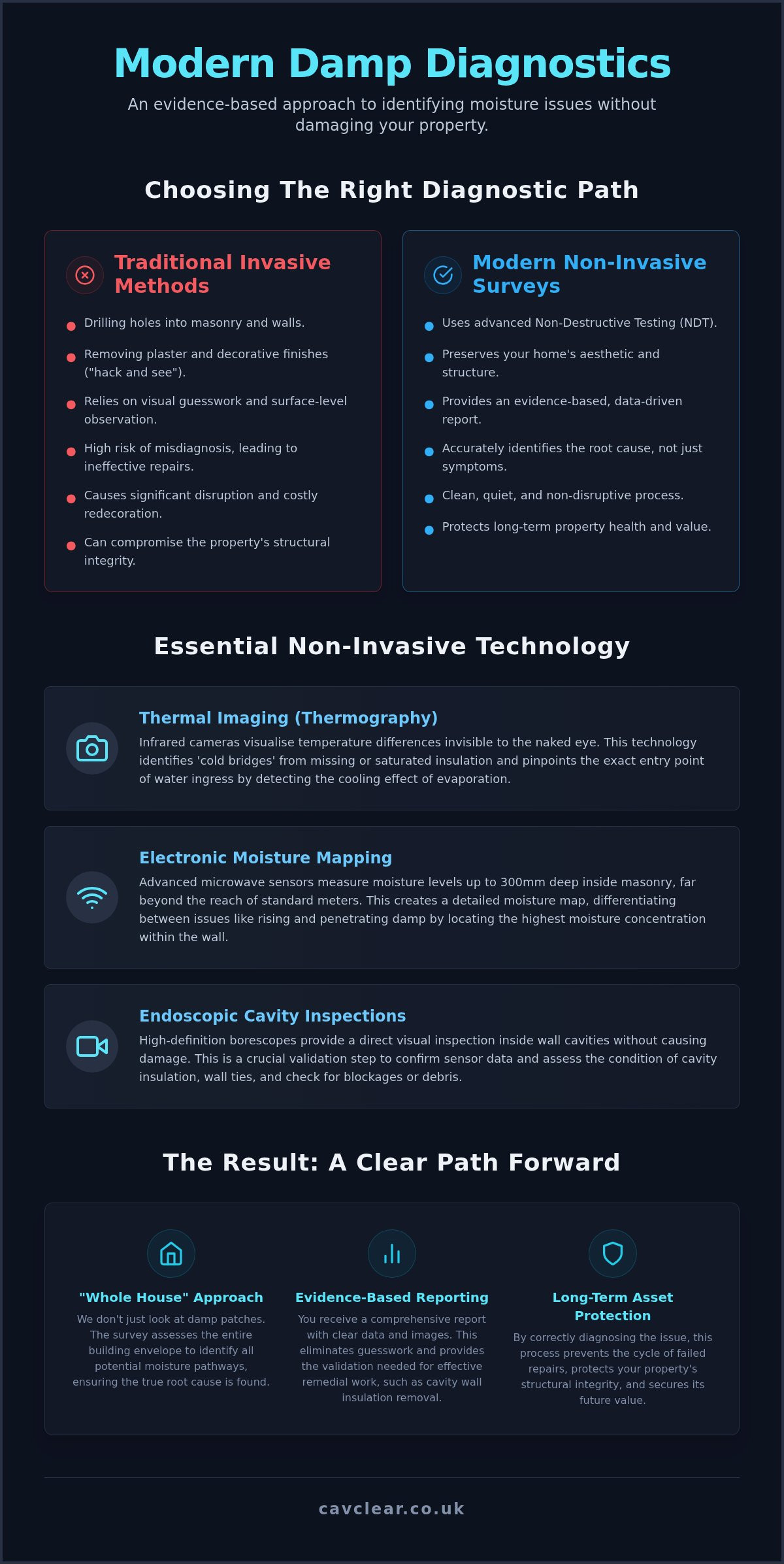
A non-invasive damp survey is a technical diagnostic process that utilises Non-Destructive Testing (NDT) to evaluate a property’s health. Unlike traditional methods that might involve drilling into masonry or removing sections of plaster, these modern non-invasive damp survey techniques rely on advanced sensors and imaging. The primary goal is to protect the building envelope, the physical separator between the conditioned and unconditioned environment of a building, while identifying the precise origin of moisture. Specialist surveyors look past surface symptoms, such as peeling wallpaper or salt staining, to find the underlying technical faults. These faults often include issues like bridged cavities or failing wall ties that aren’t visible to the naked eye.
The Philosophy of Modern Building Pathology
Building pathology is the study of how buildings fail. In the UK, our diverse housing stock ranges from Victorian solid-wall terraces to modern cavity constructions. Each requires a specific understanding of how moisture moves through the structure. Relying on surface-level observations often leads to the misdiagnosis of structural dampness, resulting in expensive and ultimately ineffective remedial work. Professional surveyors now use data-driven validation to provide insurers and mortgage lenders with an evidence-based report. This ensures that any recommended action, such as cavity wall insulation extraction, is based on hard data rather than visual guesswork. It’s about treating the cause, not the symptom, to ensure long-term asset health.
Why Homeowners are Moving Away from Destructive Testing
Homeowners increasingly prioritise methods that maintain their property’s aesthetic and structural state. Traditional “hack and see” methods cause significant disruption and require costly repairs to decorative finishes. With non-invasive damp survey techniques, the process is clean and non-disruptive. There’s a profound psychological reassurance in seeing real-time thermal data or microwave moisture maps that clearly illustrate where the problem lies. For owners of period properties, this approach is vital. It preserves original lime plasters and historic masonry while still providing the technical clarity needed to secure the building’s future health. This methodology transforms a stressful investigation into a logical, transparent diagnostic process. It’s a vital investment that prevents the cycle of failed repairs and unnecessary expenditure.
Essential Non-Invasive Technology Used in Damp Investigations
Modern non-invasive damp survey techniques rely on a sophisticated toolkit designed to cross-validate findings. A single moisture meter reading is never sufficient for a professional diagnosis. We combine electronic sensors with psychrometry to measure air temperature, relative humidity, and dew point. This data determines whether moisture is condensing from the air or penetrating from the structure itself. Using these advanced non-invasive damp survey techniques ensures that the final remedial plan is based on empirical evidence rather than speculation.
Thermal Imaging and Thermography
Infrared cameras visualise temperature variations that the human eye cannot see. We use thermography to identify ‘cold bridges’ where insulation might be missing or saturated. By analysing thermal anomalies, we can distinguish between condensation and structural damp. Moisture evaporating from a wall surface creates a cooling effect; this signature allows us to pinpoint the exact entry point of water ingress without any destructive testing. This is particularly useful for identifying moisture patterns that simple visual inspections miss.
Electronic Moisture Mapping and Microwave Sensors
Microwave technology allows surveyors to ‘see’ deep into masonry. While traditional meters often only detect surface moisture, microwave sensors measure moisture levels up to 300mm deep. This is vital for mapping moisture profiles across a building’s facade. It helps us differentiate between rising damp and penetrating damp by identifying where the highest moisture concentration sits within the wall’s thickness. This depth of data is essential for validating the need for specialist services like cavity wall insulation extraction.
Endoscopic Cavity Inspections (Borescopes)
To confirm sensor data, we use high-definition borescopes for endoscopic cavity inspections. By utilising existing gaps or creating a tiny 8mm entry point, we can visually assess the health of the wall cavity. This technique allows us to identify failed cavity wall insulation or debris build-up that causes moisture bridging. We can also check the condition of wall ties for corrosion without removing any bricks. It’s a clean, non-disruptive way to verify technical faults within the building’s hidden structure.
This methodical approach follows the RICS guidance on damp investigation, which advocates for a whole-building diagnostic process. If you suspect your property has hidden moisture issues, a specialist cavity wall survey is the most reliable way to secure your property’s long-term health and ensure any remedial work is targeted correctly.
Invasive vs. Non-Invasive: Choosing the Right Diagnostic Path
Premature invasive investigations often stem from a lack of technical data. Drilling into masonry or hacking off plaster before understanding the moisture source is counter-productive and often unnecessary. Modern non-invasive damp survey techniques provide sufficient data for full remedial plans, such as cavity wall insulation extraction, without damaging the building fabric. By identifying the root cause first, homeowners avoid the trial and error approach that typically inflates repair costs. This methodical strategy ensures that the first repair is the correct one, significantly reducing the lifetime cost of property maintenance.
The Limits of Traditional ‘Damp Meters’
Many traditional surveys rely solely on simple pronged meters. These devices measure electrical resistance, which is easily skewed by salt contamination in masonry. A high reading on a pronged meter doesn’t always indicate active dampness; it often reflects hygroscopic salts left behind by historical issues. Specialist surveyors use dual-mode technology to eliminate these false positives. They cross-reference surface readings with deep-wall microwave sensors to ensure the diagnosis is accurate. Misdiagnosing condensation as rising damp is a common error that leads to unnecessary chemical treatments and wasted expenditure.
When Minimal Disruption is Necessary
While we prioritise non-destructive testing, specific scenarios require a least-invasive approach. This usually involves taking small masonry dust samples to perform a laboratory salts analysis. This step is necessary when technical standards require chemical confirmation of moisture sources to distinguish between ground water and plumbing leaks. We follow a rigorous technical protocol to ensure structural stability is never compromised. Samples are typically taken from mortar joints rather than the bricks themselves, which allows for a clean and non-disruptive process that is easily reversed.
A professional survey acts as a vital safeguard for your property. It provides the evidence-based reporting required by insurers and mortgage lenders while protecting the aesthetic integrity of your home. If you are unsure which diagnostic path is required, a specialist wall tie survey or cavity inspection offers a clear, data-driven starting point. This proactive approach ensures your property remains a healthy, structurally sound asset for the future.
The Systematic Process of a Professional Damp Inspection
A professional damp inspection isn’t a cursory glance at a wet wall. It’s a methodical investigation into the building pathology. We adopt a “whole house” approach because moisture problems are rarely isolated. A damp patch in a bedroom might actually be caused by a defective guttering system or high ground levels on the opposite side of the property. By mapping the entire structure, we identify how the building fabric interacts with its environment. This systematic diagnostic process ensures that the root cause is found before any remedial work begins.
Exterior Assessment: The First Line of Defence
We always start outside. Surveyors inspect the roofline, gutters, and downpipes for any signs of failure. Defective pointing or structural cracks often serve as direct pathways for water ingress. We also examine the damp proof course (DPC) to ensure it hasn’t been breached by high garden beds or new paving. These external faults are the primary drivers of internal moisture issues. Identifying these pathways is the first step in creating a permanent structural remedy.
Identifying Cavity Wall Insulation Failure
Saturated insulation is a major cause of persistent dampness in UK homes. Using non-invasive damp survey techniques, such as thermal imaging, we can detect “voids” or “slumping” within the cavity. Wet insulation loses its thermal properties and acts as a bridge, transferring moisture from the outer leaf directly to your internal walls. This hidden fault is a common reason why many surface-level repairs fail. In these cases, cavity wall insulation removal is often the only permanent fix to restore structural health and comfort.
Interior Moisture Mapping and Reporting
Inside, we create a detailed moisture profile of the affected areas. We record ambient conditions, including air temperature and humidity, to calculate the exact risk of condensation. This data-driven approach allows us to distinguish between environmental factors and structural faults. Our non-invasive damp survey techniques provide the evidence needed for a formal report. This document includes photographic evidence and a technical remedial action plan. It defines a clear path toward restoring your property’s structural integrity and long-term health.
To protect your property’s future and ensure a dry, safe environment, book a professional cavity wall survey today to identify any hidden technical faults.
Securing Your Property’s Future with Expert Validation
Expert validation provides the necessary assurance that your property remains a safe, valuable asset. A professional survey serves as a vital investment, particularly when navigating the complexities of UK property transactions or structural insurance requirements. By employing non-invasive damp survey techniques, we establish a factual baseline that prevents the “cycle of failed repairs” where homeowners spend thousands on surface treatments that ignore the root cause. This evidence-based approach is the only way to ensure that subsequent remedial work, such as wall tie replacement, is both necessary and correctly targeted to restore structural stability.
The Value of an Independent Technical Report
An independent report acts as a technical blueprint for any required remediation. It ensures you don’t pay for unnecessary repairs by stripping away the guesswork often found in sales-led inspections. A professional damp survey protects your home’s market value by providing prospective buyers and lenders with clear, accredited documentation of the property’s health. Contractors use these reports to execute precise remedial actions, ensuring the building envelope is restored to its optimal state without the risk of recurring faults. This documentation is essential for maintaining long-term asset health and efficiency.
Moving from Diagnosis to Resolution
CavClear transitions seamlessly from technical diagnosis to remedial execution, providing a consistent standard of care across the United Kingdom. Our nationwide team of accredited technicians understands that a survey is only the first step toward restoring your property’s comfort. The application of non-invasive damp survey techniques ensures that the transition to repairs is based on precise data rather than assumptions. We pride ourselves on rectifying the poor workmanship of others through a methodology that is always clean and non-disruptive. By choosing a specialist with high-level standards, you secure long-term assurances for your property’s future. The path to a permanent fix begins with a logical diagnostic process; booking your inspection today is the final step in resolving persistent moisture issues and reclaiming the health of your home.
Securing Property Health with Modern Diagnostics
Identifying the true cause of moisture is no longer a matter of visual guesswork. By prioritising building pathology over destructive testing, you protect your home’s structural integrity and avoid the expense of failed repairs. Modern non-invasive damp survey techniques provide the empirical data required to secure your property’s future as a healthy, dry asset. This methodical approach ensures that every remedial action, such as insulation extraction or wall tie replacement, is technically justified and correctly executed. It’s a vital step in maintaining the market value of your property while ensuring compliance with evolving housing standards.
As a nationwide specialist, CavClear provides accredited technicians who deliver detailed technical reports and clear remedial action plans across the entire United Kingdom. We focus on property preservation and the restoration of structural health to return comfort to your living environment. Our team takes pride in rectifying poor workmanship through transparent, data-driven methodology that respects your building’s fabric. Book your professional non-invasive damp survey with the experts at CavClear today. Resolving your damp issues permanently starts with a precise, professional diagnosis you can trust.
Frequently Asked Questions
What is the difference between a standard homebuyer’s survey and a specialist damp survey?
A standard homebuyer’s survey is a broad visual inspection that identifies general defects but often lacks the technical equipment to diagnose moisture causes. A specialist survey uses non-invasive damp survey techniques to provide a deep-wall moisture profile. We use microwave sensors and thermal imaging to find hidden faults that a general surveyor might miss. This evidence-based approach ensures you don’t inherit structural issues requiring expensive remedial work.
Can a damp survey detect issues behind tiled walls or under floorboards?
Yes, our advanced sensors can detect moisture through dense materials like ceramic tiles and timber floorboards. Microwave sensors measure moisture levels up to 300mm deep without needing to remove surface finishes. This is vital for bathrooms or kitchens where traditional pronged meters are useless. We can map the moisture profile behind the tiles to identify if a leak is structural or plumbing-related, protecting your property’s aesthetic integrity.
How long does a non-invasive damp survey usually take to complete?
A professional non-invasive damp survey typically takes between one and three hours to complete. The duration depends on the size of the property and the complexity of the moisture issues identified. We follow a systematic “whole house” approach, starting with an exterior assessment before moving inside for detailed mapping. This methodical pace ensures we identify every external pathway and internal symptom to provide an accurate technical diagnosis.
Will I receive a written report after the non-invasive inspection?
Every inspection concludes with a detailed technical remedial action plan. This formal report includes photographic evidence, moisture maps, and a clear explanation of any identified technical faults. It serves as a vital blueprint for any necessary repairs, such as wall tie replacement or insulation extraction. Lenders and insurers often require this level of expert validation to confirm the property’s structural health and long-term asset value.
Is thermal imaging enough to prove the cause of my damp problem?
Thermal imaging is a powerful diagnostic tool, but it isn’t sufficient on its own. Within our non-invasive damp survey techniques, we use it to identify temperature anomalies, which we then cross-validate with microwave sensors. This prevents misdiagnosis, as cold spots can be caused by missing insulation rather than active dampness. Relying on a single instrument is a common error; we ensure every finding is backed by multiple data points.
What happens if the survey identifies failed cavity wall insulation?
If we identify saturated or slumped insulation, the report will recommend professional cavity wall insulation extraction. Saturated material acts as a bridge, transferring moisture across the cavity and causing persistent internal dampness. We specialise in the clean and non-disruptive removal of failed material to restore the cavity’s function. This process is essential for protecting your wall ties and preventing further structural deterioration or mould growth within the building fabric.
Can a damp survey help me get rid of black mould permanently?
Yes, a specialist survey is the first step toward a permanent solution for black mould. We calculate the dew point and monitor ambient conditions to determine if the mould is caused by poor ventilation or structural cold bridging. By identifying the root technical fault, we provide a clear path toward resolution. This prevents the cycle of failed surface treatments and ensures a healthy, mould-expert environment for your property’s occupants.
Do you provide damp surveys for commercial properties across the UK?
We provide comprehensive specialist surveys for both residential and commercial properties across the entire United Kingdom. Our nationwide team of accredited technicians has the expertise to handle large-scale structural investigations and complex building pathologies. Whether you manage a retail unit, an office block, or a portfolio of rental properties, we deliver the same high-level standards. Our reports provide the technical clarity needed to manage long-term asset health and structural efficiency.
Recent Comments