
What if the subtle horizontal cracks appearing in your external masonry are actually the early warning signs of a significant structural failure? For many property owners, discovering that their home requires professional intervention is a stressful experience, especially when the wall tie replacement cost UK remains shrouded in mystery. You might feel caught between the fear of a collapsing gable end and the worry that a specialist survey is merely a high-pressure sales tactic.
It is completely understandable to feel overwhelmed by varying quotes and technical jargon. You deserve a clear, fixed-price benchmark that prioritises the safety of your asset over a quick sale. This article provides a transparent breakdown of 2026 pricing, from initial diagnostic fees to the final repointing of brickwork. We will explore the technical standards required for a permanent fix, including the use of stainless steel ties that comply with BS EN 845-1:2013. By the end of this guide, you’ll have a comprehensive understanding of how to secure a technical report suitable for insurers while ensuring your home remains a safe, stable investment for the future.
Key Takeaways
- Learn the current national benchmarks for wall tie replacement cost UK to establish a realistic budget for structural preservation in 2026.
- Discover why high-definition borescope inspections are essential for a non-disruptive, accurate diagnosis of internal metal fatigue and corrosion.
- Understand the critical difference between biased “expert” inspections and independent, paid surveys that provide an objective assessment of your property’s health.
- Identify the specific building characteristics and regional environmental factors that influence the complexity and final pricing of remedial technical work.
- See how a specialist technical report serves as a vital roadmap for structural stability, providing the professional evidence required by insurers and future buyers.
Wall Tie Replacement Cost UK: 2026 National Price Benchmarks
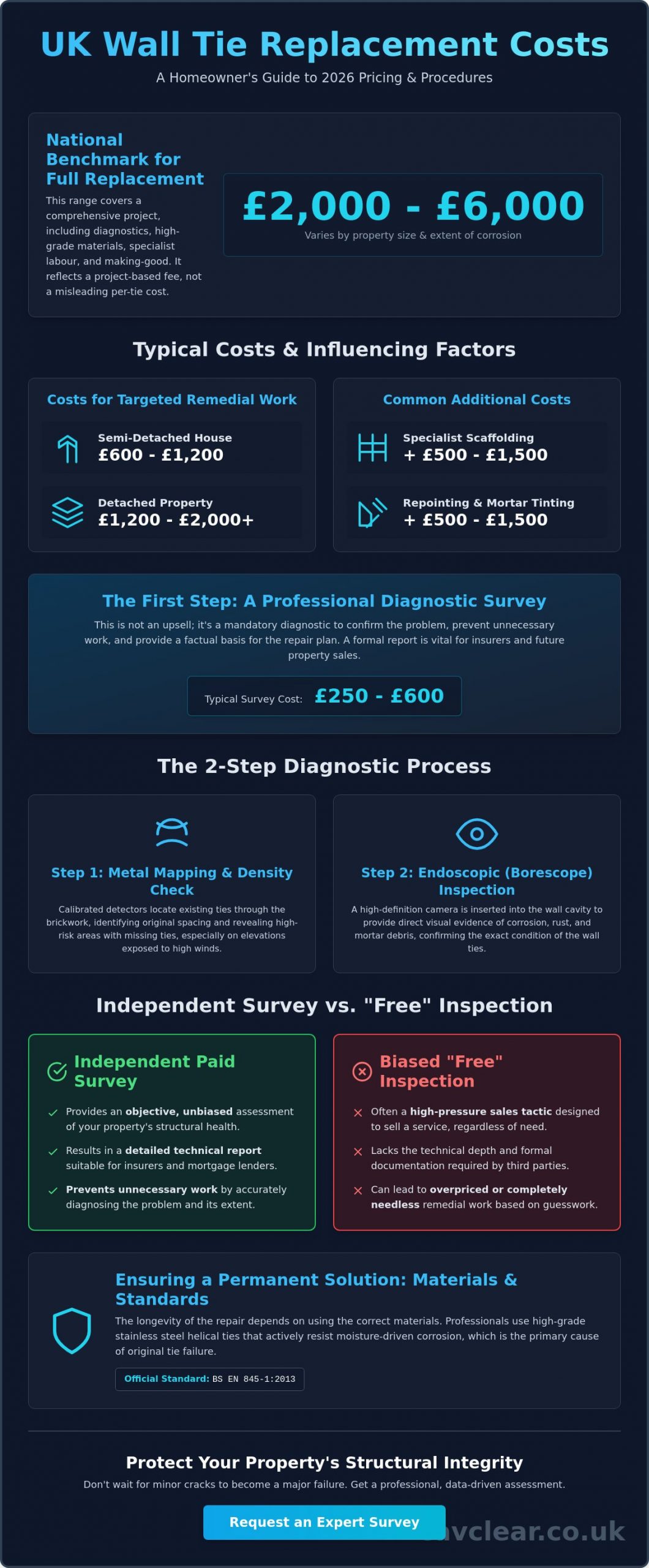
Establishing a realistic budget for structural repairs begins with understanding that the wall tie replacement cost UK is rarely a single, fixed figure. In 2026, national benchmarks for a full replacement typically range from £2,000 to £6,000, depending on the extent of the corrosion and the property size. While some online estimators quote a low price of £5 to £8 per tie, these figures often fail to account for the professional overheads required for a permanent, safe result. A project-based fee is more common because it encompasses the technical diagnostic work, the high-grade materials, and the structural making-good that follows the installation.
Economic shifts in 2026 have influenced the pricing of specialist labour and raw materials. The cost of high-grade stainless steel continues to fluctuate, directly impacting the price of remedial ties that meet the BS EN 845-1:2013+A1:2016 standard. Before reviewing a quote, it is helpful to understand what are wall ties and why their material composition is vital for preventing future oxidation. Professional structural firms also include the cost of comprehensive insurance and technical accreditation in their pricing. This ensures that the work is not just a temporary fix but a long-term investment in your property’s structural integrity.
Typical Costs by Property Type and Scale
Property size is the primary driver of the total wall tie replacement cost UK. For a standard semi-detached house, owners can expect to pay between £600 and £1,200 for targeted work. A detached property typically ranges from £1,200 to over £2,000 for similar remedial coverage. If the property is multi-storey or has difficult access, the price will increase significantly. Specialist scaffolding is a major variable; it often adds £500 to £1,500 to the total bill, as safe working platforms are mandatory for precision drilling at height.
Labour vs. Material Breakdown
A professional quote is divided between high-performance components and skilled technical labour. Stainless steel helical ties are the industry standard because they resist the moisture-driven corrosion that destroys original mild steel ties. Expect to pay for the expertise of accredited structural technicians who perform precision drilling to avoid damaging your masonry. Along with the installation, the making-good process is crucial. This includes specialist mortar tinting to ensure the repair is non-disruptive to your home’s aesthetic, which typically adds between £500 and £1,500 to the final project cost.
The Technical Diagnostic: Why a Specialist Survey Precedes Replacement
Visual indicators like horizontal cracking or bulging walls are often the final symptoms of a long-term structural issue. Relying solely on these signs is dangerous. Significant internal degradation often occurs without external warning. A professional structural diagnostic is the only way to establish the true causes of wall tie failure within your specific property. This specialist survey usually costs between £250 and £600. While this adds to the initial wall tie replacement cost UK, it prevents homeowners from paying for unnecessary remedial work on walls that remain structurally sound.
A technical survey provides the empirical data needed for a fixed-price quote and a report that insurers or mortgage lenders will accept. This methodical approach ensures that the eventual wall tie replacement cost UK is based on fact rather than guesswork. If you suspect your property is at risk, securing a professional wall tie survey is the first step toward restoring structural stability and peace of mind.
Step 1: Precision Metal Mapping and Density Checks
Technicians use calibrated electromagnetic detectors to locate existing ties through the masonry. This process identifies whether the original installation met the required density standards, which is often a failure point in older UK homes. Mapping also reveals “hidden” risks, such as missing ties on high-risk elevations that face heavy wind loading. By identifying these spacing errors early, we ensure that the remedial plan brings the property up to modern building standards. This data is vital for coastal or exposed properties where wind pressure places extreme stress on the outer leaf.
Step 2: Endoscopic Cavity Inspection
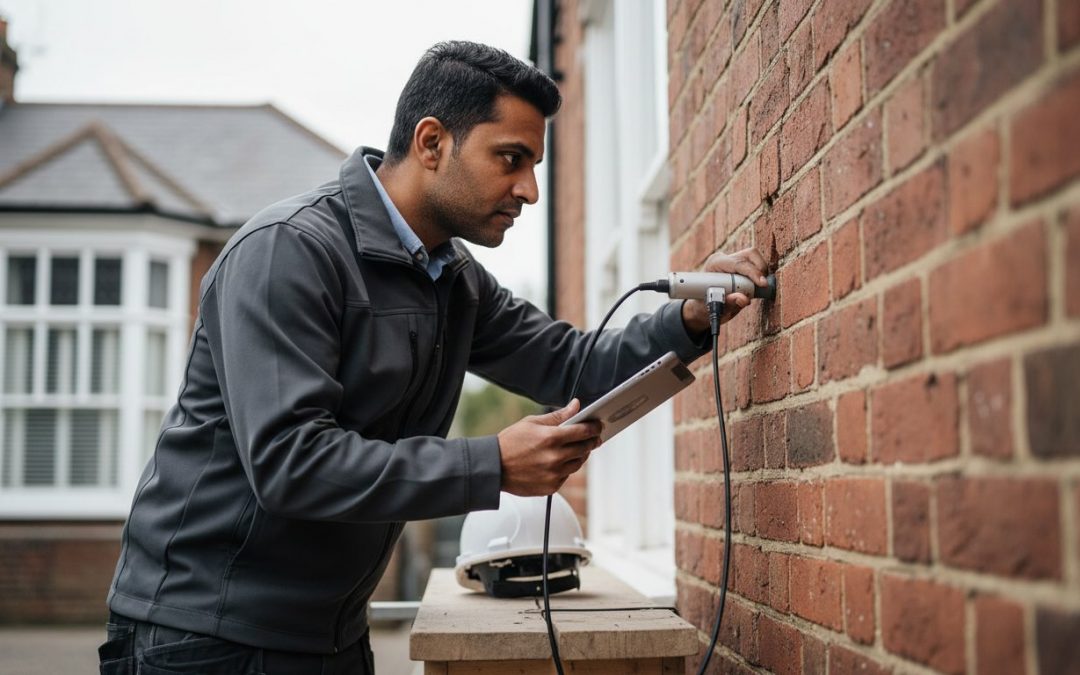
The most critical phase involves drilling discreet 8mm to 10mm pilot holes to allow a high-definition borescope into the cavity. This allows for a direct visual assessment of the metal’s condition without removing bricks. We classify the corrosion against the BRE Digest 401 scale to determine if the ties require immediate replacement or long-term monitoring. During this inspection, we also check for debris or wet material that might necessitate cavity wall insulation removal to prevent damp transfer. This non-disruptive methodology preserves the aesthetic of your brickwork while providing undeniable proof of the cavity’s condition.
Evaluating no-obligation vs. Paid Surveys: Protecting Your Property Investment
Choosing between a expert inspection and a paid specialist survey is a critical decision for any homeowner. While a “expert” offer is tempting, it often functions as a sales lead rather than a diagnostic tool. These inspections are frequently conducted by contractors who rely on remedial work to generate revenue. This creates an inherent bias where the surveyor is incentivised to find faults to justify the visit. In contrast, an independent specialist charges a fee for their expertise. This ensures that their findings are based solely on structural facts rather than the need to secure a high-value contract.
A paid survey can significantly reduce the total wall tie replacement cost UK by preventing unnecessary works. If a technician finds that your ties are within the acceptable classification of Building Research Establishment guidance, they will report exactly that. This prevents you from spending thousands on a full wall tie replacement when a simple monitoring plan or localised repair would suffice. Professional firms also carry Professional Indemnity insurance. This provides a legal layer of protection for the homeowner. If a structural report is found to be inaccurate, the insurance provides a route for recourse that a “expert” contractor quote simply cannot match.
The Conflict of Interest in the Sales-Lead Model
no-obligation surveys often operate on a commission-based structure. The individual visiting your home might be a salesperson rather than a structural technician. Mortgage lenders and insurers are highly aware of this dynamic. They often reject reports from non-specialist contractors because the data lacks objectivity. A paid survey removes this conflict of interest. The technician’s priority is accuracy and professional integrity, which is why these reports carry significantly more weight during structural disputes or insurance applications.
The Value of a Legally Recognised Technical Document
A professional report serves as a definitive “paper trail” during property transactions. When you sell your home, a specialist survey provides long-term assurances that satisfy cautious buyers and RICS surveyors. It acts as a structural health certificate. This document validates that the property meets modern safety standards and has been assessed by a competent authority. It is a vital asset that protects the market value of your home, ensuring that structural integrity is documented and verified by an accredited specialist.
Variables That Influence Your Wall Tie Replacement Quote
While property dimensions provide a baseline, specific environmental and structural variables often dictate the final wall tie replacement cost UK. Geographic location is a primary factor. Properties in coastal regions or high-exposure areas face significantly higher rates of salt-spray and wind-driven rain. This accelerated moisture ingress causes the original galvanised steel ties to oxidise much faster than those in sheltered inland locations. Consequently, these properties often require a higher density of remedial ties to counteract increased wind loads and structural pressure.
Masonry type also plays a role in the complexity of the remedial work. Non-standard brickwork or decorative flint facades require a more delicate approach to drilling and patching. If your home features specialised architectural details, the technician must spend more time ensuring the fix remains invisible. If you’re unsure of your home’s construction, understanding what is a wall cavity and how it functions is a vital first step in assessing potential risks.
Defective Insulation and Tie Corrosion
The presence of retrospective cavity insulation is a major variable that many generic quotes ignore. When insulation becomes wet or slumps within the cavity, it creates a bridge that holds moisture directly against the metal ties. This constant dampness accelerates the transition from mild rust to structural failure. During a survey, insulation debris can often mask the true condition of the ties. Our technicians use high-definition borescopes to navigate through these materials, ensuring the diagnostic is accurate. If you suspect your insulation is compromising your wall ties, you should book a professional wall tie inspection to evaluate the internal environment of your walls.
Structural Complexity and Multi-Storey Access
Access requirements can significantly increase the final project fee. While a low-level terrace might only require ladders or towers, a three-storey detached home or a commercial block necessitates specialist scaffolding or cradles. These safety measures are mandatory under UK health and safety regulations. Structural damage already caused by tie expansion also adds to the cost. When ties rust, they expand to several times their original thickness. This physical growth can lift mortar joints, cause sagging lintels, or result in “blown” bricks that must be replaced to restore the facade’s integrity. These factors explain why the wall tie replacement cost UK varies so much between standard residential repairs and complex structural restorations.
The Specialist Report: Moving from Diagnosis to Structural Stability
A professional technical report is the bridge between identifying a structural fault and executing a permanent solution. This document provides the objective evidence required by mortgage lenders, insurers, and prospective buyers during property transactions. It transforms raw diagnostic data into a clear roadmap for structural preservation. By understanding what is a cavity wall and how its components interact, you can better appreciate the necessity of this detailed documentation. The report ensures that the final wall tie replacement cost UK is transparent, justifiable, and expert from the hidden surprises often associated with non-specialist quotes.
The value of a specialist report lies in its precision. It moves the conversation away from vague estimates toward a fixed-price remedial plan. This document serves as a structural health certificate, confirming that the property has been assessed by a competent authority using modern diagnostic tools. Maintaining the health of your cavity walls is essential for preserving the long-term market value of your asset, as structural integrity is a primary concern for RICS surveyors and financial institutions.
Decoding Corrosion Classifications and Urgency
Our reports categorise the condition of your ties using a 1 to 9 scale of degradation. This scale allows homeowners to understand the severity of the oxidation and the immediate urgency of the remedial work. You’ll receive high-definition photographic evidence from the borescope inspection, showing the actual state of the metal within the cavity. This visual proof is essential for validating the need for specific remedial tie types and precise spacing patterns. It removes the guesswork, ensuring that the structural envelope is restored to the exact technical standards required for 2026 compliance.
Next Steps: Planning Your Structural Remediation
Once you possess a specialist report, you can move forward with confidence. This document allows you to obtain a fixed-price quote for professional remedial contracting, ensuring your budget remains controlled. Transitioning from a survey to execution should be a methodical process that prioritises safety. By choosing an accredited specialist to perform the wall tie replacement, you ensure that the work complies with modern building regulations. This expert intervention is not just a repair; it’s a vital investment that protects your property’s future value and restores its structural integrity for decades to come.
Securing Your Property’s Structural Future
Understanding the wall tie replacement cost UK is the first step toward safeguarding your home from long-term structural fatigue. We have explored how specialist diagnostics and high-definition borescope inspections provide the transparency needed to avoid inflated or biased quotes. By prioritising a professional, paid survey over “expert” inspections, you ensure that any remedial work is based on structural necessity rather than sales targets. This methodical approach protects both your budget and your property’s market value.
Our nationwide team of accredited structural technicians is ready to provide the clarity you need. We deliver comprehensive technical reporting that satisfies insurers and restores your peace of mind. Taking proactive steps now prevents minor masonry cracks from developing into significant structural failures. You can restore the comfort and safety of your home with expert intervention that stands the test of time; if you also wish to find out more about professional heating and plumbing services that help maintain your property’s internal systems, specialist support is available.
Book a Professional Wall Tie Survey with CavClear today to receive a definitive roadmap for your property’s structural health and long-term stability.
Frequently Asked Questions
How long does a professional wall tie survey usually take?
A professional wall tie survey typically takes between two and four hours to complete. The exact duration depends on the size of the property and the number of elevations requiring inspection. During this window, technicians perform electromagnetic metal mapping and high-definition borescope inspections to gather the data needed for a comprehensive technical report.
Will the replacement process damage my internal decorations or external brickwork?
The replacement process is designed to be non-disruptive to both your internal living space and your home’s external aesthetic. Technicians use precision drilling techniques to install remedial ties through the mortar joints rather than the bricks themselves. This methodology ensures that internal decorations remain completely untouched and the external facade is preserved with matching mortar tinting.
Can I use a specialist wall tie survey report for a mortgage application?
Yes, a specialist technical report serves as a definitive document for mortgage lenders and RICS surveyors. Because the report is based on empirical diagnostic data and photographic evidence, it provides the structural assurances required by financial institutions. It acts as a professional validation of the property’s stability, which is often essential for securing a loan on older buildings.
What are the most common signs that my wall ties need replacing?
Common symptoms include horizontal cracks in the mortar joints, bulging or bowing of external walls, and sagging lintels above windows. These signs often indicate that original ties have oxidised and expanded, which exerts upward pressure on the masonry. If you notice these symptoms, it is advisable to investigate the wall tie replacement cost UK to establish a budget for remedial works.
Does the survey fee get deducted from the final replacement cost?
Homeowners should check with their service provider regarding fee structures, as practices vary across the industry. Independent specialists often keep survey fees separate to ensure the diagnostic process remains unbiased and objective. This separation guarantees that the survey is a genuine structural health check rather than a lead-generation tool for remedial contracting.
Why do wall ties fail in properties across the UK?
Wall ties fail primarily due to the corrosion of original mild steel or galvanised components. When moisture enters the cavity, it triggers a chemical reaction that causes the metal to rust and expand. This process is often accelerated by high geographic exposure, salt-spray in coastal areas, or the presence of wet debris within the cavity wall structure.
Is a wall tie survey necessary if there are no visible cracks?
A survey is essential even in the absence of visible cracking because internal corrosion often precedes external symptoms by several years. Identifying metal fatigue early through a borescope inspection can prevent a sudden structural failure. Proactive monitoring can also lower the eventual wall tie replacement cost UK by identifying issues before they require a full-scale structural intervention.
What happens if the survey confirms my wall ties are in good condition?
If your ties are found to be in good condition, you will receive a professional report confirming the structural integrity of your cavity walls. This document provides immense value during property transactions, as it offers documented proof of safety to prospective buyers and surveyors. It ensures you avoid unnecessary repair costs while providing long-term peace of mind regarding your asset’s health.
Recent Comments