
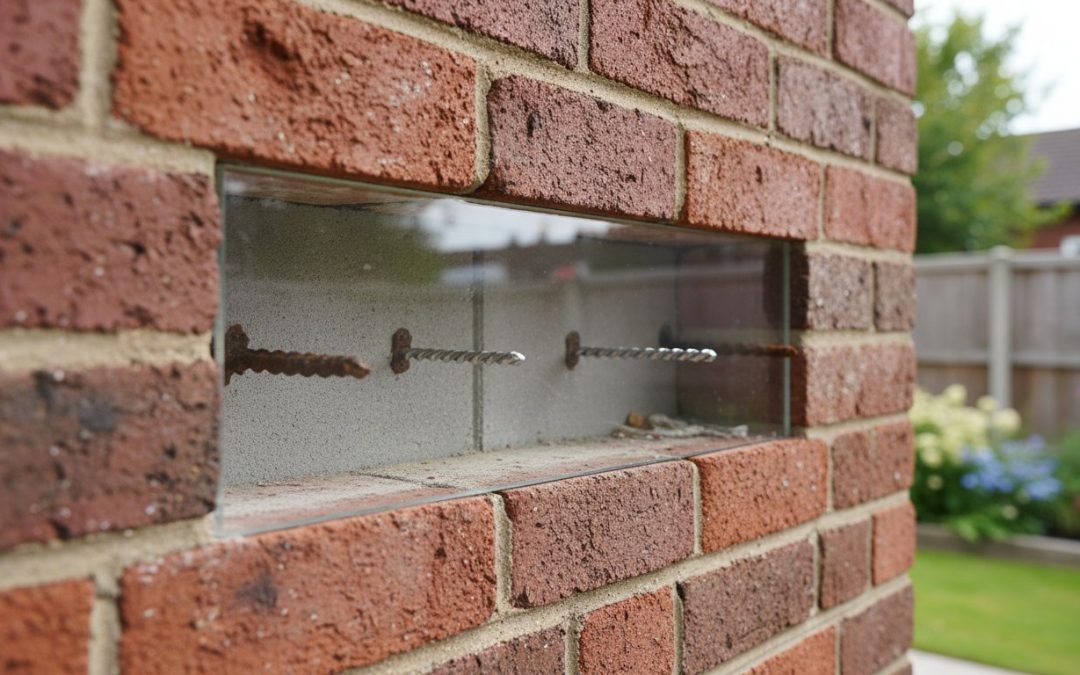
A hairline crack in your external masonry is rarely just a cosmetic issue. It’s often the first warning sign that the structural ties holding your home together are failing. You’re likely feeling the weight of this uncertainty, especially when faced with conflicting advice or the fear of a sudden structural collapse. It’s natural to worry about the wall tie replacement cost UK 2026, particularly when you want a permanent fix rather than a temporary patch from a general contractor who doesn’t specialize in structural integrity.
We understand that your property is your most significant asset. Protecting its value requires a transparent, expert approach. This guide provides a clear framework for evaluating specialist quotes and understanding the technical factors that dictate professional pricing. You’ll learn why a detailed survey is the non-negotiable first step to uncovering the true condition of your cavity. We’ll also explain how modern materials like stainless steel helical ties provide a long-term investment in your home’s safety, ensuring your repairs meet current standards like PD 6697:2019 and your peace of mind is restored.
Key Takeaways
- Learn how to budget effectively by understanding the wall tie replacement cost UK 2026 and why specialists use square-metre rates to ensure pricing accuracy.
- Identify the specific variables, such as building height and masonry composition, that dictate the final investment required for your property’s stability.
- Understand why a professional boroscope inspection is the only reliable method to diagnose hidden corrosion and prevent unnecessary structural work.
- Compare the technical benefits of helical stainless steel ties against mechanical alternatives to ensure a permanent, non-disruptive fix for your home.
- Discover the importance of using accredited structural specialists to protect your asset’s long-term health and guarantee compliance with modern building regulations.
Projected Wall Tie Replacement Costs for UK Homeowners in 2026
The 2026 economic climate has introduced new variables into structural maintenance. While previous years relied on static pricing, the current market is influenced by the fluctuating cost of high-grade stainless steel and increased regulatory overheads. Establishing a baseline for the wall tie replacement cost UK 2026 involves looking beyond simple material units. To understand the fundamental mechanics of your property’s structure, it’s helpful to first define what are wall ties and why their degradation compromises the safety of the entire building envelope. These components are the invisible backbone of a cavity wall, and their failure is a technical fault that requires a professional remedy.
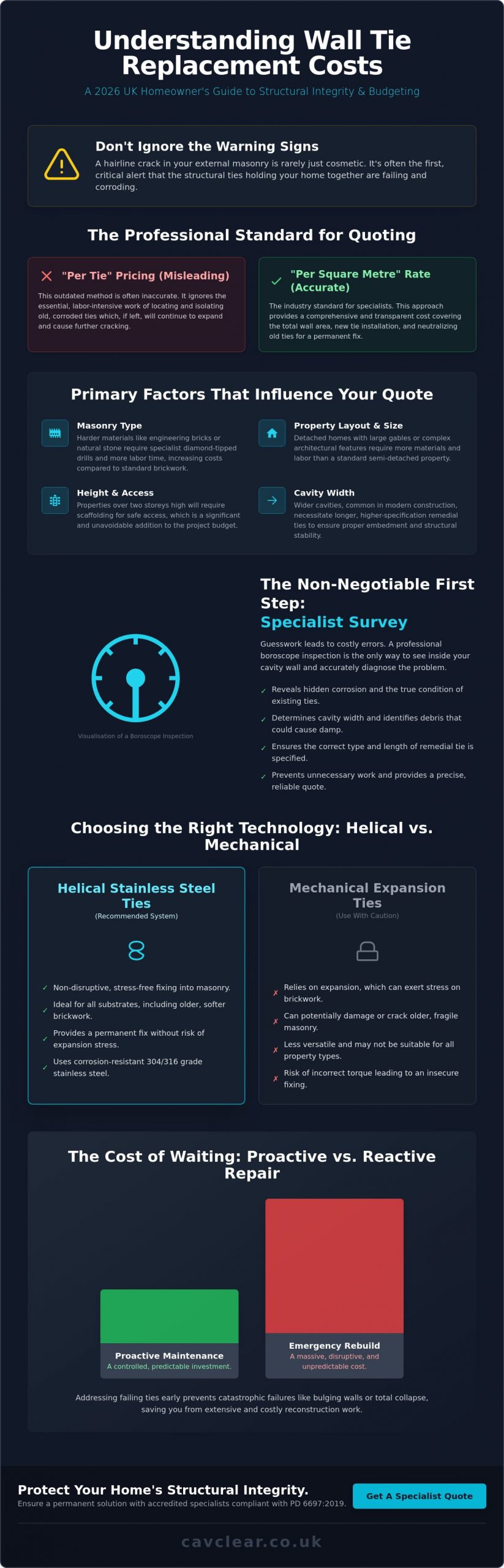
Professional budgeting now favors “per square metre” estimates over “per tie” quotes. This methodology is more reliable because it accounts for the total surface area requiring stabilization, including the necessary isolation of existing, corroded ties. Simply counting new ties ignores the labor-intensive process of neutralizing old ones. If left untreated, older mild steel ties continue to oxidize and expand, which exerts internal pressure on the mortar joints and causes horizontal cracking. High-grade remedial tie kits, specifically those using 304 or 316-grade stainless steel, have seen price adjustments in 2026. This makes the grade of the material a significant factor in the quote you receive.
Choosing preventative maintenance is always more cost-effective than waiting for emergency structural repairs. When wall ties fail completely, the resulting lateral movement can lead to bulging walls or even the collapse of the outer leaf. These scenarios require extensive rebuilding work that far exceeds the investment of a proactive remedial installation. Addressing the issue early ensures that the structural integrity of your home remains intact without the need for reactive, high-cost masonry reconstruction or extensive scaffolding for major rebuilds.
The Economic Shift in Specialist Contracting
In 2026, the availability of skilled structural technicians has become a primary driver of project costs. Specialist day rates reflect a shortage of qualified labor capable of performing precise, non-disruptive remedial work. Additionally, the cost of technical certification and adherence to updated safety standards adds a layer of necessary expense for reputable contractors. Selecting the cheapest quote often leads to secondary failures. Unqualified builders may use incorrect tie types or fail to follow the spacing requirements set out in PD 6697:2019. These errors inevitably result in higher long-term costs when the work must be rectified by a specialist.
Standard vs. Complex Property Layouts
The layout and age of your home significantly influence the overall budget. For a standard three-bedroom semi-detached property, the surface area is relatively predictable, allowing for straightforward planning. However, detached homes with large gables or complex architectural features require more materials and longer labor times. Property age is also a critical factor. Buildings from the early 20th century often require a higher density of ties to meet modern structural safety requirements. Older masonry may also be softer, necessitating specific helical ties that provide a secure fix without stressing the delicate brickwork.
Primary Factors Influencing Your Remedial Wall Tie Quote
Every property presents unique technical challenges that influence the final wall tie replacement cost UK 2026. One of the most significant variables is the masonry type itself. While standard brickwork is relatively straightforward for drilling and fixing, engineering bricks or natural stone require specialized equipment and significantly more labor time. These harder materials increase the wear on diamond-tipped drill bits and slow the installation rate, which is reflected in the specialist’s quote. It’s a technical reality that harder substrates demand more precision and better quality hardware to ensure a permanent fix.
Cavity width also plays a direct role in material selection and pricing. As building standards have evolved, we often see wider cavities that require longer, high-specification remedial ties. The length of the tie must be sufficient to achieve the required embedment depth in both the inner and outer leaves to satisfy the structural requirements outlined in Approved Document A of the Building Regulations. Using ties that are too short or of an incorrect grade for the local environment is a common failure point in budget installations. Ensuring the tie is correctly specified for your specific cavity width is essential for the long-term stability of the building leaf.
Access Requirements and Site Logistics
Safety is paramount when performing structural repairs at height. For multi-storey buildings, the necessity for scaffolding can represent a substantial portion of the project’s logistics. While some smaller, low-level projects might utilize specialist mechanical platforms, most comprehensive remedial work requires a stable scaffold to ensure technicians can work precisely at every level. Restricted access, common in terraced property layouts, also impacts the duration of the work. If equipment and materials must be moved through narrow passages, the increased labor time will naturally affect the project’s overall budget.
Cavity Conditions and Existing Insulation
The presence of defective or wet cavity insulation is a critical factor that many general builders overlook. When insulation becomes saturated due to driving rain or bridgeable debris, it creates a permanently damp environment that accelerates the oxidation of original mild steel ties. In these cases, performing a replacement without addressing the insulation is often a futile exercise. We frequently recommend cavity wall insulation removal as a concurrent step to ensure the new stainless steel ties aren’t subjected to an unnecessarily corrosive environment from the outset.
Debris within the cavity, such as mortar droppings from the original construction, can also block the installation path for remedial ties and create moisture bridges. A clear cavity is essential for effective moisture management and structural longevity. If you’re concerned about the stability of your elevations, you should arrange a specialist wall tie survey to identify these underlying issues before they lead to visible masonry damage.
The Non-Negotiable Necessity of a Specialist Wall Tie Survey
A visual inspection of masonry cracks provides only a surface-level indication of structural distress. It doesn’t reveal the specific condition of the ties hidden within the cavity. Relying solely on external symptoms often leads to inaccurate budgeting for the wall tie replacement cost UK 2026. A specialist survey is the only way to determine if the internal ties are suffering from expansion, thinning, or complete snapping. Expansion occurs when mild steel ties oxidize and swell, which forces brickwork apart. Thinning is common in older wire ties that corrode until they lose all structural capacity. Snapping is the final stage of failure, where the connection between the inner and outer leaves is completely severed.
A professional report serves as a fixed-price roadmap for remedial work. It eliminates the guesswork that often leads to varying quotes from general builders who lack the technical equipment to see inside the wall. By identifying the exact state of the cavity, you can move forward with a clear plan that addresses the root cause of the movement. This data-driven approach ensures that the repair is permanent and certified, providing the long-term assurance that your property’s structural integrity is fully restored. It’s a vital step in ensuring the wall tie replacement cost UK 2026 remains predictable and transparent.
Diagnostic Tools Used by Accredited Surveyors
Specialists use advanced technology to assess your property without causing unnecessary damage. High-resolution boroscopes allow us to see inside the cavity through small, discreet holes. This non-disruptive method provides a clear view of the ties and the general environment of the cavity. Metal detection is used to map the density and location of existing ties, ensuring they meet structural requirements. Endoscopic photography provides a permanent record of corrosion levels. This documentation is often essential for insurance purposes or when securing a mortgage on a property with known structural issues.
Survey Costs vs. Long-Term Savings
Investing in an independent damp and structural survey often results in significant long-term savings. An accurate diagnosis prevents over-specification, which happens when contractors recommend more ties than necessary to cover their own uncertainty. Precise mapping reduces the total number of remedial ties required, which directly lowers the overall project cost for the homeowner. Beyond the immediate repair, a professional survey report is a vital document for property resale. It proves to potential buyers and lenders that the structural health of the asset has been professionally managed and rectified.
Comparing Remedial Systems: Helical vs. Mechanical Ties
The selection of a remedial system is a technical decision that directly influences the wall tie replacement cost UK 2026. Helical stainless steel ties remain the industry standard for the majority of domestic projects because they offer a non-disruptive solution. These ties maintain the aesthetic integrity of the brickwork while providing a permanent structural fix. For properties located in coastal regions, we typically specify Grade 316 stainless steel to provide superior resistance against salt-induced corrosion. While Grade 304 is the standard for inland areas, the marginal increase in material cost for Grade 316 is a vital investment for the long-term health of assets in marine environments.
Mechanical expansion ties are still utilized in specific high-strength applications where the masonry substrate is dense enough to withstand expansion stress. However, they are less suitable for older, softer brickwork where the expansion mechanism could cause internal cracking. In cases involving fragile or porous masonry, resin-fix systems provide a chemically bonded alternative. This process involves injecting a structural resin into the pilot hole to create a stress-expert anchor. Although resin systems are more labor-intensive and can increase the project budget, they are often the only reliable way to ensure stability in severely compromised substrates.
Helical Tie Installation Methodology
The “drive-fix” process is favored by specialists for its speed, reliability, and minimal impact on the property’s appearance. Technicians drill a precise pilot hole through the outer leaf and into the inner leaf of what is a cavity wall structure. The helical tie is then driven into this hole using a specialized power tool, allowing the fins to corkscrew into the masonry. This method creates a secure mechanical bond without the risk of splitting the brick. We monitor embedment depths throughout the installation to ensure maximum pull-out strength and compliance with structural safety standards.
Isolation of Failed Existing Ties
Installing new ties is only one part of a professional remedy; the original corroded ties must be isolated to prevent ongoing damage. As mild steel oxidizes, it expands significantly. This expansion exerts immense pressure on the mortar joints, leading to “wall tie blow-out” where the external brickwork is physically pushed outward. Isolation techniques, such as foam-sleeving or the physical removal of the corroded ends, decouple the old ties from the outer leaf. This critical step ensures that any further oxidation of the original hardware won’t compromise the new remedial installation. To ensure your property is treated with this level of technical precision, you can book a specialist wall tie inspection with our nationwide team.
Ensuring Structural Stability with CavClear Specialist Contracting
CavClear operates as a dedicated specialist contractor across the entire United Kingdom. We understand that property owners are navigating a complex market where the wall tie replacement cost UK 2026 is influenced by both material quality and technical expertise. Our nationwide reach ensures that regardless of your location, you have access to accredited technicians who prioritize the structural integrity of your home. We don’t just perform repairs; we provide a calibrated solution designed to restore the long-term health of your building’s envelope.
Our methodology is built on the principle of minimal disruption. Many general builders approach structural work with heavy-handed techniques that can cause secondary damage to delicate masonry. In contrast, CavClear utilizes a clean and non-disruptive approach. We use high-precision tools and dust-extraction systems to ensure that the remedial process is as unobtrusive as possible. This commitment to cleanliness and precision is a core part of our service. It ensures that your property is left in a better state than we found it, both structurally and aesthetically.
Our Specialist Remedial Process
The journey to a stable home begins with a high-resolution boroscope survey. This diagnostic step allows our technicians to see inside the cavity and identify the exact state of the existing ties. Once we’ve established the requirement, the wall tie replacement process is carried out using high-grade stainless steel helical ties. We integrate this work with a broader view of property preservation. This includes ensuring that any debris or moisture bridges within the cavity are addressed to prevent future corrosion. The final stage involves a meticulous “make-good” of the masonry, where we color-match the mortar to ensure the repair is virtually invisible.
Booking Your 2026 Structural Assessment
Receiving a detailed remedial action plan is the most effective way to manage your property’s maintenance budget. If you’ve noticed horizontal cracking along mortar joints or signs of lintel sagging above windows, these are technical faults that require immediate attention. Ignoring these signs can lead to more expensive repairs or even structural failure. Our assessment provides a transparent breakdown of the necessary works. This helps you understand the wall tie replacement cost UK 2026 for your specific property layout and masonry type.
Securing your property’s future requires a partner who provides long-term assurances and certified repairs. Every project we undertake is backed by our commitment to quality and technical excellence. We provide the documentation you need for insurance and resale purposes. This proves that the structural health of your asset has been professionally restored. To take the first step toward a permanent fix, Contact CavClear for a professional wall tie survey and quote today.
Restoring Structural Integrity and Asset Value
Addressing structural faults early prevents the technical and financial burden of major masonry rebuilds. You now understand that the wall tie replacement cost UK 2026 is determined by a combination of building height, masonry type, and the specific remedial system required for a permanent fix. Prioritizing a specialist boroscope survey eliminates the uncertainty of hidden corrosion. It ensures every new tie is correctly specified for your cavity’s environment, preventing the secondary failures often seen with general building work. This methodical approach protects the long-term health of your property.
Our accredited specialist technicians provide nationwide UK service coverage, delivering the technical precision your home requires. We focus on detailed technical reporting and remedial plans that prioritize the restoration of comfort and safety. Protecting your property isn’t just a repair; it’s a vital investment in its future health. It’s time to replace anxiety with an expert, no-nonsense resolution that secures your home for decades to come.
Secure your property’s structural integrity with a CavClear wall tie survey
Take the first step toward a stable, secure home today.
Frequently Asked Questions
How do I know if my wall ties need replacing in 2026?
Visible signs include horizontal cracks in mortar joints, bulging elevations, or sagging window lintels. These technical faults indicate that original ties are expanding due to corrosion. However, external symptoms don’t always appear immediately. A specialist survey using a boroscope is the only definitive method to assess the internal state of the cavity and determine the actual wall tie replacement cost UK 2026 for your property.
Will wall tie failure affect my ability to sell my house?
Yes, structural instability is a major red flag for mortgage lenders and surveyors. If a homebuyer’s survey identifies failing ties, the lender may refuse the mortgage or insist on a significant retention until repairs are completed. Providing a specialist report and a certificate of remedial work is often essential to satisfy legal requirements and maintain your property’s market value during a sale.
Is wall tie replacement a messy or disruptive process?
Professional wall tie replacement is a non-disruptive process that doesn’t require internal access. Technicians drill small pilot holes through the external mortar joints or bricks to install helical ties. These holes are then meticulously color-matched to your existing masonry, making the repair virtually invisible. We use dust-extraction systems to ensure the site remains clean throughout the duration of the structural work.
How long do remedial wall ties typically last?
Modern remedial ties manufactured from Grade 304 or 316 stainless steel have a design life of 60 years or more. Unlike the original mild steel ties used in older properties, stainless steel doesn’t oxidize or corrode in standard cavity environments. This makes the installation a permanent fix and a vital long-term investment in the structural safety and asset health of your home.
Can I replace wall ties myself using a DIY kit?
We don’t recommend DIY installation for structural repairs. Correct tie spacing, embedment depth, and the isolation of existing corroded ties are critical for safety and compliance with building standards. Without specialist equipment like boroscopes and calibrated power drivers, it’s impossible to guarantee the ties are correctly anchored. Mistakes can lead to further masonry damage and the eventual failure of the building envelope.
Does building insurance cover the cost of wall tie replacement?
Standard building insurance policies typically exclude wall tie replacement because they classify corrosion as gradual wear and tear rather than an sudden peril. It’s important to review your specific policy wording, but most homeowners must budget for the wall tie replacement cost UK 2026 as a necessary maintenance expense to prevent more costly structural collapse or rebuilding work in the future.
What happens if I ignore failing wall ties?
Ignoring failing ties leads to progressive structural instability. As ties continue to corrode and expand, they force the outer leaf of the wall to move away from the inner leaf. This causes severe cracking, bulging, and eventually, the complete collapse of the external wall. Failing ties can also create moisture bridges that lead to dampness and internal plaster damage, increasing the total repair bill.
Are there specific building regulations for wall tie replacement?
Yes, all remedial structural work must comply with Approved Document A of the Building Regulations, which covers structural safety. The specific installation requirements, including tie density and spacing, are outlined in PD 6697:2019. Using an accredited specialist ensures that your repairs meet these technical standards, providing you with the necessary documentation to prove the building is structurally sound for future insurance or sale purposes.
Recent Comments