
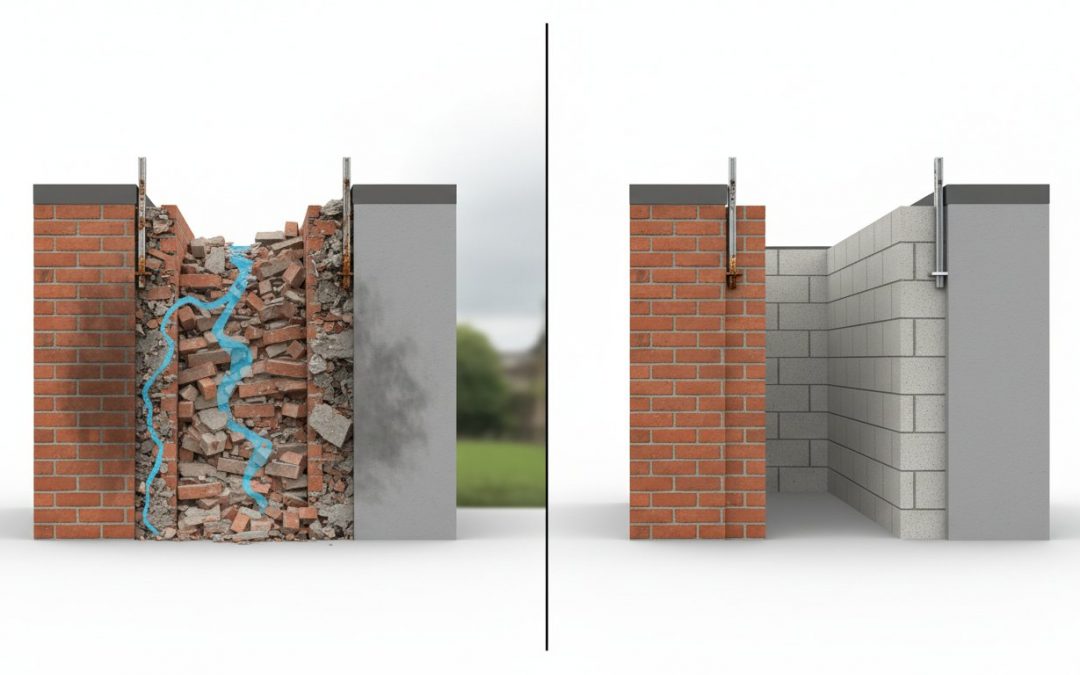
What if the very walls designed to protect your home from the British weather are actually funneling moisture directly into your living space? It’s a reality for many homeowners, as industry data from January 2024 suggests that 25% of UK properties with retrofit insulation now face significant moisture issues. When mortar droppings, rubble, or degraded materials accumulate, the consequences of debris in wall cavity installations become impossible to ignore. These materials act as a structural bridge, allowing water to cross the air gap and settle against your internal walls.
You’re likely frustrated by damp patches that reappear despite frequent repainting or heating bills that remain high while your home feels cold. Since failing cavity walls can account for 33% of a home’s total heat loss according to GreenMatch data from November 2024, these issues represent a serious drain on your finances. This specialist guide explains how debris compromises your thermal efficiency and why professional extraction is the only way to restore a dry, warm environment. You’ll learn how our nationwide team identifies blockages and the non-invasive methods we use to provide a permanent, guaranteed fix for your property’s long-term health.
Key Takeaways
- Identify how common construction waste like mortar snots and brick rubble creates a moisture bridge, bypassing your property’s primary defenses.
- Understand the long-term consequences of debris in wall cavity environments, specifically how trapped moisture leads to the rapid oxidation and failure of structural wall ties.
- Recognize the specific diagnostic signs of a blocked cavity, including damp spots that appear during heavy rain but fade during dry spells.
- Discover how specialist extraction techniques effectively clear obstructions to restore the vital air gap required for proper moisture management.
- Learn how professional cavity clearance protects your home’s thermal efficiency and prevents the need for invasive and expensive structural repairs.
What is Cavity Debris and Why Does it Accumulate?
To understand why your home feels damp, you must first understand the purpose of the void between your walls. What is a Cavity Wall? Essentially, it’s a precisely engineered air gap, typically 50mm to 100mm wide, designed to prevent moisture from traveling from the outer brickwork to the inner leaf. A “clean cavity” ensures that any rain soaking into the external bricks drains away or evaporates before it can reach your living space. When foreign objects fill this space, the defense system fails. We define cavity debris as any non-structural material, such as construction waste or failed insulation, that obstructs this vital gap.
The consequences of debris in wall cavity installations are often hidden but severe. These materials act as a physical bridge, allowing moisture to seep across the void via capillary action. Common contaminants include mortar “snots” (excess mortar dropped during bricklaying), brick shards, and timber offcuts. While these items might remain dry for years, changes in local weather patterns or building settling can suddenly turn them into active conduits for damp. The consequences of debris in wall cavity environments extend beyond simple moisture; they threaten the very fabric of your home’s thermal performance.
The Origin of Cavity Contamination
Most debris issues start during the initial build. Poor workmanship, such as failing to clear the base of the wall or neglecting to use cavity batts to catch mortar droppings, leaves the cavity compromised from day one. Renovations are another frequent cause. When contractors replace windows or repair roofs, rubble and plaster often fall into the void. Even pests contribute to the problem. Nesting materials from birds or rodents can pack the cavity tight, trapping moisture against your home’s inner leaf and creating localized damp patches that are difficult to diagnose without a specialist survey.
Failed Insulation as Debris
It’s a mistake to view all insulation as a permanent asset. When glass wool or mineral fiber becomes saturated by driving rain, it stops being an insulator and starts acting as debris. This sodden mass holds water directly against your internal walls, leading to musty smells and mould growth. Older bonded bead systems also degrade over 25 years, settling into dense blockages at the base of the wall. Degraded insulation loses all thermal properties and becomes a structural liability by facilitating wall tie corrosion and persistent dampness. Because this material can’t dry out on its own, professional extraction is the only reliable way to restore your property’s health.
The Science of Moisture Bridging and Internal Damp
Moisture management relies on the complete separation of the inner and outer leaves of your home. When this separation is compromised, the consequences of debris in wall cavity installations manifest as moisture bridging. Capillary action allows water to travel across solid materials like mortar droppings or rubble. This process essentially “wicks” moisture from the wet external bricks directly into your internal plasterwork. With UK rainfall levels increasing by 10% over the last decade according to industry data from February 2025, the pressure on these cavities has never been higher. According to professional surveyors, Common Cavity Wall Defects often go unnoticed until internal damage is visible.
Debris accumulation at the base of the wall is particularly dangerous because it bypasses the Damp Proof Course (DPC). The DPC is a barrier designed to stop rising damp, but if rubble fills the cavity above this line, ground moisture simply climbs over the barrier via the debris. This often introduces hygroscopic salts into your home. These salts are problematic because they naturally attract moisture from the air, meaning your walls stay damp even during dry summer months. Once these salts saturate your plaster, the damage becomes permanent, often requiring the complete removal of the internal wall finish after the cavity is cleared.
Penetrating Damp and Mould Growth
You’ll often notice damp patches appearing at the exact height where debris has settled inside the wall. This consistent moisture creates the perfect environment for black mould to thrive. Living in a property with elevated internal moisture isn’t just a cosmetic issue; it poses documented risks to respiratory health. If you suspect your home’s defenses are failing, a specialist cavity wall survey can pinpoint the exact location of these blockages before the structural damage worsens.
Thermal Bridging and Cold Spots
While moisture bridging involves liquid water, thermal bridging involves the transfer of heat. Materials like brick rubble conduct heat much faster than the still air found in a healthy wall cavity. This creates “cold spots” on your internal walls where the debris is touching. When warm, moist indoor air hits these cold spots, it condenses into water droplets, fueling further mould growth. This heat loss explains why many homeowners see their energy bills rise despite having insulation; the debris creates a thermal leak that bypasses your home’s protection. The consequences of debris in wall cavity spaces mean your heating system has to work significantly harder to maintain a comfortable temperature.

Structural Risks: Wall Tie Corrosion and Material Decay
Wall ties serve as the essential structural backbone of your property, bridging the gap between the internal and external leaves to ensure they act as a single, stable unit. While earlier sections highlighted the damp issues caused by moisture bridging, the structural consequences of debris in wall cavity spaces are often more severe and permanent. When rubble or mortar droppings settle around these metal connectors, they create a “wet pocket” that holds moisture directly against the steel. This constant exposure triggers oxidation, a process that can compromise the structural integrity of your home far faster than natural aging would allow.
The speed of this decay is a critical concern for homeowners. In a clean, dry cavity, galvanized or stainless steel ties can last for many decades. However, when debris creates a saturated environment, the rate of corrosion accelerates. As the metal rusts, it undergoes a volumetric expansion, often growing to seven times its original thickness. This physical growth exerts immense pressure on the surrounding masonry, effectively acting like a slow-motion jack that forces the brick courses apart. This process doesn’t just weaken the bond between the two leaves; it actively damages the external skin of your property.
Identifying Wall Tie Failure
Visual symptoms often start with fine horizontal cracking in the mortar joints, typically spaced every six or seven courses where the ties are bedded. In advanced cases, you may notice the external brickwork beginning to bulge or bow outward. Ignoring these signs leads to significant long-term costs, whereas proactive wall tie replacement can stabilize the structure before a partial collapse occurs. Because these ties are hidden, a specialist technical survey using borescopes is the only way to accurately assess their health behind the brickwork.
Secondary Structural Damage
Prolonged dampness within the cavity also leads to chemical degradation of the building materials. Sulphate attack occurs when moisture reacts with components in the masonry and mortar, causing the joints to crumble and lose their load-bearing capacity. For properties with hybrid constructions or timber frames, the risks are even higher. Debris holding moisture against timber studs can lead to wet rot, which quietly destroys the wooden frame and floor joists that bed into the damp walls. Ultimately, your property’s structural integrity is entirely dependent on a dry, clear cavity environment.
Identifying the Signs of a Blocked Wall Cavity
Most homeowners only realize they have a problem when internal decorations begin to spoil. Because the void between your walls is hidden, you must rely on external and internal symptoms to diagnose the health of your property. Understanding the visible consequences of debris in wall cavity spaces allows you to act before structural damage becomes irreversible. While some signs are subtle, they typically follow a pattern that correlates with weather conditions and thermal changes.
You should monitor your home for the following definitive symptoms of cavity blockages:
- Transient Damp Patches: Stains that appear on internal walls after heavy, wind-driven rain but fade during dry spells. This suggests a physical bridge is allowing water to cross the cavity.
- Efflorescence: A white, salty powder on either internal plaster or external brickwork. This indicates that moisture is traveling through the masonry and bringing hygroscopic salts to the surface.
- Localized Cold Spots: Patches of the wall that feel significantly colder to the touch than the surrounding area. These spots often attract condensation and are a direct result of thermal bridging caused by rubble or saturated material.
- Cracking Near Openings: Fine cracks appearing around window and door frames. Debris often settles on lintels, trapping moisture and causing the metal or timber to expand or decay.
- Persistent Musty Odours: A smell of damp that remains even with good ventilation, often accompanied by black mould growth in corners or behind furniture.
The Role of Professional Surveys
Standard moisture meters used by many general builders only confirm that a wall is wet; they don’t explain why. A comprehensive damp survey is the first step toward a permanent solution. Our specialists use high-definition borescopes, which require only a small 10mm to 12mm hole to visually inspect the cavity. This allows us to see the exact nature of the debris without removing any bricks. We also utilize thermal imaging to identify heat loss patterns, providing a non-invasive way to map out where the consequences of debris in wall cavity installations are most severe. According to August 2024 pricing data, a professional survey typically costs between £150 and £300, representing a small investment to avoid thousands in structural repairs.
When to Call a Specialist
It’s vital to distinguish between surface condensation and deep-seated cavity issues. If you find that “damp-proof” paint only masks the problem for a few months before the patches return, you’re likely dealing with a blocked cavity. Masking the symptoms is dangerous because it allows wall tie corrosion to continue unseen. Early intervention is the most cost-effective path to restoring your home’s integrity. If you’ve noticed any of these symptoms, you should book a specialist cavity wall survey to get a clear, factual assessment of your property’s health.
The Professional Extraction Process: Restoring Property Health
Resolving the consequences of debris in wall cavity spaces requires a methodical, technical approach that goes beyond simple cleaning. We utilize a high-powered vacuum extraction system designed to remove saturated insulation, mortar snots, and construction rubble with surgical precision. This specialist equipment creates a powerful airflow that draws all contaminants out of the void, ensuring that no material is left behind to cause future moisture bridging. Our technicians pay particular attention to the base of the cavity and the areas above window lintels, where heavy rubble accumulation is most common. By clearing these specific blockages, we eliminate the physical bridges that allow water to bypass your home’s defenses.
The extraction process isn’t complete without a final verification of the air gap. Once the bulk of the material is removed, we perform a secondary borescope inspection to guarantee a 100% clear cavity. This visual confirmation ensures that the separation between the inner and outer leaves is fully restored, allowing the wall to breathe and manage moisture as originally intended. For homeowners dealing with failed materials, our process for cavity wall insulation removal provides a permanent solution that stops the cycle of recurring damp and decorative spoiling.
A Non-Invasive Solution
We’ve designed our extraction techniques to be as non-invasive as possible. Our team removes individual bricks at strategic points to create “extraction ports,” which allow our equipment to reach every part of the wall. Once the debris is cleared, we replace these bricks using mortar that matches your existing masonry, making the intervention virtually invisible. Because all work is performed from the outside, there’s zero disruption to your internal living space. A standard residential property extraction is typically completed within one to two days, providing a rapid resolution to long-standing property health issues.
Long-Term Benefits of a Clear Cavity
Restoring the air gap provides immediate improvements to your home’s environment. You’ll notice that internal walls feel warmer to the touch and damp patches begin to dry out permanently. By removing the thermal bridges caused by debris, your home’s thermal efficiency improves, which directly leads to lower heating bills. According to November 2024 data, uninsulated or compromised cavities can be responsible for 33% of total heat loss, so clearing them is a vital investment in your home’s future. Ultimately, a clear cavity is the only way to ensure the long-term structural health of a UK property. We provide a guarantee with every extraction, giving you total peace of mind that the consequences of debris in wall cavity installations have been permanently resolved.
Securing Your Property’s Future Health
A clear wall cavity is the only reliable defense against penetrating moisture and long-term structural decay. As established, untreated blockages act as a bridge for water and accelerate the oxidation of vital wall ties, which compromises your home’s stability. Addressing the consequences of debris in wall cavity environments requires more than surface-level repairs; it demands a specialist solution that restores the original engineering of your building. Our accredited technicians offer nationwide UK coverage, providing comprehensive borescope inspections and detailed reporting to identify every obstruction. We utilize non-invasive extraction techniques that deliver guaranteed results, ensuring your home remains dry, warm, and structurally sound for decades to come.
Protecting your investment starts with a factual assessment of what’s happening behind your brickwork. By clearing the void and restoring thermal efficiency, you stop the cycle of recurring damp and high energy costs. You deserve the peace of mind that comes from a permanent, professional fix. Book a Specialist Cavity Survey with CavClear Today to begin the restoration of your home’s integrity. We’re ready to help you create a safer, more comfortable living space.
Frequently Asked Questions
Can I clear debris from my cavity wall myself?
No, you shouldn’t attempt to clear a cavity without specialist equipment and training. Effective clearance requires industrial-grade vacuum systems and technical access through specific extraction ports created by removing individual bricks. DIY efforts often result in pushing the debris further down the wall or damaging the hidden wall ties. Professionals use high-definition borescopes to ensure the void is 100% clear, which is impossible to verify using domestic tools.
How do I know if the damp is caused by debris or something else?
A professional survey is the only way to be certain about the source of moisture. While condensation usually appears on cold surfaces in corners, damp caused by the consequences of debris in wall cavity spaces typically manifests as localized patches that darken after heavy rain. We use thermal imaging and borescope inspections to visually confirm if rubble, mortar snots, or saturated material are creating a physical bridge for moisture to cross.
Will removing debris make my house colder?
No, removing wet debris and saturated material actually makes your home feel warmer. Saturated debris conducts heat significantly faster than a clear air gap, essentially acting as a heat sink that sucks warmth out of your living space. By restoring the vital air void, you re-establish the property’s natural thermal resistance. This process prevents cold spots and reduces the workload on your heating system.
How much does it cost to remove debris from a wall cavity?
Professional survey costs typically range from £150 to £300 according to GAP Insulation Services data from August 2024. For minor debris clearance, MyJobQuote April 2026 figures suggest an additional cost of £150 to £300. If the property requires full insulation and debris extraction, the average cost for a semi-detached house generally ranges from £1,500 to £2,800 depending on the total wall area.
What happens if I ignore the debris in my walls?
Ignoring the problem leads to severe structural failure and persistent health risks. Constant dampness encourages black mould growth and triggers the oxidation of metal wall ties. If these ties are left to corrode, the external leaf of your property can become unstable or bow. This eventually leads to expensive reconstruction requirements that far exceed the cost of a proactive specialist extraction.
How long does a professional cavity extraction take?
A standard residential extraction usually takes between one and two days to complete. Our nationwide teams work efficiently from the exterior of the property, which means your daily routine remains undisturbed. This timeframe includes the strategic removal of bricks, the full vacuum extraction of all contaminants, and a final borescope inspection to guarantee that the air gap is fully restored.
Does debris in the cavity affect my property value?
Yes, unresolved damp and structural concerns significantly lower a home’s marketability and value. Surveyors often flag moisture bridging and wall tie corrosion in their reports, which can lead to buyers withdrawing or demanding price reductions. Providing evidence of a professional extraction with a long-term guarantee protects your investment and provides the necessary peace of mind for potential future buyers.
Can debris cause wall ties to snap?
Yes, debris holds moisture against the metal ties, creating the exact conditions needed for them to rust and fail. As a tie oxidizes, it expands and weakens, which can lead to it snapping or losing its structural grip on the masonry. The consequences of debris in wall cavity environments mean that the essential bond between your inner and outer walls is slowly destroyed, threatening the overall stability of the building.
Recent Comments