
Could your home’s insulation actually be the primary cause of your rising energy bills and damp internal walls? You likely installed insulation to create a warmer, more efficient environment, but when materials become saturated, they act as a bridge for moisture rather than a thermal barrier. Dealing with wet cavity wall insulation issues is a serious concern for homeowners across the UK, especially as 2026 property health reports indicate that poorly installed materials remain a leading cause of internal damp. You shouldn’t have to tolerate musty smells or black mould growth that persists despite your best efforts to heat the building.
We understand the stress that structural damp causes to your family and your investment. This specialist guide will help you identify the warning signs of failed insulation and explain why professional extraction is the only way to safeguard your property. You’ll learn how our methodical approach removes saturated debris to restore your home to a dry, healthy state. By the end of this article, you’ll have a clear understanding of the extraction process and how it protects your building’s long term structural integrity.
Key Takeaways
- Learn how retrospective insulation compromises your home’s original design by creating a moisture bridge that facilitates damp transfer between external and internal walls.
- Recognise the critical warning signs of wet cavity wall insulation issues, including persistent black mould growth and visible damp patches on internal paintwork.
- Understand the hidden structural dangers posed by damp cavity debris, such as the accelerated corrosion of wall ties and the resulting impact on property value.
- Discover the professional extraction process used to clear compromised cavities, utilising specialist borescope surveys and systematic techniques to restore structural health.
- Secure the long-term longevity of your property by understanding why a clean, dry cavity is the most effective way to ensure lasting thermal efficiency and peace of mind.
Understanding the Impact of Wet Cavity Wall Insulation
The primary design of a traditional UK property relies on a simple yet effective principle: the cavity. This 50mm to 100mm gap exists to prevent moisture from transferring from the external brickwork to the internal living space. When homeowners introduce retrospective materials into this void, they inadvertently bypass a critical structural defense. Dealing with wet cavity wall insulation issues requires a technical understanding of how these materials interact with the British climate.
In many areas across the UK, particularly those exposed to significant driving rain, external masonry frequently saturates. A clear cavity allows this moisture to drain away or evaporate through natural ventilation. However, filled cavities often act as a sponge. The insulation absorbs the water and holds it against the inner leaf of the property. This process negates the original architectural intent of Cavity wall construction and issues arise when the material fails to dry out naturally. Even products marketed as “breathable” often fail in practice because they cannot cope with the volume of water present in high-exposure zones.
The Science of the Moisture Bridge
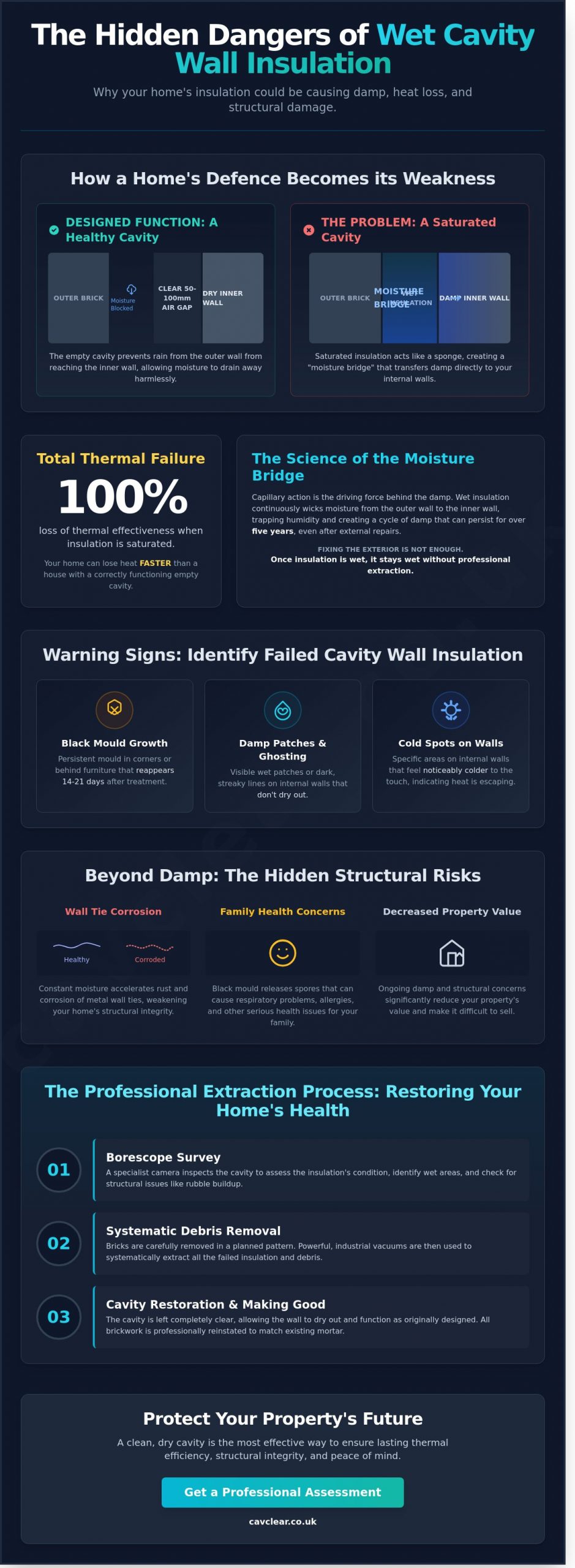
Capillary action is the driving force behind internal dampness in filled cavities. When insulation becomes saturated, it creates a “moisture bridge” that pulls liquid across the gap. This isn’t just a surface problem. The wet material traps humidity against the internal blockwork, leading to localized cold spots and persistent mould growth. From a technical standpoint, the thermal resistance (U-value) of the wall collapses. Research indicates that saturated insulation can lose nearly 100% of its effectiveness, meaning the property actually loses heat faster than a house with a correctly functioning empty cavity.
Why External Maintenance Is Not Enough
A common misconception is that fixing the outside of the house will solve the internal damp problem. Repointing the mortar joints or applying “waterproof” coatings often fails to address the root cause. Once the insulation is wet, it stays wet. The lack of airflow within the filled cavity prevents evaporation, creating a long-term saturation cycle that can persist for over five years even after external repairs. These coatings can sometimes worsen the situation by trapping existing moisture inside the wall. As a specialist in this field, we know that professional extraction is the only reliable method to restore the structural integrity and thermal efficiency of the building. This process provides peace of mind by removing the bridge and allowing the property to breathe again.
Warning Signs: How to Identify Failed Cavity Wall Insulation
Identifying wet cavity wall insulation issues requires a keen eye for subtle changes in your property’s internal climate. You might notice visible patches of damp or “ghosting” on your wallpaper, which often appears as dark, streaky lines following the pattern of the internal masonry. This happens when moisture from saturated insulation creates a direct thermal bridge to the inner leaf of your home. Persistent black mould growth is another critical indicator. It tends to cluster in corners or behind heavy furniture where airflow is restricted and the wall surface remains cold.
A significant drop in temperature on specific wall sections, known as cold spots, suggests the material inside has failed. These areas feel noticeably colder to the touch than the surrounding wall. You may also see a sharp rise in condensation on your windows. While many homeowners blame poor ventilation, the presence of saturated material within the wall cavity significantly increases internal humidity levels. Finally, pay attention to musty, earthy odours. If these smells linger even after deep cleaning, it usually indicates that microbial growth is active within the cavity itself.
Internal Symptoms of Saturated Cavities
When insulation becomes wet, it often slumps or settles toward the bottom of the wall. This creates voids at the top of the cavity, leading to “cold bridging.” This is a technical term for areas where heat escapes rapidly because the thermal barrier is no longer continuous. Unlike standard surface condensation, penetrating damp caused by faulty insulation often presents as localized, heavy wet patches that don’t dry out during the day.
Many homeowners find that mould reappears within 14 to 21 days of being treated with expensive anti-mould paint. This happens because the paint only masks the surface symptom. The wet insulation continues to provide a constant source of moisture from within the structure, rendering surface treatments ineffective. For a broader understanding of how these systems are intended to function, you can consult Energy Saving Trust guidance on cavity wall insulation to see why maintaining a dry cavity is essential for thermal efficiency.
External Indicators of Cavity Issues
The exterior of your property often provides the most honest assessment of its structural health. Keep an eye out for cracked mortar joints or “spalling,” where the brick face begins to flake away. This occurs because moisture-heavy bricks undergo intense expertze-thaw cycles during UK winters, causing the masonry to expand and shatter.
You might also see evidence of previous insulation injection holes that appear to be “weeping” moisture or showing dark stains around the drill points. If you notice moss or thick vegetation growth concentrated on specific sections of the brickwork, it’s a clear sign of high moisture retention. Our extraction specialists use high-definition borescope cameras to inspect these areas, providing a transparent view of the debris or saturated material trapped inside. Identifying these external triggers early can prevent long-term damage to your wall ties and overall structural integrity.
The Structural Risks of Damp Cavity Debris
Wet insulation within a cavity isn’t just a thermal failure; it’s a structural catalyst for decay. When debris or saturated material bridges the gap between the inner and outer leaves, it creates a direct path for moisture to travel. This moisture remains trapped for years, leading to severe wet cavity wall insulation issues that compromise the very fabric of the building. The presence of water against the inner leaf causes internal plaster damage and the emergence of salt efflorescence. These white, powdery deposits are more than an eyesore; they are hygroscopic salts that actively pull more moisture from the atmosphere, ensuring the wall stays damp even during dry spells.
Property value takes a direct hit when these issues are present. RICS surveyors are trained to identify the symptoms of failing insulation during home buyer reports. If a survey reveals high moisture readings or structural movement, it can make a property difficult to sell or even unmortgageable in some instances. Potential buyers often walk away from homes requiring extensive remedial work, viewing the property as a high-risk investment rather than a safe haven.
Wall Tie Corrosion and Structural Stability
One of the most significant hidden dangers is the acceleration of wall tie corrosion. These metal components are essential for holding the two layers of your wall together. In a dry environment, they last for many decades. However, moisture-laden debris provides the perfect environment for rust to form. As the ties oxidise, they expand to several times their original thickness. This expansion exerts immense pressure on the mortar joints, often resulting in horizontal cracking or bulging walls. In these scenarios, a wall tie replacement is often needed alongside extraction to restore the building’s stability. We find that following the Centre for Sustainable Energy advice regarding damp identification helps homeowners understand that while insulation is intended to save energy, wet cavity wall insulation issues lead to specific, avoidable structural faults.
Long-term Property Degradation
The damage doesn’t stop at the masonry. Saturated insulation frequently makes contact with timber floor joists that are embedded in the inner leaf. This leads to a rapid transition from simple dampness to wet rot in nearby timber. Once wood-rotting fungus takes hold, the structural timber loses its load-bearing capacity, which can lead to sagging floors and costly replacements. Internally, persistent dampness affects air quality and resident health. Damp environments are breeding grounds for mould spores that can trigger or worsen respiratory conditions. Delaying the extraction process makes major structural repairs inevitable and significantly increases the final bill for restoration.
The Professional Extraction Process: Restoring Your Home
Resolving wet cavity wall insulation issues requires a methodical, technical approach that goes beyond simple removal. It’s a restorative process designed to return your property to its original, breathable state. Our specialists treat every extraction as a precision engineering project, ensuring the structural integrity of your home remains the primary focus throughout the intervention.
Technical Inspection and Preparation
A professional damp survey is the essential first step in any extraction project. We don’t rely on guesswork; instead, we use high-definition borescopes inserted through small, 12mm pilot holes to map the internal conditions of the wall. This allows our technicians to identify specific zones of high saturation where insulation has slumped or compacted. Mapping these areas is vital because wet material often gathers at the base or around wall ties, creating bridges for moisture to enter your living space.
Before any extraction begins, we implement rigorous property protection measures. We use industrial dust-suppression systems and heavy-duty ground coverings to protect your landscaping and driveway. Our nationwide teams follow a safety-first protocol that ensures the work site remains clean and contained, providing you with peace of mind while we address the underlying faults in your wall’s performance.
Non-Invasive Extraction Methodology
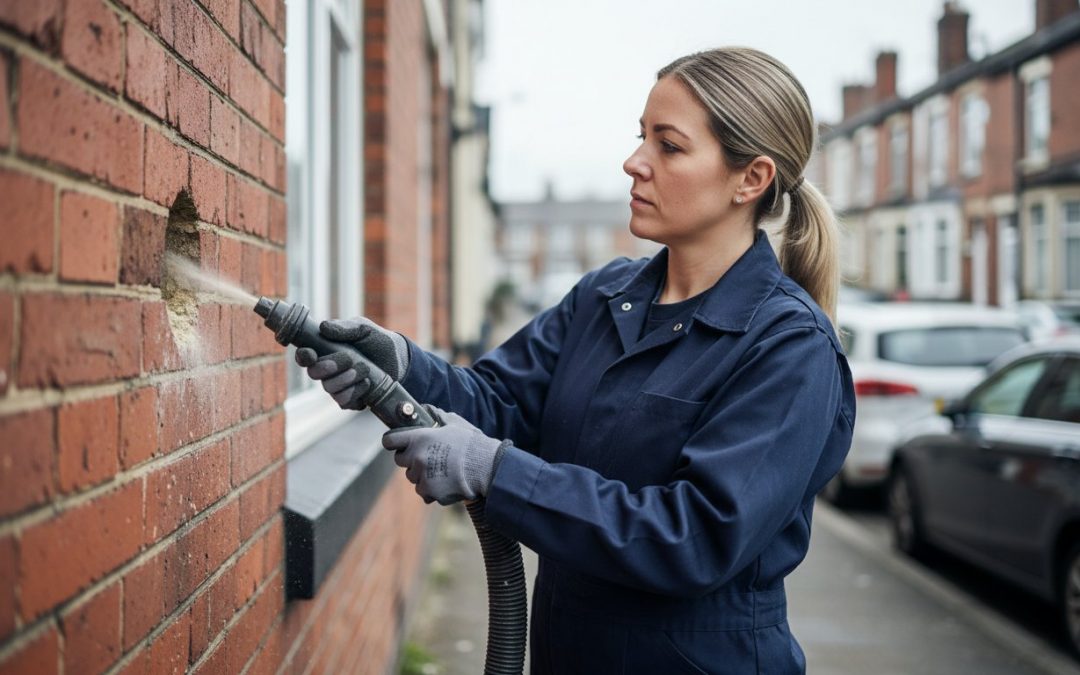
The actual removal of failed material is a systematic process. We remove individual bricks at the base of the elevations to create strategic extraction points. This technique allows us to access the lowest points of the cavity where debris and wet insulation naturally settle. Our specialists use a combination of industrial-grade compressed air to agitate the material and high-suction vacuum systems to pull it safely from the building.
We pay specific attention to the “cavity tray” areas located above windows and doors. These horizontal barriers are frequent collection points for damp debris, and clearing them is essential to prevent future damp penetration. Our tools are designed to remove wool, bead, or even difficult bonded foam without causing any structural damage to the inner or outer leaf of the masonry.
Once the extraction is complete, we perform a final borescope inspection to guarantee the cavity is 100% clear. We then replace the removed bricks and re-point the extraction holes using a mortar that matches your existing masonry in both colour and texture. This ensures a seamless finish that’s virtually invisible to the naked eye. This professional standard of care stops wet cavity wall insulation issues from recurring, allowing your home to dry out naturally and regain its thermal efficiency.
If you’re concerned about dampness or failing insulation, contact our specialist team for a professional assessment.
Specialist Remedial Action: Protecting Your Property’s Future
Addressing wet cavity wall insulation issues is a critical investment in your home’s long-term structural health. When insulation becomes saturated, it stops acting as a thermal barrier and starts functioning as a bridge for moisture. This allows water to travel from the outer brickwork to the inner skin of your property. Removing this compromised material is the only way to restore the building’s original design intent. An empty cavity provides a natural buffer zone that keeps the interior dry and protected. It’s a proven method for maintaining UK building standards and preventing structural decline.
Leaving wet material inside your walls leads to accelerated wall tie corrosion and internal timber decay. Professional extraction stops this damage immediately. It ensures that the property maintains its market value and structural integrity for decades to come. By treating the removal as a necessary upgrade rather than a simple repair, you secure the future of your most valuable asset. Our nationwide service ensures that homeowners across the UK have access to these vital remedial works, regardless of their location.
Why Choose a Specialist Contractor?
General builders often lack the specific machinery required for thorough cavity wall insulation removal. Our technicians use industrial-grade suction systems and compressed air tools to clear every piece of debris from the bottom of the cavity. We don’t take shortcuts. Our process is clean and non-invasive; we work from the outside to minimize disruption to your daily life. Every extraction we perform follows strict technical standards to ensure your home meets structural requirements. We provide a guaranteed result that general tradespeople cannot match.
Restoring Comfort and Efficiency
A dry cavity is the most effective way to manage moisture in UK homes. Once the wet insulation is gone, the air gap allows the inner leaf of the wall to dry out completely. This restores the natural insulating properties of your masonry. It also eliminates the damp environment required for black mould to grow permanently. You’ll notice a significant difference in air quality and temperature stability once the moisture bridge is removed. If you suspect your home is suffering from wet cavity wall insulation issues, don’t wait for the damage to spread. Contact CavClear today for a specialist cavity inspection to begin the process of restoring your home’s comfort.
Securing Your Property’s Structural Health
Addressing wet cavity wall insulation issues requires a methodical approach to prevent long-term timber decay and internal damp. When insulation becomes saturated, it loses its thermal efficiency and acts as a bridge for moisture to reach your internal walls. Removing this compromised material is the only way to restore the natural ventilation your property needs to remain dry and sound. CavClear provides nationwide UK coverage with a team of accredited specialist technicians who focus on precision extraction and thorough cavity cleaning. Every survey results in a detailed technical report that includes specific structural recommendations to ensure your home meets the property health standards of 2026. It’s vital to act before dampness causes permanent damage to wall ties or masonry. Our specialists use non-invasive techniques to clear debris and restore your home’s comfort. You’ll receive a clear roadmap for remedial action that prioritizes the longevity of your building. Taking these steps now protects your investment and ensures a healthier living environment for years to come.
Book Your Specialist Cavity Survey with CavClear
Restoring your home’s efficiency is a straightforward process when you have the right technical support behind you.
Frequently Asked Questions
Can wet cavity wall insulation cause rising damp?
Wet cavity wall insulation doesn’t cause rising damp, but it frequently results in penetrating damp that mimics its symptoms. Rising damp occurs when moisture travels up from the ground through masonry via capillary action. In contrast, wet insulation acts as a bridge, allowing moisture to travel horizontally across the cavity. This often leads to damp patches on internal walls. A 2021 survey of UK properties found that 75% of damp issues in insulated homes were caused by this bridging effect rather than ground-level failures.
How much does it cost to remove wet cavity wall insulation?
The cost of removing wet cavity wall insulation typically starts from £1,500 for a small semi-detached house and increases based on property size. According to industry data from 2023, the average price for a full extraction on a standard three-bedroom home ranges between £1,800 and £2,500. These figures include the vacuum extraction of debris and the disposal of saturated materials. Final costs depend on the accessibility of the walls and the severity of the wet cavity wall insulation issues.
Will my house be colder once the insulation is removed?
Your home will likely feel more comfortable and easier to heat once the wet material is removed. Saturated insulation loses its thermal efficiency and actually conducts heat away from the interior, acting like a cold sponge against your walls. Removing the damp material allows the cavity to breathe and the internal masonry to dry. This restoration of the air gap prevents the rapid heat loss associated with wet thermal bridges, improving the overall structural health of the building.
How long does the cavity extraction process take?
A standard cavity extraction for a residential property usually takes 1 to 2 working days to complete. Our specialists use high-powered vacuum machinery to ensure the removal of all debris and saturated fragments. Larger detached properties or those with complex architectural features might require up to 3 days for a thorough clean. This timeframe ensures that every section of the cavity is clear, allowing for proper airflow and the eventual drying of the masonry.
Can I just wait for the insulation to dry out naturally?
You can’t wait for insulation to dry naturally because the enclosed environment of a wall cavity lacks the necessary airflow for evaporation. Once materials like mineral wool or urea-formaldehyde foam become saturated, they retain moisture indefinitely. This stagnant dampness leads to wall tie corrosion and timber rot. Research indicates that saturated mineral wool can retain 95% of its moisture content for several years if it isn’t professionally extracted, causing continuous damage to the property’s structure.
Is the extraction process messy for the interior of my home?
The extraction process is entirely external and doesn’t create any mess inside your living spaces. Specialists remove individual bricks at the base of the walls and use compressed air tools to direct the material toward suction points. This non-invasive technique ensures that your interior decor remains untouched. We seal all extraction points with matching mortar upon completion, leaving the exterior of your home in its original condition while resolving the underlying wet cavity wall insulation issues.
What happens if I leave wet insulation in my walls?
Leaving wet insulation in your walls leads to persistent black mould growth and the eventual degradation of your wall ties. Saturated material creates a permanent bridge for moisture, which causes internal plaster to perish and timber skirting boards to rot. The presence of mould spores can decrease indoor air quality by 60% within six months of the initial saturation. Over time, the moisture causes the metal ties holding your walls together to rust, potentially compromising the building’s structural integrity.
How do I know if my insulation was installed incorrectly?
You can identify incorrect installation by looking for localized cold spots or damp patches on your internal walls. These often appear near the ceiling or around window frames where the insulation has slumped or was never properly filled. A borescope inspection by a specialist can confirm if there are voids or if the material is contaminated with rubble. Statistics show that 1 in 4 retrospective installations suffer from poor distribution, which prevents the cavity from functioning as a protective moisture barrier.
Recent Comments