
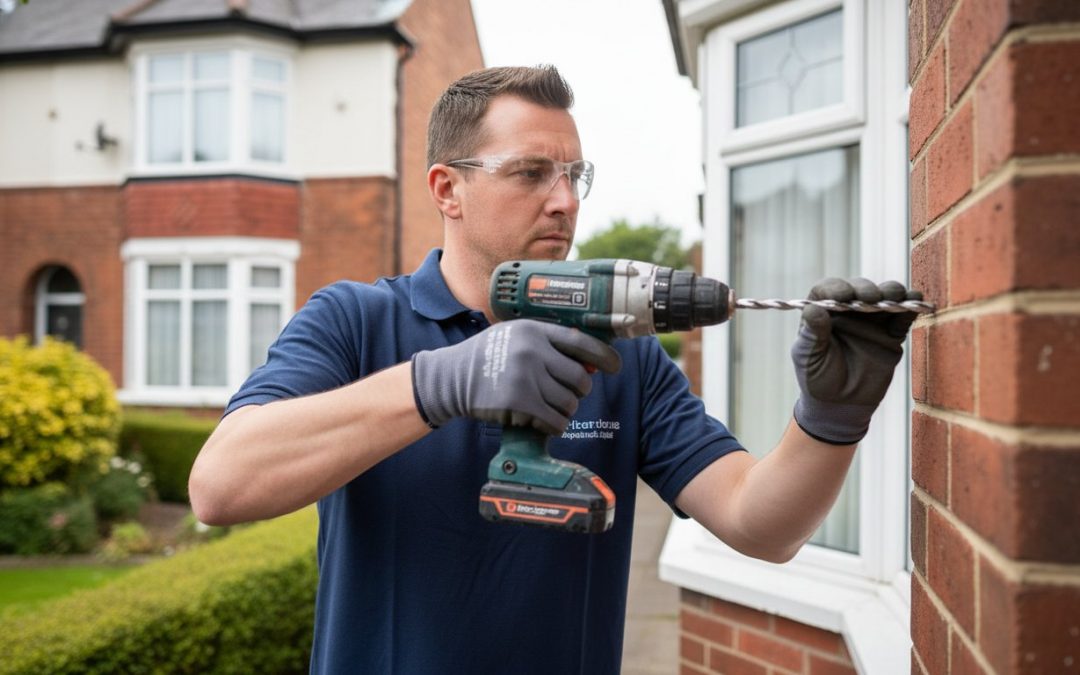
A homeowner in Manchester recently noticed horizontal cracking along their brickwork and felt the immediate weight of uncertainty regarding their property’s safety. It’s a common scenario where the fear of structural movement is compounded by the dread of having scaffolding and workmen on-site for an indefinite period. You likely share these concerns, worrying about the noise, the mess, and the potential for a drawn-out project that disrupts your family life.
Understanding exactly how long does wall tie replacement take is essential for regaining control over your home’s maintenance. Most property owners are relieved to find that professional remedial work is a methodical and efficient process. While minor repairs might be completed in just 1 to 3 days, a full-scale wall tie replacement typically takes between 2 and 5 days to execute correctly. This article provides a clear, day-by-day expectation of the work, from the initial specialist survey to the restoration of your masonry’s structural integrity. You’ll discover how modern, clean extraction techniques provide a permanent fix while maintaining a tidy and professional site environment throughout the duration of the project.
Key Takeaways
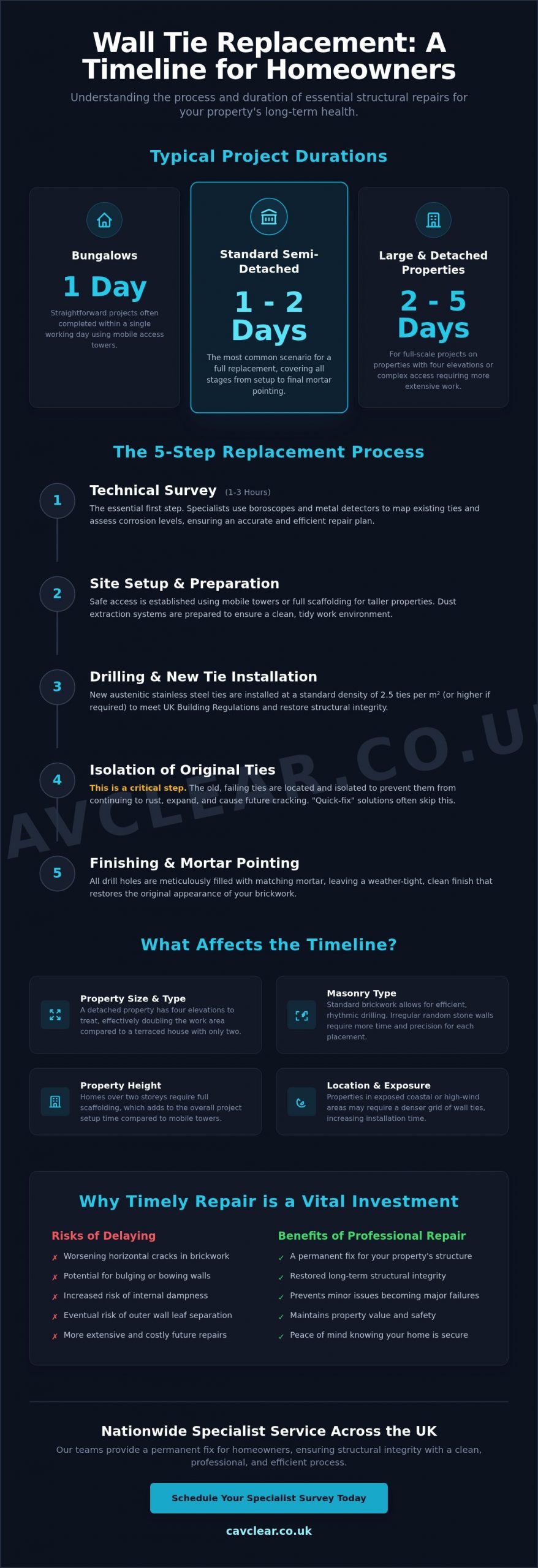
- Standard semi-detached properties typically require only 1 to 2 days for a full replacement, covering every stage from site setup to final mortar pointing.
- Understand the specific variables, such as masonry type and property scale, that determine how long does wall tie replacement take for your unique home.
- Learn why a technical survey using boroscopes is the essential first step to accurately map corrosion levels and ensure a targeted, efficient repair.
- Discover how specialist dust extraction systems and methodical site management minimise noise and residential disruption during the drilling phase.
- Identify the benefits of a professional remedial approach that prioritises long-term structural integrity and provides a permanent fix for your property.
How Long Does Wall Tie Replacement Take? The Short Answer
For most UK homeowners, the most pressing concern is how much time the remedial process will subtract from their daily lives. For a standard three-bedroom semi-detached property, a full replacement usually takes between 1 and 2 days. This timeline isn’t just a guess; it’s a reflection of a methodical engineering process that ensures your home’s stability for decades. While the actual installation of remedial ties is relatively swift, the preparation and finishing phases require a meticulous approach to ensure the property remains weather-tight and structurally sound.
The process begins with a technical survey, which typically lasts between 1 and 3 hours. During this phase, technicians use boroscopes and metal detectors to map the current state of the masonry. You should be wary of any “quick fix” solutions that promise completion in a few hours. These rushed jobs often ignore the critical step of isolating the old, corroding ties. Without isolation, the original cavity wall tie will continue to expand as it rusts, eventually causing the very horizontal cracking you’re trying to fix.
Defining the Scope of Remedial Wall Tie Works
A ‘full replacement’ is significantly different from a simple patch repair. It involves the installation of new, austenitic stainless steel ties at specific intervals, followed by the isolation of every existing failed tie. We follow strict density requirements, usually 2.5 ties per square metre, to meet UK Building Regulations. The property’s height also influences the schedule. If your home requires specialized scaffolding rather than mobile towers, the setup time might extend the project’s start date. We manage these logistics carefully to ensure the actual work on the masonry remains as non-disruptive as possible.
The Urgent Need for Specialist Timing
Delaying structural repairs never saves time in the long run. In fact, it often leads to secondary damage like bulging walls or internal dampness. Opting for a professional wall tie replacement early prevents total wall leaf separation. We operate as a nationwide specialist, ensuring that homeowners across the UK receive a permanent fix before minor cracks turn into major structural failures. Our teams focus on restoring the comfort and integrity of your home through a transparent, day-by-day schedule. This proactive approach isn’t just a repair; it’s a vital investment in your property’s long-term health and safety.
Variables Affecting the Speed of Structural Remediation
The physical dimensions of your property are the primary drivers of the project schedule. As a nationwide specialist, we account for these regional masonry variations across the entire United Kingdom. While a terraced house only requires treatment on two elevations, a detached property involves four separate walls, effectively doubling the surface area. This increase in square meterage directly correlates to the number of ties required. Standard brickwork allows our technicians to maintain a steady rhythm, but random stone walls present a different challenge. The irregular nature of stone masonry requires individual pilot holes to be carefully positioned, and this precision can add several hours to the labour timeline. Homeowners often ask how long does wall tie replacement take when faced with complex masonry, and the answer depends heavily on these technical constraints.
Building height and geographic location also dictate the necessary tie density. Properties in exposed coastal areas or those exceeding two storeys face higher wind loads, requiring a tighter grid of remedial ties than the standard 2.5 per square metre. Following official guidance for homeowners regarding structural repairs ensures your project remains compliant with safety standards. Scheduling a professional wall tie survey allows for a precise calculation of these variables before work begins.
The Impact of Property Size and Height
Bungalows are often the most straightforward projects. These are frequently completed within a single working day because they are accessible via mobile towers. Conversely, three-storey homes or those with difficult access points require full scaffolding. While the replacement process itself remains efficient, the time needed to erect and dismantle scaffolding must be factored into your overall expectations. We calculate the required number of ties per square metre during the inspection phase, which provides a reliable predictor of the total labour hours required for your specific property.
Complications from Retrospective Cavity Insulation
The presence of retrospective cavity insulation is a significant factor that many generic contractors overlook. Materials like bonded bead or mineral wool can hide existing corrosion and, more importantly, trap moisture against the metal ties, accelerating their failure. If your cavity is filled, the project timeline must include a phase for cavity wall insulation removal before any remedial ties are installed. This ensures the cavity is clear of debris, allowing the new stainless steel ties to be bedded into the inner leaf without obstruction. Attempting to install ties through wet insulation is a compromise that risks the long-term health of your masonry.
The Project Timeline: Breaking Down the Replacement Process
The transition from identifying a structural fault to completing a permanent repair follows a strict engineering sequence. Each stage is designed to ensure the structural integrity of your home while minimising disruption to your daily routine. Understanding the specific steps involved helps clarify exactly how long does wall tie replacement take for a typical UK residence. Our process is methodical, moving from diagnostic observation to physical remediation without unnecessary delays.
- Step 1: The Technical Survey — Technicians use boroscopes and metal detectors to map existing ties and assess corrosion levels within the cavity.
- Step 2: Access and Preparation — We set up mobile towers or scaffolding and protect the surrounding grounds to maintain a clean site.
- Step 3: Precision Drilling — Small entry points are created in the mortar joints to receive the new remedial stainless steel ties.
- Step 4: Isolation of Failing Ties — This is a vital step where we isolate the old, corroding ties so they can’t continue to expand and damage the masonry.
- Step 5: Testing and Pointing — We perform tension tests on the new ties before sealing the entry points with colour-matched mortar for a seamless finish.
Phase 1: The Diagnostic Survey
Many homeowners first discover structural issues during a professional damp survey, as horizontal cracking often leads to water ingress and internal dampness. A dedicated wall tie inspection typically takes about 2 hours for a standard property. During this time, accredited technicians perform a non-destructive assessment using boroscopic cameras to see inside the wall. You’ll usually receive a comprehensive remedial action plan within 24 to 48 hours of the inspection, allowing you to move forward with a clear understanding of the necessary works.
Phase 2: The On-Site Execution
On-Site Logistics and Minimising Residential Disruption
When assessing how long does wall tie replacement take, homeowners are often relieved to learn that the process is far less intrusive than a standard building project. Most of the audible disruption is concentrated during the drilling and extraction phases, which occur in short, manageable bursts. We use high-performance industrial vacuum systems to capture masonry dust at the point of origin, ensuring your garden, windows, and vehicles remain clean. This focus on a clean working environment is a standard part of our methodology, designed to restore your home’s structural integrity without compromising your comfort.
Weather conditions are a secondary factor that can influence the final project schedule. While the mechanical installation of new ties can proceed in most conditions, the final mortar pointing requires dry weather and temperatures above 5 degrees Celsius to cure correctly. If the UK weather brings heavy rain or frost, we may pause the finishing work to ensure the aesthetic match of the mortar is perfect. This commitment to quality ensures that the structural fix is not only permanent but also visually seamless, maintaining the kerb appeal of your property for years to come.
Maintaining a Clean Working Environment
Preparation Tips for Homeowners
To ensure the project remains on schedule, you can take a few simple steps to prepare your property. We recommend clearing a 1 to 2-metre perimeter around the affected walls by moving garden furniture, pots, or vehicles. Keeping pets indoors and ensuring driveways are clear allows our technicians to work safely and efficiently during the 1 to 2 days they are on-site. Choosing a nationwide specialist ensures these high standards of site management are consistent across the UK, providing a reliable and professional experience from start to finish. If you’re concerned about the stability of your masonry, you can book a professional wall tie inspection to receive a detailed logistical plan for your home.
Why CavClear is the Trusted Choice for Nationwide Wall Tie Replacement
CavClear provides a level of technical expertise that local general builders often cannot match. As a nationwide specialist, we deploy accredited technicians across the entire United Kingdom to deliver precise wall tie replacement solutions. Our approach isn’t just about fixing a visible symptom; it’s about a comprehensive property inspection that identifies the underlying cause of failure. We look beyond the surface cracks to understand the environmental factors affecting your masonry. Whether it’s the age of the original ties or the presence of moisture-trapping debris, we address the root problem to ensure long-term structural stability. A specialist survey is the only logical first step toward a permanent fix that protects your home’s value and your family’s safety.
The CavClear Methodology: Quality Over Speed
While we understand homeowners want to know how long does wall tie replacement take to minimize disruption, we refuse to compromise on safety. Rushing a structural repair often leads to the poor workmanship we are frequently called to rectify. Our methodology ensures every tie is correctly isolated and every new stainless steel tie is tested for tension before we sign off on the work. This rigorous process results in a detailed technical report that serves as a permanent record of the remedial works. This document is a vital asset for insurance purposes and provides essential proof of structural health during future property sales. Additionally, we maintain a firm stance against retrospective cavity insulation. We’ve seen firsthand how these materials accelerate tie corrosion and cause significant damp issues, which is why our remedial recommendations always prioritize a clear and dry cavity.
Your Next Steps for Structural Peace of Mind
Securing your property begins with an accurate diagnosis. Booking a nationwide survey with our team is a straightforward process that sets the foundation for a permanent structural fix. Our detailed reports provide more than just a price; they offer a full map of your property’s wall tie condition and a clear timeline for the necessary remedial works. This transparency eliminates the uncertainty of how long does wall tie replacement take by giving you a project-specific schedule that fits your life. Our technicians pride themselves on their no-nonsense, transparent approach, ensuring you understand every stage of the diagnostic and repair process. This methodical flow from observation to recommendation ensures you aren’t overwhelmed by the technical details while remaining fully informed. Secure your property’s future with a professional wall tie survey from CavClear and ensure your home remains a safe, stable investment for the future.
Securing Your Home’s Structural Future
Restoring the stability of your property doesn’t have to be a source of ongoing anxiety. While the question of how long does wall tie replacement take often leads to concerns about weeks of disruption, the reality is a streamlined process that typically lasts only 1 to 2 days for most UK homes. By prioritising a methodical approach that includes the isolation of corroded ties and the use of stainless steel replacements, you ensure a permanent fix that preserves your home’s long-term value.
CavClear operates as a nationwide specialist, deploying accredited technicians who provide detailed structural reports to guide every remedial recommendation. We specialise in both clean insulation extraction and precision wall tie replacement, ensuring your cavity remains clear and your masonry remains secure. Taking action now prevents minor cracks from developing into significant structural failures. Book a professional wall tie survey with CavClear today to receive a clear, expert assessment of your property’s specific needs. You can move forward with confidence, knowing your home is in the hands of dedicated specialists committed to structural integrity and your peace of mind.
Frequently Asked Questions
How do I know if my wall ties need replacing immediately?
You can identify the need for immediate replacement by looking for horizontal cracking in mortar joints or visible bulging in the external brickwork. These symptoms indicate that the original steel ties have corroded and expanded, which exerts pressure on the masonry. If you notice movement around window frames or doors, the structural integrity is already compromised. A professional inspection is necessary to confirm the extent of the failure before the outer leaf becomes unstable.
Can I stay in my house while the wall ties are being replaced?
You can remain inside your home throughout the entire replacement process because all remedial work is performed from the exterior. Our technicians don’t require internal access to install the new stainless steel ties or isolate the failing ones. While there is some noise during the drilling phase, it is localised and intermittent. We prioritise a clean site environment, ensuring that your daily routine remains undisturbed while we secure the property’s structure.
Does wall tie replacement require scaffolding for a standard house?
Scaffolding isn’t always a requirement for standard two-storey residential properties. In many cases, we use mobile access towers to reach the upper elevations safely and efficiently. However, if your home has three storeys or difficult access points over conservatories, fixed scaffolding may be necessary to meet safety standards. The choice of access equipment is determined during the initial survey and directly influences the total project schedule and on-site logistics.
How long do modern stainless steel remedial wall ties last?
Modern remedial ties made from austenitic stainless steel are designed to last for the remaining life of the building, typically over 50 years. Unlike the mild steel ties used in houses built before 1981, stainless steel is highly resistant to corrosion even in damp cavity environments. This durability makes the replacement a permanent structural fix. By choosing high-quality materials, you’re making a long-term investment in the asset health and efficiency of your property.
Will the replacement process leave visible marks on my brickwork?
The replacement process is designed to be virtually invisible once completed. We drill small entry points into the mortar joints rather than the bricks themselves. After the new ties are secured, these holes are filled with mortar that is carefully colour-matched to your existing masonry. This attention to detail ensures that the structural repair doesn’t detract from the kerb appeal of your home, leaving the exterior looking clean and professional without any obvious signs of remediation.
What happens if I ignore failing wall ties for too long?
Ignoring failing ties leads to progressive structural damage, including the potential collapse of the outer wall leaf during high winds. As ties corrode and expand, they create cracks that allow water ingress, often resulting in internal dampness and timber decay. Addressing the issue early is vital to prevent these secondary problems. Delaying the work only increases the complexity of the eventual repair and risks the safety of the building’s occupants and the public.
Is a wall tie survey necessary before getting a quote for the work?
A formal survey is essential because it allows us to determine the exact density and type of ties required for your specific masonry. Without a boroscopic inspection, it’s impossible to see the level of corrosion or identify if debris in the cavity is accelerating the failure. Understanding how long does wall tie replacement take for your home depends on these technical findings. A survey ensures you receive an accurate remedial recommendation based on concrete structural facts.
How does the weather affect the duration of the replacement project?
Weather conditions primarily affect the final pointing stage of the project. While we can install mechanical ties in most conditions, heavy rain or temperatures below 5 degrees Celsius can prevent the mortar from curing correctly. If the conditions are unsuitable for finishing, we may pause the work to ensure the aesthetic match remains perfect. This commitment to quality ensures that the final result is structurally sound and visually seamless, ensuring how long does wall tie replacement take remains a predictable timeline.
Recent Comments