
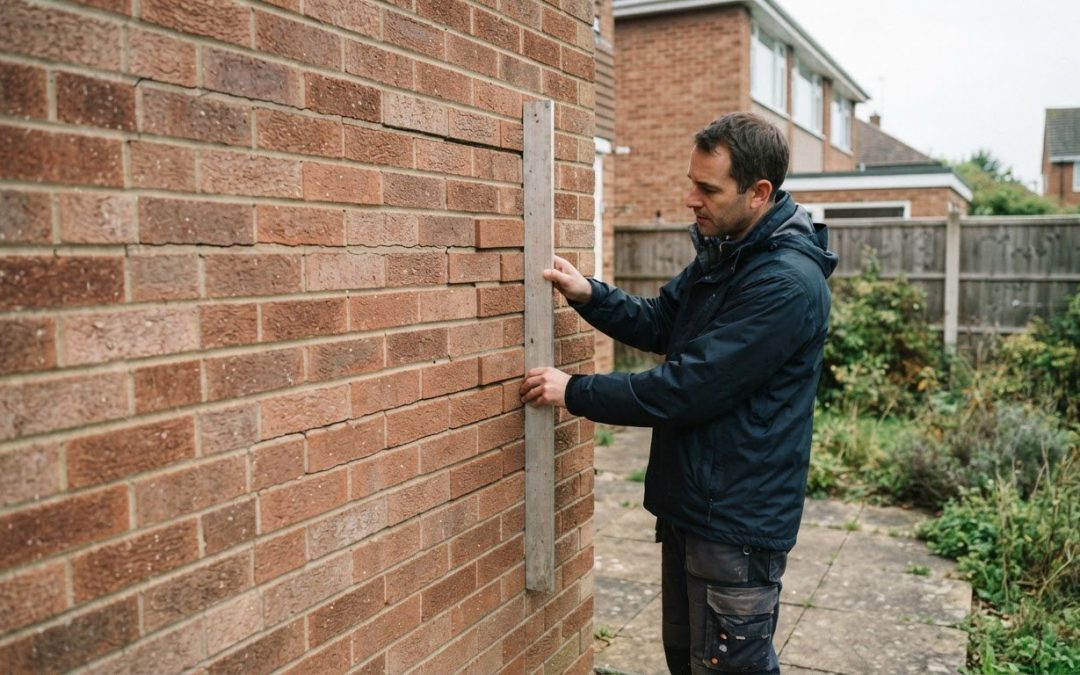
A horizontal crack in a mortar joint can point to movement inside a cavity wall, not just a surface defect. Understanding how failed wall ties can cause horizontal cracks starts with corrosion: as metal ties rust, they expand and press against surrounding masonry, opening bed joints and sometimes pushing brickwork outwards. Cracks may recur at roughly 450 mm intervals, around every sixth mortar course.
It’s understandable to be concerned when cracks appear, particularly if they form a repeated pattern. However, horizontal cracks can have several causes, so their pattern is a clue, not proof of wall tie failure.
This article explains what wall ties do, how corrosion or other failures can affect the outer wall, and which additional signs may warrant specialist inspection. You’ll also learn how a wall tie survey can help identify the cause of cracking and guide appropriate remedial work.
Key Takeaways
- Wall ties connect the two leaves of a cavity wall, helping them remain stable together.
- Corroding ties can expand and press against mortar joints, creating horizontal cracks and sometimes pushing brickwork outwards.
- Cracks can have several causes, so their direction or pattern alone cannot confirm wall tie failure.
- Bulging brickwork and recurring cracks may strengthen the case for a specialist wall tie inspection.
- A wall tie survey can investigate the cause of the damage and help determine whether replacement is needed.
What Are Wall Ties?
In a cavity wall, metal ties connect the inner and outer leaves of masonry. They help the two leaves act as one stable structure and resist sideways forces, including wind. UK cavity walls commonly have a gap around 50 to 100 millimetres wide. The ties cross that space, with their ends embedded in the masonry. If a tie corrodes or loses its grip, the outer leaf can move more expertly.
Corrosion can damage masonry because rust takes up more space than the original steel. As a tie rusts, it can expand and press against the surrounding mortar, potentially splitting a horizontal bed joint. The pressure may also lift nearby masonry or crack bricks. Because the damage follows the tie’s position inside the wall, it can form a repeated pattern rather than one isolated surface crack.
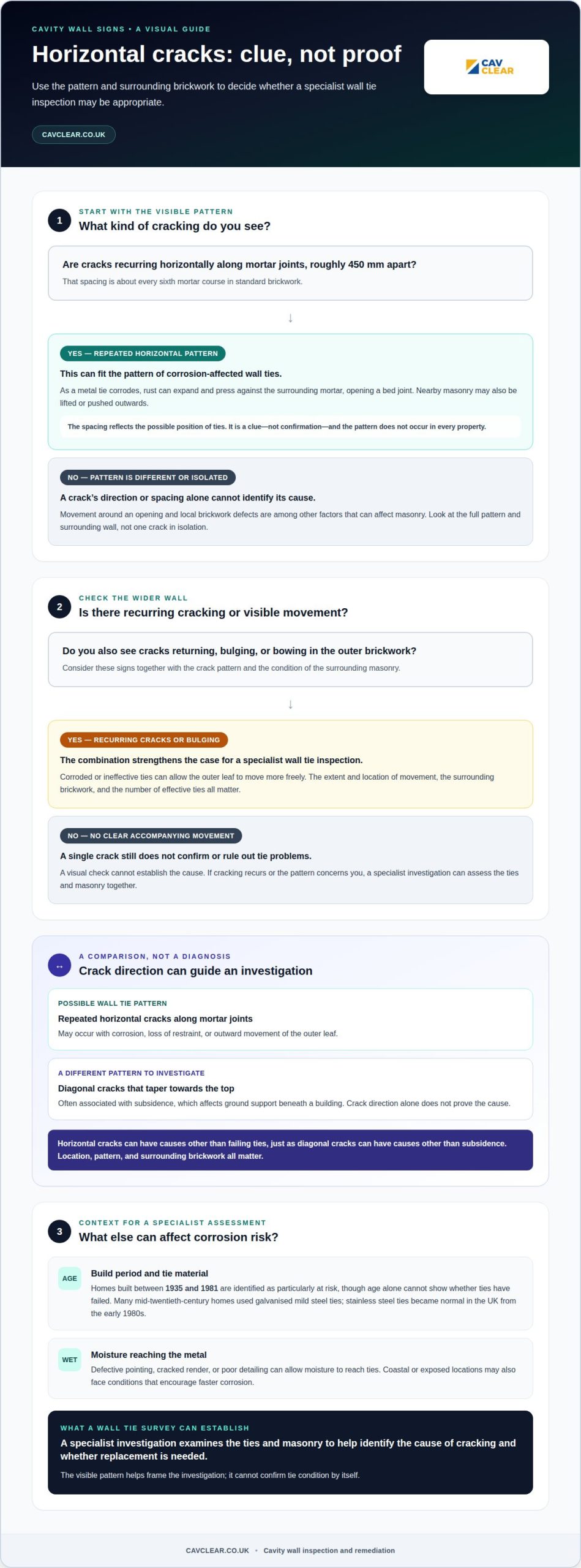
Horizontal cracks associated with corroding ties can recur at roughly 450 millimetre intervals, about every sixth mortar course in standard brickwork. This spacing reflects the vertical arrangement of ties, not a guaranteed pattern in every property. A crack may follow a bed joint, then appear again several courses above or below. Corrosion can also produce localised cracks around a tie, where pressure acts directly on the surrounding mortar.
Age and material affect corrosion risk. Many mid-twentieth-century UK homes used galvanised mild steel ties, and cavity walls built before the early 1980s commonly contained them. Older protective coatings can deteriorate, allowing moisture to reach the steel. Moisture entering through defective pointing, cracked render or poor detailing can accelerate corrosion. Coastal or exposed locations may also face conditions that encourage faster corrosion.
Wall ties are commonly spaced about 900 millimetres horizontally and 450 millimetres vertically under the cited structural guidance. If ties are arranged differently, the guidance specifies at least 2.5 ties per square metre. These figures describe spacing guidance, not a way to diagnose a particular wall from its cracks. Stainless steel ties became normal in the UK from the early 1980s, but a property’s age alone cannot establish the condition of its existing ties. A specialist inspection can assess the masonry and ties together.
What Is Wall Tie Failure?
Wall tie failure occurs when ties no longer hold the two leaves of a cavity wall securely together. The resulting crack pattern may differ from subsidence, but a visual check alone cannot establish the cause.
Distinguishing Tie Failure from Subsidence
Wall tie failure affects the connection between the inner and outer leaves of a cavity wall. Corroded or ineffective ties may allow the outer leaf to move, causing horizontal cracks or outward bulging. Subsidence affects the ground support beneath a building and typically causes diagonal cracks that taper towards the top.
Crack direction can help surveyors frame an investigation, but it does not prove the cause. Diagonal cracks can have causes other than subsidence, just as horizontal cracks can have causes other than failing ties. The location, pattern and surrounding brickwork all matter. For example, repeated cracks along mortar joints, especially with visible wall movement, provide different evidence from one isolated crack.
Other factors can affect masonry too, including movement around an opening or local brickwork defects. Distinguishing between these patterns matters because repairs need to address the underlying cause, not just cover the visible crack.
Risks of Untreated Tie Failure
As wall tie failure progresses, the outer leaf may lose restraint against sideways movement. Corrosion and expansion can put pressure on mortar and bricks, while ties that have lost their grip may no longer hold the leaves securely together. This can lead to worsening cracks, displaced masonry or outward bulging.
More severe movement can affect wall stability and needs prompt attention. A bulging wall is not simply a cosmetic concern: continued movement can affect how securely the masonry remains in place. The risk depends on the extent and location of the failure, the condition of the surrounding brickwork and whether enough effective ties remain.
If the cause remains unaddressed, surface repairs may not resolve recurring cracks. Repointing a horizontal joint, for example, does not restore a tie’s connection across the cavity. Establishing whether ties have failed is therefore central to deciding what remedial work is appropriate.
British Standards and Premature Failure
British wall-tie standards changed over time, including their requirements for galvanising. A UK wall-tie standard introduced in 1945 set a minimum thickness for the protective coating, and that minimum was reduced in 1968. In 1981, the zinc coating on wire ties was tripled in thickness.
These changes help explain why tie material and installation period can matter when surveyors assess a property. Homes built between 1935 and 1981 are identified as particularly at risk, although age alone cannot show whether ties have failed. Moisture exposure, tie type and the condition of the masonry also inform an assessment.
The Building Research Establishment has indicated that steel or iron ties installed before 1981 may be at risk of premature failure against a notional 60-year building life. That risk context is not a diagnosis of an individual cavity wall. A specialist investigation can examine the ties themselves and establish whether corrosion, loss of embedment or another defect explains the cracking.
Other signs including regular vertical cracks and bulging brickwork
Horizontal cracks are not the only visible change in cavity walls. Wall tie problems may also accompany bulging or bowing in the outer leaf, where brickwork appears to curve away from the building. Regular vertical cracks can also appear, particularly around openings or where sections of masonry meet. Consider these signs as part of the overall pattern, but remember that no single crack direction confirms wall tie failure.
Look at how the affected area relates to the rest of the elevation. A local bulge alongside repeated cracks, for example, differs from one narrow crack near a window. A roof edge that appears lifted or separated from the wall is another change to include in an assessment. It does not identify the cause on its own, but may indicate movement at the wall and roof junction that needs investigation.
Other defects can cause cracking or bulging. Subsidence typically causes diagonal cracks that taper towards the top, while wall tie failure more commonly causes horizontal cracks and wall bulging. Cracked render, defective pointing or poor detailing can also allow moisture into a cavity and contribute to tie corrosion. Movement around an opening or local masonry damage may create a different pattern. Surveyors consider these possibilities together rather than diagnosing from one mark.
Some movement calls for prompt assessment. A cavity wall more than about 25 mm out of plumb should be assessed by an engineer without delay. A wall bulging more than about 10 mm within a single-storey height also warrants assessment without delay. These measurements describe signs that need attention, not a test that confirms corroded ties. The condition and stability of the affected wall remain central to determining remedial work.
Bulging and bowing matter because the outer leaf may no longer be held securely in position. Concern increases if movement appears to be progressing, bricks are displaced, or cracks are widening. For example, a bowed elevation with loose or visibly shifted bricks needs a different level of attention from an isolated hairline crack. An inspection can establish the extent of movement and whether cavity wall ties are involved.
Record where each sign occurs, such as above a window, along a roof edge or across one elevation. Comparing these locations with the crack pattern helps an inspection distinguish local damage from broader wall movement. The pattern guides the investigation, but does not replace it.
Surveyor inspections and specialist investigation
A specialist investigation considers both the masonry and evidence from inside the cavity. The surveyor records where cracking or bulging appears, which elevations are affected and whether other visible defects may contribute. This builds a property-specific picture instead of treating one crack as a complete diagnosis. External details, such as pointing and render, also provide context when assessing potential moisture entry.
A metal detector can help locate ties behind the outer leaf and guide further examination. A borescope camera is inserted through small holes drilled into mortar joints, allowing the surveyor to view and grade ties within the cavity. These observations can reveal corrosion or other deterioration that cannot be judged reliably from the external brickwork alone.
Where closer evidence is needed, an inspector may expose sample ties. Examining the metal directly can help assess its condition and compare it with borescope observations elsewhere. The surveyor can then consider whether the findings are consistent across an elevation or whether deterioration appears localised. The investigation method depends on what the initial inspection reveals.
A useful report sets out the observed defects, areas examined and investigation findings. It should explain how those findings relate to visible cracking or movement, then recommend remedial work where needed. For example, evidence of corroded ties in an affected area may lead to a different recommendation from a survey that finds no tie defect there.
Because cracking and bulging can have several causes, an investigation also considers alternative explanations. Defective pointing, cracked render or poor detailing may contribute to moisture entering a cavity. A surveyor weighs these observations alongside tie condition and masonry movement, rather than treating a surface symptom as proof of one specific structural defect.
The final assessment should make clear what was inspected and where further investigation took place. This distinction matters if only selected areas were accessible or sample ties were exposed. Clear findings help property owners, buyers and property professionals understand the evidence and recommended next step, whether that involves remedial work or further assessment of the cavity wall.
Horizontal bed joint cracking as a sign of failing wall ties
The details of a horizontal crack can help explain what is happening to a wall. An inspection considers whether the line follows one mortar course, changes direction or appears alongside cracked bricks. A crack confined to a short section provides different evidence from one extending across a broad part of an elevation. Its position and relationship to nearby masonry matter as much as its direction.
Cracks may be interrupted by windows, doors or changes in the brickwork. These interruptions do not automatically confirm or rule out wall tie failure. For example, a crack stopping at a window shows where the visible damage ends, but not what is happening inside the cavity above or beside it. The surrounding masonry needs to be considered as a whole.
Inspectors also distinguish an open joint from a surface mark. A crack may follow the mortar, pass through the face of a brick or show signs of previous filling. These differences help describe the condition accurately. Earlier repointing can obscure the original line, so an inspection records visible repairs alongside current cracking rather than treating every filled joint as evidence of active movement.
Changes over time provide another useful part of the picture. Comparing dated photographs can show whether a crack has lengthened, widened or remained visually similar. A single photograph captures only one moment. It cannot establish whether movement is continuing or identify its cause, but it can help an inspector understand the history of the affected area.
Cracking may vary across an elevation. One section can show a clear horizontal line while another has no obvious damage. This variation helps identify where closer assessment may be relevant, but the absence of visible cracks does not establish the condition of ties elsewhere. The inspection relates the affected masonry to other observations across the property.
The useful takeaway is to describe the crack precisely, not diagnose it from appearance. Note whether it follows mortar or crosses bricks, where it begins and ends, and whether previous filling is visible. Understanding how failed wall ties can cause horizontal cracks is part of the wider assessment, but the pattern needs to be considered alongside other evidence from the wall before remedial work is recommended.
CavClear
CavClear helps property owners across the UK investigate cavity wall concerns, including recurring horizontal cracks, bulging brickwork and suspected tie failure. Its wall tie surveys and cavity wall surveys assess the condition of the wall and help establish whether visible cracking relates to cavity wall ties or another issue. This is a practical next step when cracks return, follow a repeated pattern or appear alongside movement in the masonry.
A survey can examine affected areas and identify findings relevant to the property. CavClear provides written reports with findings and recommended remedial solutions, giving homeowners, buyers, surveyors and mortgage lenders clear information about the cavity wall. For a pre-purchase decision, a specialist inspection can help assess concerns that a crack pattern alone cannot resolve.
If an inspection identifies failed or corroded ties, Wall Tie Replacement addresses the connection between the wall leaves. The appropriate remedial work depends on the survey findings and the extent of affected masonry. A report explains what has been observed and what work is recommended, rather than treating every horizontal crack as evidence of the same defect.
Cavity wall concerns can also involve insulation. Defective or incorrectly installed cavity wall insulation may contribute to moisture problems within a property. CavClear carries out Cavity Wall Insulation Removal when a professional survey confirms it is needed. This work is distinct from wall tie replacement, though an inspection may consider issues within the same cavity wall system.
These services are relevant at different points: a homeowner may need an investigation after noticing cracks, while a buyer may seek a pre-purchase cavity wall inspection. A survey can also help clarify the cause of bulging or recurring brickwork movement before remedial work is planned. Its findings guide the next step, whether that involves wall ties, other cavity wall concerns or removal of defective insulation.
CavClear provides specialist cavity wall services nationwide across the UK. The focus is on assessing the evidence, reporting findings clearly and recommending appropriate remedial solutions for each property. A survey offers a considered route from visible symptoms towards a better understanding of the wall’s condition.
Contact CavClear to discuss a cavity wall concern.
Frequently Asked Questions
Can it be repaired without rebuilding the wall?
The repair scope may be limited to affected parts of the wall rather than requiring an entire elevation to be rebuilt. The condition of the bricks, mortar and surrounding masonry helps determine what work is needed after the tie defect has been assessed. If sections have suffered substantial damage, repairs may need to address that masonry too. A written recommendation should explain the work required for the specific area.
Do all cavity walls have this problem?
No. Having a cavity wall does not mean its ties have failed. Tie condition varies between properties, even where construction types appear similar. For example, a home with intact masonry and ties may have no tie-related defect, while another property may need closer assessment. Visible cracking is a reason to consider the building’s condition, not to assume every cavity wall needs remedial work.
Does this affect newer houses?
Newer buildings can still develop defects, so age should not be the only consideration. The way ties were selected, positioned and installed can affect their performance, as can the condition of the surrounding masonry. If a newer home shows cracking or movement, the relevant question is whether the evidence points to a cavity wall defect. An assessment can establish whether tie-related investigation is appropriate.
How does a surveyor confirm it?
A surveyor reaches a conclusion by comparing physical evidence with the property’s construction and condition. The report should identify the areas examined, explain the significance of the findings and distinguish observed defects from possible causes. For example, it can clarify whether further investigation is recommended before remedial work is specified. This gives the owner a record to use when planning the next step.
What should you do if you are buying a property with these signs?
Arrange a specialist pre-purchase cavity wall inspection and obtain written findings before deciding how the signs affect your plans. The report can set out the areas assessed and any recommended remedial work, helping you understand the property-specific issue rather than relying on a brief description of cracking. Keep the report with the property documents so its findings are available when planning maintenance or discussing the building with relevant professionals.
How do failed wall ties cause horizontal cracks in brickwork?
Cracking develops when forces within the cavity wall affect the masonry around a tie. Visible damage may involve mortar, brick faces or both, depending on the tie’s location and the condition of the surrounding materials. The crack records stress in the wall, but does not reveal the precise condition of every tie. Establishing the connection requires evidence about the cavity as well as the external surface.
What do horizontal cracks caused by wall tie failure look like?
Cracks may appear as a split in a mortar joint, a damaged brick face or a repaired line that has become visible again. Surface finishes can make the original extent harder to judge, particularly where previous repointing or filling has covered the area. A clear, straight-on photograph showing the full affected section can help document its appearance for an inspection.
How can you distinguish wall tie failure cracks from other types of cracks?
Visual clues can guide an assessment, but cannot reliably establish the cause on their own. Consider the crack’s location in relation to openings, changes in materials and previous repairs. A recurring defect in one area may need a different investigation from damage at a junction between materials. A specialist considers these building details alongside the wider condition before recommending remedial work.
Recent Comments