
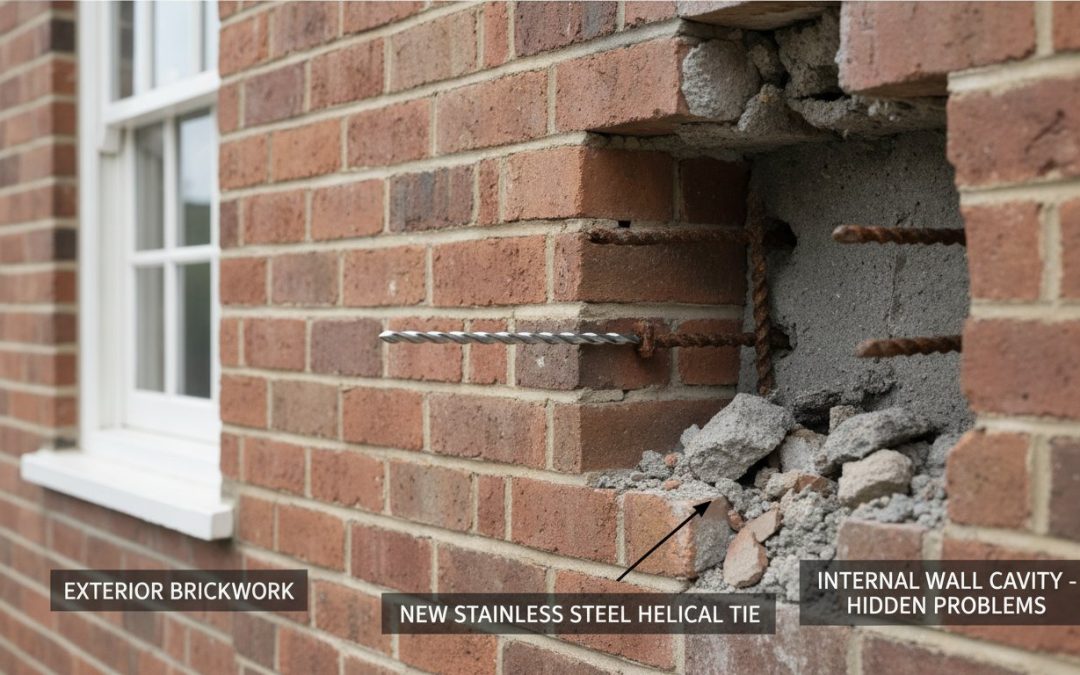
What if the most expensive part of your structural repair isn’t the stainless steel ties themselves, but the debris trapped deep inside your cavity walls? Many homeowners begin their research by looking for a simple price per tie, only to discover that the hidden costs of wall tie replacement often stem from logistical variables that aren’t visible from the street. It’s a stressful experience to receive a quote that feels like a moving target, particularly when the safety and stability of your property are at stake.
We recognize that technical jargon and the fear of escalating bills can make property maintenance feel overwhelming. You deserve a transparent explanation of why certain repairs require more intensive labor than others. This guide explains the critical factors that influence your project, from the impact of existing cavity insulation to the specific requirements of 2022 Building Regulations (Part L). We’ll examine how access requirements and the condition of your masonry dictate the true scope of work, helping you avoid poor repairs and ensuring the long-term structural integrity of your home.
Key Takeaways
- Understand why wall tie replacement is a vital structural investment rather than a cosmetic repair, and why a “price per tie” quote often fails to reflect the true scope of work.
- Identify the hidden costs of wall tie replacement associated with site access, property height, and the presence of debris within the cavity that can complicate installation.
- Learn to avoid the “buy it twice” scenario by ensuring the use of stainless steel ties and correct specifications that meet modern building standards.
- Discover the importance of professional wall tie surveys and pull-testing to verify the structural bonding strength before committing to a full remedial plan.
- Recognise how a specialist, non-disruptive approach protects your property’s long-term value and ensures a clean, efficient site during the restoration process.
Beyond the Quote: What Defines the True Cost of Wall Tie Replacement?
Wall tie replacement isn’t a cosmetic upgrade like a new kitchen or a fresh coat of paint; it’s a critical structural intervention. When you observe horizontal cracks in your mortar or bulging brickwork, you’re seeing the external symptoms of a failing internal skeleton. Understanding the hidden costs of wall tie replacement begins with recognizing that your home’s stability depends entirely on the connection between the inner and outer leaf. If these ties fail, the outer leaf can become detached, leading to catastrophic structural movement or collapse.
While structural stability is the immediate priority, many homeowners use these repairs as a starting point for wider property improvements. For those considering more extensive residential or commercial projects, Crafted Master Building Contracting LLC offers comprehensive renovation and construction services that can transform a property after its structural integrity is secured.
To understand the scope of the project, homeowners must first understand what cavity wall ties are and the vital role they play in load-bearing masonry. They aren’t just simple pins; they’re structural anchors designed to distribute wind loads and stabilize the building’s envelope. Many homeowners focus on the unit price of the hardware, but the physical cost of the ties represents a tiny fraction of a professional remedial budget. The real investment lies in the methodology, the precision of the installation, and the management of ancillary costs that often emerge once the project moves beyond the initial estimate.
The Misleading Nature of Standard Unit Pricing
Relying on a simple “price per tie” metric is often a mistake for UK property owners. This figure rarely accounts for the complexity of the host material. For example, installing ties into high-density concrete blocks or traditional stone walls requires significantly more labor and specialized drill bits than standard brickwork. Additionally, a basic quote might assume a standard pattern of 2.5 ties per square metre, but it often ignores the labor-intensive process of locating and isolating “lost” or failing original ties. If the old ties aren’t properly identified and treated, they continue to corrode and expand, leading to further masonry damage that requires expensive repointing later.
Why Initial Estimates Often Underestimate Structural Reality
The true state of a building’s interior cavity is often revealed only after the physical work begins. Initial surveys provide a diagnostic baseline, but the “expansion factor” of rusting mild steel ties can create hidden damage. As a tie corrodes, it can expand to several times its original thickness, physically lifting the mortar joints and cracking the surrounding masonry. This isn’t just a replacement job; it’s a structural restoration. In some cases, simple ties aren’t enough, and the project must evolve into a full lateral restraint solution to stabilize a bowing wall. These are the hidden costs of wall tie replacement that a generic, surface-level estimate will inevitably miss.
Logistical Gotchas: Access, Debris, and Cavity Variables
Physical access to your property’s facade is a major factor in project budgeting. While homeowners often focus on the price of the ties, the methods used to reach the upper storeys of a building carry significant weight in the final invoice. Precision drilling and correct tie placement require a stable, vibration-expert platform that simple ladders cannot provide. This is where logistical variables begin to impact the total investment. Recognising the signs of wall tie failure is only the first step; the physical environment of the cavity determines how effectively those ties can be replaced.
The Scaffolding and Access Financial Hurdle
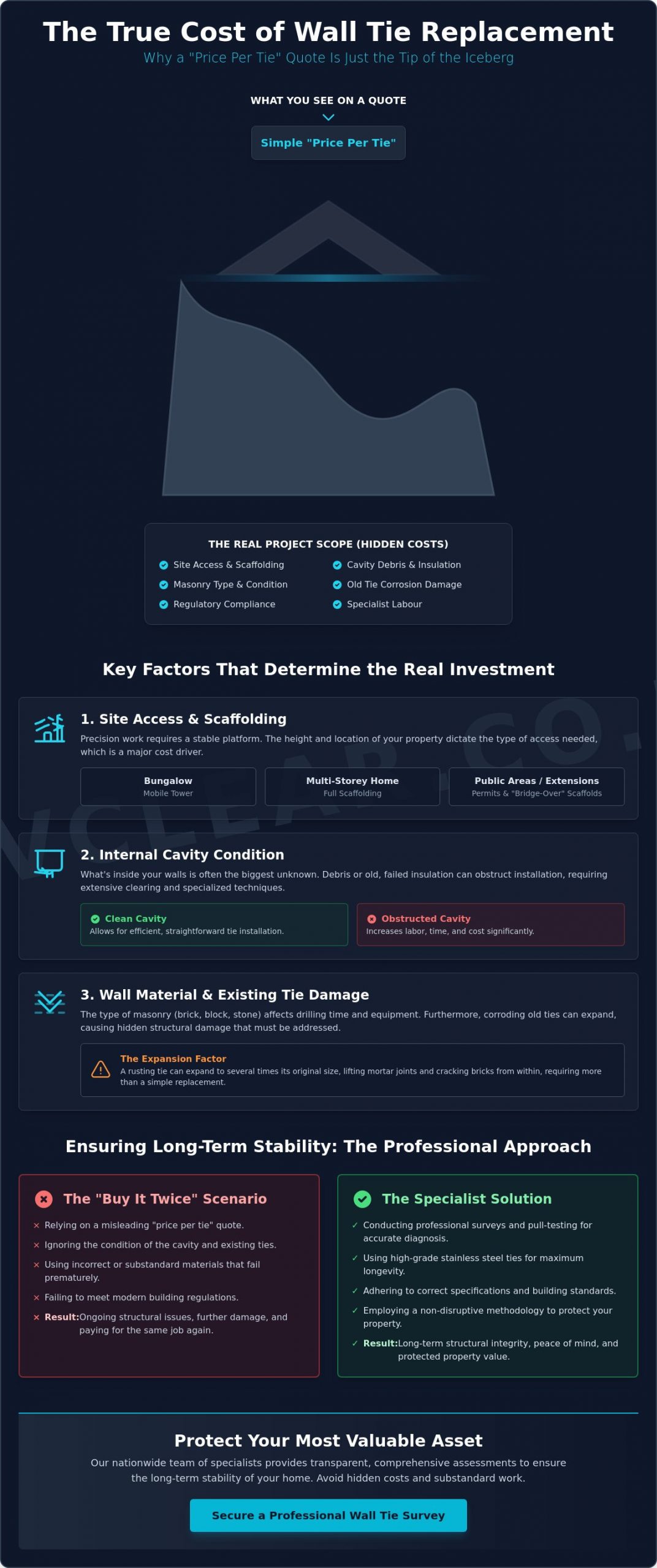
Property height and location are primary drivers of the hidden costs of wall tie replacement. Specialist contractors require high-level access to ensure every tie is installed at the correct angle and depth. While a low-level bungalow might only require a mobile tower, a three-storey semi-detached home often necessitates full independent scaffolding. If your home faces a public footpath or road, you’ll also need to account for pavement licenses and local authority permits. These administrative costs are mandatory for safety and legal compliance. Additionally, if your home features a conservatory or a lightweight extension, contractors must often install “bridge-over” scaffolding. This specialized structure protects your extension while allowing technicians to reach the main walls above, adding significant time and equipment costs to the project.
The Hidden Danger of Debris and Previous Insulation
The condition inside your walls is just as important as the external brickwork. In many cases, professional cavity wall insulation removal is a non-negotiable prerequisite for a successful tie replacement. If a cavity is filled with old, degraded insulation or “dirty” mortar droppings from the original construction, the new ties cannot be seated correctly. Debris at the base of the cavity can also bridge the gap between the inner and outer leaf, creating a path for moisture to travel and cause dampness. Contaminated cavities can cause remedial ties to fail pull-tests, rendering the repair ineffective. Scheduling a professional cavity wall survey is the most effective way to identify these logistical hurdles before work begins.
Finally, you must consider the cost of “making good” the facade. Once the new ties are installed, the drill holes must be filled with a mortar that matches your existing brickwork. Achieving a seamless finish requires skilled labor and specific mortar pigments. If your property uses traditional lime mortar or unique historic bricks, the time required for mortar matching and repointing will naturally increase the overall budget. These steps are essential to protect the long-term structural integrity and aesthetic value of your home.
The Financial Fallout of Substandard Workmanship
Choosing a general builder over a specialist might seem like a cost-saving measure, but it often invites the most significant hidden costs of wall tie replacement. Substandard workmanship doesn’t just fail to solve the problem; it creates new structural liabilities that can cost twice as much to rectify. One of the most common errors involves using incorrect tie lengths for specific cavity widths. If a tie doesn’t achieve the minimum embedment depth in the inner leaf, it provides zero structural restraint. Conversely, using oversized drill bits or excessive hammer action can shatter fragile inner-leaf materials like lightweight thermalite blocks, leaving the new tie with nothing to grip.
Another critical failure is the neglect of original corroding ties. Simply installing new ties alongside old ones is insufficient. The original mild steel ties must be isolated or removed. If left untreated, they continue to oxidize and expand, physically lifting the mortar joints and eventually causing the very masonry cracking the repair was intended to prevent. This oversight forces homeowners into a cycle of “doing it twice,” where the facade must be opened up again to fix the damage caused by the initial poor repair. The cost of removing a failed remedial installation is significantly higher than getting it right the first time.
The “Cheap Contractor” Trap: Material and Pattern Errors
Structural safety relies on a precise 450mm staggered spacing pattern. Deviating from this standard compromises the load-bearing capacity of the wall, particularly during high wind events. Cheap contractors often cut corners by using galvanized steel ties instead of high-grade stainless steel. In aggressive environments or when paired with acidic mortars, galvanized coatings fail rapidly. The resulting chemical reaction leads to “blown” bricks, where the expanding metal forces the brick face to shear off, necessitating expensive masonry replacement that goes far beyond simple repointing.
Long-term Asset Health vs. Short-term Savings
Investing in certified specialist work protects your home’s value during future property sales. Mortgage surveyors are trained to identify non-standard remedial work. Without a specialist report and a clear methodology, a failed wall tie inspection can derail a sale or lead to significant price renegotiations. A professional installation ensures the long-term preservation of the wall cavity function, maintaining the essential air gap that prevents moisture transfer. This specialist approach transforms a repair into a vital asset protection strategy, providing the documentation needed to satisfy insurers and lenders alike.
Calculating the Real Investment: Surveys, Testing, and Regulations
A professional diagnostic phase is the only way to accurately quantify the hidden costs of wall tie replacement. Many property owners view a survey as a mere formality, but it is actually a precise engineering assessment. Without it, contractors are essentially guessing the condition of the internal leaves and the density of the existing tie grid. A specialist survey ensures that the remedial plan is based on data rather than assumptions, preventing mid-project price hikes. These diagnostic steps identify the specific technical requirements of your building before the first drill bit touches the masonry.
The Role of the Specialist Survey
A comprehensive damp survey often works in tandem with a wall tie inspection. This dual approach reveals how corrosion might be linked to moisture ingress or condensation within the cavity. Industry standards require a minimum sampling of 10% of the ties across the building’s facade to provide a statistically reliable quote. Specialists use high-sensitivity metal detectors to map the existing tie grid, which identifies areas where original ties were omitted or spaced incorrectly. This mapping phase is vital for calculating the exact volume of replacement hardware required for structural safety.
The use of an endoscope is another non-negotiable part of a professional survey. The endoscope provides a non-invasive window into the cavity, allowing the surveyor to see the true state of the wall ties and the presence of any mortar bridges. These “snots” of mortar can transfer moisture from the outer leaf to the inner leaf, leading to internal dampness. Identifying these issues early allows for a more accurate budget that accounts for both structural repair and environmental protection.
Verification and Certification Costs
On-site verification is a standard part of a professional remedial contract. Technicians perform pull-tests using calibrated equipment, which measures the physical bonding strength between the new tie and the masonry leaf. This testing ensures the repair meets the structural requirements for wind loading and lateral stability. Without these tests, there is no objective proof that the ties are functioning as intended. These verification steps culminate in a Certificate of Completion, which is a vital document for future mortgage applications and property sales. It proves to lenders that the work was performed to a recognized technical standard.
Building Control sign-off is often required for structural remedial work, especially in multi-storey properties or buildings with specific heritage protections. These regulatory fees and the time required for inspections represent significant hidden costs of wall tie replacement that must be factored into the early budgeting stage. To ensure your project meets these rigorous standards and protects your property’s long-term value, you should book a wall tie survey with a national specialist who understands the interplay between regulations and structural integrity.
Why a Specialist Approach Protects Your Property Value
A specialist approach is the most effective way to eliminate the hidden costs of wall tie replacement. While general repairs might offer a temporary fix, they often fail to address the underlying structural dynamics that lead to masonry failure. CavClear’s national expertise provides a safer return on investment by combining technical rigor with a deep understanding of UK property archetypes. We prioritize the restoration of structural integrity through methods that are both permanent and non-disruptive. Our “clean-site” promise ensures that your home remains a comfortable environment throughout the remedial process, with minimal impact on your daily routine.
Structural stability is a fundamental pillar of property preservation. Professional wall tie replacement acts as a shield against the progressive deterioration that occurs when ties are neglected or replaced incorrectly. By addressing these issues proactively, you prevent the need for more invasive and expensive masonry reconstruction in the future. Our methodology focuses on long-term asset health, framing our services not as a simple repair, but as a vital investment in your home’s future marketability and safety.
The CavClear Methodology: Reliability and Rigour
Our technical standards are built on the use of high-grade stainless steel remedial ties as a standard requirement. These materials resist the chemical aggression of diverse mortar types and provide a lifespan that can exceed the building itself. Our accredited technicians understand the specific challenges posed by different UK building eras, ensuring that the remedial pattern is tailored to the unique load-bearing needs of your home. Because we operate as a nationwide company, we provide consistent, high-level service coverage across the entire United Kingdom, ensuring that property owners receive the same specialist care regardless of their location.
Securing Your Property’s Future
A one-time professional fix prevents decades of recurring masonry issues and the stress of escalating structural damage. When a property is surveyed for sale, a specialist report from a recognized national provider adds significant weight to the home’s valuation. It demonstrates to potential buyers and lenders that the building’s envelope is secure and has been maintained to high technical standards. This transparency removes the hidden costs of wall tie replacement that often emerge during the survey stage of a property transaction.
If you’re concerned about structural movement or have noticed signs of masonry cracking, the safest path forward is a professional assessment. Booking a technical inspection allows our specialists to uncover the specific needs of your property and provide a clear, low-pressure resolution. Protecting your home’s structural integrity today ensures its value and safety for years to come.
Securing Your Home’s Structural Future
Understanding the hidden costs of wall tie replacement is the first step toward a transparent and safe structural repair. As we’ve discussed, the final budget is rarely defined by the hardware alone; it is dictated by the complexity of your property’s cavity and the precision of the installation method. Cutting corners with uncertified contractors or substandard materials only leads to recurring masonry issues that can devalue your asset during a future sale. A proactive approach focuses on the long-term health of the building envelope rather than a short-term patch.
Investing in a specialist intervention ensures that your home remains stable, dry, and structurally sound for decades. Our accredited technicians provide detailed remedial action plans tailored to your specific building archetype. With nationwide service coverage across the entire United Kingdom, we specialize in clean, non-disruptive structural repairs that restore your peace of mind without compromising your comfort. Our methodology is designed to protect your property’s value and structural integrity with a permanent fix.
Book Your Professional Wall Tie Survey with CavClear Today to receive a clear, technical assessment of your property’s needs. Taking action now prevents minor cracks from becoming major structural liabilities, ensuring your home remains a safe and secure investment for the future.
Frequently Asked Questions
How much does wall tie replacement typically cost for a semi-detached house?
The total investment for a semi-detached property is determined by the total wall area and the required density of the tie grid. While the physical hardware is a minor expense, the labor involved in precision drilling, the isolation of original corroding ties, and the setup of safe access platforms represents the bulk of the budget. A professional survey is the only way to establish an accurate quote that accounts for your specific masonry type and property height.
Will my buildings insurance cover the cost of wall tie replacement?
Can I replace cavity wall ties myself to save on labour costs?
DIY replacement is strongly discouraged due to the structural risks and the specialist equipment required. Installing remedial ties requires calibrated drilling and specific embedment depths into both the inner and outer leaves to ensure a secure bond. Without professional pull-testing equipment, you cannot verify if the new ties are providing the necessary structural restraint. Improper installation can lead to shattered masonry or wall collapse, which is far more expensive to rectify.
How long does the wall tie replacement process take for an average UK home?
For a typical residential property in the United Kingdom, the physical installation usually takes between one and three working days. This timeline accounts for the setup of safe access, the installation of the remedial ties, and the isolation of the original corroding ones. However, the hidden costs of wall tie replacement can impact this schedule if significant debris or old insulation is discovered within the cavity that requires extraction before work can safely proceed.
What happens if I only replace the ties that are currently failing?
Replacing only a few failing ties creates a patchwork of structural support that can lead to localized stress on your masonry. If some ties have failed due to corrosion, the remaining original ties are likely in a similar state of decay and will fail shortly after. A full replacement ensures a uniform distribution of wind loads and prevents the need for multiple, disruptive visits from contractors over several years.
Does wall tie replacement cause significant mess or damage to my interior walls?
Wall tie replacement is a non-disruptive, external methodology that doesn’t require access to your home’s interior. Technicians work entirely from the outside of the building, drilling small pilot holes into the mortar joints or bricks. These holes are subsequently filled with matching mortar to ensure a seamless finish. This process leaves your internal decorations completely untouched and ensures your comfort is maintained throughout the project.
How do I know if a quote for wall tie replacement is too good to be true?
A quote that is significantly lower than average often indicates that the contractor is omitting vital steps like pull-testing or using inferior materials. You should verify if the quote includes high-grade stainless steel ties and the isolation of original ties. If a quote ignores logistical variables like scaffolding or fails to mention a specialist survey, those expenses will likely appear as hidden costs of wall tie replacement once the project has already started.
Is a wall tie survey necessary if I can already see cracks in the brickwork?
A specialist survey is essential even if external cracking is already visible. Cracks only indicate where the structural failure is most advanced; they don’t reveal the condition of ties in other areas or the presence of mortar bridges. A survey uses endoscopes to inspect the cavity and metal detectors to map the existing grid. This data ensures the remedial plan addresses the root cause of the failure and provides a permanent structural fix for the entire property.
Recent Comments