
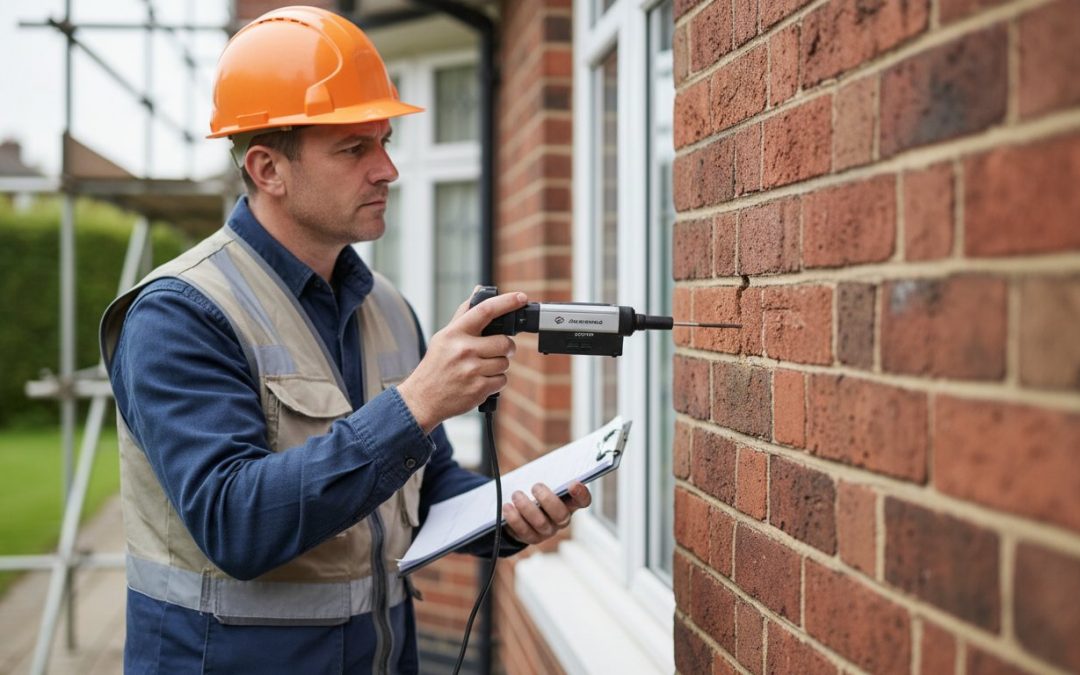
A bulging brick wall isn’t just an aesthetic flaw; it’s a structural warning that your home’s outer leaf is losing its connection to the main building. If you’ve noticed horizontal cracking or shifting masonry, the cost to replace wall ties on a 3 bed semi is likely your primary concern. It’s natural to feel stressed when faced with varying quotes and the technical jargon of structural surveys. You want a stable, safe home and a transparent understanding of the investment required to protect it from further deterioration or potential collapse.
We understand that your property is your most significant asset, and maintaining its structural health requires a methodical approach. This guide details the specific factors influencing current pricing, from the rising cost of structural steel to the necessity of specialized diagnostic tools like borescopes. You’ll learn how a professional wall tie survey identifies the exact state of corrosion, ensuring you only pay for the repairs your home actually needs. By focusing on technical standards and long-term reliability, we provide the clarity you need to restore your property’s integrity with confidence.
Key Takeaways
- Understand the structural role of wall ties in maintaining the stability of your home’s outer leaf and why certain property eras are more susceptible to failure.
- Discover how the cost to replace wall ties on a 3 bed semi is influenced by material standards, scaffolding requirements, and the complexity of the masonry.
- Learn why a professional methodology must include isolating existing corroded ties to stop ongoing structural damage to your brickwork.
- Recognize the importance of specialist borescope inspections to accurately diagnose internal cavity issues that visual checks from the ground cannot detect.
- See how removing defective cavity wall insulation acts as a vital step in safeguarding your new wall ties and preserving the property’s long-term asset value.
Understanding Wall Tie Failure in 3-Bed Semi-Detached Homes
Wall ties are small but essential components that secure the outer masonry leaf to the inner structural wall. In a typical 3-bed semi-detached home, these ties ensure the stability of the entire building envelope. Without them, the outer wall acts as a expertstanding skin that is vulnerable to wind loads and gravity. For those researching the cost to replace wall ties on a 3 bed semi, it’s vital to first understand the technical reasons behind their failure. Most issues stem from the natural oxidation of the original metal ties, a process that compromises the building’s structural integrity over several decades.
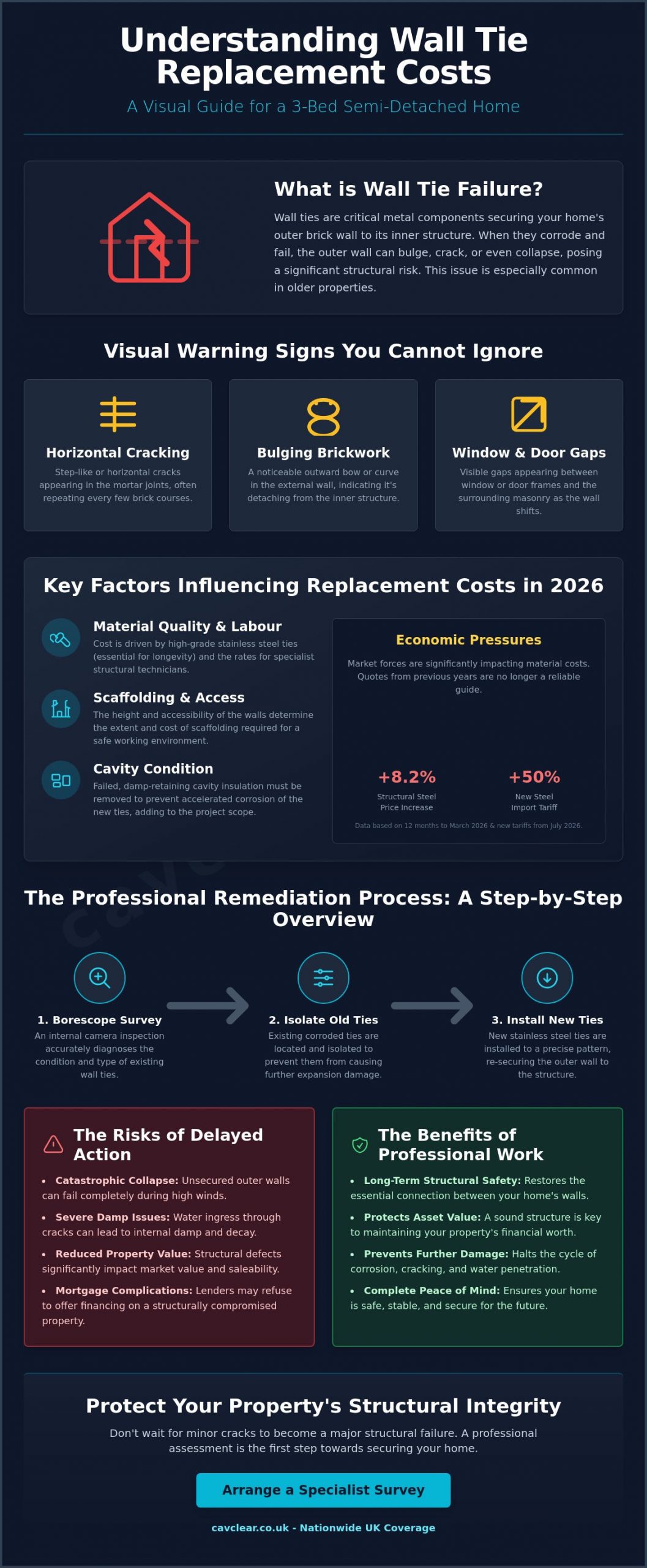
Properties built between the late Victorian era and the early 1980s are particularly at risk. During these decades, wall ties were often manufactured from mild steel with a thin zinc coating. Over time, this protective layer degrades and exposes the steel to moisture. You can gain a deeper technical perspective on Understanding Wall Tie Failure by examining how different tie designs have evolved. When these ties fail, they no longer provide the necessary restraint, which leads to a disconnect between the two leaves of the cavity wall.
A specific chemical reaction known as ferrous expansion is the primary driver of visible damage. As a steel tie corrodes, it expands to several times its original thickness. This physical growth exerts incredible pressure on the surrounding mortar, often lifting an entire course of bricks. This problem is frequently worsened by retrospective cavity wall insulation. While intended to improve thermal efficiency, these materials often trap moisture against the metal ties. This creates a damp environment that accelerates corrosion. We often find that homes with failed ties also require a professional cavity wall insulation extraction to prevent further damage to the new stainless steel replacements.
Visual Warning Signs You Cannot Ignore
Look for horizontal cracking in the mortar joints, usually occurring every six courses of bricks. This is a classic sign of tie expansion. You might also notice a visible bulge or bow in the external skin, which suggests the wall is beginning to pull away from the internal structure. In some cases, the masonry shifts enough to cause gaps between window frames and the surrounding brickwork. If you see these signs, calculating the cost to replace wall ties on a 3 bed semi becomes a priority for both safety and property preservation.
The Structural Risks of Delayed Action
Ignoring these symptoms leads to severe consequences. During high wind events, a compromised outer leaf can collapse entirely because it lacks the support of the inner wall. Beyond physical safety, failed wall ties allow water to bridge the cavity, which leads to internal dampness and timber decay. From a financial perspective, structural instability often prevents homeowners from securing a mortgage or achieving a full market valuation during a sale. Addressing the issue early through a specialist wall tie survey is a vital investment in your property’s future health.
Cost Breakdown: Factors Influencing Your 2026 Investment
The financial commitment required for structural remediation is rarely a flat fee. When evaluating the cost to replace wall ties on a 3 bed semi, homeowners must account for a range of variables that extend beyond the simple purchase of stainless steel components. While a partial replacement might address a localized failure, a full remedial service is often necessary to ensure the long-term stability of the building. Relying on a “cost per tie” estimate is frequently misleading. This model fails to account for the technical complexity of the installation, the density of the existing ties, or the specific structural requirements of your masonry. It’s better to view the project as a comprehensive structural restoration.
External economic factors also play a significant role in current pricing. Data from the Department for Business and Trade shows that the construction material price index for repair and maintenance work rose by 2.6% in the 12 months to March 2026. More specifically, fabricated structural steel saw an 8.2% increase in the same period. With new UK government policies introducing a 50% tariff on steel imports effective July 1, 2026, the cost of high-grade stainless steel wall ties is under significant upward pressure. These shifts mean that quotes from previous years are no longer accurate reflections of the current market.
Direct Costs: Materials and Specialist Labour
The choice of replacement tie depends on your property’s specific substrate. Mechanical expansion ties are often suitable for solid brick, while resin-bonded ties provide a secure fix in more fragile or perforated materials. Specialist labour represents a significant portion of the investment. Unlike general builders, expert contractors utilize precise drilling patterns and load-testing to ensure compliance with BS EN 845 standards. This technical rigor ensures the repair is permanent. If you suspect your property requires attention, a professional wall tie survey can provide a clear diagnosis before structural issues escalate.
Indirect Costs: Access and Making Good
A standard 3-bed semi-detached property typically requires scaffolding for safe access to the gable end and upper elevations. This is a non-negotiable safety requirement under UK Building Regulations. Additionally, the condition of the existing mortar dictates the time required for repointing. Professional “making good” involves specialist mortar matching to ensure the remedial work remains invisible and maintains the aesthetic value of your home. A formal post-completion report is also essential. This document provides the certification needed for insurance purposes and future property surveys, confirming that the building’s structural health has been professionally restored.
The Replacement Process: Why Methodology Dictates Price
When comparing quotes, homeowners often focus solely on the bottom line. However, the methodology used is what truly determines the cost to replace wall ties on a 3 bed semi and the longevity of the repair. A low-cost quote typically indicates a “drill and fill” approach where new ties are added without addressing the original failed components. A professional remedial service follows a rigorous diagnostic and execution path. This ensures the structural faults are not just hidden but permanently rectified through a methodical process.
The industry standard for a permanent fix involves more than just inserting new metal. It requires a clean, non-disruptive process that respects the existing masonry. Using specialist tools like high-speed diamond-tipped drills and calibrated tension testers allows for precision that general construction equipment cannot achieve. This technical rigor protects your home’s long-term asset health and ensures the intervention remains invisible to the naked eye.
The Isolation Technique Explained
The most critical omission in cheap repairs is the failure to isolate the original corroded ties. As established, old mild steel ties continue to expand even after new ones are installed. We use high-accuracy metal detectors to map the exact location of every existing tie across the elevations. Once located, these ties are either physically removed or “sleeved” with a specialist foam wrap. This process decouples the expanding metal from the mortar; it effectively stops the ferrous expansion that causes horizontal cracking. Low-cost providers skip this step because it’s labour-intensive. This omission eventually leads to further masonry damage, making the initial saving a false economy.
Installing Remedial Stainless Steel Ties
Once the old ties are isolated, we install new stainless steel remedial ties. The selection of the correct tie length and type is a technical decision based on the specific cavity width and the density of the inner leaf. Whether using resin-bonded or mechanical expansion ties, the goal is a secure, corrosion-resistant connection that complies with current building regulations. These materials are selected for their durability in the face of UK weather patterns.
Quality assurance is the final step of the installation. We perform pull-out tension tests on a representative sample of the new ties. This verifies that the anchors have achieved the required load-bearing capacity within the specific substrate of your home. This methodical approach ensures that the cost to replace wall ties on a 3 bed semi results in a certified, stable structure that meets modern safety standards. It provides the long-term assurances that every property owner deserves.
Identifying Failures: The Importance of a Specialist Survey
Ground-level visual inspections are often inconclusive. While cracks and bulges are clear indicators of advanced failure, they don’t reveal the early stages of corrosion hidden within the cavity. A specialist survey is the only way to establish the true condition of your masonry. This diagnostic phase is vital for property owners who want a fixed-price roadmap for repairs rather than a generic estimate. It provides the empirical evidence required to justify the cost to replace wall ties on a 3 bed semi, especially during a property transaction where mortgage lenders require structural certainty. Understanding the exact cost to replace wall ties on a 3 bed semi starts with this data-driven approach, removing the guesswork from structural maintenance.
Our surveyors use high-resolution borescopes to look directly at the ties within the wall. This technology allows us to see the extent of the ferrous expansion discussed in previous sections. By identifying the exact state of the metal, we can determine if a full replacement is urgent or if the property is currently within acceptable safety margins. This level of detail protects you from unnecessary work while ensuring that genuine structural risks are addressed promptly.
What Happens During a Wall Tie Survey?
The process begins with the use of a metal detector to map the existing tie pattern. We then drill small, discrete pilot holes in the mortar joints. A borescope camera is inserted through these holes to inspect the ties and the cavity itself. We assess corrosion on a standardized scale from Grade 1, where there is no visible rust, to Grade 4, which indicates severe loss of section or total failure. We also check for debris or failed cavity wall insulation. These materials often hold moisture against the ties and accelerate their decay, making their identification a critical part of the inspection.
Interpreting Your Structural Report
Your final report will detail the density of ties found per square metre. Standard building regulations require a specific frequency to ensure structural stability, and your report will highlight any deficiencies. It’ll differentiate between urgent structural threats and elective maintenance, allowing you to prioritize your investment. If our inspection reveals that moisture is bridging the cavity, you may also need to consult our professional damp survey guide to address the root cause of the dampness.
A specialist report is an essential document for any homeowner. It transforms a vague structural concern into a clear, actionable plan that preserves your home’s value. To ensure your property remains safe and mortgageable, you can book a comprehensive wall tie survey with our nationwide team today.
CavClear: Professional Structural Remediation for UK Homeowners
CavClear provides a specialist service that prioritizes the long-term structural health of your property. We understand that discovering structural faults is stressful; however, our team uses a methodical approach to restore safety without resorting to alarmist tactics. When you consider the cost to replace wall ties on a 3 bed semi, it’s vital to choose a partner that views the project as a permanent investment in your home’s future. Our technicians deliver technically superior workmanship across the entire United Kingdom, ensuring that every remedial task meets the highest industry standards for structural safety.
We take pride in rectifying the poor workmanship of others and restoring the comfort of your living environment. Our methodology is designed to be clean and non-disruptive, utilizing specialist tools that minimize impact on your daily life. By focusing on technical rigor and transparent pricing, we position ourselves as a calm, expert solution-provider for homeowners facing complex masonry issues. This commitment to reliability ensures that your property remains a safe, stable asset for decades to come.
A Holistic Approach to Property Health
A common cause of premature tie failure is the presence of wet or degraded material within the wall cavity. We often recommend cavity wall insulation removal alongside tie replacement. This ensures that the new stainless steel ties aren’t immediately subjected to the same damp conditions that destroyed the originals. Maintaining a clear, ventilated cavity is the most effective way to prevent future moisture bridging and internal dampness. This comprehensive strategy addresses the root cause of the problem rather than just treating the visible symptoms, ensuring the cost to replace wall ties on a 3 bed semi represents a final fix.
Secure Your Property’s Future
Professional remediation does more than just stop a wall from bulging. It protects your property’s resale value and ensures it remains mortgageable in an increasingly scrutinized housing market. Many lenders now require documented evidence of structural health and professional certification before approving a sale or remortgage. By providing detailed reports and using accredited methodologies, we help you secure your asset’s future. If you’re concerned about structural distress, contact our team for a comprehensive structural assessment. We’ll provide a transparent, expert path to restoring your home’s integrity and your peace of mind.
Restoring Your Property’s Structural Stability
Securing the structural health of your semi-detached home is a vital investment in its long-term future. We’ve established that the cost to replace wall ties on a 3 bed semi is defined by the technical rigor of the methodology, particularly the isolation of existing corroded ties to prevent further masonry expansion. A specialist survey provides the necessary roadmap, using borescope technology to identify faults that visual checks simply cannot detect. This data-driven approach ensures your home remains safe, stable, and mortgageable in an increasingly scrutinized housing market.
Our accredited structural technicians offer nationwide UK coverage, providing comprehensive remedial reports that certify the integrity of your masonry. We prioritize clean, non-disruptive solutions that address root causes, such as defective cavity insulation, to ensure a permanent fix. You don’t have to manage structural concerns without expert guidance. Book Your Specialist Wall Tie Survey Today to receive an expert diagnosis tailored to your property. Your home is your most significant asset; it deserves the highest standard of professional care.
Frequently Asked Questions
How do I know if my wall ties have failed?
Visible indicators of failure include horizontal cracking in mortar joints, bulging brickwork, or window frames pulling away from the masonry. These signs often appear only after significant corrosion has already occurred. A specialist survey is the only definitive way to confirm failure; it uses borescope technology to inspect the internal condition of the metal ties directly within the cavity.
Does home insurance cover the cost of wall tie replacement?
Most standard home insurance policies don’t cover wall tie replacement because they classify it as gradual deterioration or wear and tear. Insurers typically view the maintenance of structural ties as the homeowner’s responsibility rather than an accidental event. You should check your specific policy wording for clauses regarding structural movement, but coverage for corroded ties is extremely rare.
How long does it take to replace wall ties on a semi-detached house?
A full remedial service for a standard 3-bed semi typically takes between two and four days to complete. This timeline includes the installation of new ties, the isolation of original failed components, and the professional repointing of all drill holes. Factors like the height of the property and the hardness of the existing mortar can influence the total duration of the work.
Can I sell my house with failing wall ties?
Selling a house with failed ties is difficult because structural issues usually appear on a buyer’s survey. Mortgage lenders often refuse to release funds until the problem is rectified or a professional remediation report is provided. Addressing the cost to replace wall ties on a 3 bed semi before listing the property ensures a smoother transaction and protects your final sale price.
Is it possible to replace wall ties from the inside?
No, wall tie replacement is performed from the exterior to ensure the outer masonry leaf is correctly secured to the main structure. Accessing the cavity from the inside would cause significant disruption to internal decorations and plasterwork. Our methodology focuses on a clean, external approach that uses discrete pilot holes to preserve the building’s aesthetic and structural integrity.
What is the lifespan of new remedial wall ties?
Modern stainless steel remedial ties are designed to last for the remaining life of the building. Unlike the original mild steel ties used in older properties, these components are highly resistant to corrosion. When installed correctly according to modern technical standards, they provide a permanent structural solution that requires no further maintenance under normal environmental conditions.
Will replacing wall ties fix the cracks in my brickwork?
Replacing the ties stabilizes the structure and stops further movement, but it doesn’t automatically close existing cracks. After the structural integrity is restored, we professionally repoint the affected areas to seal the masonry and restore the property’s appearance. If the cracks are severe, additional masonry reinforcement might be required during the remediation process to ensure the wall is fully repaired.
Why is my cavity wall insulation being blamed for wall tie failure?
Retrospective cavity wall insulation often traps moisture within the wall cavity, creating a damp environment that accelerates the corrosion of metal ties. This moisture bridge allows water to sit against the original mild steel; it leads to faster oxidation and the destructive ferrous expansion mentioned earlier. This is why we advocate for cavity wall insulation removal as a vital step in protecting your new structural ties.
Recent Comments