
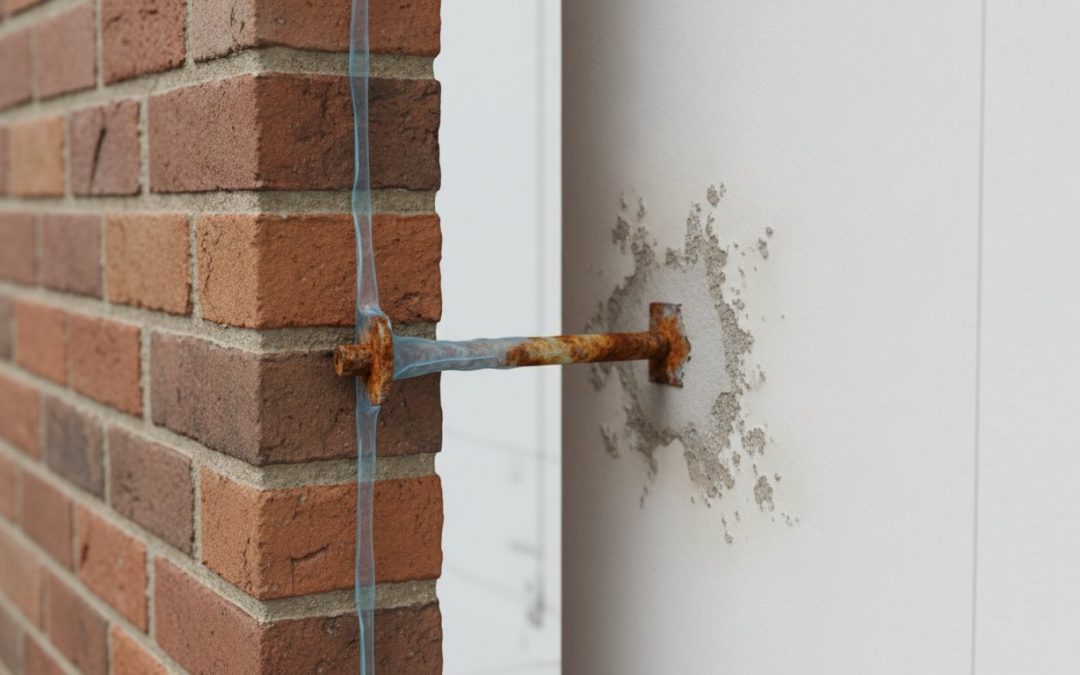
Could the invisible metal components buried deep inside your masonry be the hidden culprit behind those stubborn wet patches on your walls? Many property owners find themselves asking: can failing wall ties cause damp? It is a logical question, especially when you’ve already tried standard waterproofing measures only to see the moisture return after every heavy UK downpour. We understand the anxiety that comes with seeing horizontal cracks in your mortar or feeling like your home’s structural integrity is at risk.
This specialist guide explains the direct link between wall tie corrosion and penetrating damp, showing how structural failure turns your protective wall cavity into a moisture bridge. You’ll learn the early warning signs to look for and understand the professional survey process used to diagnose these hidden issues. We provide a clear look at how specialist replacement techniques restore your property’s health, ensuring your home remains a dry and secure investment for the long term. By identifying these faults early, you can prevent costly secondary damage and maintain the safety of your building’s structure.
Key Takeaways
- Understand how the corrosion of internal metal connectors turns a protective cavity into a moisture bridge that bypasses your property’s weatherproofing.
- Discover the definitive answer to “can failing wall ties cause damp” by examining how rust alters the shape of the tie, allowing water to creep across the air gap.
- Learn why defective cavity wall insulation acts as a saturated sponge that accelerates tie decay and leads to significant structural instability.
- Identify the specific external masonry cracks and internal damp patterns that signal a serious structural fault rather than a simple ventilation issue.
- Explore the diagnostic power of borescope inspections and why a specialist wall tie survey is the only way to ensure a permanent, non-disruptive repair.
What is the Link Between Wall Ties and Penetrating Damp?
A cavity wall tie is a small but vital piece of metalwork that secures the two layers of your home’s masonry. In standard UK construction, these ties bridge the gap between the external weather-facing leaf and the internal structural leaf. While their primary role is to provide lateral stability, they are also positioned in a way that can inadvertently affect moisture control. When property owners ask, can failing wall ties cause damp, the answer is a definitive yes. These components are the only physical connection between the wet exterior and the dry interior, making them a potential weak point.
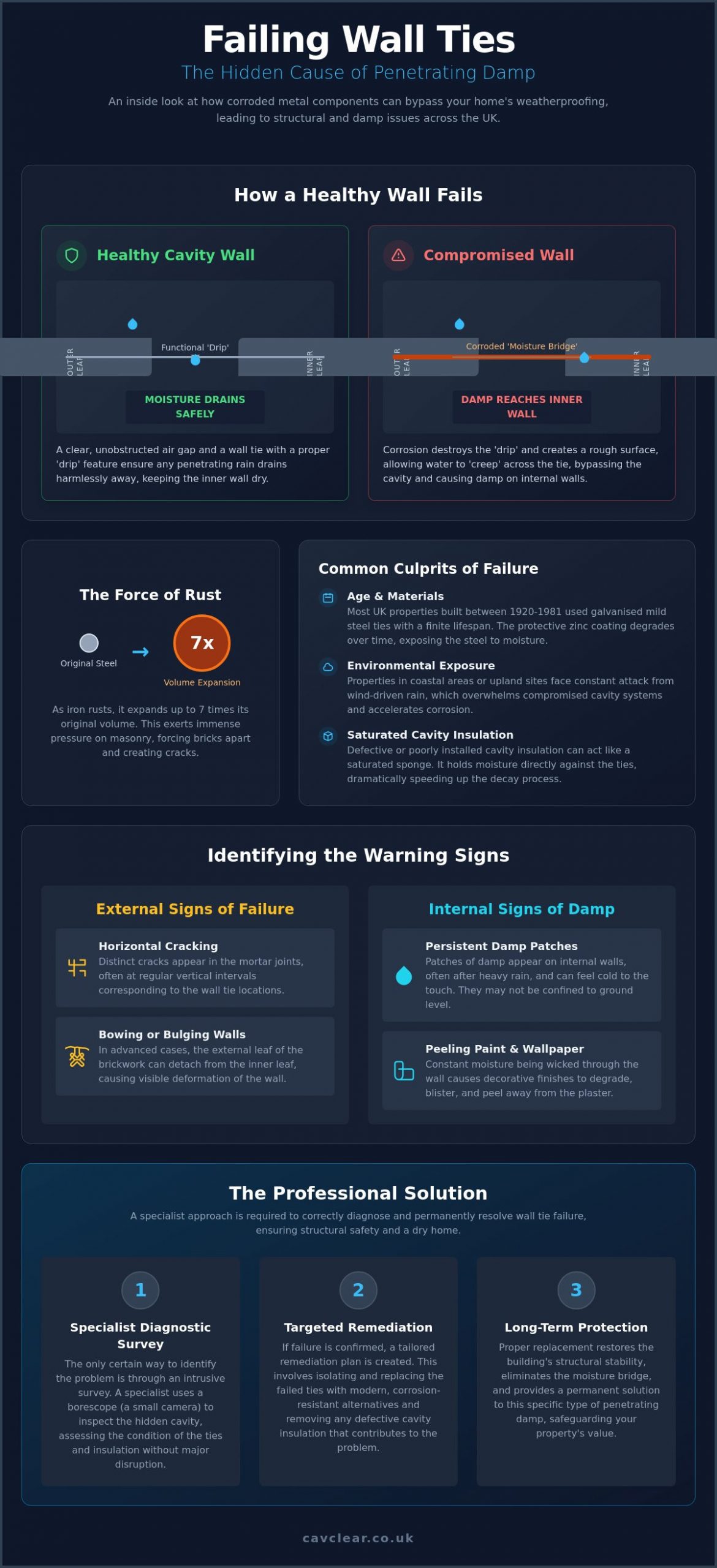
A functioning cavity wall relies on a clear, unobstructed air gap to prevent moisture transfer. This gap serves as a thermal and moisture break. However, when ties begin to fail, they often create a “moisture bridge.” This structural bridge becomes a conduit that allows water to bypass the cavity entirely. We often refer to this as the ‘Path of Least Resistance.’ Water doesn’t just sit on a surface; it exploits every available structural weakness to move from high-pressure areas to low-pressure ones. A corroded or incorrectly installed tie provides a perfect horizontal track for this movement.
The Purpose of the Cavity Air Gap
Most UK homes built after the 1920s moved away from solid wall construction to combat our wet climate. The primary reason for the cavity air gap is to act as a permanent barrier against wind-driven rain. When rain hits the outer leaf, the bricks absorb a portion of that moisture. In a healthy system, this water drains down the internal face of the outer leaf and exits harmlessly through weep holes at the base. Because a tie must cross this gap, it is designed with a specific “drip” feature. This ensures that any water travelling along the tie is forced to drop off into the cavity rather than reaching the inner wall.
When the Structural Bridge Becomes a Moisture Conduit
The bridging effect occurs when the physical properties of the tie change, usually due to corrosion. As the metal rusts, it can expand to several times its original thickness, sometimes up to seven times the volume of the original steel. This expansion creates a rough, porous surface that disrupts the intended drainage path. This new texture allows water to “creep” horizontally across the tie using surface tension. It effectively turns the tie into a pipe for penetrating damp. This failure bypasses your property’s primary defences, delivering moisture directly to your internal plasterwork. This phenomenon is particularly prevalent in high-exposure regions across the United Kingdom, such as coastal areas or upland sites. In these locations, the sheer volume of wind-driven rain can overwhelm a compromised cavity system, leading to rapid internal damage and structural decay.
How Failing Wall Ties Create Moisture Pathways
The engineering behind a standard wall tie is surprisingly precise. Every tie features a central “drip”, which is either a V-shaped bend or a plastic washer designed to break the flow of water. Gravity pulls moisture down to this specific point, where it falls harmlessly into the cavity base. When we investigate the question, can failing wall ties cause damp, we look specifically at how this drip mechanism is compromised. Corrosion fundamentally changes the geometry of the metal. Instead of a smooth, angled surface that sheds water, the tie becomes a rough, horizontal bridge covered in porous iron oxide. This allows moisture to bypass its intended exit point and travel directly toward your living space.
Rusting iron is a destructive force because it expands significantly. Iron oxide can grow to between five and seven times the thickness of the original steel. This physical expansion exerts immense pressure on the surrounding masonry. It doesn’t just block the cavity; it physically lifts the bricks. This process creates the common signs of wall tie failure, such as horizontal cracking in the mortar joints. These cracks then act as open funnels. They invite even more wind-driven rain into the cavity space, overwhelming the wall’s natural drainage and accelerating the damp cycle. If you notice these cracks appearing at regular intervals, a specialist wall tie survey can confirm if the internal metalwork has reached its limit.
The Corrosion Process in Galvanised Steel Ties
Most UK properties built between 1920 and 1981 used galvanised mild steel ties. These were manufactured with a protective zinc coating, but this layer has a finite lifespan, typically failing after 20 to 50 years. Once the zinc depletes, the raw steel is exposed to the humid environment of the cavity. Corrosion is an electrochemical reaction accelerated by damp cavity conditions, leading to the rapid structural decay of the metal. This cycle is self-sustaining; as the tie rusts, it holds more moisture, which in turn causes more rust.
Compromised Drips and Capillary Action
Beyond the rust itself, “mortar snots”, which are clumps of excess mortar dropped during the original construction, often settle on the ties. This creates a flat, solid bridge across the air gap. Capillary action then pulls water along these rust flakes and mortar deposits toward the internal blockwork. Because this transfer happens at specific points where the ties are located, it often results in isolated damp “spots” on your internal walls rather than a uniform tide mark. These spots often darken during heavy rain and fade slightly during dry spells, indicating a direct moisture link to the external environment.
The Cavity Bridge: When Insulation and Ties Combine
While a clear air gap is the gold standard for masonry health, many UK properties have had that gap filled with retrospective insulation. This is where the answer to can failing wall ties cause damp becomes even more critical. In a clear cavity, a wall tie has a chance to dry out between rain spells. However, when defective insulation is present, it acts as a giant structural sponge surrounding the metalwork. Instead of allowing moisture to drain away, the insulation traps water against the ties for extended periods. This creates a saturated environment that accelerates the electrochemical reaction of corrosion.
We maintain a firm stance on the risks associated with this practice. Retrospective cavity wall insulation often creates the very damp problems it was originally intended to prevent. When the material becomes compromised, it turns the entire cavity into a moisture bridge. In these scenarios, replacing the ties alone is rarely a permanent fix. We frequently find that cavity wall insulation removal is a necessary partner to structural remediation. Removing the saturated material is the only way to restore the protective air gap and stop the cycle of penetrating damp for good.
Saturated Insulation as a Corrosion Catalyst
Materials like mineral wool or urea-formaldehyde foam can hold moisture for months after a single heavy storm. This constant exposure is devastating for metal components. Even “modern” ties that were expected to last decades can fail prematurely when encased in wet insulation. The material creates a “wicking” effect, where capillary action pulls water across the cavity gap much faster than a bare tie would. This bypasses the drip mechanism entirely, delivering a steady stream of moisture to the inner leaf and your internal decorations.
Debris and ‘Mortar Snots’ on Wall Ties
Poor workmanship during the original construction of a property often leaves behind “mortar snots.” These are clumps of excess mortar that fall and rest on the wall ties during the bricklaying process. Because mortar is naturally porous, these deposits act as small, permanent bridges for moisture. They hold dampness directly against the inner leaf, which often leads to localized mould growth or “spot” dampness on your wallpaper. These hidden bridges are impossible to see from the outside. Only a specialist cavity survey using high-definition borescope technology can identify these obstructions. This diagnostic approach allows us to see exactly where the bridges are located without needing to remove any bricks, ensuring a clean and non-disruptive inspection process for the homeowner.
Identifying the Signs: Is Your Damp Caused by Wall Tie Failure?
Identifying a structural fault early is essential to prevent long-term damage and escalating repair costs. When homeowners ask, can failing wall ties cause damp, they’re often looking at the internal symptoms without realising the root cause is hidden within the masonry. The most distinctive external indicator is horizontal cracking in the mortar joints. These cracks typically appear at regular intervals, often every three or four courses of brickwork, which coincides with the location of the internal tie rows. Unlike vertical settling cracks, these horizontal lines suggest that the metal ties are expanding as they rust, physically jacking the masonry apart.
This expansion doesn’t just affect the mortar. As the outer leaf of the wall “lifts” due to the pressure of the corroding steel, it can cause secondary structural issues throughout the property. You might notice window frames becoming pinched or external doors that suddenly begin to stick in their frames. Internally, you may see “efflorescence,” which appears as white, powdery salts on your plasterwork. These salts are carried from the masonry into your home by the moisture travelling along the failed tie. It’s a clear sign that the structural bridge has become a moisture conduit.
Visual Cues in Brickwork and Mortar
Expansion cracking is a powerful force that shouldn’t be ignored. While simple settling cracks often follow a stepped diagonal pattern through the mortar joints, wall tie failure is strictly horizontal. In more advanced cases, you might observe the wall “bulging” outwards. This occurs because the ties have either snapped or lost their grip, meaning the two leaves of the wall are no longer tied together securely. You should also look for localized patches of green algae or moss on specific sections of the exterior. This growth indicates areas where the cavity is bridged and the wall remains permanently saturated, even during dry spells.
Internal Damp Patterns and Mould
Damp caused by wall tie failure rarely looks like a traditional rising damp tide mark at the base of the wall. Instead, it appears as isolated, circular patches mid-wall or on upper floors. These patches are highly reactive to the UK weather. They darken and expand significantly during periods of heavy, wind-driven rain and may dry out slightly during the summer months. If you recognize these patterns, it’s vital to book a professional wall tie survey to assess the internal condition of your masonry before the damage worsens. Identifying the problem early allows for a cleaner, non-disruptive repair process.
If your property is showing these symptoms, you can arrange a specialist wall tie inspection today to ensure your home’s long-term structural integrity.
Professional Remediation: Solving the Problem Permanently
Many homeowners attempt to resolve damp issues by applying anti-mould paint or re-plastering the affected internal walls. These measures are merely cosmetic masks that ignore the underlying structural decay. If you’ve been asking can failing wall ties cause damp, you must accept that the moisture is a symptom of a mechanical failure inside the masonry. A permanent fix requires addressing the physical bridge itself, not just the stain on the wallpaper. As a specialist provider, we focus on restoring the cavity to its original, clear state to ensure long-term structural integrity and a dry living environment.
The Technical Survey and Borescope Inspection
Our accredited technicians use specialist borescope inspection technology to look directly into the cavity. We drill small, discreet holes in the mortar joints and insert high-definition cameras to visually inspect the health of the ties and the condition of the cavity. This diagnostic step is vital for transparency. It allows us to produce detailed technical property reports that serve as an essential tool for long-term asset management. A professional survey also confirms whether the damp is structural or simply environmental, such as internal condensation, ensuring you don’t invest in structural repairs unless they’re strictly necessary.
Structural Repair and Insulation Extraction
Once we confirm a structural fault, we typically initiate the insulation extraction process. Removing saturated or defective material is the only way to break the moisture bridge permanently. Following extraction, we install remedial stainless steel ties. These new components are chemically or mechanically anchored into the masonry to restore the connection between the two leaves. We follow strict standards for tie spacing to ensure the wall meets modern UK building requirements.
The old, failing ties are either removed or isolated with specialized sleeves to prevent their continued expansion from causing further “jacking” of the mortar joints. Our final advice to every property owner is to allow the masonry to dry naturally before any internal re-plastering begins. This patient, methodical approach ensures that all residual moisture is fully evacuated from the building fabric. Investing in this professional remediation process doesn’t just fix a damp patch; it secures the structural future of your home and restores the comfort of your living space.
For additional technical resources on professional moisture control and building protection, you can visit Izolstav s.r.o. to learn more about their specialized structural waterproofing services.
Protecting Your Property’s Structural Health
Understanding the internal mechanics of your masonry is the first step toward a permanent solution. We’ve detailed how a corroded metal component turns from a structural support into a moisture bridge, especially when combined with saturated insulation. The definitive answer to whether can failing wall ties cause damp lies in the physical breach of the cavity air gap. By identifying horizontal cracking or isolated damp spots early, you prevent the risk of significant structural instability and high future repair costs.
Our team of accredited UK technicians provides a nationwide specialist service to help you regain peace of mind. We utilize high-definition borescope technology to deliver detailed structural reporting, ensuring you have a transparent roadmap for your property’s health. Don’t let unexplained moisture compromise your home’s long-term value. Book a Professional Technical Wall Tie Survey with CavClear Today and take the first step toward a dry, secure environment. You can restore your property’s integrity and comfort with the right specialist guidance.
Frequently Asked Questions
Can failing wall ties cause damp on the inside of my house?
Yes, failing wall ties are a primary cause of penetrating damp on internal walls. When a tie corrodes, it loses its ability to shed water, allowing moisture to travel from the wet outer leaf directly to the inner leaf. This bypasses your home’s natural defences and results in visible damp patches on your plasterwork. If you’ve wondered can failing wall ties cause damp, this moisture bridging is the most common mechanical explanation.
How do I know if my wall ties are failing without a survey?
You can often identify potential failure by looking for horizontal cracking in the mortar joints of your external brickwork. These cracks usually appear at regular intervals, typically every three to four courses. Other indicators include bulging masonry or internal damp spots that appear in a regular grid-like pattern. While these signs are strong indicators, only a specialist borescope inspection can provide a definitive diagnosis of the metal’s condition.
Is it expensive to replace cavity wall ties in the UK?
The cost of replacement depends on factors like the size of your property, the type of masonry, and the height of the walls. While it’s a significant maintenance task, it is a vital investment in protecting the long-term structural integrity of your asset. We recommend a professional survey to determine the exact scope of work required, as early intervention prevents the need for more costly masonry reconstruction later.
Can wet cavity wall insulation make my wall ties rust faster?
Yes, wet insulation significantly accelerates the corrosion of metal wall ties. The material acts as a saturated sponge, trapping moisture against the steel and creating a permanent damp environment that triggers rapid rusting. This is why we often recommend cavity wall insulation extraction alongside tie replacement. Removing the wet material is the only way to ensure a permanent fix for structural dampness.
Will my building insurance cover damp caused by wall tie failure?
Most standard UK building insurance policies do not cover damage caused by wall tie failure. Insurers typically categorize this issue as “gradual deterioration” or a lack of maintenance rather than an insurable “event” like a fire or sudden flood. You should check your specific policy documents or speak with your provider, but it’s generally considered the homeowner’s responsibility to maintain the structural ties.
What happens if I ignore failing wall ties and damp patches?
Ignoring these signs can lead to severe structural instability or even the total collapse of the outer leaf in extreme conditions. The damp will continue to spread, potentially causing timber rot in floor joists or roof timbers. Over time, the expanding rust will cause further cracking in your masonry, decreasing your property’s value and making eventual repairs far more complex and expensive.
Is penetrating damp the same as rising damp?
No, they’re different issues with distinct causes. Penetrating damp moves horizontally through walls, often via a structural bridge like a failing wall tie or through porous masonry. Rising damp travels vertically from the ground up due to capillary action. Identifying which type you have is crucial because the remedial treatments are entirely different; a wall tie replacement won’t fix a failed damp proof course.
Can I fix wall tie damp myself with waterproof paint?
No, waterproof paint is a temporary cosmetic fix that doesn’t address the underlying structural fault. The moisture bridge remains inside the cavity, and the corrosion will continue to expand and damage your masonry regardless of the internal finish. Solving the problem permanently requires professional tie replacement and the restoration of a clear, dry cavity air gap.
Recent Comments