
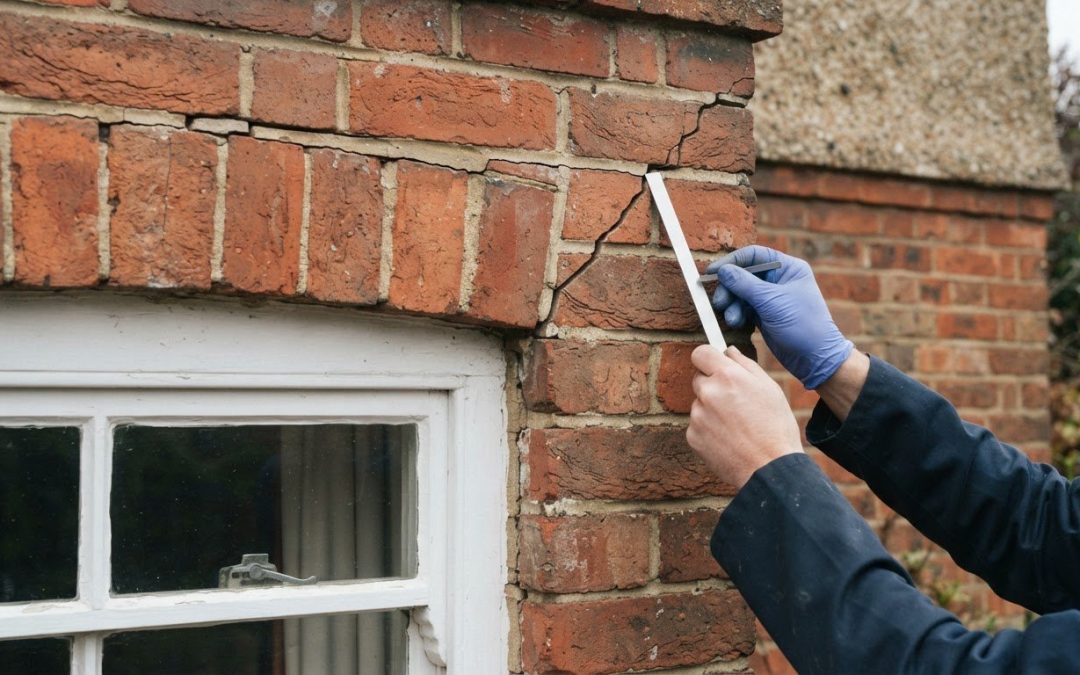
A stepped crack doesn’t automatically mean subsidence, but its pattern can point to movement within a cavity wall. Knowing when stepped brickwork cracks need a cavity wall inspection starts with looking at their position, direction and whether horizontal cracks are also present, as these can be signs of wall tie corrosion.
It’s understandable to worry when cracks appear in brickwork, especially if they seem to be spreading. Their cause isn’t always obvious from the outside: movement, support problems and failing wall ties can produce different patterns, and each needs a different assessment.
This article explains how a specialist examines stepped and horizontal cracking, which clues may help distinguish possible causes, and when a cavity wall inspection is appropriate. You’ll also learn what an inspection can establish and how its findings guide next steps, without assuming every crack needs the same repair.
Key Takeaways
- Crack location, direction, width and changes over time help a specialist judge whether a cavity wall inspection is appropriate.
- Stepped cracking can have several causes, so establishing the likely cause is important before choosing remedial work.
- Monitoring can help reveal whether a crack is changing, but new or widening cracks may warrant a specialist inspection sooner.
- Horizontal cracking along mortar joints can be a sign of corroded or failing wall ties and should be assessed in context.
- A cavity wall tie inspection can identify relevant signs and inform whether a wall tie survey or replacement is the appropriate next step.
When do stepped brickwork cracks need a cavity wall inspection?
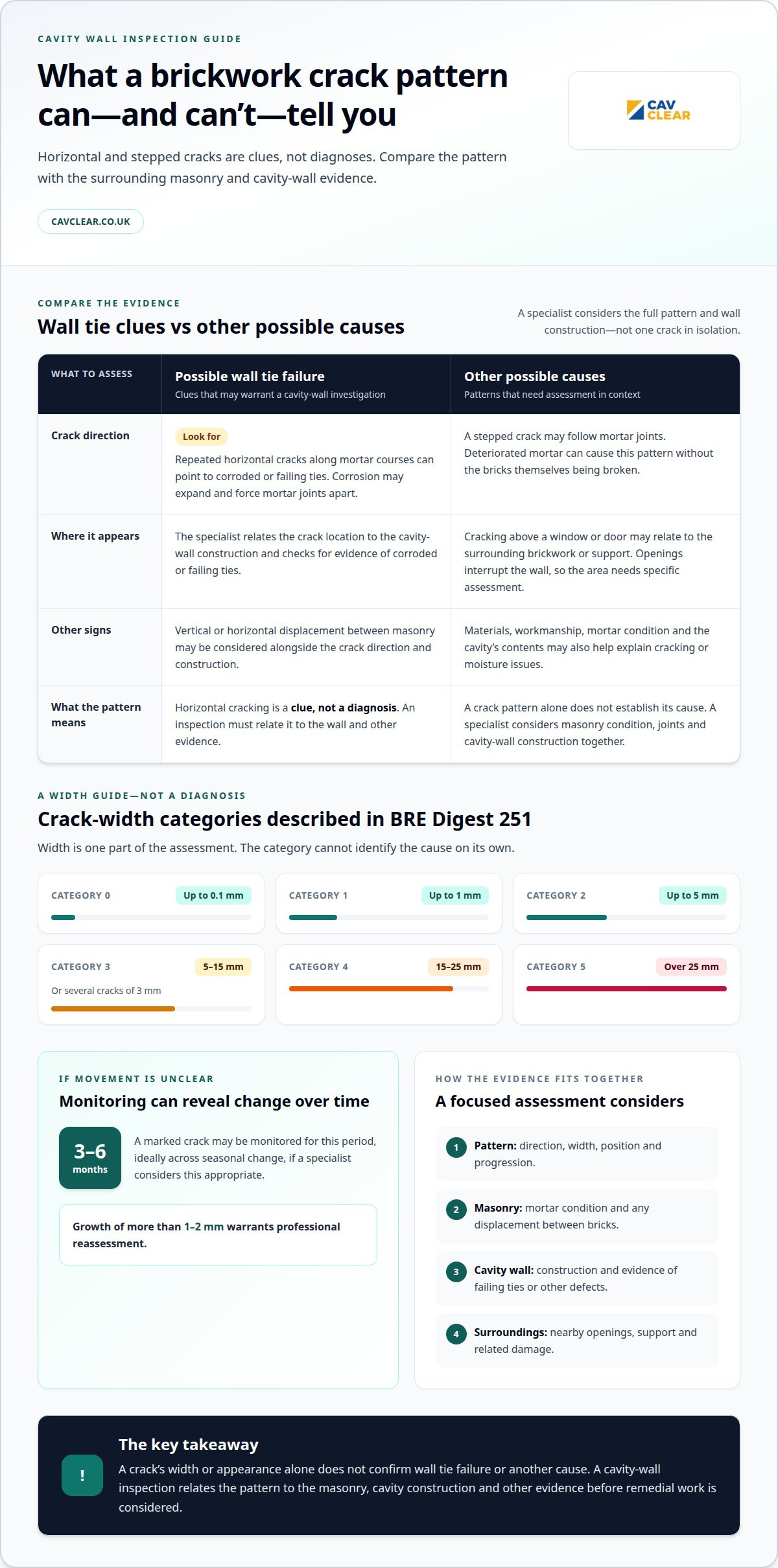
A specialist considers a cavity wall inspection when a crack’s position, width or progression suggests a wall defect, including possible wall tie failure. BRE Digest 251 categories describe crack severity, but cannot identify the cause alone.
-
Establish the Cause Before Recommending Repairs
Arrange a professional assessment before filling or repointing a stepped crack. The specialist considers its position, whether it crosses bricks or follows mortar joints, and whether similar damage appears inside. Nearby openings, lintels, corners and wall construction also matter. This helps distinguish possible settlement from support defects, wall tie failure or mortar deterioration. Identifying the likely cause first helps ensure repairs address more than the visible line.
-
Plan Monitoring and Proportionate Repairs
Ask the specialist to record the crack’s width and location and advise on proportionate monitoring. If movement remains unclear, a marked crack may be monitored for three to six months, ideally across seasonal change. Growth of more than one or two millimetres warrants professional reassessment. A stable, localised crack may need only a limited repair. Stainless steel helical bars can stitch cracked masonry when the diagnosis supports this method, but they do not replace investigation of active movement.
-
Assess Crack Location, Direction and Width
Have the specialist assess the opening, direction, width and pattern together, rather than relying on one measurement. BRE Digest 251 classifies cracks up to 0.1mm as Category 0, up to 1mm as Category 1, and up to 5mm as Category 2. Cracks from 5 to 15mm, or several cracks of 3mm, fall into Category 3; 15 to 25mm is Category 4, and over 25mm is Category 5.
-
Recognize Patterns That May Indicate Serious Movement
Arrange an investigation if stepped cracking widens, runs diagonally from an opening, or appears alongside displacement between bricks. These patterns may prompt a specialist to investigate structural movement, but they do not establish subsidence by themselves. To assess whether a structural survey is needed, a professional considers the crack pattern, changes over time, nearby defects and whether the issue appears limited to the cavity wall or affects the wider structure.
-
Consider the Risks of Ignoring Cracks
Record changes and arrange an assessment if a stepped crack grows, returns after filling, or appears with horizontal cracking. Ignoring a changing crack can delay identifying movement or a cavity-wall defect. An opening in the exterior wall may also let water enter. A specialist’s findings help determine whether monitoring, further investigation or a proportionate repair is appropriate, rather than treating the crack as cosmetic without establishing its cause.
Distinguishing wall tie failure from other causes of cracking
A specialist cavity-wall inspection considers wall tie failure and other defects in the cavity wall rather than treating every crack as evidence of tie corrosion. The inspection may assess the crack pattern, masonry and wall construction to identify signs of failing ties or other cavity-wall problems.
- Compare the crack pattern with possible signs of wall tie corrosion. Steel ties connect the two masonry leaves of a cavity wall. As ties corrode, expansion can force mortar joints apart. Repeated horizontal cracks along mortar courses may therefore point to tie failure, particularly in older cavity walls. The pattern is a clue, not a diagnosis: an inspection must consider where the cracking occurs and how it relates to the wall construction.
- Assess whether cracking appears local or affects a wider part of the cavity wall. A wall tie inspection considers the crack’s direction and any vertical or horizontal displacement between masonry. These features can help distinguish possible wall tie failure from other cavity-wall defects. A specialist inspection relates the cracking to the wall construction and checks for signs of corroded or failing ties.
- Include the masonry around openings in the cavity-wall inspection. Cracking above a window or door may relate to the surrounding brickwork or support, because openings interrupt the wall. A crack near an opening therefore needs to be assessed alongside the masonry and cavity-wall construction, rather than assumed to indicate wall tie corrosion.
- Consider moisture, materials and workmanship as part of the cavity-wall inspection. Deteriorated mortar can produce stepped cracks that follow joints without breaking the bricks, while defective workmanship may create a separate weakness. A specialist also considers the cavity and its contents, including whether defective cavity wall insulation could be contributing to moisture issues. These features help assess potential cavity-wall defects.
- Use the combined evidence to decide whether the cracking needs further cavity-wall investigation. A specialist examines the crack pattern, masonry condition and evidence within the joints, then relates those findings to the building’s cavity-wall construction. Cracks in internal and external walls can be associated with wall tie failure, while other patterns may indicate defects in the masonry or cavity. This focused assessment helps identify a cavity-wall issue before recommending appropriate remedial work.
When to Monitor Cracks and Arrange Wall Inspections
Monitoring helps show whether a crack is changing, but it should not delay an inspection when the pattern raises concern. A cavity-wall inspection can investigate whether the evidence points to a wall-tie or masonry defect.
-
Identify When a Cavity-Wall Inspection Is Needed
Arrange a cavity-wall inspection if horizontal cracks appear along mortar joints, or stepped cracking grows or returns after repair. A specialist considers the crack’s position, its relationship to the cavity wall and any signs of wall-tie failure. Cracks around windows and lintels also need careful assessment, as they may occur alongside defects in the cavity wall.
Monitoring can help when a specialist considers a crack stable but its cause remains uncertain. They can record its location and width, then set a suitable review interval. A dated photograph with a ruler or crack-width gauge gives a consistent comparison. If the gap widens, new cracks develop, or the masonry moves out of line, arrange a cavity-wall inspection rather than waiting for the next review.
Keep monitoring separate from diagnosis. A crack monitor records change, but does not explain whether movement comes from wall ties, settlement or another defect. If the crack crosses from exterior brickwork to an internal finish, or appears alongside horizontal cracking, a specialist cavity-wall inspection can assess the masonry and ties directly.
-
Know When to Arrange a Wall-Tie Survey
Choose an inspection that fits the evidence. A cavity-wall specialist can investigate cracking associated with cavity wall ties and masonry leaves. A wall-tie survey is appropriate when cracks appear alongside signs of possible tie failure, or a crack exceeds 15mm. These signs warrant attention beyond routine monitoring and should be assessed in the context of the cavity wall.
Give the specialist relevant context, including when the crack appeared, whether it has changed and whether repairs have been made. Note related features, such as doors or windows that have become difficult to open, cracks near lintels, or separation between an extension and the main house. These details help the specialist consider the masonry and wall ties in relation to the reported cracking.
If a home survey identifies a crack for further investigation, use its location and description to clarify the focus of the next inspection. Where the evidence points specifically to cavity-wall deterioration or tie failure, a cavity-wall inspection can examine that system rather than treating every crack as a general structural problem.
Arrange an inspection sooner if cracking changes quickly, the wall visibly bulges, or masonry becomes displaced. Monitoring is appropriate when a specialist sets a measured plan for an uncertain, stable crack; it is not a substitute for investigating clear signs of movement. The findings can guide whether continued observation, a cavity-wall inspection or a wall-tie survey is the appropriate next step.
Horizontal cracking and corroded cavity wall ties
In the UK, a cavity wall inspection examines the crack pattern and the condition of the wall ties connecting the masonry leaves. Horizontal cracks along mortar joints can indicate corrosion, but their position and relationship to other signs matter.
- Note where horizontal cracks follow the mortar courses. In cavity walls built between the 1920s and 1980s, cracks appearing every five or six brick courses can indicate corroded wall ties. Rusting steel expands and can force mortar joints apart. This pattern warrants investigation, but it isn’t proof on its own. A specialist considers the wall’s age, construction and other visible signs before drawing conclusions.
- Have the specialist compare cracking on both sides of the wall. Cavity walls have two masonry leaves joined by wall ties, and cracks may not line up exactly between them. Differences in masonry strength and the ties themselves can affect how cracking appears inside and outside. An offset pattern, or related cracking on both faces, gives the specialist useful evidence about the cavity wall’s condition.
- Distinguish tie-related cracking from other horizontal marks. Hairline cracks can have different explanations, including movement at a junction or thermal movement affecting masonry. Cracks near a window, lintel or extension may also relate to local support or connections. The specialist assesses each location and pattern against the wall construction, rather than treating every horizontal line as corrosion or assuming a small crack is merely cosmetic.
- Use a cavity wall inspection to assess the masonry and wall ties together. The specialist records the crack’s location, direction and course, then considers the property’s construction and signs of corrosion or failure. A UK inspection focuses on the cavity-wall system and whether the visible evidence supports concern about wall ties. The findings help distinguish a tie defect from other causes that may need separate investigation.
- Arrange further assessment when horizontal cracking is repeated, widening or accompanied by stepped cracks. For example, a crack following mortar joints every five or six courses in an older cavity wall deserves closer attention than an isolated mark without related signs. The key is the combined evidence: age and construction, the crack pattern, joint condition and any corresponding internal cracking. That assessment helps determine whether wall tie remedial work is appropriate.
Cracks in cavity walls can be offset between the external and internal masonry leaves because of differences in masonry strength and the presence of wall ties. Consider each face as part of the same wall, but do not assume a crack must occupy the same position on both leaves. An offset can still matter when assessing the connection between them, so the pattern on each side should form part of the overall assessment.
A wall tie connects the two masonry leaves of an external cavity wall. Wall tie corrosion or failure affects properties across the UK and may require structural repairs or specialist remedial wall tie replacement. This makes a suspected defect worth assessing, but its prevalence alone cannot establish the condition of any particular property.
CavClear cavity wall tie inspections
CavClear provides cavity wall tie inspections for property owners concerned that cracking may relate to corroded or failing ties. This is a relevant next step when horizontal cracks follow mortar joints, stepped cracks keep changing, or damage appears on both internal and external walls. An inspection focuses on the cavity-wall system, helping distinguish possible tie problems from other visible defects before remedial work is considered.
During the assessment, the specialist considers the location and pattern of cracking alongside the wall’s construction and visible condition. The findings help determine whether the evidence is consistent with wall tie failure or whether another cause needs consideration. A crack alone cannot establish that ties have corroded, so an inspection relates the signs to the property’s cavity walls rather than assuming the cause from appearance.
A wall tie survey is a relevant next step when the ties need further investigation. Survey findings can help establish the extent of a suspected problem and inform suitable recommendations. CavClear provides clear reports with findings and recommended remedial solutions, giving homeowners, buyers, surveyors and mortgage lenders information about the cavity wall system and work that may be appropriate.
If an inspection identifies corroded or failing wall ties, wall tie replacement may be recommended as remedial work. The appropriate response depends on the findings, including the condition of the ties and related masonry. If the evidence instead points to another issue, the report can help avoid treating wall tie replacement as a default repair. Establishing the likely cause supports decisions about the property’s long-term structural condition.
Cracking can also occur alongside problems involving defective cavity wall insulation. CavClear provides cavity wall insulation removal when a professional survey confirms that defective insulation needs removing. This is distinct from a wall tie inspection or replacement. Identifying the specific issue helps ensure recommendations address the relevant part of the wall system rather than combining unrelated repairs.
If changing cracks or horizontal mortar-joint splits raise concern about wall tie failure, contact CavClear to discuss a cavity wall tie inspection or wall tie survey.
Frequently Asked Questions
What should you do when you spot a crack in your wall?
Keep a brief record of when you first noticed the crack and any recent work near that part of the property. Note, for example, window replacement, an extension alteration or nearby excavation. Share this context with the specialist assessing the cavity wall, along with details of previous repairs. Avoid filling or painting over the crack before assessment, as this can obscure its edges and make the original condition harder to interpret.
When do cracks need inspection?
Arrange a cavity wall inspection when masonry looks loose, a section of wall appears to bulge, or fragments of brick or mortar fall away. These conditions may relate to the cavity wall or its ties, so an assessment can help establish their condition. If a property survey identifies a crack, use its location notes to explain which elevation or room is affected. This helps the specialist focus on the relevant part of the building.
What causes stepped cracks in brickwork cavity walls?
Stepped cracks can form where stress is concentrated along the joints between bricks. In a cavity wall, the two masonry leaves and materials within the cavity can affect how the wall behaves. Debris or defective insulation may also be relevant cavity conditions for a specialist to consider. The visible line alone cannot show what lies inside the wall, so its context and construction matter.
Can a cavity wall inspection identify wall tie failure or cavity debris?
Yes. A specialist can assess signs of wall tie failure and inspect cavity conditions, including possible debris. The written report can set out findings, photographs, tie-condition grading and practical recommendations. This gives property owners a record of what was observed and helps distinguish a confirmed finding from an issue that may need further investigation. The report also supports clear discussions about appropriate remedial work.
What repairs are used for stepped cracks caused by movement or wall tie failure?
Repairs depend on the findings of a cavity wall assessment and the condition of the affected masonry. Where wall tie failure is identified, recommendations may include wall tie replacement. Brickwork crack stitching with helical bars may also be recommended where appropriate to address cracking in the masonry. The report should explain which cavity-wall remedial work relates to each finding.
Recent Comments