
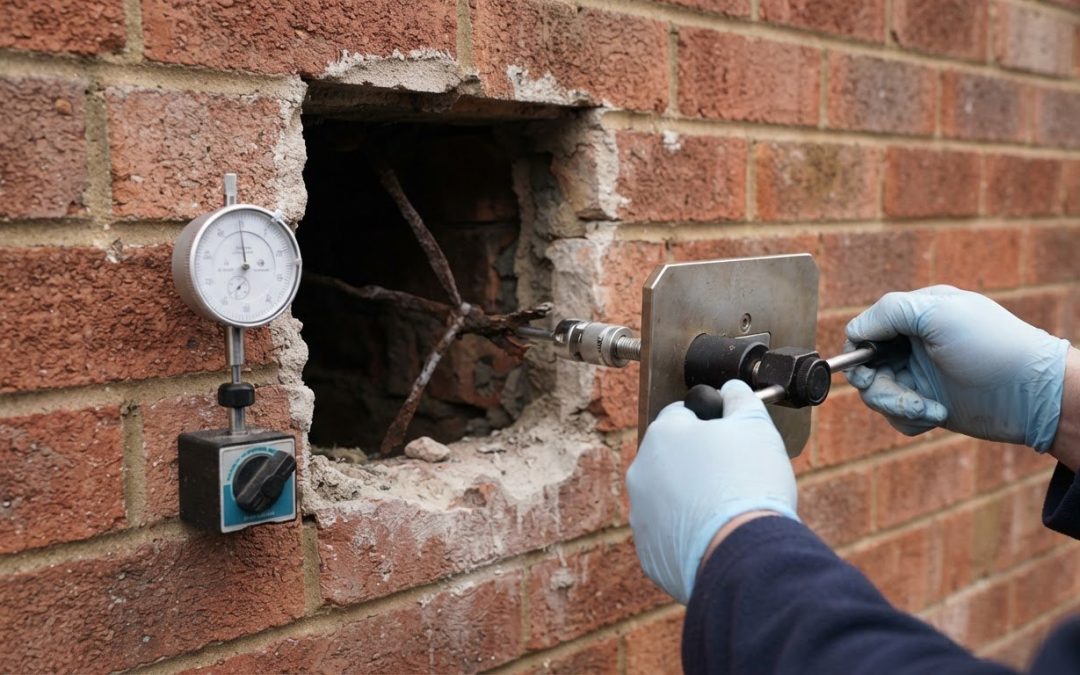
A pull test is only useful when the applied load is appropriate for the tie. The stated load is about 2.0 kN for 5 mm ties and up to 2.5 kN for 6 mm ties. Understanding how wall tie pull testing checks anchorage means considering both the load applied and how much the tie moves under pressure.
It’s reasonable to want a clear result before deciding what to do about a wall tie. A professional test applies a controlled tensile load and measures movement, helping assess whether the tie is securely anchored rather than relying on appearance alone.
This article explains how the test is set up, what the recommended loads mean in practice, and why a tie may fail. It also covers how testing equipment helps limit stress on the surrounding masonry, so you can understand what a sound assessment should tell you about the wall.
Key Takeaways
- Understand how controlled loading and movement readings help assess whether a wall tie is securely anchored.
- See the recommended test loads: about 2.0 kN for 5 mm ties and up to 2.5 kN for 6 mm ties.
- Learn why the test set-up matters, including how equipment can help limit stress on the surrounding masonry.
- Recognise that deterioration over time can leave a wall tie unfit for purpose and contribute to a failed test.
- Find out when a wall tie survey can help clarify the condition of ties and whether replacement may be needed.
How a professional applies load and measures wall tie movement
During a professional wall tie pull test, the tester applies a controlled tensile force and records the tie’s movement. The result helps assess whether the tie remains anchored as the load increases.
How a professional applies a test load
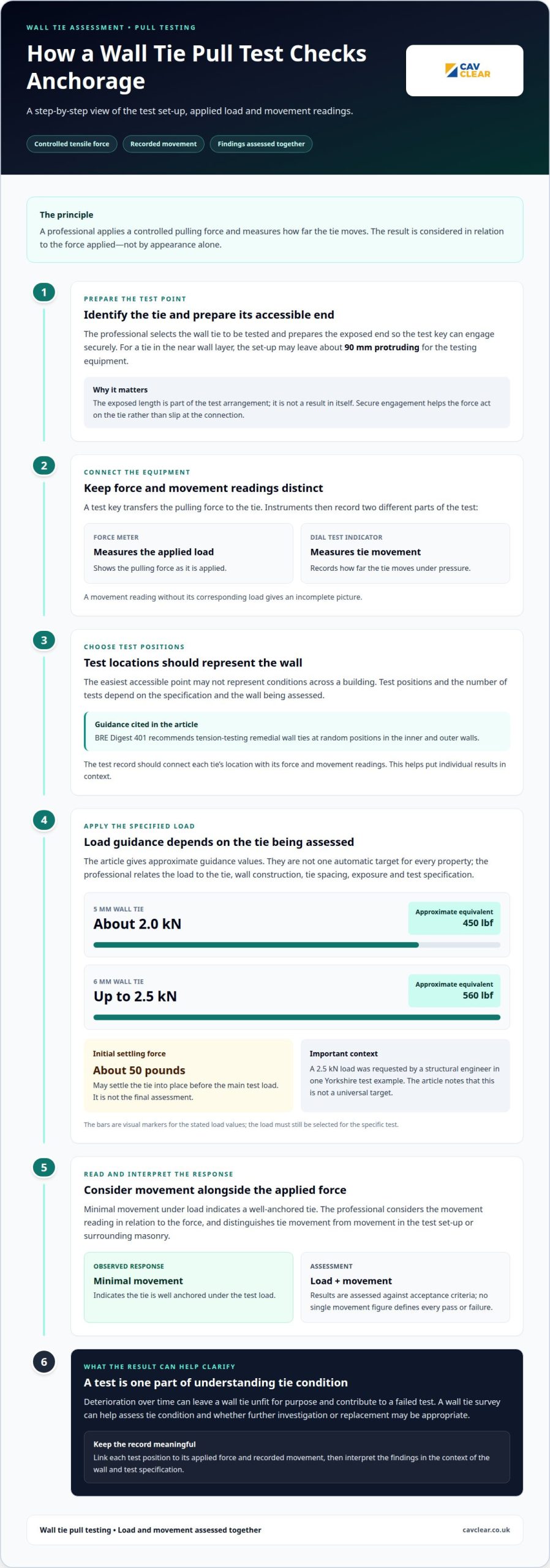
A professional transfers a measured pulling force to the wall tie, then observes its response under load. Applying force in a controlled way matters because the assessment must distinguish secure anchorage from movement that suggests weakness. An initial force of about 50 pounds may settle the tie into place before the main test load is applied. That initial step is not the final assessment.
The required test load depends on the test specification and the wall tie being assessed. A 2.5 kN load was requested by a structural engineer for a Yorkshire wall-tie test, as a safety factor. That example is not a universal target for every property. The load must relate to the specific test, rather than being treated as a standard figure for all ties.
During the test, force passes through the tie’s anchorage into the masonry. The reading therefore needs context: it reflects both the tie and the material holding it. A tie may look intact at the surface yet move under tension if its anchorage is inadequate. The professional records the tie’s response in relation to the applied load, rather than judging it by appearance alone.
For a tie installed in the near wall layer, the test set-up may leave about 90 mm protruding. This provides a length for attaching testing equipment while the pull is applied. The exposed length is part of the test arrangement, not a result in itself. The professional considers the tie’s position and the intended test load when interpreting its response.
How a professional measures wall tie movement
A dial test indicator measures how far a wall tie moves as the professional applies pressure. Its reading provides a recorded movement value, helping show whether the tie stays relatively stable under the test load. Minimal movement under load indicates a well-anchored tie. The measurement matters because it turns the test from a visual check into an assessment of the tie’s response.
The professional considers movement alongside the applied force. A movement reading without its corresponding load gives an incomplete picture, because the tie’s response must be understood in relation to the force applied. The tester also distinguishes movement of the tie from movement in the test set-up or surrounding masonry, so the recorded result reflects the anchorage as accurately as possible.
No single movement figure defines a pass or failure in every case. The test load and observed response are considered together for the tie being assessed. This is how wall tie pull testing checks anchorage: it applies force, measures movement and records whether the tie remains stable under that force. Results are assessed against acceptance criteria.
How a professional attaches the test key and sets up the meter
A professional connects a test key to the exposed wall tie and positions equipment to record the test. The key transfers the pulling force to the tie, while the meter records the applied load. The test location and the relationship between force and movement help make the result meaningful.
Before loading, the professional identifies the tie to be tested and prepares its accessible end for the test key. The connection must engage securely, so the force acts on the tie rather than slipping at the connection. The key and tie form the load path between the equipment and the wall’s anchorage. Poor engagement could make the reading unreliable.
The force meter gives the professional a reading as the load is applied. A dial test indicator can separately record movement, providing a reference for the tie’s response. These instruments measure different things: force describes what the test applies, while movement describes how the tie responds. Keeping those readings distinct helps the professional interpret the result accurately.
Set-up also involves choosing test positions that represent the wall, not simply the easiest accessible point. BRE Digest 401 recommends tension-testing remedial wall ties at random positions in the inner and outer walls. That approach gives the assessment a broader basis than testing only one convenient tie. The number and location of tests depend on the test specification and the wall being assessed.
Where wall conditions vary across a building, the professional considers whether the selected test positions represent those conditions fairly. A tie in one wall may have different anchorage from a tie in another. If one wall resists less load, in-process testing during remedial installation should focus on the weaker anchorage. Test location therefore matters when assessing both the existing wall and remedial work.
The test record should link each tie’s location with its force and movement readings. Without that connection, a result can be difficult to interpret later. Recording the wall and test position also helps distinguish an isolated result from a pattern across several locations. These details matter when findings inform a wider wall tie assessment.
Professionals use the readings to explain what the test shows, rather than treating the meter alone as a verdict. A wall tie survey can help assess tie condition and identify whether further investigation or remedial work is appropriate.
Recommended loads for 5 mm and 6 mm ties
The stated test load is about 2.0 kN for a 5 mm wall tie and up to 2.5 kN for a 6 mm tie. These are approximate guidance values, not one automatic target for every property. The correct load depends on the tie, wall construction, tie spacing and exposure. The professional must match the test to the installation and its specification.
For context, the example guidance gives equivalent approximate loads of 450 lbf for 5 mm ties and 560 lbf for 6 mm ties. These figures describe the same approximate loads in different units. They don’t mean that a thicker tie can be tested at any chosen force. A test load must remain appropriate to the tie and the masonry anchorage being assessed.
BRE Digest 401 Table 5 sets minimum tensile proof loads for remedial ties, based on stated assumptions. Those assumptions include each wall being at least 90 mm thick and a remedial tie density of 2.5 per sqm. If the actual wall or tie arrangement differs, the table values may not apply directly. The professional considers the construction details before interpreting a result.
Wind exposure also affects the demand on wall ties. In the described exposed East coast of Yorkshire position, each tie was expected to carry no more than 1.5 kN in service. That is a specific example, not a general value for every UK property. A building’s position, including land slope within 1 km, is among the factors used to determine the necessary test load.
A test load is not the same as the force expected during normal service. The test checks whether the tie’s anchorage responds adequately under the specified proof load. Applying a higher force does not automatically make the assessment more reliable. It may instead stress the tie or surrounding masonry beyond the intended test conditions.
Remedial wall ties should not be tested beyond the loads specified by BRE Digest 401. Overloading can damage the tester, tie or masonry, so the professional follows the applicable load limit rather than simply increasing force until movement appears. The test result is useful only when the load and the tie’s response are considered together.
In practice, a 5 mm tie may be assessed against about 2.0 kN, while a 6 mm tie may be assessed up to 2.5 kN. The final selection still depends on the wall, tie arrangement and exposure. This distinction helps explain how wall tie pull testing checks anchorage without treating a diameter-based figure as a universal pass-or-fail rule.
How professionals avoid overloading a wall tie during testing
A professional sets the test load from the applicable specification, then avoids exceeding it. This matters because excess force can damage the tester, tie or masonry. For remedial wall ties, BRE Digest 401 provides the relevant proof-load guidance. A controlled test assesses anchorage without using force beyond the specified limit.
The test frame affects how force reaches the wall. A bridge frame spreads the force across the masonry instead of concentrating it around one small point. This helps the equipment test the tie’s anchorage without damaging the wall supporting the test. The frame and load path are therefore important parts of a sound set-up.
The professional selects the required load for the tie and its installation, rather than treating a stronger pull as a better test. Tie diameter, wall construction, tie density and exposure influence the test requirement. For example, the guidance values for 5 mm and 6 mm ties differ. The specified limit still governs how far the test proceeds.
UK references have different roles. BRE Digest 401 gives minimum tensile proof-load recommendations for remedial wall ties and recommends testing at random positions in inner and outer walls. BS EN 845-1 is the product standard for masonry-to-masonry wall ties. PD 6697 describes the familiar duty classifications, Types 1 to 4. These references should not be treated as interchangeable testing instructions.
Test conditions also matter. In an isolated demonstration, test anchors separate from the actual installation meant substrate overstressing was not relevant to that test. A wall tie installed in masonry is different because the surrounding material forms part of its anchorage. A bridge frame helps spread force, but it does not justify exceeding the specified load.
During remedial installation, in-process tests provide a quality-control check on new ties. If one wall offers weaker anchorage than the other, testing should focus on that weaker wall. This directs attention to the less resistant part of the installation instead of applying an excessive load to every tie. Each test uses a controlled tensile load, and results are recorded and assessed against acceptance criteria.
Load selection also reflects the building’s conditions. The land slope within 1 km of a building is one factor used to determine the necessary test load. A test specification therefore needs to reflect the property, not just the tie’s diameter. Following BRE Digest 401 limits and using a bridge frame helps keep the assessment controlled while protecting the masonry.
Possible causes of a failed test
A failed pull test indicates that the tie did not meet the criterion set for that assessment. The finding needs to be interpreted alongside the applied load, movement reading and wall construction. There is no single cause of failure for every property. The test identifies a concern with the tie’s response, while further inspection can help establish why it occurred.
Wall ties can deteriorate over time and may become unfit for purpose. Corrosion is one form of deterioration that can affect a metal tie, and its condition may not be clear from the visible end alone. Poor resistance during a test can prompt closer examination of the tie and its anchorage, rather than an assumption based only on surface appearance.
Embedment is another relevant detail. Approved Document A and NHBC set minimum wall-tie embedment at 50 mm into each masonry leaf, while tie makers design for 62.5 mm embedment in each leaf. If a tie does not extend sufficiently into sound masonry, its anchorage may be inadequate. A pull test assesses the installed tie, not merely its diameter or visible condition.
The masonry also forms part of the anchorage. A test measures the tie’s response through the material holding it, so movement may indicate an issue with the tie, its embedment or the surrounding masonry. A professional can use localised drilling to examine embedment depth, tie condition and cavity condition. Removing masonry units can expose the tie for more detailed checks.
The test arrangement matters when interpreting an unexpected reading. If the test key does not engage the tie securely, or the equipment is unstable, the reading may not accurately represent the tie’s response. A bridge frame spreads the force across the wall. The professional considers the equipment, load and recorded movement before deciding whether the result reflects a tie problem.
A single result should also be considered in relation to the other test positions. BRE Digest 401 recommends tension-testing remedial ties at random positions in the inner and outer walls. If one wall resists less load than the other during remedial installation, in-process testing should focus on the weaker anchorage. This helps locate whether a concern is isolated or relates to a particular wall.
After a failed result, the useful next step is to identify the cause before deciding on remedial work. A wall tie survey can assess tie condition, installation and the surrounding cavity, helping clarify whether replacement is appropriate. The assessment should connect the reading with physical evidence, such as deterioration or insufficient embedment, rather than treating failure as a diagnosis on its own.
CavClear
CavClear can assess concerns about wall tie condition through a specialist wall tie survey or cavity wall inspection. If a pull test has raised concerns, a wider assessment can consider the ties alongside the wall and cavity, helping clarify whether remedial work such as wall tie replacement is appropriate. Recommendations are based on survey findings, not the test reading alone.
Use the test result to plan the next step
A pull-test result is most useful when it helps you decide what needs attention next. If a test has raised concerns, consider how its findings fit with the wider condition of the wall. A clear assessment can help distinguish a local issue from a broader pattern and guide decisions about further investigation or remedial work.
Understanding how wall tie pull testing checks anchorage gives you a basis for discussing the findings and their implications. CavClear offers wall tie surveys and wall tie replacement, as well as cavity wall insulation removal where defective insulation is part of the property’s cavity-wall concerns. The appropriate service depends on what the inspection identifies.
For a practical discussion about your property and its wall tie concerns, contact CavClear about wall tie testing. A considered next step can help you move forward with greater clarity and protect the long-term condition of your home.
Frequently Asked Questions
What tensile load value is necessary for testing wall ties?
The stated loads are about 2.0 kN for 5 mm ties and up to 2.5 kN for 6 mm ties. These are guidance values, not universal targets for every wall. A professional selects the controlled tensile load for the tie and installation, then records results and assesses them against acceptance criteria. BRE Digest 401 says remedial ties should not be tested beyond their specified loads.
What do the results mean?
Results show how a tie responded to the applied force and whether it met the test’s acceptance criteria. A tie that moves more than expected may need further investigation, but the reading alone does not identify the cause. The professional considers the tie, its anchorage and the surrounding masonry together. This helps determine whether the finding points to a local concern or a need for further assessment.
What is a pull-out test?
A pull-out test applies a controlled tensile load to a selected tie to assess how securely it is held in the wall. The equipment records the load, and results are assessed against acceptance criteria. This differs from inspecting the visible tie end, which cannot show how the embedded section is performing. A professional interprets the readings alongside the installation and wall construction.
Why use the load test meter?
A load test meter records the force applied during testing, giving the professional a measured value to compare with the required criterion. It distinguishes the applied force from the tie’s movement, which a dial test indicator measures. Together, the readings provide a clearer picture of the tie’s response. The controlled tensile load and results are recorded and assessed against acceptance criteria.
Why are pull-out tests necessary when installing remedial brick ties?
Testing during remedial tie installation provides a quality-control check on anchorage. The professional assesses whether installed ties meet the applicable acceptance criteria, rather than relying only on their appearance. If one wall resists less load than the other, testing should focus on the weaker anchorage. Each pull test applies a controlled tensile load, with results recorded and assessed against acceptance criteria.
What is a wall tie pull test and what does it assess?
A wall tie pull test is a professional assessment of a selected tie’s response to tension. It applies a controlled tensile load to examine whether the installed tie is securely anchored. Results are recorded and assessed against acceptance criteria. This can inform decisions about further investigation, but it does not identify every cause of concern or establish the condition of every tie in a wall.
How does a wall tie pull test measure anchorage strength?
The test applies a controlled tensile load to the tie and records its response. A load reading shows the force applied, while a movement reading indicates how far the tie shifts under that force. The professional assesses both against acceptance criteria. This provides evidence about the tested tie’s anchorage, not a direct measure of every tie across the property.
What equipment is used for wall tie pull testing?
Wall tie pull testing uses pull-testing equipment to apply a controlled tensile load, with results recorded and assessed against acceptance criteria. A test key connects the equipment to the selected tie, while a load meter records force. A dial test indicator can measure movement, and a bridge frame spreads force across the wall. The professional selects equipment and a set-up suited to the test and masonry.
Recent Comments