
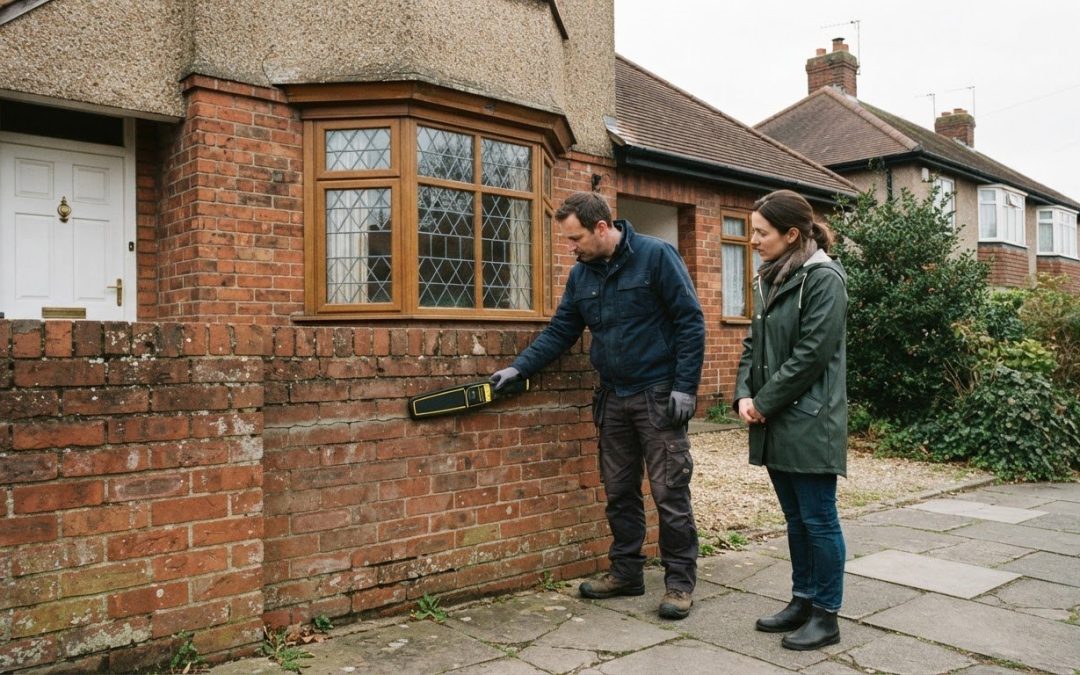
A warning in a homebuyer survey is a reason to investigate, not proof that wall ties have failed. This is when a homebuyer needs a wall tie survey: when a Homebuyer, Level 2 or Level 3 survey identifies possible concerns with the cavity wall ties. Horizontal cracking along brick courses or bulging brickwork can also point to a problem that needs closer assessment.
It’s understandable to want a clear answer before deciding what to do next. When a homebuyer needs a wall tie survey, a specialist inspection can assess the ties and help distinguish signs that may need remedial attention from findings that do not indicate failure. The report explains what was inspected and sets out any recommended next steps.
This article explains what a wall tie survey checks, what the report can contain and how an inspector assesses ties inside a cavity wall, including when access is needed to view them. It also covers signs and property circumstances that may make specialist advice useful, so you can understand what a finding means before moving forward with a purchase.
Key Takeaways
- Recognise why horizontal cracks or bulging brickwork may warrant a closer look, while remembering that a visible sign alone doesn’t confirm tie failure.
- Understand how inspectors use metal detection and a borescope to assess cavity wall ties, and when they may need more direct access.
- See what a wall tie report can tell you about the ties’ condition, the inspection findings and possible next steps.
- Learn why a property’s age, wall construction and exposure to corrosive conditions can affect the risk of wall tie deterioration.
- Know when a homebuyer survey’s observations or the property’s visible condition may justify specialist advice before you proceed.
What are the signs of cavity wall tie failure?
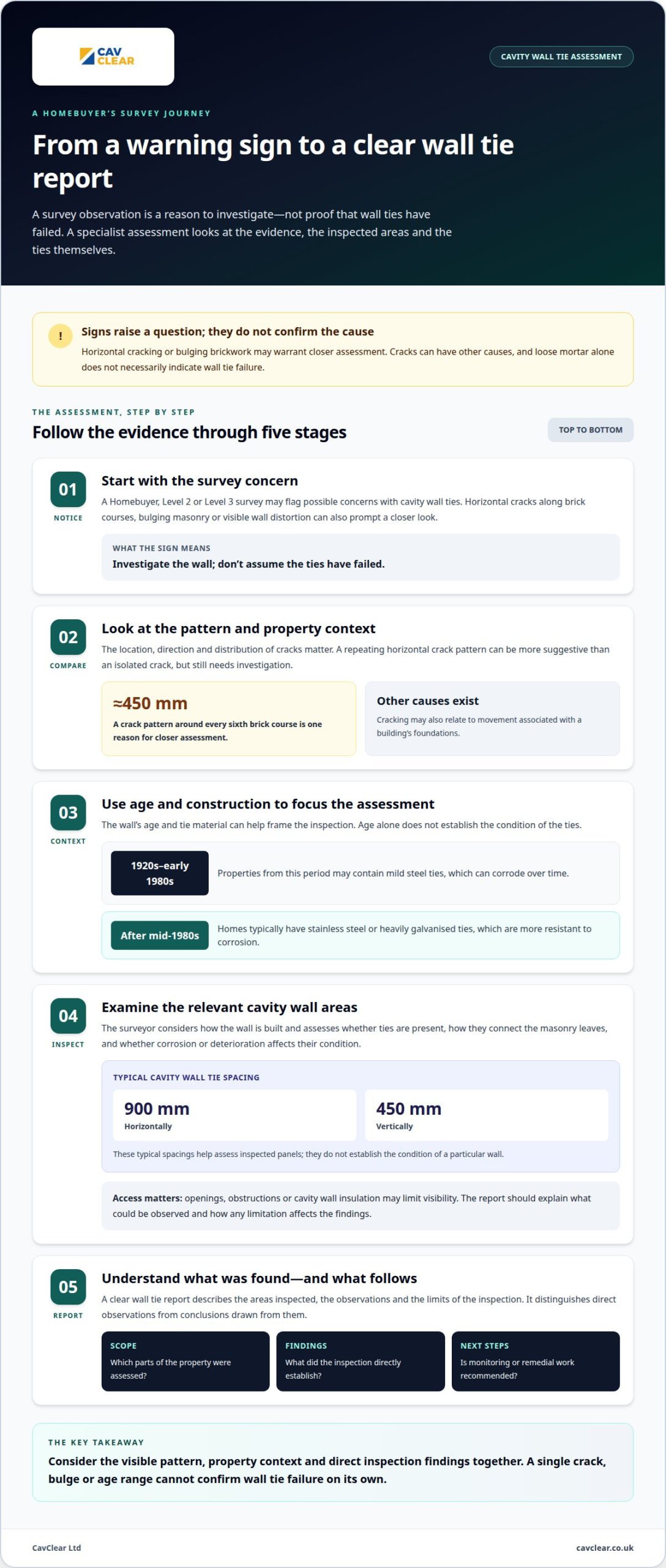
Horizontal cracks along brick courses and bulging masonry can indicate wall tie failure, but neither sign confirms the cause. A crack appearing around every sixth brick course, roughly 450mm apart, is one pattern that warrants closer assessment.
Cracks and Bulging Brickwork
Cracking brickwork and outward bulging can occur when corroded ties no longer hold the two masonry leaves securely together. Movement in the outer leaf can affect the stability of a masonry panel. Consider the pattern as well as the location: horizontal cracks repeating along brick courses can be more suggestive than an isolated crack, but still need investigation.
Risk by Property Age and Construction
Wall tie failure risk is linked to the type and age of a property’s cavity wall. Properties built between the 1920s and early 1980s may contain mild steel ties that can corrode over time. Homes built after the mid-1980s typically have stainless steel or heavily galvanised ties, which are more resistant to corrosion. Construction age helps focus an assessment, but doesn’t establish the ties’ condition.
Other clues include bulging brickwork, cracks following the bed joints and visible distortion around a wall panel. Loose mortar alone does not necessarily mean wall tie failure. Corrosion can expand metal ties inside the cavity and put pressure on surrounding masonry. As ties deteriorate, their ability to connect the leaves may reduce. The overall pattern and wall condition matter more than a single surface defect.
Cracks can also have causes other than wall ties, including movement associated with the building’s foundations. An inspector considers the location, direction and distribution of cracking across the elevation, alongside any wall distortion. A horizontal crack near a brick course may raise concern about wall ties, while a different pattern may point to another cause. A crack’s appearance alone cannot reliably distinguish between them.
To investigate suspected failure, a specialist assesses the wall and examines the ties within the cavity rather than relying only on external signs. The inspection considers whether ties are present, how they connect the masonry leaves and whether corrosion or deterioration affects their condition. The findings inform whether monitoring or replacement is recommended. This assessment is particularly relevant when the property’s age, visible cracking and bulging raise related concerns.
Survey methods, including metal detection and borescope inspection
A useful inspection starts with the concern raised about the property, then focuses on the relevant wall areas. The aim is to establish whether the evidence answers that concern or whether restricted access leaves questions unresolved. This keeps the survey relevant to the homebuyer’s decision rather than treating every property as if it presents the same issue.
The surveyor considers how the wall is built and what the inspection needs to establish. Different elevations may have different construction details or visible conditions, so findings for one area should not automatically be applied to another. A useful report makes clear which parts of the property were assessed and where the observations relate.
Access also affects how confidently ties can be assessed. An inspection opening may provide a limited view, while obstructions can restrict what the surveyor observes. The report records the available findings and distinguishes direct observations from conclusions drawn from them. For buyers, a clear account of the inspection’s scope shows what the report does and does not establish.
Where cavity wall insulation is present, the surveyor considers whether it affects visibility of the wall ties. The key question is not simply whether insulation exists, but whether the inspection can adequately assess the relevant components. If visibility is restricted, the report should explain the limitation and its effect on the findings. This helps the buyer understand whether the assessment has answered the original concern.
Inspection findings are considered alongside the wall’s construction and the specific area under review. The surveyor assesses whether observations are consistent across inspected locations or point to a localised concern. This helps prevent a finding in one part of a property from being treated as proof of a defect everywhere. The report’s description of inspected areas is therefore important when considering any recommendation.
For a homebuyer, the useful question is whether the survey provides enough direct evidence to understand the concern raised in the property report. If it identifies a limitation, that should be clear, along with what the available observations establish. A wall tie inspection can help clarify the condition of the relevant cavity wall areas as part of a purchase assessment.
What is a Wall Tie Survey and What Does a Wall Tie Report Contain?
A wall tie survey assesses whether ties connect the two masonry leaves and remain in suitable condition. The report explains whether monitoring or remedial work is recommended. For a property purchase, ask which areas were inspected and what previous repairs covered.
Factors in Wall Tie Assessment
Wall tie assessment considers the ties’ condition, distribution and ability to connect the inner and outer leaves. In a typical cavity wall, ties are spaced 900mm horizontally and 450mm vertically. This helps the surveyor assess whether the inspected panels have adequate connections. The report may also record photographs, defects, condition grading and recommendations, giving a buyer specific findings to consider.
Interpreting Results and Repair Needs
Survey results describe what the inspection found, not simply whether a wall looks sound from outside. A report may identify ties in satisfactory condition, corrosion or defects that need attention. Depending on the findings, recommendations may include monitoring or wall tie replacement. The stated condition and affected areas help the buyer understand the structural implications and discuss the next steps with the surveyor.
Reports may refer to BRE Digest 329 and 401 guidance and include photographs, a condition grading, identified defects and professional recommendations. These details help distinguish an observed issue from a suggested remedy. If the report recommends further work, its description of the affected panels and ties helps clarify what the recommendation addresses.
Failed Ties and Previous Repairs in a Sale
If a property has failed ties or previous repairs, clear records of the inspection findings and work completed are useful. Buyers can ask the seller which areas were repaired, what method was used and whether reports or repair documents are available. The surveyor can explain whether the current inspection covered those areas and whether its findings indicate further attention.
A metal detector can help locate ties within a wall, but it does not establish their condition. The surveyor uses detected positions to guide inspection access and assess visible metal. Locating a tie is different from confirming whether corrosion has affected its performance.
Wall ties connect the two leaves of a cavity wall while allowing them to move independently and transfer loads. If replacement is recommended, the report should explain the observed defect and the areas affected. Access requirements, including scaffolding where needed, can then be considered alongside the recommended work. Do not assume that previous repairs carry a guarantee: check any written terms and what work they cover.
How is a cavity wall tie survey conducted?
A survey examines the wall’s construction, the ties’ positions and their condition within the cavity. The inspector considers whether ties are present, adequately distributed and still able to connect the masonry leaves. Where ties are accessible, their visible condition can be considered alongside the wider condition of the wall. The findings help distinguish corrosion from inadequate tie provision or another defect.
Corrosion develops when protective coatings deteriorate and metal is exposed to conditions within the cavity. The tie can then lose material and strength. Some UK properties built in the 1920s to 1950s used black ash mortar, which is highly corrosive to mild steel ties. Wire butterfly ties were common in the 1960s and 1970s, and corrode faster than strip ties. These construction details help explain why a survey considers both tie type and surrounding materials.
Corroding metal can expand inside the masonry and put pressure on the surrounding area. This expansion may contribute to cracking or movement in the outer leaf. Inadequate ties present a different concern: even ties without visible corrosion may not provide a sufficient connection across a wall panel. The inspector therefore considers the number and distribution of ties as well as their condition, rather than treating corrosion as the only possible cause.
For visible ties, the inspector assesses corrosion using the grading described in BRE Digest 401, issued in 1995. This guidance sets out nine classes, from bright and shiny ties to very rusty, laminating ties. Class 1 indicates a bright, shiny tie with no problem. Class 9 describes a very rusty, laminating tie requiring urgent repair. The grading gives the report a consistent way to describe observed corrosion and its severity.
A survey report explains where ties were inspected, what condition was visible and whether concerns affect particular wall areas. It may identify corrosion, missing or inadequate ties, and recommend remedial work where the findings support it. A low corrosion grade does not establish that every tie across the property is in the same condition: the assessment applies to the locations inspected. Photographs, recorded positions and an explanation of the findings help connect the observed defect to the recommendation.
The outcome may be monitoring, further investigation or replacement, depending on the tie condition and distribution. For example, a class 9 observation points to urgent repair, while the report must still explain which inspected area it concerns. A buyer can use these findings to understand the property’s structural condition and the remedial work being recommended, rather than relying on the building’s age alone.
When a homebuyer may need a specialist wall tie survey
A specialist survey is useful when a purchase survey flags a possible tie concern or visible defects need closer investigation. The findings can clarify the property’s condition before you decide how to proceed.
Reasons for a Specialist Survey
A specialist wall tie survey investigates the ties themselves when a general property inspection identifies a concern. It matters because visible cracking or bulging cannot establish the condition of concealed ties. A property built with cavity walls before 1981 may face higher corrosion risk, while exposure near the sea or industrial pollution can increase concern.
Consider specialist assessment when a Homebuyer, Level 2 or Level 3 survey mentions possible wall tie defects, recommends further investigation, or cannot establish the cause of masonry movement. A lender reviewing the property’s condition may also need clear findings about the ties and any recommended remedial work. The survey separates a reported concern from an assessment of the actual cavity wall components.
Property context matters. For a coastal home with cracking, older cavity wall construction or previous wall tie replacement, consider the areas inspected and any repair records. Where replacement has taken place, the current condition of the masonry and the scope of the earlier work help shape the next inspection. A specialist report sets out findings and recommendations rather than treating the building’s age as proof of failure.
Limits of a RICS Homebuyer Survey
A RICS homebuyer survey can identify visible signs or flag a potential wall tie concern, but it does not necessarily inspect concealed ties inside the cavity. A surface inspection cannot confirm the condition of metal components hidden behind brickwork.
If the survey mentions cracking, bulging or suspected tie failure, read its recommendation carefully. A request for further investigation means the concern needs a more focused assessment; it does not, by itself, prove that replacement is required. A specialist inspection can examine accessible ties and report on their observed condition.
Before proceeding, note which elevation or wall panel the survey identifies and whether it records previous repairs. Ask the surveyor or seller what information exists about earlier wall tie replacement, which areas it covered and whether any inspection report is available. Those details help distinguish a localised repair from a concern affecting other parts of the property.
For a buyer, the practical takeaway is to treat a flagged concern as a reason to obtain specific evidence, not as a confirmed failure. If the survey identifies a wall tie issue, arrange a specialist wall tie survey to clarify the findings and any recommended next steps.
CavClear
CavClear helps homebuyers investigate concerns about cavity wall ties through Wall Tie Surveys and Cavity Wall Surveys. When a property report notes possible defects, a specialist inspection can assess the ties and provide detailed findings and recommendations. If the findings indicate failed or corroded ties, Wall Tie Replacement may be appropriate. Where a professional survey confirms defective cavity wall insulation needs removal, CavClear provides Cavity Wall Insulation Removal.
The appropriate work depends on the property and the survey findings. A clear assessment helps you understand the issue and consider relevant next steps for the home.
Contact CavClear to discuss a wall tie concern identified during your property purchase.
Make your next property decision with clarity
Understanding when a homebuyer needs a wall tie survey can turn an unresolved concern into a clear next step. The value lies in understanding what the findings mean for the specific property and how any recommended work fits your plans. This gives you a firmer basis for discussing the results and deciding how to proceed with the purchase.
Focus on evidence about the cavity wall, not assumptions based only on the property’s age or appearance. A specialist assessment can explain the ties’ condition and any recommended remedial work. CavClear carries out Wall Tie Surveys and Wall Tie Replacement nationwide, and provides Cavity Wall Insulation Removal where a professional survey confirms defective insulation needs attention.
If a property report has raised concerns, take the next step with a focused discussion. Contact CavClear about a wall tie survey to discuss the property and its inspection needs.
Frequently Asked Questions
What are wall ties?
Wall ties are metal connectors that hold the inner and outer leaves of a cavity wall together. They help the two masonry layers act as a connected wall while allowing each leaf some independent movement. A tie sits across the cavity rather than forming a visible feature on the brick face. Its position and condition matter because deterioration can weaken the connection between the leaves.
Does a wall tie survey always mean replacement?
No. A survey identifies the condition of the ties and whether further action is appropriate; replacement is not an automatic outcome. Where deterioration is minor, monitoring and a later inspection may be recommended instead. Some ties with minor corrosion may be monitored and inspected again after 5 or 10 years. The report should explain which findings support monitoring, further investigation or remedial work.
What are the differences between an intrusive survey and a non-intrusive survey?
A non-intrusive inspection can use small access holes for an endoscope or fibre optic camera to view ties inside the cavity. If the cavity cannot be viewed adequately, an intrusive survey may provide more direct access, which can involve removing a small brick panel. Cavity wall insulation can obstruct camera views. The inspection method depends on whether the ties can be seen and assessed through the available access.
What is a wall tie survey and what does it inspect?
A wall tie survey examines whether ties are present and connecting the masonry leaves effectively. It considers visible tie condition, corrosion and whether the inspected wall areas have suitable connections. A written report can include photographs, condition grading, identified defects and recommendations. For a buyer, these details help distinguish an observation requiring attention from a finding that supports monitoring or remedial work.
What signs of wall tie failure should homebuyers look for?
Horizontal cracking along brick courses and bulging brickwork can indicate possible wall tie problems, particularly when they occur together. Cracks repeating at roughly 450mm intervals may follow every sixth brick course. These signs do not prove tie failure, and loose mortar alone is not necessarily evidence of it. The pattern, location and condition of the surrounding masonry all help guide further assessment.
When should a homebuyer arrange a wall tie survey?
Arrange a specialist assessment when a Homebuyer, Level 2 or Level 3 survey raises concerns about cavity wall ties or recommends further investigation. Visible cracking or bulging can also justify closer assessment, especially in an older cavity-wall property. A focused survey can help clarify the reported concern before you decide how it affects your purchase plans. A survey warning alone does not confirm that the ties have failed.
How is a wall tie survey carried out, and how long does it take?
The surveyor assesses the wall, locates ties and examines them through cavity access using suitable inspection equipment. If a camera cannot show the ties clearly, a more direct inspection may be needed. The time required depends on access and construction. The report records the inspection findings.
Are wall tie surveys recommended for particular house types, ages or locations?
Older cavity-wall properties may warrant closer attention, especially homes built before 1981. Coastal locations and areas affected by industrial pollution can increase corrosion concerns. By contrast, a solid-wall house has no cavity wall ties to inspect; solid-wall homes were mostly built before about 1920. Construction type therefore matters as much as age when deciding whether a wall tie survey is relevant.
Recent Comments