
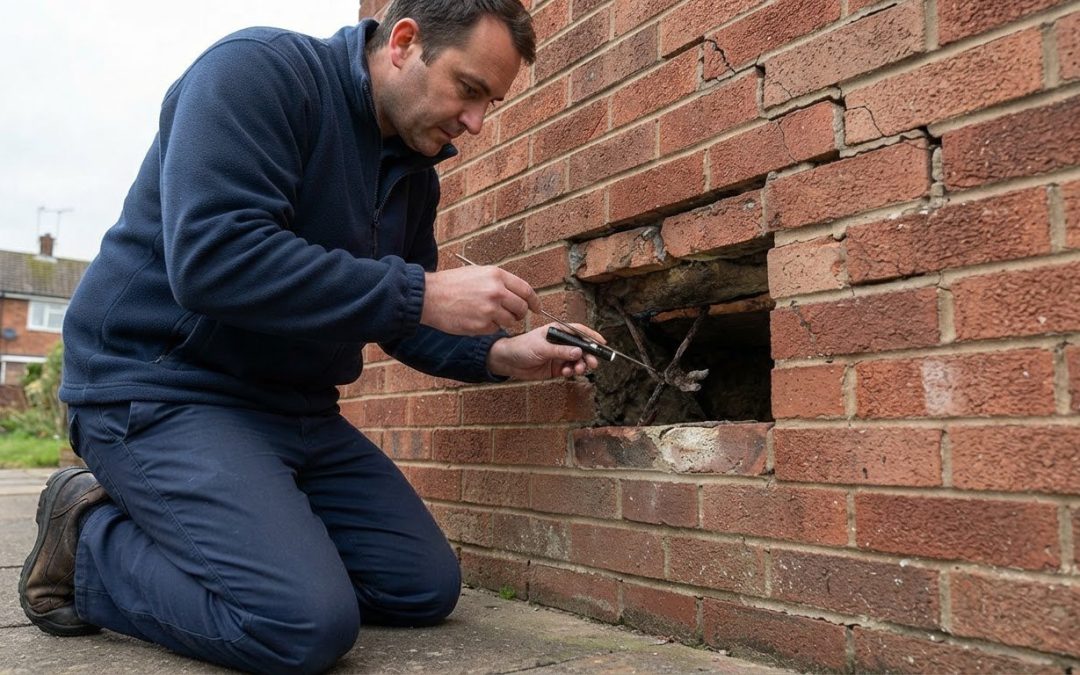
Cracks in brickwork can indicate movement, but they do not show whether wall ties are the cause. Understanding what a wall tie survey checks explains how a specialist assesses the ties, surrounding masonry and signs of corrosion or movement.
It’s reasonable to wonder whether an inspection will damage the wall. A survey typically begins with an external assessment of the elevations, cracks and wall alignment, then uses targeted checks to locate and assess representative ties. Small inspection holes may be needed, and are typically made good afterwards.
This article explains what an inspection can reveal, when further investigation may be recommended and how to interpret the findings and next steps in a report. It also shows how a survey can distinguish visible symptoms from evidence of wall tie problems, helping you make a more informed decision about your property.
Key Takeaways
- A survey combines an external assessment with targeted checks of representative ties and the cavity.
- Small inspection holes may be used to assess ties directly and are typically made good afterwards.
- Read the report for the inspection method, evidence, areas checked, limitations and recommended next steps.
- Cracking, changes in wall alignment or signs of movement can help indicate when further investigation is needed.
- Recommendations should reflect the evidence found, including whether monitoring, further testing or replacement is appropriate.
Will the survey damage the wall?
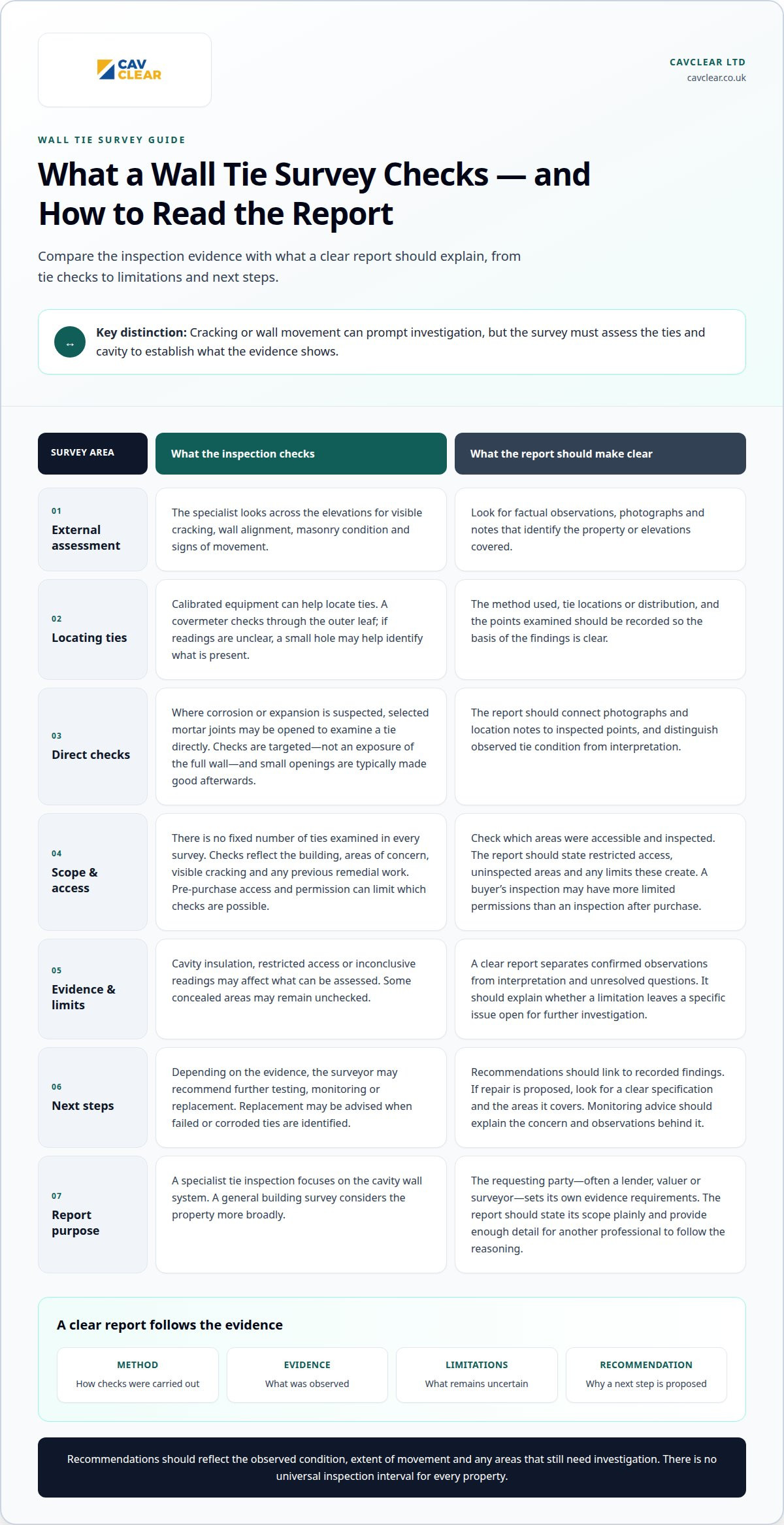
A wall tie survey focuses on the cavity wall system, including tie locations, condition and signs of movement. Trained specialists begin with an external visual inspection, then use calibrated equipment to locate ties and examine the cavity. The checks are targeted to the property and the concerns being investigated.
A covermeter can help locate ties through the outer leaf. If readings are unclear, a specialist may drill a small hole to identify what is present. Where corrosion or expansion is suspected, the surveyor may open selected mortar joints to assess a tie directly. These checks disturb only chosen points, rather than exposing the full wall. Inspection holes and opened joints are typically made good afterwards.
A wall tie survey differs from a general building survey because it focuses on the cavity wall system, including tie locations, condition and signs of movement. A general survey considers the property more broadly, while a specialist tie inspection uses targeted checks to investigate representative ties and the cavity.
There is no fixed number of ties examined in every survey. The checks should reflect the building and the concern being investigated, including its elevations, visible cracking and any previous remedial work. For example, a surveyor may focus checks around an area where cracks or distortion are visible, rather than treating every wall as identical.
For a pre-purchase inspection, access and permission can affect which checks are possible. A buyer’s inspection takes place before ownership, so investigation permissions may be more limited. After purchase, homeowners generally have greater flexibility over inspection permissions. In either case, the surveyor should explain which areas were accessible and record any resulting limits in the report.
There is no single acceptance checklist for every UK wall tie report. The party requesting it, often a lender, valuer or surveyor, sets the evidence it will accept. Any practical recommendation should follow the survey findings and clearly describe proposed work. Avoid treating a generic recommendation as a property-specific design.
Replacement may be recommended if the inspection identifies failed or corroded ties, but the report should link that advice to recorded evidence. It should also state whether further testing or monitoring is appropriate. There is no universal future inspection interval: recommendations depend on the observed condition, extent of movement and any unresolved areas. A clear report distinguishes confirmed defects from questions requiring further investigation.
Report findings, limitations and recommendations
A useful report connects each conclusion to recorded evidence from the inspection. Its photographs, methods and recommendations should make clear what was observed and what remains uncertain.
Survey Report Contents
Look for photographs, the inspection method, areas examined and factual observations. A report may record tie distribution, visible defects, mortar condition, wall alignment and the condition of inspected ties. These details show how the surveyor reached a conclusion. A clear report also identifies the property or elevations covered, so its findings are not mistaken for an assessment of uninspected areas.
Findings and Limitations
The conclusion should distinguish observed evidence from interpretation. For example, a report can describe a tie as corroded if inspection revealed corrosion, while noting separately that concealed areas were not examined. Check the stated limitations, including restricted access, areas not inspected and inconclusive readings. These boundaries explain how far the findings apply; they do not automatically invalidate the assessment.
Remedial Recommendations
Recommendations should follow from the recorded condition, not just the presence of cracking. The report may specify further testing, monitoring or replacement, and should explain which findings support that next step. If repair is recommended, look for a clear specification and the areas it covers. This helps you understand the proposed work and distinguish it from investigation that may still be needed.
A report should give enough detail for another professional to understand the inspection without relying on verbal explanations. The method matters because a covermeter survey, visual inspection and direct examination provide different kinds of evidence. Photographs and location notes help connect each observation to a particular elevation or inspection point.
Read the limitations carefully. Insulation in the cavity, restricted access or inconclusive readings may affect what the surveyor could assess. The report should identify these constraints and explain whether they leave a specific question unresolved. It may recommend targeted testing where the available evidence cannot establish a tie’s condition.
Recommendations can also guide a wider assessment. A wall tie report may be submitted to a mortgage lender, local authority building control officer or structural engineer as part of that process. The requesting party sets its own evidence requirements, so a report should state its scope and findings plainly. A generic phrase such as “repairs required” gives less direction than a documented diagnosis and repair specification.
Use the report to follow the sequence from evidence to conclusion to action. If it recommends monitoring, look for the concern being monitored and the observations that prompted the advice. If replacement is proposed, its stated scope should correspond with the affected areas. This makes the reasoning easier to follow and clarifies whether the next step is repair, further investigation or observation.
Checking tie type and condition
A wall tie survey assesses tie location, spacing, type and condition alongside the surrounding masonry. The findings help distinguish visible movement from evidence of deterioration within the cavity.
Defects and Signs of Failure
Inspectors look for corrosion on observed ties, mortar defects and changes in wall alignment. Corroding ties can expand, placing pressure on masonry and contributing to horizontal cracking or bulging. Cracks alone do not prove tie failure, so their position and pattern need to be considered alongside inspection findings.
Wall tie reports can also record tie distribution and the condition of the surrounding masonry. Movement across an elevation may prompt closer checks at representative locations, especially where cracking or distortion is visible.
Cavity Wall Tie Inspection
A specialist locates ties using a metal detector and maps their positions. The survey considers representative original and remedial ties, where present, and may investigate areas of concern. A borescope camera can examine the cavity where conditions allow. Insulation or debris can affect what is visible and how the findings are interpreted.
A borescope camera can provide images inside the cavity where access and conditions allow. Insulation may make this examination difficult, so the survey method must suit the construction and the question being investigated.
Equipment and Tests
A metal detector helps locate metal ties through the masonry and map their distribution. Its readings help identify points for closer examination, but do not show the full condition of concealed metal. A borescope camera can provide visual evidence where access and cavity conditions allow.
If readings are ambiguous, a specialist may use a small drill hole to establish what is present. Selected mortar joints may be opened where suspected corrosion needs direct assessment.
Wall ties are commonly steel elements embedded in mortar between the brick leaves. In cavity walls built before the mid-1980s, ties may have a thin zinc coating that can deteriorate over time. The survey records the type and condition of observed ties, rather than relying on the building’s age alone to diagnose failure.
The inspection also considers tie spacing and whether the observed distribution appears consistent across examined areas. A report may record mortar condition, visible defects and surrounding masonry alongside tie findings. These details provide context: a reading from one point should be considered with the masonry and other inspected locations.
When considering what defects and signs of wall tie failure a survey checks, key evidence includes corrosion, cracking, bulging and wall distortion. A specialist combines those observations with metal-detector readings and, where appropriate, borescope examination or other inspection methods. This helps establish whether the evidence supports further investigation or remedial recommendations.
Cracking and other reasons to request a survey
Cracking can prompt a wall tie survey, but a crack by itself does not establish the cause. The survey considers its position and pattern alongside wall alignment, openings and other signs of movement. This wider assessment helps determine whether tie condition needs investigation or whether the visible defect may have another explanation.
Horizontal cracks along mortar joints can be a reason to investigate, particularly when they appear in a repeated pattern across an elevation. That pattern alone cannot diagnose failed ties. A surveyor maps the cracks and compares them with the wall’s geometry and inspection findings.
Bulging or distortion in the outer leaf is another significant warning sign. Failed ties can allow the outer leaf of a cavity wall to move out of alignment, and severe failure can lead to its collapse. A specialist assessment examines whether movement coincides with suspected tie deterioration, rather than treating a visible bulge as proof of a particular fault.
Building age can also influence the decision to investigate. A cavity-wall property from the 1950s or 1960s that has never had its ties formally assessed may be a sensible candidate for a survey, especially if cracking or distortion is present. Age provides context, not a diagnosis; the inspection still needs to assess the actual wall and representative ties.
Other reasons to arrange an assessment include:
- Visible movement: cracks, bulges or changes in alignment across an external elevation.
- Corrosion concerns: properties in coastal or exposed locations, where ties tend to corrode faster.
- Previous repairs: remedial ties that need to be considered alongside original ties.
- A property purchase: a pre-purchase inspection where cracking or wall movement has raised a specific concern.
For a buyer, a focused inspection can clarify whether observed cracking is accompanied by evidence of a wall tie issue. The survey findings should identify the areas assessed and any access limitations, so the buyer understands what the inspection establishes. If a lender, valuer or surveyor requests a report, its requirements may shape the evidence needed.
Cracks can have causes unrelated to wall ties, so the pattern must be interpreted alongside other evidence. A survey examines the external elevations and wall geometry, then targets checks where visible signs or readings justify closer investigation. This helps distinguish a reason to investigate from a confirmed defect and guides next steps.
Forum contributors described horizontal cracks and suspected wall tie problems; another said replacement may be needed before bulges and structural problems develop. Failed ties can distort or cause complete failure of the outer leaf.
What is a wall tie survey?
A wall tie survey is a specialist investigation of the connections within a cavity wall. Understanding what a wall tie survey checks means looking beyond a simple count of metalwork. The assessment considers whether the ties, masonry and signs of movement make sense together. Its purpose is to build a reasoned picture of the wall, not to treat one visible symptom as a diagnosis.
Wall ties connect the two leaves of a cavity wall. Their condition matters to the relationship between those leaves, not just the appearance of the brickwork. A survey considers the wall as a system: the position and condition of ties matter alongside the surrounding masonry and any evidence of movement.
The word “survey” describes a structured assessment, not a guarantee that every concealed tie has been individually examined. Findings are based on evidence gathered from the areas investigated. This distinction matters when interpreting a conclusion: a finding about observed ties is different from an assumption about every tie hidden in the wall.
Construction details shape how a specialist interprets evidence. Original ties and ties added during earlier remedial work may differ in type and placement. Considering both helps build a more complete understanding of the wall’s history and present condition. The survey relates these details to the specific concern rather than viewing each observation in isolation.
A useful way to understand what a wall tie survey checks is to consider the questions it helps resolve: whether the wall shows evidence consistent with tie deterioration, whether the observed condition warrants further investigation, and whether remedial action is supported by the findings. These conclusions come from assessment, not automatically from a building’s age or a crack’s appearance.
The assessment gives a property owner or buyer a clearer technical basis for a decision. It can distinguish a concern that needs closer investigation from one where the evidence supports a defined next step. This is especially useful when a visible symptom has caused uncertainty but its cause has not been established.
CavClear
CavClear provides Wall Tie Surveys & Reports, Specialist Cavity Wall Inspections and Cavity Wall Tie Surveys & Replacement nationwide across the UK. Trained specialists use calibrated equipment, including a metal detector and borescope camera, and provide detailed reports. Where survey findings identify failed ties, Wall Tie Replacement may be recommended. CavClear also provides Cavity Wall Insulation Removal when a professional survey confirms it is needed.
A survey report can clarify which areas were inspected, what evidence was recorded and whether further investigation or remedial work is recommended. This gives homeowners and buyers a clearer basis for deciding what to do next, without assuming that visible cracking automatically means tie failure.
For a survey or guidance on your property’s wall ties, contact CavClear.
Choose a clear next step for your property
Understanding what a wall tie survey checks gives you a better basis for deciding what deserves attention. Use the findings to set a practical priority for the property, rather than treating every visible defect as evidence of the same problem. A clear assessment can focus decisions on the wall’s condition and the evidence gathered.
If you are considering an inspection, identify the specific concern you need resolved, such as unexplained movement or uncertainty about cavity wall ties. CavClear provides wall tie surveys and can recommend relevant remedial work based on the findings, including wall tie replacement. For concerns about defective cavity wall insulation, a professional survey can establish whether removal is needed.
Discuss a wall tie survey with CavClear to take the next step towards understanding your property’s needs.
Frequently Asked Questions
What are Wall Ties?
Wall ties are metal connectors that link the inner and outer leaves of a cavity wall. They help the two masonry layers act together while maintaining the cavity between them. Because ties sit inside the wall, their condition usually cannot be judged from the brick surface alone. A specialist inspection assesses representative ties alongside the surrounding masonry.
Why is Wall Tie Detection Important?
Detecting tie deterioration can help identify a structural concern before movement becomes more pronounced. Corrosion may weaken a tie or cause it to expand within the masonry, while missing or poorly performing ties can affect the outer leaf’s stability. Inspection findings provide evidence to guide proportionate next steps, such as further investigation or remedial work. Visible cracking needs assessment because it can have causes unrelated to wall ties.
What does a wall tie survey report include?
A report should explain the inspection approach and record findings for the areas examined. Look for photographs, observations about tie condition and distribution, the surveyor’s conclusion, and any limitations affecting its scope. If a mortgage lender or property professional requested the report, their acceptance requirements may differ. The stated scope helps show whether it addresses the specific concern raised.
When should a property have a wall tie survey?
Consider a specialist survey if external cracking, bulging or changes in wall alignment raise concerns about the cavity wall. An assessment can also be useful during a purchase when a property report identifies a specific question about ties. For a lender-related request, sharing its exact wording with the surveyor helps define the required scope. A property’s age alone does not establish that its ties have failed.
What are the risks of corroded or failing wall ties?
Corroded or failing ties can reduce the connection between the two leaves of a cavity wall. If the outer leaf loses restraint, it may move out of alignment, contributing to distortion or more serious structural failure. Corrosion can also expand within the masonry and place pressure on surrounding materials. These risks depend on actual wall conditions, so visible cracks should prompt assessment rather than an assumed diagnosis.
What repairs are recommended after a wall tie survey?
Recommended work depends on the survey evidence. If inspection findings identify failed or corroded ties, wall tie replacement may be advised; if evidence is incomplete, further testing may be recommended first. A report may instead advise monitoring a specific area. The recommendation should explain its basis and scope, distinguishing confirmed remedial work from further investigation or observation.
Recent Comments