
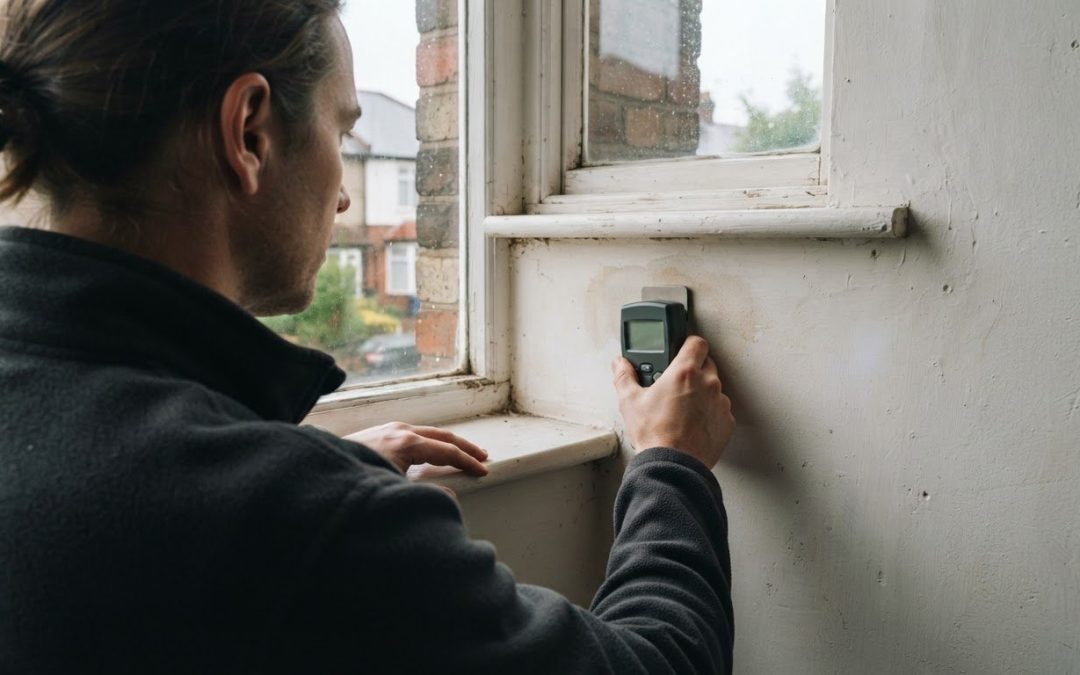
A high wall reading is a warning to investigate, not a diagnosis. Understanding what high moisture readings mean in practical terms starts with the scale: a 20% reading on a standard meter is a wood moisture equivalent (WME), not proof that the wall contains 20% water by weight. Meters indicate moisture or electrical conductivity, but they can’t identify the source on their own.
It’s understandable to feel concerned when a meter shows a high reading, particularly if you’ve also noticed staining, peeling finishes or a musty smell. The number matters, but so do the wall material, meter type, salts and surrounding signs. One result can mislead; a consistent pattern deserves closer attention.
This article explains how to interpret common wall readings in UK homes, how reliable moisture meters are on plaster and masonry, and what clues can help distinguish leaks, condensation and rain ingress. It also explains why cavity-wall defects, including problematic insulation or failing wall ties, may warrant specialist investigation when the evidence points to them.
Key Takeaways
- Read wall-meter figures in context: the meter type, wall material and surrounding evidence all affect what a result means.
- Look for patterns across the wall and compare them with unaffected areas; one isolated reading may not explain the cause.
- Use the location and appearance of moisture, along with ventilation and weather exposure, to help distinguish condensation, leaks and rain ingress.
- Persistent damp alongside cavity-wall symptoms may call for a specialist cavity wall survey or inspection of the insulation and wall ties.
- Understanding the likely source helps determine whether further investigation or a cavity-wall remedy is appropriate.
What Is a Bad Moisture Reading for Walls?
A wall reading around 20% on a standard moisture meter is usually a wood moisture equivalent (WME), not proof that the wall contains 20% water by weight. Understanding what high moisture readings mean in practical terms starts with the meter scale and the material tested. Readings consistently above 20% may indicate damp in plaster or masonry, but the figure needs context. The material, meter type and pattern across the wall all affect its meaning.
Many electrical resistance meters were designed for timber. They pass a small electrical current between two pins or through a contact plate, then measure how easily it travels. In masonry, the result reflects electrical conductivity, not a direct measurement of water content. Salts can absorb moisture from the air and conduct electricity, while metal beneath plaster, such as a pipe, cable or fixing, can create an artificially high reading.
Pin meters use steel probes, typically two to four, to make contact with the material. The reading depends on what the probes encounter, so a pin near a metal bead may differ from one nearby. Pinless meters use a contact plate to assess the material without penetrating it; some can read to a depth of 0.75-1.5 inches. Neither method identifies whether moisture came from a leak, rain ingress or condensation.
Scale matters. A manufacturer’s reference scale can describe 4% as bone-dry for wood but already damp for brick. That illustrates why the same percentage cannot be treated as a universal wall threshold. Compare readings taken with the same meter, on similar materials, and against unaffected baseline areas. Note the location and look for a consistent pattern rather than relying on one high spot.
Visible evidence helps put meter readings in context. Wet patches, discolouration, peeling paint or bubbling wallpaper may indicate moisture beneath the finish. A musty odour can point to mould growth. If you’re asking what high moisture readings mean in practical terms, consider these signs alongside the readings: salts or concealed metal can also produce high results without proving active water ingress.
To reduce indoor moisture and help walls or floors dry, use extractor fans when cooking and bathing, ventilate rooms, and deal with leaks or other water sources promptly. Keep air moving around affected surfaces, and avoid covering damp areas with furniture or impermeable finishes while they dry.
Do Moisture Meters Diagnose Damp?
No. A meter can indicate moisture or conductivity, but it cannot identify the cause or establish whether repairs are needed. Diagnosis depends on the pattern of readings and evidence from the building.
Damp Sources and High Readings
Rising damp, penetrating damp, condensation and leaks can all produce elevated meter readings, but they have different causes. Rising damp is associated with moisture moving upwards from the ground, while penetrating damp occurs when water enters through the building envelope. Condensation forms when humid indoor air meets a colder surface; a leaking pipe can create a localised wet area. Identifying the source matters because each requires a different response.
Why High Readings Do Not Prove Rising Damp
A high reading near floor level alone does not prove rising damp. Meters respond to conductivity, and salts in masonry can affect results; concealed metal can also distort them. Assessing rising damp involves considering the moisture pattern, salt contamination and other signs, not just one meter result. A meter alone cannot confirm whether the pattern and salt contamination are consistent with rising damp.
Height and distribution help guide investigation. True rising damp is typically associated with moisture rising to below 1 metre, but a low-level reading can also come from a plumbing leak, rain penetration or bridging. A damp patch beside a pipe, for example, points to a different possible source than a consistent low-level pattern. The reading indicates where to investigate, not which cause is present.
A damp survey builds a wider picture. The assessment can compare readings across similar materials and unaffected areas, inspect visible staining and check how moisture behaves over time. Depending on the property, it may also use hygrometer readings for relative humidity and dew point, thermal imaging, salt analysis of plaster or monitoring. A typical damp survey takes 1-2 hours, depending on property size.
Persistent moisture matters for timber as well as plaster. Structural timber below about 16-18% moisture content is described as a normal service range where decay is unlikely to start. At around 18-22%, sustained moisture can create conditions that permit decay; consistently elevated readings increase concern, especially in cool, dark, poorly ventilated areas. These timber thresholds are not wall-reading limits.
Seasonal and building-specific moisture levels
Moisture readings shift with material and indoor conditions, so one scale cannot describe every UK wall. Plaster readings are often discussed around 12% to 15%, while indoor wood readings commonly sit around 6% to 14%. These figures are not interchangeable: a device calibrated for timber does not directly measure the water content of plaster or brick.
Seasonal conditions influence how quickly moisture enters and leaves a building. Warmer air can hold more water vapour than cooler air, while cold surfaces encourage condensation when humid indoor air meets them. A reading taken during a cold spell may differ from one taken after changes to ventilation or heating. Compare measurements from the same material and locations, rather than treating a seasonal difference as proof of a new defect.
Building age and construction also matter. Traditional and historic buildings often rely on materials and details that allow moisture to evaporate. Inappropriate modern treatments can trap moisture and restrict natural drying, potentially worsening dampness. For example, a moisture-resistant coating over an older wall can change how moisture behaves at the surface. Interpret the meter reading alongside the wall’s construction and finishes.
Materials respond differently to the same device. Brick, plaster, timber and fresh concrete have distinct properties, so a displayed percentage does not carry the same meaning for each. A fresh concrete slab can read high for months while drying normally. In a typical UK home, indoor joinery and furniture often show wood readings around 6% to 8%; that provides a timber comparison, not a target for masonry.
Sampling can add useful detail when surface readings do not explain a pattern. A timber core sample is often 10-12 mm in diameter, allowing examination of moisture within the material rather than only at its surface. Drilled samples can also provide readings from selected points; obtaining six readings in an hour is described as quick work. These methods disturb materials, so the surveyor chooses sampling locations to answer a specific question.
Relative humidity measurements offer a different view from a moisture meter. Measuring humidity under a waterproof cover is impractical for building surveys because each point would take several hours. The method and instrument affect what can be established. In a listed building or older property, an assessment should account for seasonal conditions, material type, finishes and the building’s ability to dry before interpreting elevated readings.

Distinguishing leaks from condensation and rain ingress
A high reading identifies moisture or conductivity at a location, not its source. To distinguish a leak, condensation or rain ingress, an investigation compares the affected surface with nearby areas and considers how the property is used, its appearance and its exposure. For example, a damp patch beneath a pipe directs attention to the plumbing, while moisture around an external wall calls for attention to weather exposure and the wall’s condition.
Condensation forms when water vapour in indoor air meets a cooler surface. The dew point is the temperature at which air becomes saturated and water vapour condenses; if a surface reaches that temperature, moisture can collect there. Poorly ventilated areas can develop condensation, especially where air movement is restricted. A bathroom mirror after bathing is a familiar example of surface condensation, although a wall reading alone cannot establish that condensation caused dampness.
Cold surfaces help explain why condensation may appear in particular places. External corners, window reveals and areas behind furniture can remain cooler than the room air, allowing moisture to form on the surface. Relative humidity reaches 100% when the air is fully saturated. A survey considers room conditions and the distribution of moisture, rather than treating one high reading as proof of condensation.
A plumbing leak can create a concentrated wet area near a pipe, fitting or appliance. An investigation looks for a relationship between the damp patch and nearby water services, along with staining or changes to finishes. Peeling paint or bubbling wallpaper can result when moisture becomes trapped beneath the surface. These signs help locate the affected area, but meter readings still need to be interpreted alongside other building evidence.
Rain ingress occurs when water penetrates from outside, and poor external maintenance can contribute to penetrating damp in brick walls. An assessment considers whether dampness corresponds with an exposed section of the property and whether the outside wall shows a relevant defect. Rainwater entering through brickwork can affect internal finishes; a meter reading alone cannot determine the entry point or distinguish this from a leak.
Patterns over time can help clarify an investigation. A surveyor can compare affected and unaffected locations, record visible changes, and monitor whether moisture responds to weather, ventilation or plumbing repairs. Persistent damp in a consistent area calls for investigation of the likely source, not just repeated meter readings. If a cavity-wall defect is suspected, assessing the wall construction can help determine whether the cause lies within the wall rather than on its internal surface.
Typical moisture readings for UK walls
UK wall readings need to be interpreted against the meter scale and material; a percentage is not a universal pass-or-fail standard. Practical guides use different bands, so a surveyor should explain which scale applies and consider the wall’s condition alongside the figure. To understand what high moisture readings mean in practical terms, first identify whether the meter displays a wood moisture equivalent scale or another reference scale.
A commonly used UK guide treats wall and plaster readings below roughly 17% to 20% on the WME scale as dry. Another traffic-light guide labels readings below about 17% green, around 17% to 20% amber, and above 20% red. These are guides, not proof of damage. Electrical resistance meters indicate conductivity, and masonry readings are not direct water-content percentages.
Other classifications use narrower bands. One guide describes 0% to 10% as dry, 11% to 16% as slightly damp, 17% to 20% as moderately damp, 21% to 25% as damp, and 26% and above as very damp. Such labels can appear precise, but they only make sense when the meter’s scale and wall material are known. A displayed 20% is not the same as 20% water by weight.
Material changes the interpretation. Typical UK brick-wall readings are given as around 13% to 16%, while plaster-wall levels are ideally described as 12% to 15%. A brick reading above 17% may indicate an issue for investigation; plaster readings over 20% may indicate significant water ingress. These values are not interchangeable or a diagnosis on their own.
A useful comparison uses the same instrument on similar materials. A surveyor can record readings across affected and unaffected parts of a wall, then compare the pattern with visible staining, soft plaster or peeling finishes. For example, several elevated readings across one external wall differ from a single result beside a metal fixing. Salts and concealed metal can distort electrical readings.
For UK guidance, these practical classifications do not establish damp in every wall at one universal percentage. A consistent method identifies the meter scale, accounts for material and calibration, and assesses readings alongside building evidence. Put simply, what high moisture readings mean in practical terms depends on whether the results form a repeatable pattern that fits the wall’s visible condition.
The practical takeaway is that 20% deserves context, not an automatic diagnosis. Persistent high readings, visible damage or cracking associated with a cavity wall can justify a focused investigation. A cavity wall survey can assess whether a cavity-wall issue is relevant to the moisture pattern.
CavClear
CavClear can investigate whether persistent moisture may be connected to a cavity-wall issue. A meter reading alone cannot identify defective cavity wall insulation or failing wall ties, so the wider pattern of damp, staining or cracking needs careful assessment.
Where the evidence points to the cavity, a Cavity Wall Survey can examine the wall system. CavClear also carries out Wall Tie Surveys and Wall Tie Replacement, and Cavity Wall Insulation Removal where insulation is defective or causing moisture problems. These services address specific cavity-wall concerns, rather than treating every high reading as the same fault.
If elevated readings persist alongside signs of cavity-wall problems, contact CavClear to discuss the property and a suitable investigation.
Choose a Clear Next Step for Your Property
Understanding what high moisture readings mean in practical terms is a starting point, not a reason to treat every damp patch the same way. The useful next step is to connect the evidence inside your home with the building’s condition, especially if moisture persists or appears alongside cracking or other cavity-wall symptoms.
A focused assessment can establish whether a cavity-wall concern warrants further investigation and which remedial approach fits the findings. Addressing the source, rather than only the visible surface, supports the property’s long-term condition.
If damp is causing concern, contact CavClear about your property. A clear discussion can help you decide what to do next, with no pressure to proceed.
Frequently Asked Questions
Need help interpreting damp readings?
Yes. If readings persist alongside damp patches or cracking, CavClear’s cavity wall surveys can assess whether a cavity-wall issue may be relevant. A useful interpretation records the meter scale, material, location and nearby conditions, then compares the pattern with unaffected areas. This provides a clearer basis for deciding whether investigation should focus on plumbing, indoor condensation, rain exposure or the cavity itself.
Are Moisture Meters Ever Useful?
Yes. A moisture meter is useful for comparing similar materials and tracking changes over time, such as drying after a leak. Repeated readings at the same points, for example, can show whether a localised wet area is changing after its source has been addressed. The value lies in consistent comparisons, not treating one displayed figure as a complete diagnosis of the wall.
Are moisture meter wall percentages an exact moisture content?
No. A wall-meter percentage may use a wood moisture equivalent scale rather than express the wall’s actual water content. The same displayed value can also mean different things for brick, plaster and timber. For example, a scale intended for wood cannot be read as a direct percentage of water in masonry. Check the scale and material before interpreting a result.
At what reading does mould or decay become a risk?
There is no single wall-meter figure that establishes mould or decay risk across every material. For timber, moisture content sustained above about 18% to 20% can make it susceptible to mould and wet rot. Decay risk also depends on whether moisture persists and on local conditions. A reading in plaster or brick should not be treated as a timber moisture-content result.
Can a Moisture Meter Detect Mould?
No. A moisture meter measures a material’s moisture-related response or conductivity; it does not identify mould. Visible growth, staining or a musty odour can provide separate clues, but a meter cannot confirm what is present on or behind a surface. An elevated reading behind wallpaper, for example, may prompt closer inspection, but it cannot establish that mould is there or identify its type.
Is this a brief spike or a long-term condition?
One reading cannot show how long a wall has been damp. A short-lived change may follow surface condensation or recent water exposure, while a repeated pattern suggests moisture remains present. Compare measurements at the same locations and on the same material over time. Fresh concrete can read high for months while drying normally, so the material’s age and drying behaviour matter too.
What are moisture readings and what units are they measured in?
Moisture readings are instrument results used to assess moisture or conductivity in a material. Many handheld meters display a percentage, but that figure may be a reference scale rather than a direct measurement of water by weight. Relative humidity is different: it describes moisture in the air. For a useful comparison, record whether the instrument measured a wall material or room air.
What moisture meter readings are considered high in UK homes?
Some UK wall-meter guides describe readings above 20% as high, but this depends on the scale and material. One guide places 17% to 20% in a moderate band and 21% to 25% in a damp band. These labels help flag results for closer assessment; they do not establish a cause or confirm damage. Compare like materials and consider the wider evidence.
Recent Comments