
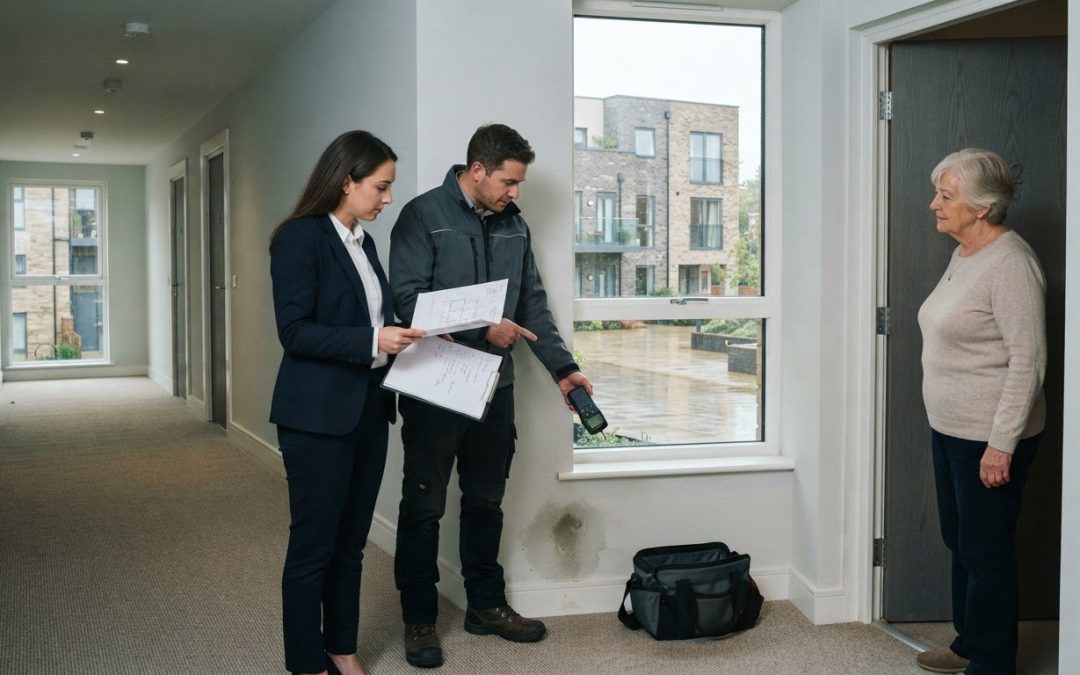
A damp patch in one flat may point to a local issue, or it may indicate a fault affecting the wider building. The managing agent’s responsibility for damp in apartment blocks is therefore best approached as a process of coordination, not guesswork. Residents need clear updates, inspections need to be arranged, and access may be required across more than one home.
It’s understandable to want a quick answer, but damp can have several causes, and appearance alone rarely confirms which one is present. This guide explains how to record a report, compare patterns across the block and organise an evidence-led investigation. It also covers when a specialist cavity-wall inspection may help assess concerns such as defective or wet cavity wall insulation, or failing wall ties. Clear findings help managing agents make informed recommendations and coordinate appropriate next steps without assuming every damp patch has the same cause.
Key Takeaways
- Keep a clear record of each report, including its location, timing and any changes, so patterns across flats or elevations are easier to spot.
- Compare isolated symptoms with recurring reports and visible external defects, but treat these as clues for inspection, not proof of a cause.
- Coordinate checks across flats and shared areas, gather relevant observations and keep residents informed as findings develop.
- The managing agent’s responsibility for damp in apartment blocks centres on organising a measured, evidence-led response rather than assuming the source.
- Where observations point to a cavity-wall concern, a specialist inspection can help assess the cavity and guide appropriate next steps.
Managing Agent Actions for Damp in Apartment Blocks
When a resident reports damp, the managing agent provides a practical point of coordination. They can acknowledge the report, gather initial details, arrange suitable checks and keep residents updated as information becomes available. This creates a clear record and helps move the issue towards an evidence-based next step.
Coordination is not diagnosis. A managing agent can organise an inspection, but a damp patch or mould growth alone cannot confirm its cause. The managing agent’s responsibility for damp in apartment blocks is best understood through this distinction: coordinate the investigation, share relevant evidence and use the findings to guide action.
A flat’s interior, shared spaces and the building fabric may all need consideration. Ownership and management arrangements, along with where moisture appears to originate, can affect who needs to be involved. Depending on the block, coordination may include the expertholder or landlord, residents, maintenance teams and a specialist inspector. The first task is to establish who and which areas need to be included in the investigation, rather than assume the source or responsibility.
Why the location of damp matters in a block
An isolated mark in one flat may call for checks focused on that room and nearby services. Similar reports in several flats, or damp in a communal area, may point to a pattern that needs a wider inspection. Neither pattern proves a shared defect, but it helps the agent decide what to examine next.
Record the affected floor, room and elevation, then consider nearby roofs, façades, rainwater goods and shared service routes as inspection context. Ask whether the same area has had previous reports or repairs. A recurring pattern is useful evidence to pass to an inspector, not a diagnosis in itself.
What information should the agent record first?
Good records make it easier to compare reports over time and coordinate access. Ask the resident what they can see and when it began. Dated photographs can show whether staining, discolouration or surface changes are spreading, while a note of any musty odour adds useful context.
- Record the flat or communal location, the date first noticed and whether the affected area is changing.
- Request dated photographs and a short description of odour, staining, mould or other surface changes.
- Log previous inspections, repairs, resident updates and access arrangements in one shared record.
Keep observations separate from conclusions. For example, record “staining below the window, reported after rain” rather than labelling it a leak before checks have taken place. Note whether access was completed or needs rearranging, and update the record when new reports arrive. This gives the next inspector a clearer account of the issue and helps the agent communicate progress consistently with everyone affected.
Which damp causes should a block investigation consider?
A damp mark or patch of mould is a symptom, not a diagnosis. Possible causes include condensation, penetrating moisture, plumbing leaks and defects in the building fabric. In an apartment block, more than one factor may be involved, so an investigation should consider the affected room alongside nearby flats, shared areas and external features.
A visible symptom shows where moisture is appearing, not what caused it. Staining on an internal wall, for example, could relate to condensation, a leak or moisture entering through the external wall. Treating the appearance as proof of one cause can lead to the wrong repair and leave the underlying issue unresolved. The RICS guidance on damp in buildings offers further context on assessing moisture in buildings.
How to distinguish common moisture patterns without diagnosing
Patterns can help focus an inspection, but they overlap and should not be used to confirm a cause. Condensation may be considered where moisture appears on cold surfaces or in rooms with limited ventilation, particularly when room use is relevant. These details are context, not grounds for attributing the issue to a resident.
Moisture that appears after wet weather may prompt checks of external exposure, the façade, roof or rainwater goods. A mark close to a kitchen, bathroom or shared service route may make plumbing worth examining. Record where the signs occur and what surrounds them, then let inspection findings guide the next step.
When cavity walls and wall ties merit specialist attention
Cavity-wall concerns may warrant specialist input when other observations point towards the wall construction. In some properties, defective or unsuitable cavity wall insulation can contribute to moisture problems. Cavity bridging, where materials or debris allow moisture to cross the cavity, may also be considered if inspection evidence supports it. Neither should be assumed from an internal damp patch alone.
Cracking or signs of movement in masonry may make wall-tie condition relevant to investigate, but cracking has several possible causes. A wall-tie survey can assess whether ties show signs of deterioration. A borescope inspection uses a camera inserted through a small opening to examine cavity conditions. Findings help establish whether further investigation or remedial work is appropriate.
For the managing agent’s responsibility for damp in apartment blocks, the practical priority is to match the investigation to the evidence and keep possible causes distinct from confirmed findings. Where observations point towards a cavity-wall issue, a specialist cavity-wall inspection can help assess the cavity and inform suitable next steps.
How should an agent coordinate investigations across flats and shared areas?
Use the location and history of reports to decide where an inspection should focus. An isolated patch may call for checks inside that flat and around nearby plumbing. Recurring reports on the same elevation or visible external defects may justify examining the façade, roof or rainwater goods as well. These clues help set the scope; they don’t prove a cause. BRE’s insights on damp diagnosis offer useful context for approaching building investigations methodically.
A general building inspection can review a range of possible moisture sources and building elements. A cavity-wall or wall-tie survey has a narrower purpose: it investigates the cavity or the condition of wall ties where the building type and observations make that relevant. The right route may involve more than one inspection area.
| Observation | Likely inspection area | Information to collect | Appropriate next step |
|---|---|---|---|
| Symptoms reported in one flat | Affected room, nearby plumbing and relevant external wall | Location, timing, changes and any nearby service routes | Arrange a focused inspection, including plumbing checks if observations point that way |
| Similar reports recurring across flats | Related floors, elevations and shared areas | Flat locations, dates and whether reports share a wall or service route | Compare the pattern and coordinate checks across the connected areas |
| Visible external defect near damp | Relevant façade, roof or rainwater route | Photographs, position and any relationship to internal symptoms | Arrange an external assessment and widen the investigation if evidence supports it |
Choosing an inspection route from the evidence available
Start with the report history and map affected locations against floors, elevations and shared spaces. If signs sit near a plumbing route, include that route in the investigation; if reports relate to an exposed wall or rainwater goods, inspect those elements too. Consider a cavity-wall assessment when construction and observations make it relevant, rather than treating it as a default response.
Keep the scope specific. A damp survey may assess possible moisture sources broadly, while a specialist cavity-wall inspection examines cavity conditions and a wall-tie survey focuses on tie condition. Specialist findings guide recommendations; they don’t establish a cause before inspection.
What a cavity-wall survey can contribute
Cavity-wall surveys use metal detectors, wall-tie locators and borescope or endoscope cameras to examine cavity conditions. A written report sets out the inspection findings and includes photographs. Wall-tie reports include tie-condition grading, and a remedial quotation is provided if required. This gives the agent a clearer basis for planning next steps, rather than a diagnosis drawn from appearance alone.
Where cracking makes wall-tie condition relevant, the guide Wall Tie Replacement: The Essential Guide to Structural Stability in 2026 provides related background. For building observations that point towards cavity-wall concerns, a specialist cavity-wall inspection can support the evidence-gathering process. This is a practical part of the managing agent’s responsibility for damp in apartment blocks: coordinate the appropriate checks, then act on the findings.
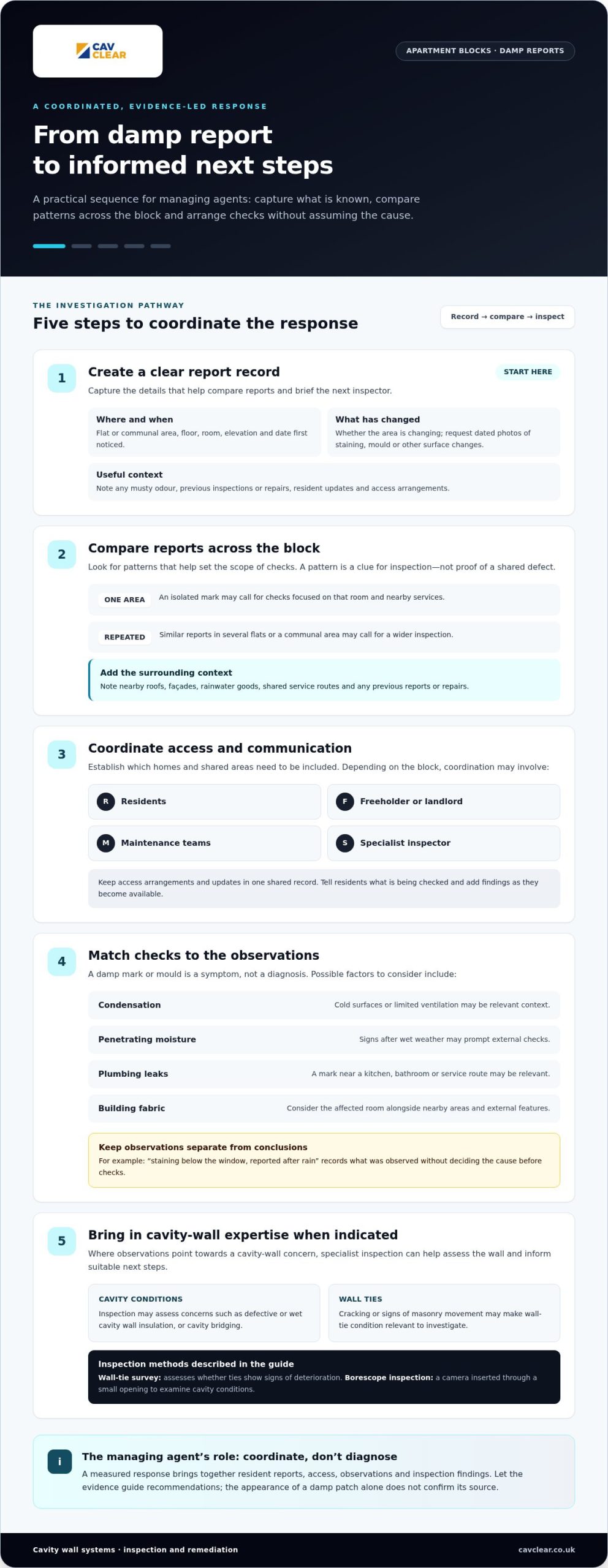
What practical steps help manage damp reports across an apartment block?
A consistent process helps an agent move from an initial report to a clear, evidence-led next step. It also makes it easier to see whether separate reports may be connected, without assuming that similar-looking symptoms have the same cause. The managing agent’s responsibility for damp in apartment blocks includes keeping communication, inspection findings and follow-up organised.
- Log each report. Record when it was received, the flat or shared area affected, when the issue began and any changes described by the resident.
- Map the locations. Mark reports by floor, room and elevation. Compare these with shared spaces and relevant service routes to spot possible patterns.
- Arrange inspections. Set out which areas need to be examined and coordinate access with residents. Record what was inspected and any areas that could not be reached.
- Coordinate specialist input. If observations point towards a plumbing route, external defect or cavity-wall concern, arrange an investigation suited to that evidence.
- Communicate findings. Explain what has been observed, what remains under investigation and what the next step is. Avoid presenting a possible cause as confirmed.
- Review and follow up. Keep a record of agreed work and revisit the affected areas afterwards to document any visible changes or further reports.
Consistent records turn separate reports into a timeline that can be compared across flats, floors and elevations. A single report may appear isolated; several reports in a similar location may help focus the next inspection. That pattern is useful, but it is not proof of a shared defect.
How to coordinate access and resident communication
Agree access with each affected resident and note which rooms or shared areas the inspection covered. If access needs to be rearranged, record that too, so the agent can distinguish an uninspected area from one where no visible issue was found.
Give practical updates about the stage of the process, such as an inspection being arranged or findings being reviewed. Don’t promise a cause or completion date before the evidence is available. Share information relevant to the building while keeping individual residents’ details private.
How to track findings and remedial follow-up
Keep survey reports, dated photographs, repair records and later observations together in the block’s record. Separate straightforward maintenance observations from specialist recommendations that need further assessment. This helps everyone involved understand what is known, what action has been agreed and what still needs investigation.
After agreed work, revisit the affected areas and record whether staining, mould or other visible conditions have changed. If symptoms persist or appear elsewhere, add the new observation to the same record and review the pattern. Clear records and follow-up help a block respond to evidence, track progress and identify when further investigation is needed.
Where findings point to a cavity-wall concern, arrange a specialist cavity-wall inspection to help assess the construction and inform appropriate next steps.
When can CavClear help investigate damp linked to cavity-wall problems?
CavClear is a nationwide UK cavity-wall specialist. Its input is relevant when observations, previous reports or the building’s construction point towards a possible cavity-wall issue. A Specialist Cavity Wall Inspection can help assess cavity conditions and wall ties, adding focused evidence to the wider investigation coordinated by the managing agent.
Damp, mould, cracking or movement alone doesn’t confirm defective insulation or failing wall ties. Findings need to come from an appropriate inspection. If cavity wall insulation is found to be defective, damp or causing issues, cavity wall insulation removal may be considered. It isn’t a routine response to every damp report, and recommendations depend on the property-specific evidence.
What property professionals can expect from a specialist survey
Trained technicians use calibrated survey equipment, including metal detectors, borescope or endoscope cameras and wall-tie locators. Inspection work is carried out from the exterior wherever possible, helping to limit disruption inside the flats. The survey scope depends on the property and the concerns being investigated.
Findings are set out in a written report with photographs and, for wall-tie surveys, tie-condition grading. The report clarifies what was observed and what remedial options may be appropriate. Recommendations follow the inspection findings, and remedial work is quoted separately according to the property’s requirements.
How to decide whether to request cavity-wall input
Consider specialist input if reports or building observations indicate a possible cavity concern, such as recurring moisture associated with an external wall, evidence of insulation problems or cracking that warrants checking wall ties. These signs are reasons to investigate, not proof of a particular defect. The inspection should address the specific concern and distinguish observed conditions from conclusions.
For background on the possible issues and the inspection process, see Cavity Wall Insulation Removal: The Complete UK Homeowner’s Guide (2026). The managing agent’s responsibility for damp in apartment blocks includes coordinating relevant investigations and communicating what the findings support, rather than treating a visible symptom as a confirmed diagnosis.
If the evidence points towards a cavity-wall concern, arrange a nationwide cavity-wall survey with CavClear. Survey scope and any subsequent remedial work are tailored to the property and its inspection findings.
Turn inspection findings into a clear next step
A damp report can be the start of a more informed maintenance plan. Once the evidence has been gathered, the managing agent can use it to prioritise appropriate action, keep residents informed and monitor whether conditions change. This measured approach supports the long-term condition of the building without treating an early observation as a final diagnosis.
The managing agent’s responsibility for damp in apartment blocks is most effective when coordination continues beyond the first inspection. Findings should inform the next decision, whether that means further assessment of the cavity wall or another appropriate response. Clear communication helps residents understand what is known and what remains to be established.
If the building evidence points towards a cavity-wall concern, CavClear provides specialist input nationwide across the UK. Explore a cavity-wall survey with CavClear to take an informed next step for the property. A well-directed investigation can help the block move forward with greater confidence and protect its long-term condition.
Frequently Asked Questions
What should a managing agent do first when damp is reported in a flat?
Acknowledge the report and establish whether there are immediate signs of active water ingress, such as a continuing leak or rapidly spreading wet area. Ask the resident to describe the location and changes they’ve noticed, then arrange an appropriate check. Record any affected nearby flats or shared spaces, since this context may help shape the inspection. Keep the resident updated while the cause is being assessed.
Is a managing agent responsible for investigating damp in shared areas?
A managing agent can coordinate checks in shared areas as part of managing the building, with the precise arrangements depending on how the property is owned and managed. For example, damp staining in a communal stairwell may need inspection alongside nearby external walls, roof areas or service routes. Record what has been observed and which areas have been checked, then use the findings to identify appropriate next steps.
Can damp in an upper-floor flat be caused by a cavity-wall problem?
Yes, a cavity-wall defect can be one possible cause, but an upper-floor location doesn’t confirm it. Moisture may also relate to a roof detail, rainwater goods, plumbing or condensation. Note whether the damp appears near an external wall, ceiling or service route, and whether similar signs occur nearby. A specialist inspection can assess cavity conditions if the available evidence makes that line of investigation relevant.
How can a managing agent tell whether damp affects one flat or the whole block?
Compare reports by room, floor, elevation and proximity to shared features such as service risers. A simple building plan can help show whether reports cluster around one vertical stack or occur in unrelated locations. Ask residents to report new signs through a consistent route, then compare dates and locations. A pattern can guide the scope of checks, but inspection is needed to establish whether reports share an underlying cause.
What information should residents provide when reporting damp or mould?
Residents can help by giving the room and exact position, when the issue first appeared, and whether it has changed. Dated photographs taken from a similar angle can make changes easier to compare. They should also describe visible features such as peeling paint, staining or mould, and mention any recent leak or repair nearby. These details support investigation, but residents don’t need to identify the technical cause.
When should an apartment block have a cavity-wall inspection?
Consider cavity-wall input when inspection history or building observations point to a possible issue within the external wall, such as damp recurring in a related area or evidence of cavity-wall insulation problems. Cracking or movement may also justify a wall-tie assessment, but neither proves tie failure. The managing agent’s responsibility for damp in apartment blocks includes choosing an investigation that fits the evidence, rather than arranging a specialist survey automatically.
Can a borescope survey identify damp or wall-tie problems inside a cavity?
A borescope camera can provide a view of cavity conditions through a small opening, helping an inspector assess what is visible at that location. It can support investigation of potential moisture-related cavity issues, but the camera view alone may not establish the source of damp. Wall-tie condition can also be assessed using appropriate survey tools, such as wall-tie locators, alongside inspection findings and reporting.
Recent Comments