
Wiping recurring black mould from your walls will never resolve a structural building defect, no matter how frequently your landlord blames indoor laundry habits. When reporting damp leads only to prolonged bureaucratic delays, gathering evidence for a housing ombudsman damp complaint becomes your most effective step forward. You already know that living alongside toxic airborne spores places your health at risk, and you shouldn’t have to endure superficial cosmetic wash-downs while clear building fabric failures go completely ignored.
This practical guide explains how to compile an undeniable, evidence-backed portfolio that conclusively refutes lifestyle blame and proves persistent landlord neglect. You’ll learn how to systematically document property defects, utilise independent technical assessments, and establish an unbroken chronological audit trail of your formal communications. We outline the exact technical proof and statutory standards needed to compel genuine structural repairs and secure a binding corrective order from the Housing Ombudsman.
Key Takeaways
- Identify your landlord’s statutory maintenance duties and learn how to hold social housing providers strictly accountable for unaddressed environmental hazards.
- Follow a structured approach to gathering evidence for a housing ombudsman damp complaint by logging recurring fungal blooms, humidity readings, and missed repair appointments.
- Discover how independent technical property surveys disprove unfair lifestyle accusations by pinpointing underlying building fabric defects like compromised cavity wall insulation.
- Package and index your evidence portfolio correctly to bypass administrative delays and secure binding orders for permanent structural remediation.
Understanding Housing Ombudsman Damp Complaints and Landlord Obligations
When persistent moisture penetrates internal living spaces, residents often face continuous delays from housing providers. The Housing Ombudsman Service investigates unresolved disputes between residents and registered social landlords, evaluating whether the landlord acted fairly and met its legal repairing covenants. Succeeding in this formal process requires establishing clear proof of administrative inaction alongside structural failure.
Social landlords frequently attempt to downplay damp reports as transient surface condensation. Systematic preparation changes this dynamic entirely. Proper procedural discipline and early preparation are critical; gathering evidence for a housing ombudsman damp complaint prevents landlords from deflecting structural liability onto domestic routines, establishing a factual baseline that caseworkers can verify immediately.
Statutory Standards and Landlord Repair Responsibilities
Registered social landlords hold non-negotiable statutory duties to preserve building integrity and provide safe environments. Section 11 of the Landlord and Tenant Act 1985 requires landlords to maintain the structure and exterior of the property, including external walls and roof envelopes. Under the Homes (Fitness for Human Habitation) Act 2018, properties must remain expert from hazards that threaten health, including damp and mould growth.
Landlords cannot meet these legal duties by dispatching contractors to apply mould spray or anti-mould paint over damp plasterwork. When moisture breaches external elevations or accumulates within external wall cavities, cosmetic wash-downs fail to rectify the defect. Ombudsman adjudicators penalise landlords who treat severe damp as an isolated decorative blemish rather than a building fabric defect. Documenting every missed appointment, superficial visit, and delayed inspection directly exposes these administrative breaches.
Challenging the ‘Lifestyle’ Condensation Defence
Housing officers routinely blame tenant behaviour for internal moisture, citing indoor clothes drying, cooking methods, or inadequate window opening. This deflection tactic conveniently ignores latent structural defects. Formal Ombudsman determinations routinely establish that social providers must investigate root structural causes before attempting to dismiss complaints based on domestic habits.
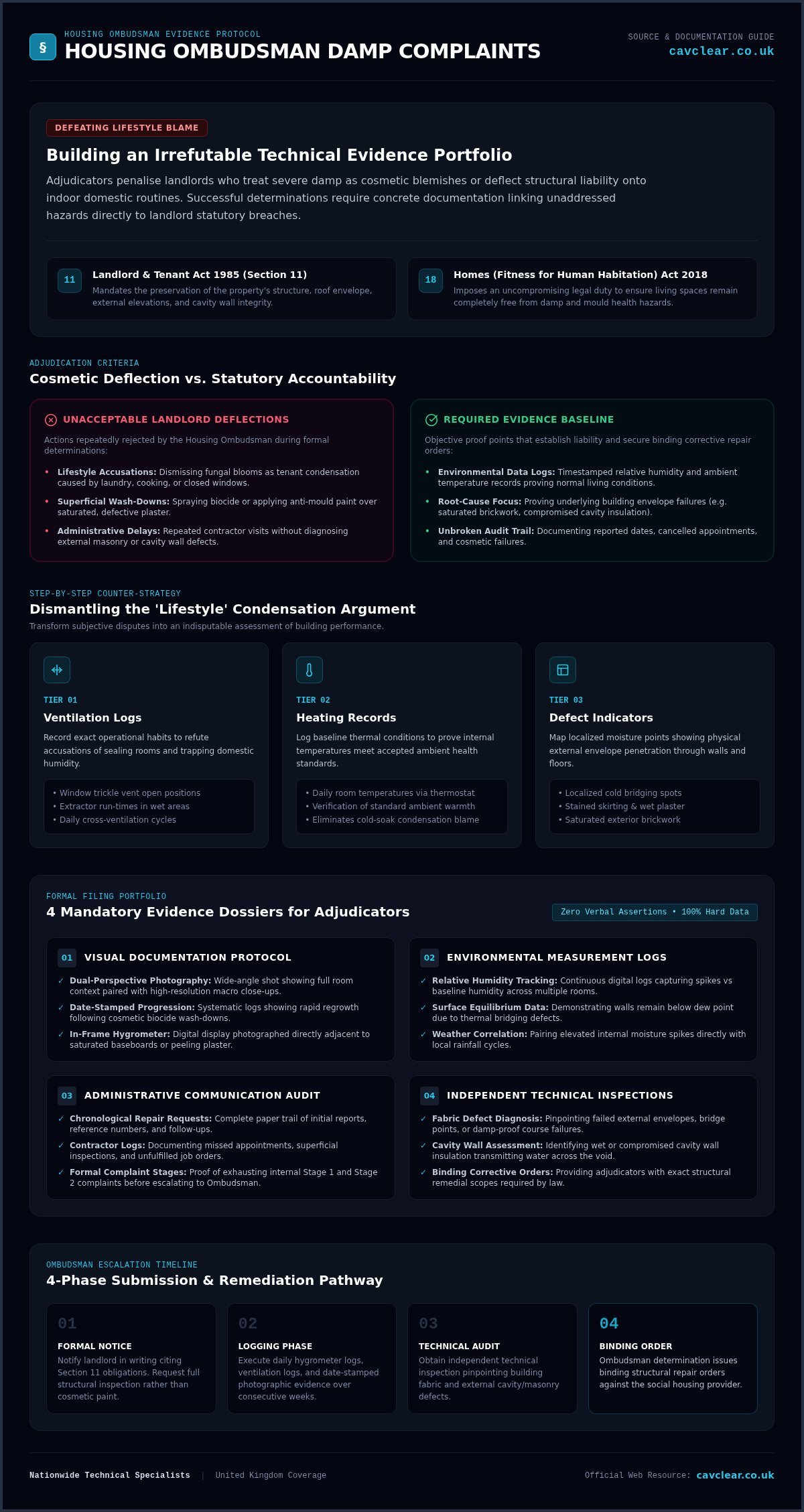
Residents can systematically dismantle this defence by gathering precise operational logs. When gathering evidence for a housing ombudsman damp complaint, pair your reports with data demonstrating that you maintain appropriate living conditions:
- Ventilation records: Log window trickle vent positions and extractor fan run-times in high-moisture rooms like kitchens and bathrooms.
- Heating logs: Record room temperatures to demonstrate that you maintain standard ambient warmth.
- Defect indicators: Document localized cold bridging, stained skirting boards, or saturated brickwork where external moisture penetrates the wall construction.
Clear environmental records transform subjective disputes into objective assessments of building performance.
Essential Categories of Evidence Required for an Ombudsman Case
Adjudicators base their determinations on hard documentation rather than verbal assertions. Successful submissions weave together photographic records, written audit trails, environmental measurements, and independent technical findings. This comprehensive approach establishes clear proof of severe property defects while exposing landlord inaction against published landlord damp and mould expectations. When gathering evidence for a housing ombudsman damp complaint, compartmentalising your records ensures caseworkers can immediately identify systemic repair delays.
Visual Documentation and Environmental Data
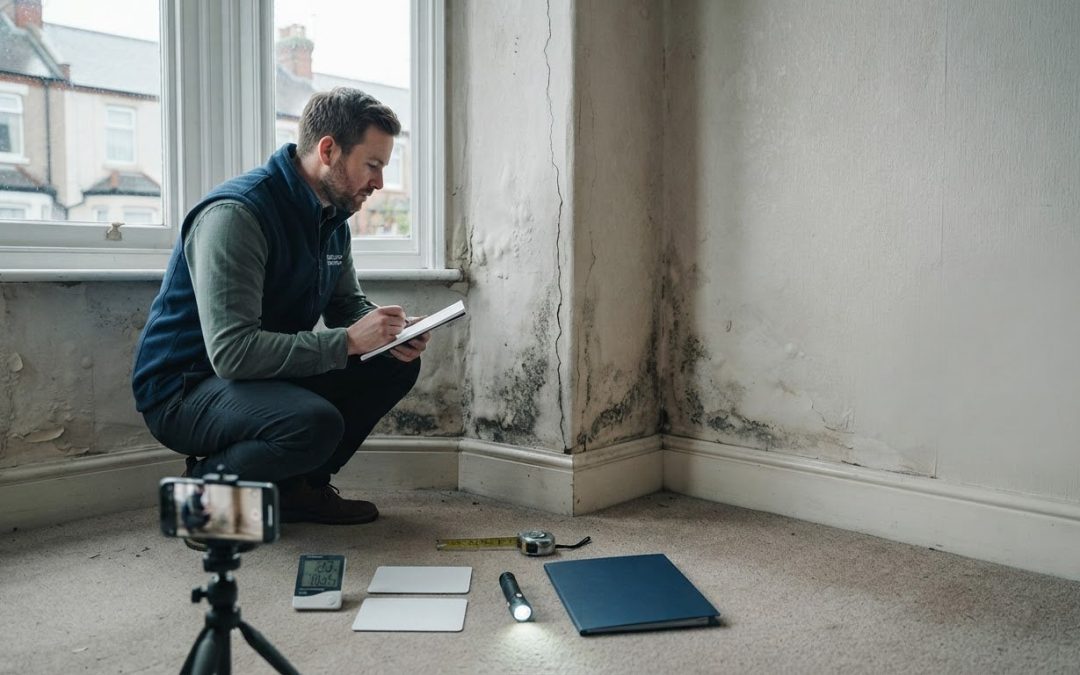
Photographic evidence must illustrate both the full extent and the aggressive progression of the moisture problem. Stand back to capture wide-angle shots showing the entire room before taking detailed close-ups of peeling plaster, wet baseboards, or saturated brickwork. Include date stamps on every photograph. You should also position digital hygrometers directly within the frame to capture real-time ambient relative humidity alongside wall surface conditions.
Documenting the failure of short-term fixes is equally important. Capture recurring black mould reappearing mere weeks after landlord wash-downs, demonstrating that surface treatments leave deep structural damp completely unaddressed.
Written Records and Correspondence Logs
A complete paper trail demonstrates that your landlord received timely notice of the defect but failed to act within statutory limits. Collate every interaction into a clear, centralised folder:
- Reference numbers: Retain all repair ticket identifiers, job confirmations, and portal messages.
- Direct correspondence: Save original emails, text alerts, and physical letters sent to or received from property managers.
- Post-call summaries: Follow up verbal phone conversations with an immediate email outlining the agreed points and requested deadlines.
- Contractor attendances: Log missed technician appointments, cancelled visits, or superficial contractor inspections that resulted in no physical repairs.
Occupant Health and Personal Belonging Records
Evidence showing personal impact demonstrates the severity of property hazards under the Housing Health and Safety Rating System (HHSRS). Secure letters or medical summaries from your GP documenting respiratory deterioration, severe asthma flare-ups, or skin infections linked to environmental damp. Photograph ruined clothing, damp mattresses, and water-damaged furnishings before discarding them, and retain purchase receipts showing replacement costs or excessive electricity bills run up trying to operate supplemental dehumidifiers.
Objective technical proof remains the ultimate lever. Booking independent diagnostic property evaluations through CavClear provides authoritative technical reports that uncover latent structural failures, such as wet cavity insulation bridging moisture to internal finishes, which caseworkers require to order comprehensive building repairs.
How to Build an Irrefutable Evidence Log: Step-by-Step
A chronological timeline turns disconnected repair complaints into a methodical legal narrative. Ombudsman caseworkers review hundreds of disputes each month, making structured clarity essential. By compiling your records into a systematic audit trail, you establish an undeniable pattern of landlord inaction. When gathering evidence for a housing ombudsman damp complaint, a clean chronological index makes procedural failures unmistakable.
Maintaining a Comprehensive Incident Diary
Consistency gives an incident log its evidential power. Dedicate a spreadsheet or bound journal specifically to your living conditions, making objective entries several times a week:
- Sensory and physical changes: Note water pooling on window sills, worsening musty odours, or peeling wallpaper after heavy rainfall.
- Contractor attendances: Document contractor arrival and departure times, what trade work they performed, and any verbal remarks about underlying building faults.
- Running expenses: Keep track of continuous heating usage required to keep wall temperatures above dew point, which social housing providers often overlook.
Tracking Deadlines Against the Complaint Handling Code
The Housing Ombudsman Complaint Handling Code sets legally binding requirements for how housing associations and local councils process disputes. You must record the exact date your formal Stage One complaint was delivered and acknowledged. Standard code rules require landlords to respond within strict working day windows; failing to issue a formal response or an agreed extension notice represents maladministration.
When a Stage One response proves unsatisfactory, log your escalation request to Stage Two immediately. Track whether your landlord complied with statutory response timelines. If your landlord delays investigations beyond mandatory limits, highlighting these elapsed windows in your diary proves procedural non-compliance to the Ombudsman adjudicator.
Packaging Your Evidence for Clear Presentation
Caseworkers should not have to piece together fragmented screenshots or scrambled filenames. A properly indexed dossier speeds up adjudication and prevents delays during intake screening. Systematic packaging is the most critical stage of gathering evidence for a housing ombudsman damp complaint:
- Folder conventions: Label digital folders using a clear numbering structure, such as “01_Formal_Complaints”, “02_Contractor_Logs”, and “03_Time-Stamped_Photos”.
- Evidence matrix: Create a front-page master index linking each specific event date to its supporting photo file or correspondence document.
- Cross-referencing: Match every photograph directly to the corresponding diary entry and repair ticket number to eliminate any dispute regarding when damage occurred.
The Critical Role of Independent Technical Property Inspections
Internal surveyors dispatched by social landlords often produce evaluations that downplay building fabric defects or attribute saturated walls to tenant behaviour. Adjudicators evaluate disputes based on empirical facts; an independent technical evaluation provides unbiased analysis that carries significant authority. When gathering evidence for a housing ombudsman damp complaint, presenting diagnostic survey data counteracts subjective assertions with verifiable building science.
Uncovering Hidden Structural Deficiencies
Understanding what is a cavity wall explains how moisture should normally drain harmlessly away through the external skin without transferring dampness inward. Qualified technicians use non-destructive borescopes to inspect the interstitial cavity space, revealing corroded wall ties, mortar snots, and construction rubble bridging the gap. External building inspections simultaneously identify cracked pointing, failed render, or damaged guttering that channels wind-driven rain straight into the wall structure.
Identifying Saturated and Compromised Cavity Insulation
Compromised insulation materials absorb intruding rainwater, functioning as a continuous cold conduit straight against interior plasterwork. Diagnostic testing confirms whether cavity wall insulation removal is required to clear bridged spaces and restore the structural air gap. Commissioning a comprehensive damp survey equips residents with the forensic documentation needed to substantiate neglected building maintenance before an ombudsman panel.
Saturated insulation causes severe thermal bridging that depresses internal wall temperatures below the dew point, proving that subsequent fungal blooms originate directly from structural saturation rather than occupant lifestyle habits.
To establish undeniable physical proof of building fabric defects for your complaint, schedule an independent cavity wall survey with our nationwide technical team.
Submitting Your Dossier and Securing Long-Term Property Remediation
Filing an escalation requires completing formal procedural requirements before the Ombudsman can accept your case. The service cannot intervene until you have formally completed your landlord’s internal complaints process. Approaching this sequence with an indexed, professional evidence package ensures your dispute clears initial triage smoothly and moves directly into formal assessment.
Navigating Internal Complaint Escalation Stages
Begin by submitting a formal Stage One complaint in writing, explicitly citing your landlord’s statutory repairing duties under the Landlord and Tenant Act 1985. Avoid emotional expressions; state the dates of initial notifications, the persistent failure to resolve the damp, and your required remediation actions.
When the landlord responds with generic apologies, minor painting offers, or missed inspection deadlines, request an immediate Stage Two escalation. Once the provider issues its Stage Two final response, or if the landlord delays its response beyond statutory limits set out in the Complaint Handling Code, obtain the final letter confirming exhaustion of their internal complaints procedure. This document acts as your gateway to the Ombudsman.
Filing with the Housing Ombudsman Service
Complete the official online submission form, pinpointing specific service failures, ignored communications, and breaches of published response standards. Gathering evidence for a housing ombudsman damp complaint culminates in this single submission package. Upload your master chronological timeline alongside your indexed evidence folders.
Structure your application around three clear elements:
- Chronological audit trail: Present dates of notifications, repair requests, and landlord non-responses.
- Impact documentation: Attach medical notes regarding respiratory difficulties alongside photos of waterlogged furnishings.
- Technical verification: Include your independent survey reports proving underlying building fabric defects.
Ensuring Permanent Structural Resolution
Ombudsman determinations carry binding authority, empowering caseworkers to issue formal orders for extensive structural remedial work and financial compensation for distress. Do not accept temporary cosmetic wash-downs as a settlement. If damp stems from wet, degraded insulation or corroded wall ties, superficial cleaning will fail, allowing fungal blooms to return.
Definitive remediation requires addressing the physical defect directly. Booking an independent cavity assessment with CavClear provides the objective forensic proof needed to demonstrate building envelope failure, eliminating unfair resident blame and compelling social landlords to execute permanent structural repairs.
Take Decisive Action to Restore Your Living Environment
Living with persistent moisture compromises your living standards and peace of mind, but you don’t have to accept endless administrative delays or unfounded lifestyle blame. Successfully gathering evidence for a housing ombudsman damp complaint transforms unresolved maintenance tickets into a cohesive, undeniable case. Pairing a structured chronological log with statutory compliance records holds social landlords accountable to their legal repairing obligations.
Objective technical data remains the decisive factor in compelling landlords to execute permanent structural repairs rather than superficial cosmetic fixes. Our accredited surveying technicians deliver specialist nationwide technical evaluations across the UK, producing independent diagnostic reports that isolate root building fabric failures from everyday condensation. When saturated materials compromise external wall envelopes, we deliver complete remedial contracting solutions, including cavity wall surveys and precision cavity wall insulation extraction.
You don’t have to navigate landlord disputes alone or endure unhealthy living conditions. Take control of your property’s structural health today and book a comprehensive cavity wall survey with CavClear to secure the authoritative proof required for a successful resolution.
Frequently Asked Questions
Can my landlord legally blame damp and mould on my everyday lifestyle?
No, housing providers cannot legally dismiss recurring moisture issues as resident lifestyle without first conducting an exhaustive structural investigation. Statutory guidance and Ombudsman determinations clearly establish that landlords must inspect the building fabric for underlying defects before blaming domestic habits like indoor clothes drying or cooking. Maintaining normal living routines is reasonable, and landlords remain legally obligated to ensure the exterior envelope and internal ventilation systems function properly.
How long must I wait before escalating a damp complaint to the Housing Ombudsman?
You can escalate your case to the Housing Ombudsman once you receive your landlord’s final Stage Two complaint response, or if the landlord exceeds the statutory timeframes established by the Complaint Handling Code. Under standard code rules, landlords must respond to Stage One complaints within 10 working days and Stage Two reviews within 20 working days. Unreasonable extensions or missed statutory deadlines allow immediate referral to the Ombudsman.
What happens if my landlord ignores my formal complaint correspondence entirely?
If a housing provider ignores formal correspondence or fails to log your formal complaint, they commit procedural maladministration under the statutory Complaint Handling Code. In these circumstances, you do not have to wait indefinitely. You can contact the Housing Ombudsman Service directly, and caseworkers can issue a formal Complaint Handling Failure Order against the landlord, legally instructing them to process your dispute and provide an immediate written response.
Is an independent damp survey necessary to support an Ombudsman investigation?
While an independent survey is not strictly mandatory, it provides decisive, unbiased proof that significantly strengthens your position. Housing association surveyors often look for surface condensation rather than latent building failures. When gathering evidence for a housing ombudsman damp complaint, an independent diagnostic report proves that moisture stems from structural defects, giving adjudicators the verified technical baseline needed to order substantial repairs.
Can the Housing Ombudsman force my landlord to carry out structural repairs?
Yes, the Housing Ombudsman possesses statutory powers to issue binding determinations that social landlords must follow. If the Ombudsman finds maladministration or service failure, adjudicators can issue legally enforceable orders compelling the landlord to execute major structural remediation works within specific deadlines. Adjudicators can also order social landlords to pay monetary compensation to residents for physical distress, property damage, and prolonged administrative inconvenience.
What specific items should be photographed when documenting property moisture damage?
Capture wide-angle photographs showing full room layouts alongside clear close-up images of affected building elements, including peeling wallpaper, crumbling plaster, wet skirting boards, and window sills. Photograph digital thermo-hygrometer readings within the frame to confirm relative humidity levels at that exact moment. You should also document waterlogged personal items, such as spoiled mattresses, ruined clothing, and damaged furniture, before throwing them away.
How do defective wall cavities contribute to internal damp and black mould?
Defective wall cavities occur when mortar droppings, deteriorating wall ties, or wet cavity insulation create physical bridges across the internal air gap. External wind-driven rain saturates the outer brickwork and tracks across these bridges straight into internal living areas, depressing wall temperatures below the dew point. When gathering evidence for a housing ombudsman damp complaint, establishing the presence of saturated cavity insulation demonstrates clear building fabric failure.
Recent Comments