
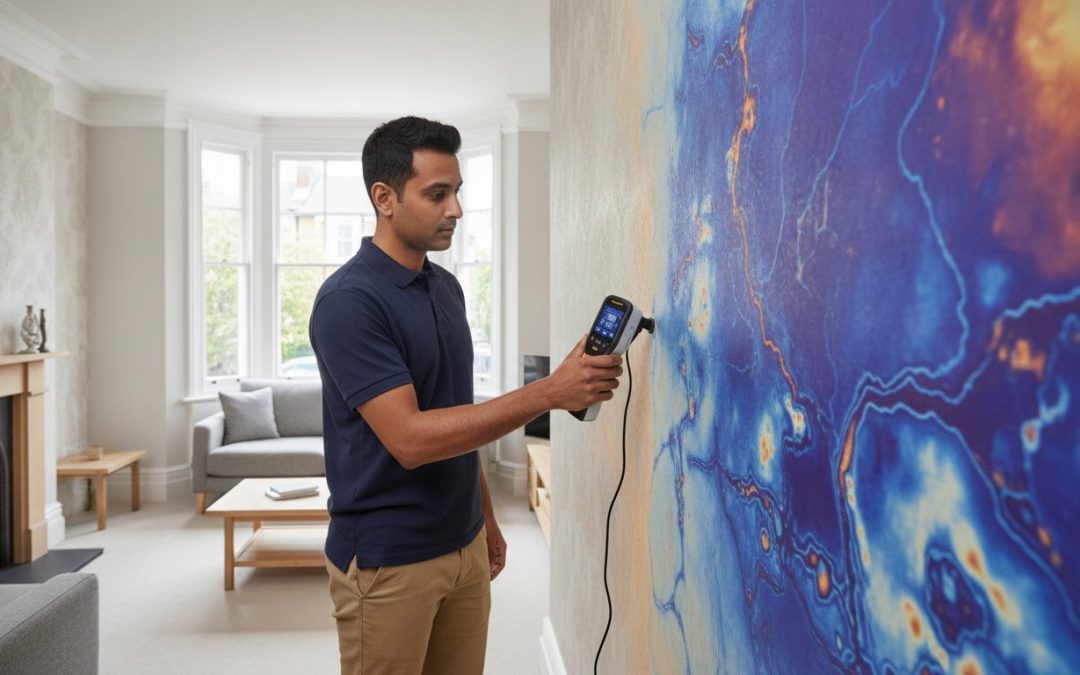
The most expensive repair you’ll ever pay for is the one that doesn’t actually fix the problem. If you’ve spotted a damp patch, you’re likely worried about the cost of repairs and the potential for a surveyor to cause structural damage just to find the source. It’s frustrating when conflicting theories leave you unsure of the next step. However, modern non-invasive damp survey methods have changed the diagnostic process entirely. These advanced techniques allow us to look through walls and floors without destructive testing, ensuring your home remains intact while we identify the precise technical fault.
As a nationwide specialist, we see how an accurate diagnosis is vital for protecting your property’s long-term health, especially since over 60% of UK homeowners now experience damp or condensation. This guide will show you how we use electromagnetic wave technology and thermal imaging to provide an evidence-based cause of moisture. You’ll learn how these professional tools lead to a clear remedial plan that restores comfort and secures your asset’s value. We’ll move from initial observation to a technical resolution, giving you the peace of mind that comes from expert validation.
Key Takeaways
- Learn how advanced technology like thermal imaging and electronic moisture meters identifies the root cause of dampness without structural disruption.
- Discover why modern non-invasive damp survey methods are now the industry standard for providing an evidence-based diagnosis over traditional, destructive guesswork.
- Understand the systematic inspection process that examines both external defects and internal moisture profiles to pinpoint specific technical faults.
- Identify the critical link between persistent dampness and failed cavity wall insulation to ensure your remedial plan addresses the actual source of the problem.
- Gain the confidence to choose a diagnostic path that protects your property’s long-term structural integrity and market value.
Understanding Non-Invasive Damp Surveying in 2026
Non-invasive damp surveying represents a fundamental shift in how we diagnose property defects. Traditionally, surveyors might have removed plaster or drilled into masonry to “see” what was happening inside a wall. In 2026, these destructive practices are largely obsolete. Using non-invasive damp survey methods allows us to identify the presence and source of moisture without causing any physical damage to your home. This methodology relies on advanced sensory technology to gather data through solid structures, providing a clear picture of the building’s internal health. By prioritising data over destruction, we ensure that the inspection process is clean, efficient, and entirely transparent.
The Philosophy of Building Pathology
Building pathology is the study of property defects and their causes. This discipline requires us to view your home as a single, integrated system where every component affects the next. A damp spot on a living room wall is rarely an isolated incident; it is a symptom of a failure elsewhere in the building envelope. We look beyond the surface to understand the relationship between environmental factors and structural faults. By adopting this holistic view, we ensure that our recommendations address the underlying cause of structural dampness rather than simply masking the visible signs. For example, high moisture readings at the base of a wall might suggest rising damp, but a professional pathologist will also check for external ground levels and guttering defects that could be the true culprit.
Why Non-Destructive Testing is the Modern Standard
Property owners today demand accuracy without disruption. Non-destructive testing preserves both the aesthetic and structural integrity of your asset. It’s particularly valuable for period properties where original features are irreplaceable. By using non-invasive damp survey methods, we eliminate the “recovery time” and additional costs associated with traditional surveys. There’s no need for messy repairs or re-plastering after our visit. Our diagnostic tools, such as electromagnetic wave detectors, provide immediate, visual proof of technical faults. This evidence-based approach gives you the confidence to move forward with a remedial plan, knowing exactly what is wrong and why the proposed solution will work.
The benefits of this modern approach include:
- Zero structural damage to interior finishes or external masonry.
- Real-time moisture mapping and data collection for precise diagnostics.
- Faster inspection times compared to traditional, destructive methods.
- Clear visual evidence that supports insurance requirements or mortgage reports.
Choosing non-destructive testing is a vital investment in the long-term health and efficiency of your property. This transition to technology-led surveying ensures that every recommendation is backed by hard data, removing the risk of misdiagnosis and unnecessary expenditure on incorrect repairs.
Essential Technology Used in Modern Damp Investigations
Identifying the root cause of moisture requires more than a visual inspection. In 2026, non-invasive damp survey methods rely on a sophisticated suite of sensors to distinguish between superficial surface moisture and deep-seated structural dampness. While surface condensation is often a ventilation issue, structural dampness signals a failure in the building’s envelope. We use electronic moisture meters to map moisture profiles across wall surfaces, identifying where concentrations are highest. This data is then cross-referenced with hygrometers that measure relative humidity and dew points. This process is essential because ignoring the health risks of damp and mould can lead to long-term respiratory issues for occupants.
Our toolkit also includes ultrasonic leak detection. This technology identifies the sound of water escaping from hidden pipes behind thick masonry. It prevents the need to tear down walls simply to locate a plumbing fault. By combining these tools, we provide a definitive diagnosis that protects your property’s future health. If you’re concerned about recurring moisture, booking a professional damp survey is the most reliable way to secure an accurate diagnosis.
Thermal Imaging and Thermography
Borescopes and Endoscopic Cavity Inspections
A major advancement in non-destructive testing is the use of high-definition borescopes. These slender, flexible cameras allow us to peer into wall cavities through existing gaps or tiny, easily repairable pilot holes. This is a critical component of professional cavity wall surveys. We can visually inspect the condition of wall ties and check for debris or failing insulation that may be bridging the cavity and transferring moisture to the inner leaf. This visual verification ensures that any remedial plan is based on the actual state of the cavity rather than assumptions.
Invasive vs. Non-Invasive: Choosing the Right Diagnostic Path
Many homeowners believe that a survey isn’t thorough unless the surveyor starts drilling holes into the masonry. This is the “Invasive First” myth. In reality, starting with destructive testing is often a sign of outdated methodology. Modern non-invasive damp survey methods provide a higher degree of accuracy by using data-driven sensors that see through masonry. These tools don’t just find moisture; they map its intensity and distribution across the entire structure. This level of detail is essential for complex diagnostics, such as a professional cavity wall survey, where internal debris might be the primary cause of moisture transfer. Using technology ensures that the diagnosis is based on hard evidence rather than visual guesswork.
Cost is a major factor for UK homeowners facing property issues. While an independent survey has an upfront cost, it acts as a vital preventative investment. It stops you from paying for a chemical damp-proof course when the real issue is a leaking gutter or poor ventilation. Organizations like The Federation of Damp advocate for these evidence-based protocols to ensure consumers aren’t sold unnecessary treatments. By focusing on long-term asset health, we help you avoid the stress of failed repairs. A non-invasive approach protects your property value by ensuring that the structure remains intact while we identify the specific technical fault.
The Risks of Prematurely Invasive Investigations
Unnecessary drilling causes permanent damage to plasterwork and original period features that are difficult to restore. More importantly, invasive methods can actually mask the true source of moisture ingress by altering the environment we are trying to measure. A common error is misdiagnosing a simple condensation issue as rising damp because a surveyor relied on a single invasive reading rather than a holistic non-destructive profile. This misdiagnosis leads to expensive, ineffective work that fails to address the underlying technical fault. By avoiding premature destruction, we maintain the integrity of the building envelope and ensure a cleaner inspection process.
When Minimal Sampling is Necessary
There are specific instances where minimal intervention is required to reach a definitive conclusion. For example, laboratory salt analysis is used to distinguish between hygroscopic salts and “pure” rising damp. This involves taking a tiny, surgically precise sample of masonry dust. We might use a “Speedy” carbide test to measure the total moisture content within the wall, comparing it against our electronic surface readings. This ensures that even when we must be slightly invasive, the impact on your property is negligible. The data gained from these samples is vital for designing a permanent fix that restores comfort and security to your home. We only move to this stage when non-invasive damp survey methods suggest that chemical analysis is the only way to validate the findings.
The Systematic Process of a Professional Damp Inspection
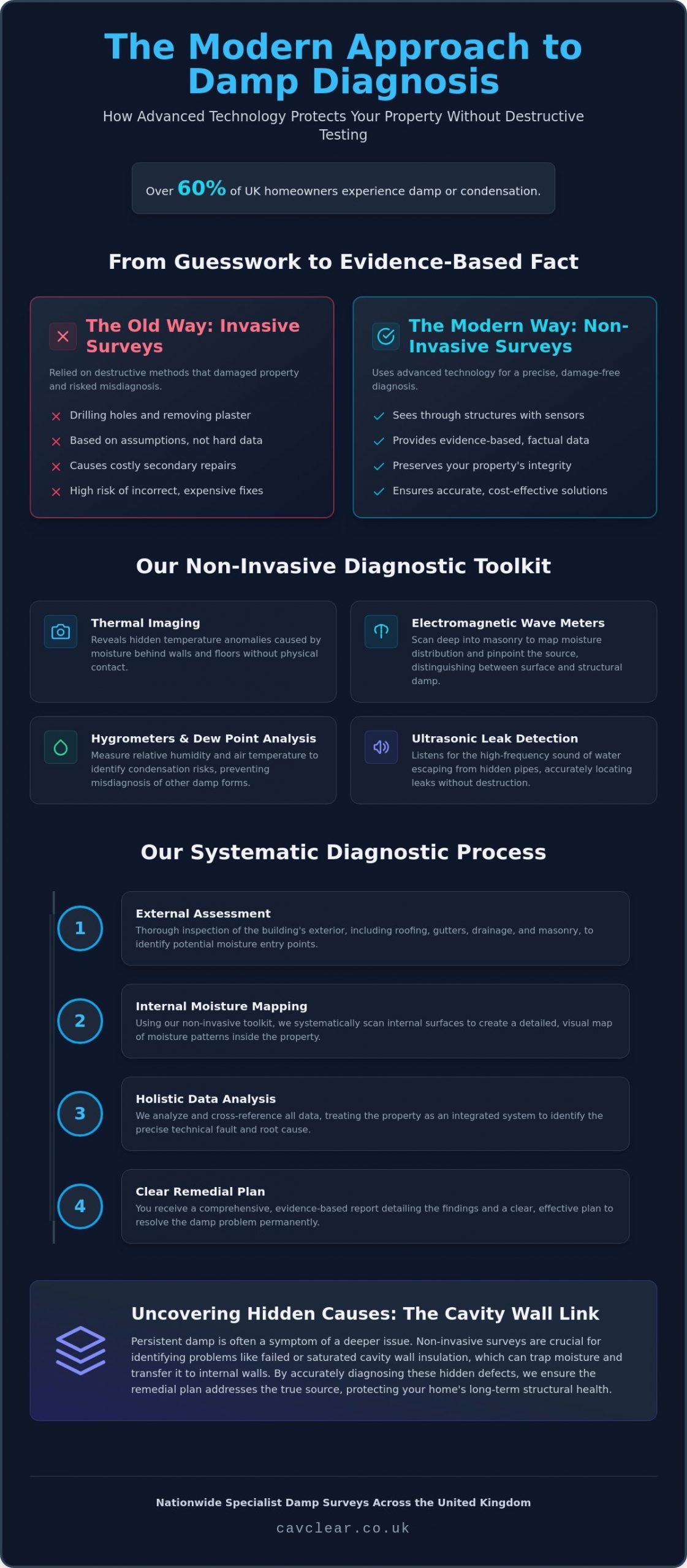
A professional damp inspection is a methodical diagnostic journey. It follows a logical progression from external observation to internal data correlation. By using non-invasive damp survey methods, we gather evidence at every layer of the building envelope without causing structural disruption. This systematic approach ensures that no technical fault is overlooked. The process moves from observation to recommendation in a steady, rhythmic pace. This ensures you understand the fault before accepting a professional remedy. Our nationwide experts follow this protocol to provide a definitive, evidence-based cause of dampness for homes across the UK.
Exterior Assessment: The First Line of Defence
The process begins outside because the exterior is your home’s primary shield. We identify signs of penetrating damp caused by failed masonry, deteriorated pointing, or cracked render. A key focus is the damp proof course (DPC). We check its height relative to the ground and its overall integrity. Blocked air bricks are another common finding; these obstructions restrict sub-floor ventilation and significantly increase the risk of timber decay. These external defects are often the primary cause of moisture ingress, making this step vital for an accurate diagnosis. Identifying these faults early prevents the stress of unnecessary internal repairs and protects long-term asset health.
Interior Mapping: Identifying Moisture Patterns
Once the exterior is assessed, we move inside to create a moisture map. Single-point readings are often misleading because they don’t show how moisture moves through the structure. Mapping allows us to find the “peak” of dampness, which usually points directly to the source of the ingress. This technique helps us differentiate between rising damp and lateral penetration from the outside. We also identify cold bridges. These are specific areas where insulation is missing or compromised, creating a cold surface where condensation and mould are most likely to form. This map provides the visual proof needed to understand the building’s pathology and the restoration of comfort.
Following the mapping, we conduct an atmospheric analysis. We use hygrometers to measure relative humidity and dew points to determine if the issue is environmental or structural. High humidity levels often indicate that a building’s ventilation is failing to cope with modern living standards. After this, we perform a cavity inspection. As discussed previously, borescopes allow us to check for internal obstructions or failed insulation that may be bridging the cavity. Finally, all findings are correlated into a formal report. This document links every symptom to a specific technical cause, providing a clear remedial plan that protects your property value. If you suspect your home has a moisture issue, you can book a professional cavity wall survey to begin this diagnostic process today.
From Diagnosis to Resolution: Restoring Your Home’s Integrity
A definitive diagnosis is only as valuable as the remedial action it informs. Once our non-invasive damp survey methods have identified the specific technical fault, the focus shifts to restoring the structural integrity of your home. A professional damp survey serves as the vital foundation for this transition. It ensures that any investment in repairs is targeted at the actual root cause rather than superficial symptoms. This evidence-based approach prevents the cycle of failed workmanship and recurring moisture issues that plague many UK properties. By moving from observation to a technical resolution, we provide a clear, low-pressure path toward a permanent fix.
Identifying Cavity Wall Insulation Failure
In a significant number of cases across the United Kingdom, persistent dampness is directly linked to failed cavity wall insulation. When insulation material becomes saturated or slumps within the wall, it creates a bridge that allows moisture to travel from the external masonry to the internal leaf. Our non-invasive surveys provide the visual and thermal proof required to confirm this failure. We often find that insulation extraction is the only effective way to stop this moisture transfer and allow the structure to breathe. We maintain a firm stance against the installation of retrospective cavity wall insulation due to the documented risks of dampness and wall tie corrosion it causes.
Structural Reliability and Wall Tie Health
Persistent dampness is a silent danger to the structural stability of your home because it accelerates the corrosion of metal wall ties. These components are essential for securing the internal and external leaves of your walls together. During our systematic inspection, we use visual evidence from high-definition borescopes to assess the condition of these ties. If corrosion is detected, the remedial plan will include wall tie replacement to ensure the long-term safety of the property. Protecting your property’s future health requires addressing these structural concerns alongside moisture control. This methodical process ensures your home remains a safe and dry environment for years to come.
The transition from a technical report to a permanent solution typically involves:
- Reviewing the evidence-based findings to prioritise urgent structural repairs.
- Executing a clean and non-disruptive cavity wall insulation removal if the material is compromised.
- Replacing corroded wall ties to restore the stability of the building envelope.
- Implementing ventilation improvements to manage atmospheric moisture and condensation.
By following this professional methodology, we move beyond temporary patches to deliver a comprehensive fix. This approach not only restores comfort but also acts as a vital investment in the property’s long-term asset health. Our nationwide specialists are committed to transparency and reliability, ensuring that every homeowner has a clear understanding of the path toward a fully restored, damp-expert home.
Securing the Long-Term Health of Your Property
Securing the future of your property requires a transition from guesswork to data-driven diagnostics. We’ve explored how modern non-invasive damp survey methods allow for a precise identification of technical faults without the need for destructive testing. By using advanced sensors and thermal imaging, we can distinguish between environmental condensation and serious structural failures like wall tie corrosion or compromised insulation. This systematic approach ensures that every remedial action is an investment in your home’s long-term health rather than a temporary patch. It’s the most reliable way to protect your asset’s value while restoring the comfort of your living environment.
Book your professional, non-invasive damp survey with CavClear today and take the first step toward a dry, structurally sound home. You can move forward with confidence, knowing your property is in the hands of trusted specialists.
Frequently Asked Questions
Are non-invasive damp surveys as accurate as invasive ones?
Non-invasive surveys are often more accurate because they rely on comprehensive data mapping rather than isolated destructive points. By using electromagnetic wave technology, we can see moisture profiles across an entire wall structure without the limitations of a single drilled hole. This data-driven approach allows us to identify the precise technical fault while preserving your property’s structural integrity.
How long does a professional damp survey usually take?
A standard inspection typically takes between two and four hours to complete. The exact duration depends on the property’s size and the complexity of the moisture patterns detected. A two-bedroom flat may take less time, whereas a four-bedroom detached home requires a more extensive external and internal assessment to ensure every potential fault is identified.
Will a damp survey identify the difference between condensation and rising damp?
Yes, our systematic process uses atmospheric analysis to distinguish between environmental and structural issues. By measuring relative humidity and dew points with hygrometers, we can determine if moisture is settling from the air or rising through the masonry. This distinction is vital for creating a remedial plan that addresses the actual cause of the problem rather than just the symptoms.
Do I need to move furniture or lift carpets before the surveyor arrives?
You don’t usually need to move heavy furniture or lift floorcoverings. Modern non-invasive damp survey methods allow us to gather data through existing structures and finishes. However, ensuring clear access to the affected walls helps our technicians perform a more thorough mapping of the moisture profile and provides a clearer path for our sensors.
What equipment should a professional damp surveyor use?
A specialist toolkit includes thermal imaging cameras, electronic moisture meters, hygrometers, and high-definition borescopes. We also use ultrasonic leak detection to find hidden plumbing faults behind masonry. This suite of technology ensures that the diagnosis is evidence-based and avoids the need for destructive testing that could damage your home’s aesthetic or structural health.
Can a damp survey help me with a pre-purchase property report?
A specialist damp survey is a vital investment during the property buying process. Standard mortgage valuations often flag dampness but don’t identify the root cause. Our detailed technical reports provide the specific evidence you need to understand the property’s structural health and any required remedial costs before you commit to a purchase.
What happens if the survey finds that my cavity wall insulation is wet?
If your insulation is saturated, we will recommend a professional cavity wall insulation extraction. Wet insulation acts as a bridge, transferring moisture to the inner leaf and accelerating wall tie corrosion. Removing the compromised material is the only way to allow the cavity to dry and restore the building’s thermal efficiency and structural security.
Is thermal imaging always necessary for a damp inspection?
While not every single patch of damp requires it, thermal imaging is a modern standard in non-invasive damp survey methods. It’s essential for identifying cold bridges and missing insulation that are invisible to the naked eye. This visual proof allows us to show you exactly why condensation is forming in specific areas of your home, leading to a more accurate resolution.
Recent Comments