
Did you know that approximately 25% of privately rented homes across the UK are currently reporting issues with visible mould or persistent damp? If you’ve found yourself repeatedly scrubbing black spots off a bathroom ceiling or worrying about a tide mark on your ground floor walls, you aren’t alone. It’s exhausting to manage symptoms that refuse to disappear, especially when you suspect the problem might be devaluing your most significant financial asset. Understanding the clear signs you need a professional damp survey is the first step toward restoring your property’s structural integrity and your own peace of mind.
We recognize that homeowners often feel caught between the confusion of rising damp, penetrating moisture, and simple condensation. This guide provides a methodical roadmap to help you identify both the subtle environmental changes and the more serious structural warnings that indicate a deeper fault. By moving beyond cosmetic fixes, you can address the root cause of moisture ingress and secure the long-term health of your home. We’ll explore the technical indicators that demand expert diagnostic tools, ensuring you have a clear path toward a permanent, dry resolution.
Key Takeaways
- A professional damp survey serves as a forensic moisture investigation, utilizing specialist diagnostic tools to pinpoint the root cause of ingress rather than just treating visible symptoms.
- Recognizing the structural signs you need a professional damp survey, such as failing wall ties or saturated masonry, is essential for protecting your property’s long-term market value.
- Defective cavity wall insulation often acts as a thermal bridge that facilitates damp; identifying these failures is the first step toward restoring a building’s natural breathability.
- Specialist reports go beyond the visual-only limitations of standard homebuyer surveys to provide a technical roadmap for permanent, evidence-based remedial works.
- Modern diagnostic techniques are non-disruptive and focus on the restoration of structural integrity, ensuring that solutions like professional cavity extraction are performed with precision.
Recognising the Early Signs of Damp and Moisture Ingress
A professional damp survey is far more than a simple visual inspection; it’s a forensic moisture investigation that utilizes specialized equipment to map the movement of water through a building’s fabric. Many homeowners mistake seasonal condensation for structural issues, or vice versa, leading to ineffective DIY fixes. While condensation is often a result of internal humidity and poor ventilation, persistent structural dampness indicates a failure in the property’s moisture-management systems. Identifying the specific signs you need a professional damp survey early is the most effective way to prevent exponential repair costs that arise when moisture begins to compromise timber and masonry.
One of the most complex aspects of damp is the presence of hygroscopic salts. These salts are often drawn from the ground or the masonry itself by moisture. Once they reach the surface of your plaster, they absorb moisture from the air, keeping the wall permanently damp even if the original leak is fixed. This chemical contamination is a primary reason why painting over a damp patch never works. Without a professional diagnosis, you’ll likely find yourself trapped in a cycle of redecorating that fails to address the underlying technical fault.
Visible Indicators on Internal Walls and Ceilings
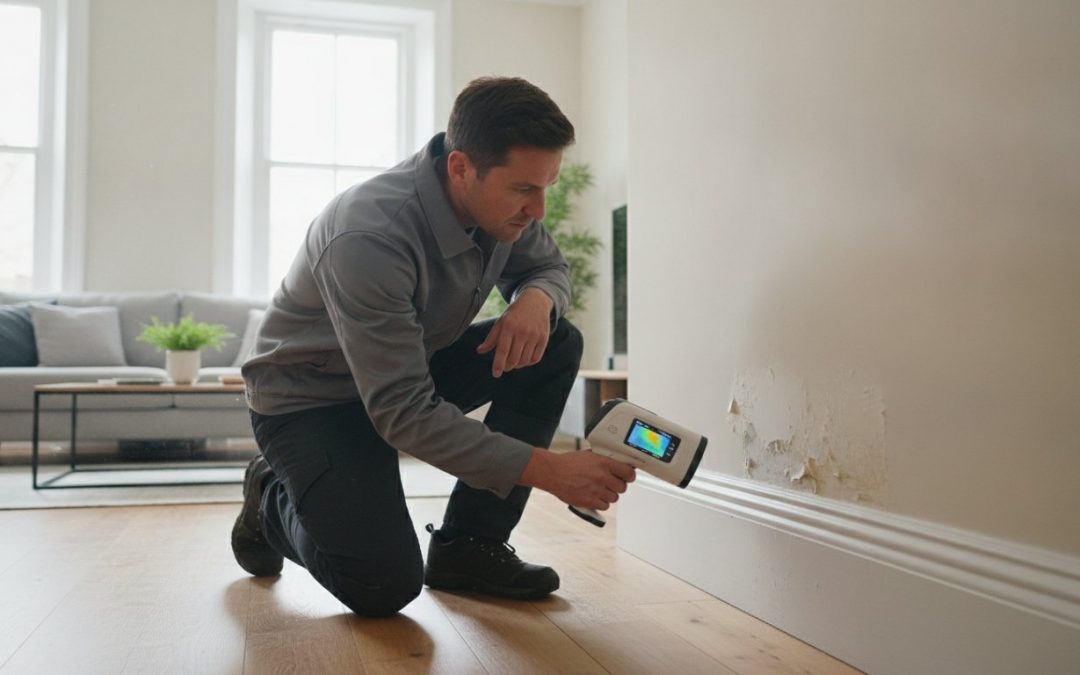
Keep an eye out for bubbling or blistering plaster, which often signals salt contamination beneath the surface. If you notice a distinct tide mark on your ground floor walls, this is a classic indicator of rising damp, where groundwater travels upwards through porous bricks. These patches often feel cold or damp to the touch and may result in peeling wallpaper or crumbling skirting boards. These are definitive signs you need a professional damp survey to determine if your damp proof course has failed or if external ground levels have been breached.
Environmental Changes and Air Quality Signals
Your senses often detect moisture issues before your eyes do. A persistent, musty, or earthy smell that lingers despite cleaning and ventilation is a strong indicator of hidden moisture trapped within the wall cavities or under floorboards. Excessive window condensation that remains even when the heating is active suggests an imbalance in the building’s thermal performance. When black mould returns rapidly in corners or behind furniture, it’s often a sign that a cold bridge exists within the structure, frequently caused by debris or failed insulation within the cavity walls.
Structural Warning Signs: Why Your Cavity Walls May Be at Risk
Structural dampness is rarely a random occurrence. It’s often the direct result of a failure in the building’s original design or subsequent modifications. A primary misconception among homeowners is that all insulation is beneficial for a property’s health. In reality, cavity walls were designed with a specific air gap to prevent moisture from crossing from the outer masonry to the internal walls. When this gap is compromised by debris or unsuitable materials, it creates a “thermal bridge.” These bridges allow moisture to bypass the building’s natural defences, leading to persistent internal damp patches. If you notice dampness that appears to follow no logical pattern, these are clear signs you need a professional damp survey to inspect the hidden environment within your walls.
External factors also play a critical role in maintaining a dry home. Your damp proof course (DPC) is a physical barrier designed to stop groundwater from rising through the masonry. However, if external ground levels have been raised through the installation of new patios, driveways, or flower beds, the DPC can be “bridged.” This allows moisture to enter the property above the protective layer. Identifying whether your damp issues stem from a breached DPC or internal cavity failure requires a specialist diagnostic approach rather than a simple visual guess.
The Impact of Defective Cavity Wall Insulation
Retrospective insulation that has slumped or become saturated acts as a permanent conduit for water ingress. Instead of keeping heat in, wet insulation holds moisture against the inner leaf of the wall, causing cold spots and mould. Professional cavity wall insulation removal restores the cavity’s protective function by re-establishing the essential air gap required for moisture control. A thorough cavity wall survey can identify these structural defects before they cause irreversible damage.
External Brickwork and Mortar Degradation
Examine your external walls for “spalling” bricks, where the masonry face has begun to crumble or peel away. This occurs when moisture is trapped within the brick and expands during expertze-thaw cycles. Similarly, cracks in mortar joints allow wind-driven rain to enter the cavity. Horizontal cracking along mortar lines is a particularly serious indicator of corroding wall ties. This specific symptom often necessitates wall tie replacement to ensure the structural stability of the outer leaf is maintained.

Why a Standard Homebuyer Survey Isn’t Enough for Damp Detection
Many homeowners rely on a standard Level 2 or Level 3 survey when purchasing a property, only to find the report contains a vague recommendation for a further specialist investigation. This occurs because general surveyors typically conduct visual-only assessments. They don’t possess the diagnostic equipment or the specific structural expertise to differentiate between a minor ventilation issue and a complex failure of the cavity wall system. If your survey report includes “high moisture readings” without a clear explanation of the source, these are primary signs you need a professional damp survey from a specialist who can look beyond the surface.
A standard surveyor often carries a basic hand-held moisture meter that measures surface conductivity. While these devices are useful for a quick check, they’re easily fooled. High readings can be triggered by condensation, metallic wallpaper, or even hygroscopic salts left behind from a previous, now-resolved leak. Relying on these superficial readings leads to incorrect diagnoses and wasted money on “treatments” that don’t address the actual fault. An independent specialist provides an unbiased technical evaluation, ensuring that any recommended remedial works are based on data rather than guesswork.
Specialised Tools vs. Visual Inspection
Professional investigators use a suite of forensic tools to map moisture accurately. Thermal imaging cameras identify cold spots where insulation has slumped or where moisture is bridging the cavity, revealing patterns invisible to the naked eye. We also utilize borescope cameras, which are inserted through small, discreet holes in the mortar. This allows us to inspect the condition of wall ties and insulation directly. Additionally, salt analysis helps us differentiate between rising damp and simple leaks by testing for ground-based nitrates and chlorides, providing a level of certainty a visual check cannot match.
Identifying the Source vs. Identifying the Symptom
General surveys stop at the symptom, noting that damp exists but rarely explaining why it is there. A specialist approach focuses on identifying the root cause, whether it’s a breached damp proof course or a thermal bridge caused by cavity debris. Instead of a simple fault list, you receive a comprehensive remedial action plan. This plan prioritizes the structural integrity of the property over mere aesthetics. By diagnosing the source correctly, we avoid the common trap of recommending “more ventilation” for problems that actually require technical solutions like cavity extraction or wall tie replacement.
What to Expect from a Comprehensive Professional Damp Survey
A comprehensive damp survey follows a logical, methodical progression from the building’s exterior to its internal living spaces. Unlike a cursory visual check, this process is a technical audit of the property’s environmental health. The investigation begins with the external “envelope,” where the specialist examines the roofline, guttering, and downpipes. Blocked or leaking gutters are frequent culprits for what appears to be structural damp, as they allow water to saturate the masonry. The surveyor also evaluates the damp proof course (DPC) and the condition of the mortar to ensure no bridging or breaches exist. If you’ve observed external signs you need a professional damp survey, such as green algae growth or moss concentrated in specific areas, these often point to hidden drainage failures.
Sub-floor ventilation is another critical focus area. The specialist will inspect air bricks to ensure they’re clear of debris and positioned correctly relative to the ground level. Restricted airflow beneath suspended timber floors is a leading cause of dry rot and joist decay. Inside the property, the surveyor uses non-disruptive techniques to map moisture levels across different wall elevations. This mapping helps identify whether the moisture is rising from the ground, penetrating from the outside, or manifesting as surface condensation due to thermal bridging. These modern diagnostic methods ensure that the investigation remains clean and non-invasive while providing a high level of technical accuracy.
The On-Site Inspection Methodology
- External check: A detailed assessment of the DPC, masonry integrity, and roofline to identify points of water ingress.
- Internal check: Forensic mapping of moisture levels across various wall elevations to track the movement of water within the fabric.
- Cavity check: Using borescope technology to assess the condition of internal insulation and check wall ties for signs of corrosion or failure.
Analysing the Professional Survey Report
Once the on-site investigation is complete, you’ll receive a detailed damp survey report. This document is much more than a list of faults; it’s a diagnostic roadmap. It should include high-resolution photographs of the affected areas, moisture maps showing the distribution of damp, and a clear breakdown of the findings. The report will distinguish between “essential” works required to protect structural integrity and “recommended” improvements for general maintenance. This clarity allows you to prioritize repairs that secure the property’s long-term health. If your home shows the signs you need a professional damp survey, booking a professional cavity wall survey provides the evidence-based data needed to secure a permanent remedial solution.
Protecting Your Property with Specialist Remedial Action
A professional damp survey is the starting point for a permanent resolution rather than a temporary patch. Once you’ve identified the technical signs you need a professional damp survey, the focus shifts to specialist remedial action. This process involves restoring the building’s natural breathability, which is often compromised by saturated cavity insulation or failed wall ties. By removing these obstructions, we allow the air gap within the wall to function as designed, protecting the inner leaf from moisture transfer. This restoration significantly improves indoor air quality and enhances the property’s overall energy efficiency, as dry walls provide better thermal resistance than damp ones.
Beyond structural health, many homeowners prioritize a holistic approach to wellness by choosing natural alternatives for their daily routines; for instance, Maxwell & McIntyre Natural Oral Health offers handcrafted, organic oral care that complements a toxin-expert home environment.
Positioning your property for long-term health requires moving beyond surface-level redecoration. Specialist extraction and structural repairs ensure the building fabric remains dry and stable. This proactive approach prevents the recurrence of mould and the degradation of structural timbers, which are common consequences of unresolved moisture ingress. CavClear serves as a nationwide partner for these complex projects, providing the technical rigor required to rectify even the most challenging environmental issues. We focus on the restoration of comfort and the long-term preservation of your home’s structural integrity.
Once you have restored your home’s structural integrity and comfort, you might consider further enhancing your living space with outdoor wellness features. To explore premium wood-fired saunas and ice baths that add value to any UK property, visit Amber Hot Tubs.
Prioritising Structural Integrity and Asset Health
Addressing dampness early is a vital investment in your property’s future resale value. Structural issues like wall tie corrosion or cavity debris can severely impact a surveyor’s valuation during a property sale. By securing an expert diagnostic report and following through with accredited remedial works, you provide future buyers with documented assurance of the property’s condition. CavClear operates nationwide to provide these essential structural fixes, ensuring that homeowners across the United Kingdom have access to specialized expertise. This commitment to high-level standards ensures that your property remains a secure, dry, and healthy asset.
Next Steps: Booking Your Specialist Inspection
Preparing for a specialist inspection is straightforward. Ensure the surveyor has clear access to both internal walls and external elevations, including areas where you’ve noticed the signs you need a professional damp survey. Choosing a contractor with specific labor expertise in cavity extraction and wall tie replacement is crucial for a successful outcome. General builders often lack the forensic tools and niche experience required for these delicate tasks. To protect your home’s structural integrity and restore a healthy living environment, Contact CavClear for a professional property inspection today.
Securing Your Property’s Structural Future
Addressing moisture ingress requires a move away from temporary surface treatments toward a technical understanding of your building’s fabric. We’ve explored how failing cavity wall systems and corroding wall ties often hide behind visible mould, making professional diagnosis essential for long-term asset health. By identifying the specific signs you need a professional damp survey, you can transition from managing symptoms to implementing permanent structural fixes that restore your home’s breathability and thermal efficiency. Moving beyond visual guesswork ensures that your remedial actions are based on forensic data rather than trial and error.
Our nationwide team of accredited specialist technicians provides the forensic clarity needed to protect your property’s value. We deliver detailed technical reporting and precise remedial plans that go far beyond the limitations of standard visual inspections. Don’t let unresolved dampness compromise your home’s integrity or your family’s comfort any longer. Book a Professional Damp Survey with CavClear today to ensure your property remains a safe, dry, and resilient investment for years to come. Taking action now is the most effective way to restore your peace of mind and protect your home’s future.
Frequently Asked Questions
How much does a professional damp survey cost in the UK?
The cost of a damp survey varies based on the property’s size, age, and the complexity of the suspected issues. Factors such as the number of bedrooms and the type of construction influence the time required for a thorough forensic investigation. We recommend contacting a specialist for a quote tailored to your specific building requirements. This ensures you receive a comprehensive report that addresses your property’s unique structural challenges and provides a clear roadmap for remedial works.
Can I carry out my own damp survey using a moisture meter?
While a handheld moisture meter can indicate surface dampness, it cannot provide a definitive diagnosis. These devices often produce misleading results due to salt contamination or surface condensation. Identifying the genuine signs you need a professional damp survey requires forensic tools like thermal imaging and salt analysis to determine the moisture’s actual source. Relying on basic tools alone can lead to expensive and unnecessary treatments that fail to fix the root cause.
How long does a specialist damp inspection typically take?
A comprehensive inspection usually takes between one and three hours to complete. This timeframe allows the surveyor to perform a detailed external audit of the roofline and drainage before mapping internal moisture levels. Larger detached properties or those with complex cavity wall issues may require additional time for a thorough technical assessment. Our methodical approach ensures every potential point of ingress is identified without causing disruption to your daily routine.
Will a damp survey identify the cause of black mould?
Yes, a specialist survey will determine whether black mould is a result of internal condensation or a structural fault. We investigate whether cold bridging, caused by debris or failed insulation in the cavity, is creating the damp conditions mould needs to thrive. This distinction is vital for choosing the correct remedial path rather than just cleaning the surface. Addressing the underlying cause is the only way to ensure a healthy living environment for your family.
Is a damp survey different from a homebuyer’s survey?
A damp survey is a specialist forensic investigation that goes far beyond the visual-only scope of a standard homebuyer’s report. While a general surveyor might note that damp exists, they often lack the diagnostic equipment to explain why it’s occurring. We use borescopes and moisture mapping to provide a technical roadmap for permanent repair. This level of detail is essential for protecting your investment and ensuring the property’s structural integrity remains intact.
What happens if the damp survey finds cavity wall insulation issues?
If the survey identifies slumped, wet, or unsuitable insulation, the standard recommendation is professional extraction. Saturated insulation acts as a conduit for water ingress, compromising the building’s thermal performance and structural health. Removing the failed material re-establishes the essential air gap required for your cavity walls to function correctly. This process restores the building’s breathability and prevents long-term damage to the internal leaf and wall ties.
How often should I have my wall ties inspected for corrosion?
We recommend a specialist wall tie inspection every 10 to 15 years, particularly for properties built with metal ties. Older buildings or those in exposed coastal locations are at higher risk of corrosion. Regular checks help identify early signs you need a professional damp survey or structural reinforcement before horizontal cracking occurs. Proactive maintenance is a vital investment in the property’s future stability and helps avoid the high costs of emergency structural repairs.
Do I need to move furniture before the surveyor arrives?
Yes, providing clear access to the internal face of all external walls is highly beneficial. Surveyors need to map moisture levels across different elevations to track patterns of ingress accurately. Moving furniture away from affected areas allows for a more precise investigation and ensures that no hidden damp patches are overlooked. This preparation helps the surveyor work efficiently and provides you with the most accurate diagnostic data possible for your final report.
Recent Comments