

A professional damp survey is a forensic structural investigation rather than a simple visual check for mould. Understanding exactly what does a damp survey check for is the first step toward protecting your property from long-term decay and ensuring its structural integrity. It is natural to feel a sense of dread when you notice moisture, especially with the fear of hidden damage or the worry that you might be pressured into expensive, unnecessary treatments that fail to address the root cause.
We promise to demystify this diagnostic process by detailing the exact technical checks, specialized tools, and structural inspections used by nationwide specialists to locate the source of the problem. You will gain a clear understanding of how professionals distinguish between rising damp, penetrating damp, and condensation. This guide previews the standard methodology for assessing wall ties and cavity conditions, providing you with the knowledge needed to interpret a technical report and secure a permanent solution for your home’s long-term health and efficiency.
Key Takeaways
- Understand that a specialist damp survey is a forensic technical inspection designed to identify the root cause of moisture ingress and its impact on structural health.
- Discover exactly what does a damp survey check for, including internal moisture mapping across high-risk walls and external assessments of the building’s weather-proofing.
- Learn about the non-disruptive tools used by specialists, such as thermal imaging and calibrated moisture meters, to track hidden moisture pathways behind plaster.
- Identify how structural faults, such as wall tie corrosion or compromised cavity conditions, are diagnosed to prevent long-term damage to the property’s integrity.
- Gain the confidence to choose permanent remedial solutions over temporary surface treatments by understanding the detailed diagnostic process used by nationwide professionals.
Defining the Scope: What is a Damp Survey and Why is it Essential?
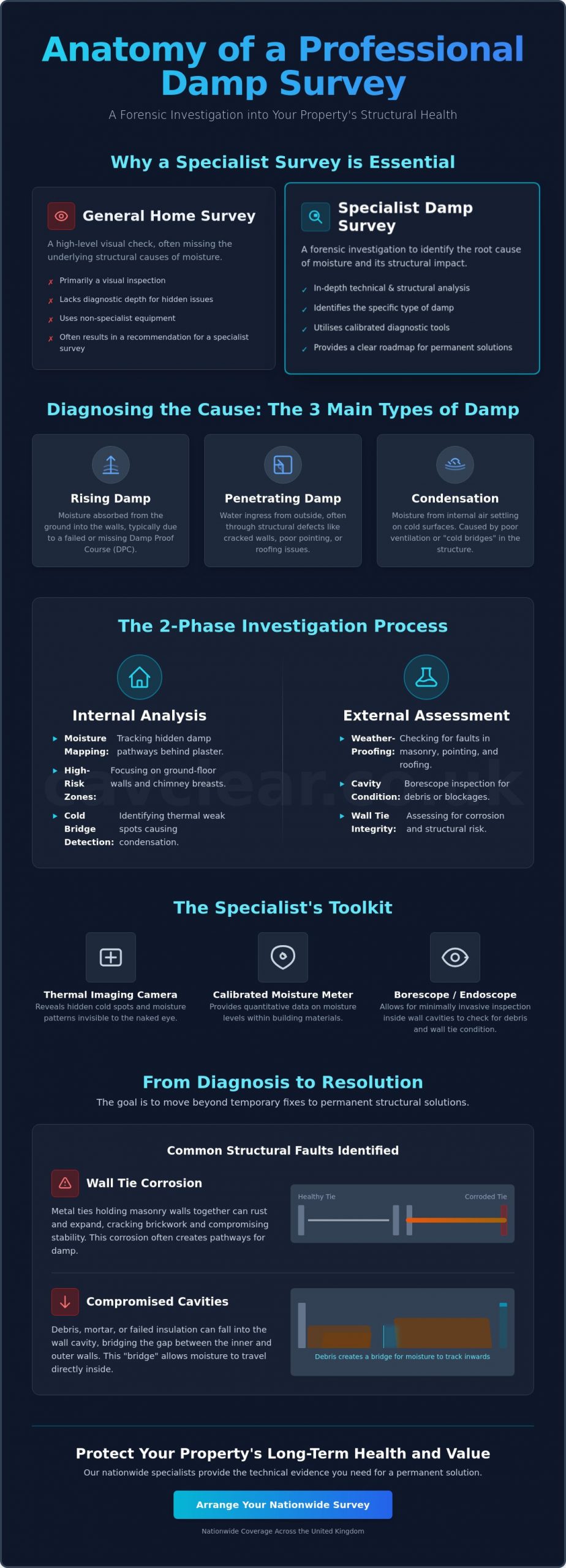
A specialist damp survey is a technical inspection designed to identify moisture ingress, diagnose its root cause, and evaluate its impact on structural health. While many property owners view damp as a cosmetic issue, it is fundamentally a symptom of structural dampness that requires a precise remedy. A professional investigation provides a definitive roadmap for remedial action. This ensures you don’t waste resources on temporary surface fixes that fail to address the underlying fault.
When homeowners ask what does a damp survey check for, they are often surprised by the level of technical detail involved. Professional surveyors look for rising damp, penetrating damp, and condensation-related issues simultaneously. By examining the property as a complete system, the surveyor can determine if moisture is entering through the masonry, rising from the ground, or accumulating due to poor ventilation. This comprehensive approach is vital because treating the wrong type of damp often exacerbates the problem.
Specialist vs. General Home Surveys
Standard RICS Level 2 or 3 reports often recommend a follow-up specialist damp survey. This happens because general surveys are primarily visual and lack the diagnostic depth required to map moisture pathways. General surveyors don’t typically use the calibrated equipment necessary to look deep into a building’s structure. For example, a visual inspection cannot determine if debris in a cavity is bridging a damp proof course or if wall ties are corroding. A specialist report provides a technically robust foundation for remedial work, focusing on the environmental and structural factors that a generalist might overlook.
When Should You Instruct a Specialist Survey?
For landlords, the extension of Awaab’s Law to the private rented sector in May 2026 makes these surveys even more critical. Under the Renters’ Rights Act 2025, landlords must investigate reported hazards within 14 days. A specialist survey provides the documented evidence needed to comply with these strict response times. Knowing exactly what does a damp survey check for helps you understand why these symptoms require more than just a fresh coat of paint. A nationwide expert can verify if the issue stems from compromised cavity conditions, allowing for a permanent fix that restores comfort and safety.
Internal Inspection: How Surveyors Map Moisture Patterns
The internal phase of a professional investigation is a methodical, room-by-room assessment. When considering what does a damp survey check for, the internal phase is where the surveyor identifies the physical footprint of moisture within the living space. Specialists prioritize high-risk zones, specifically ground-floor walls and chimney breasts, where moisture accumulates most frequently. Moisture mapping is the process of identifying invisible moisture gradients within a building fabric. By taking multiple readings across a single wall, the surveyor determines if the moisture is rising from the ground or penetrating from an external fault. This data-driven approach follows the professional methodology for investigating moisture, ensuring that the diagnosis isn’t based on visual guesswork.
Surveyors also look for “cold bridges.” These are specific points where the building’s thermal envelope is compromised, often due to poor insulation or structural defects. These cold spots allow condensation to form even in well-heated rooms. If you suspect your property has hidden issues, a professional structural inspection can identify whether cavity debris or wall tie failure is the culprit behind these cold spots.
Wall and Floor Assessments
During the wall assessment, the surveyor looks for “tide marks” or salt deposits. These are clear indicators of rising damp where groundwater carries minerals into the masonry. Timber floors also require close inspection for signs of fungal decay or rot. High sub-floor humidity can lead to dry rot, which severely compromises structural integrity. The surveyor also evaluates the condition of internal plaster. Once plaster becomes salt-contaminated, it becomes hygroscopic, meaning it will continue to attract moisture from the air even after the original source of dampness is resolved. This necessitates a specific remedial approach to restore the wall’s health.
Measuring Relative Humidity and Ventilation
A technical survey involves measuring air moisture content using hygrometers. This helps the specialist understand what does a damp survey check for in terms of environmental balance. They assess the effectiveness of existing ventilation, such as trickle vents and extractor fans, to rule out simple condensation. Surveyors are trained to identify dampness that hides in unheated voids or behind large furniture where airflow is restricted. By comparing internal humidity with external temperatures, the surveyor can determine if the property’s ventilation is sufficient to prevent atmospheric moisture from settling on cold structural surfaces.
External Structural Checks: Identifying the Root Causes of Water Ingress
The exterior phase of a professional investigation shifts focus from the internal symptoms to the building envelope. This external inspection is designed to identify exactly where the property’s weather-proofing has failed. By examining the outer leaves of the masonry, a specialist determines how environmental factors interact with the structure. When homeowners ask what does a damp survey check for, the answer often lies in the forensic examination of the Damp Proof Course (DPC). Surveyors check the DPC for signs of physical failure or bridging, where external materials like soil or render allow moisture to bypass this vital barrier.
Structural indicators provide essential clues about the health of the hidden cavity. For example, horizontal cracking in mortar joints is a common sign of wall tie corrosion. As these steel ties oxidize and expand, they force the masonry apart, creating pathways for water to enter the cavity. A technical survey assesses these cracks to determine if the structural stability of the property is at risk. Identifying these faults early prevents the need for extensive masonry repairs later, making the survey a vital investment in the property’s future.
Cavity Wall and Insulation Integrity
A critical part of the external assessment involves checking the condition of the cavity itself. Many properties across the United Kingdom suffer from cavity wall insulation problems that lead to severe penetrating damp. Surveyors look for “bridging,” where saturated insulation or fallen debris allows moisture to travel from the outer leaf to the inner leaf. We maintain a firm stance against the installation of retrospective cavity insulation. In the UK’s damp climate, these materials often act as a bridge for moisture and accelerate wall tie corrosion. Identifying compromised insulation is a primary goal when determining what does a damp survey check for, as extraction is often the only permanent fix.
Roofing, Guttering, and Ground Levels
The surveyor also inspects the property’s rainwater goods. Leaking gutters or blocked downpipes can saturate specific areas of masonry, leading to localized penetrating damp. Ground levels are another common point of failure. If new patios or driveways have been installed above the original DPC, moisture will move directly into the internal walls. Finally, the specialist evaluates the condition of the pointing and the bricks themselves. Porous bricks or cracked mortar allow driving rain to soak into the structure, especially on exposed elevations. This methodical check ensures that every potential entry point for water is identified and documented for resolution.
Specialist Equipment: The Tools of a Professional Damp Investigation
A professional investigation relies on specialized technology to move beyond visual assumptions. When understanding what does a damp survey check for, the focus is on quantifying moisture levels using calibrated electronic moisture meters. These devices operate in two distinct modes. The search mode uses radio frequencies to detect moisture deep within the masonry without damaging the decorative surface. The measure mode provides a precise percentage of moisture content at a specific point. This dual-mode approach allows the surveyor to map the exact extent of a moisture plume, providing a factual basis for remedial recommendations.
Thermal imaging cameras add another layer of diagnostic depth to the process. These tools detect hidden cold spots and moisture pathways behind plaster that the naked eye cannot see. By identifying temperature differentials, a specialist can pinpoint exactly where insulation is missing or where water is tracking down an internal wall leaf. To see inside the structure itself, surveyors use borescope cameras. These allow for a non-destructive inspection of the wall cavity to view the condition of wall ties and the presence of debris. If you are concerned about hidden structural issues, booking a professional Cavity Wall Survey can reveal exactly what is happening inside your walls.
Specialists also use salts analysis to differentiate between groundwater and tap water. This is a critical check because rising damp contains specific chemical markers, such as nitrates and chlorides, absorbed from the earth. Leaks from internal plumbing or simple condensation do not contain these minerals. Identifying these chemical signatures prevents homeowners from commissioning expensive damp proofing work when the issue is actually a localized plumbing failure.
Non-Destructive Testing Methods
Modern methodology ensures the survey remains non-invasive while providing deep structural insights. Ultrasonic and radio frequency meters can see through tiles or thick masonry, which is essential in bathrooms or older stone properties. Thermal imaging identifies thermal bridging without the need to remove wall linings or disrupt the occupants. These methods protect the property’s aesthetics while delivering the technical data required for a permanent fix. This non-disruptive approach is a hallmark of a professional nationwide service, emphasizing the restoration of comfort without causing additional damage.
Interpreting the Specialist Report
A professional report is the final deliverable of the diagnostic process. It must include clear evidence of moisture, identified root causes, and technical remedial recommendations. Many specialists use a traffic light system or risk ratings to help homeowners prioritize essential work. A CavClear report provides a definitive plan for damp survey resolutions. This documentation serves as a vital investment in your property’s future, providing a legally and technically robust foundation for any necessary remedial work.
From Diagnosis to Resolution: Addressing Structural Faults
Once the technical investigation concludes, the focus shifts from identifying symptoms to implementing permanent remedial solutions. A specialist survey moves beyond surface-level observations to provide a structural roadmap for your property. When homeowners understand what does a damp survey check for, they realize that a professional report is not just a list of problems. It is a precise diagnostic tool that prioritizes the restoration of structural integrity over temporary “tanking” or cosmetic surface treatments. These superficial fixes often trap moisture within the masonry, leading to accelerated decay and higher costs in the future.
Addressing the root cause of moisture ingress frequently involves essential structural work. For example, if the survey identified horizontal cracking or masonry bulging, wall tie replacement is often required to ensure the stability of the building’s leaves. In many UK homes, the only permanent fix for persistent damp involves the extraction of defective or wet cavity insulation. CavClear provides nationwide specialist services to execute these high-level remedial plans. Our methodology focuses on clean, non-disruptive processes that restore your property to a dry, safe, and efficient state.
The Role of Cavity Wall Maintenance
Removing wet or slumped insulation is often the only way to stop recurring penetrating damp. When insulation becomes saturated, it acts as a permanent bridge that transfers moisture from the outer leaf directly to your internal walls. By clearing the cavity, we restore the building’s natural ability to breathe and manage moisture through airflow. This process is a vital investment in your property’s future. It prevents the long-term degradation of wall ties and protects the internal fabric from the salt contamination discussed in previous sections. These structural repairs ensure the long-term health of your asset rather than just hiding a fault behind plaster.
Instructing Your Remedial Action Plan
Your survey report serves as the foundation for obtaining accurate quotes for specialist labor. It provides the technical specifications required to ensure that any contractor you hire addresses the actual cause of the dampness rather than the symptoms. It’s essential to choose an accredited contractor who understands the complexities of structural wall repairs and the risks associated with compromised cavities. A professional approach ensures that the work is performed to high-level standards, providing you with long-term assurances and peace of mind. If you are ready to resolve your property’s moisture issues, Contact CavClear for a professional consultation on your property’s structural health. Understanding what does a damp survey check for is the first step, but taking decisive remedial action is what ultimately restores the comfort and security of your home.
Securing Your Property’s Structural Future
A professional investigation is the only way to move from visual guesswork to a permanent structural resolution. By understanding exactly what does a damp survey check for, you can prioritize the long-term health of your home over temporary cosmetic repairs. We’ve explored how specialists use forensic tools to map moisture pathways and identify hidden faults within the building envelope, such as corroded wall ties or compromised cavities. This data-driven approach ensures that remedial work targets the root cause rather than just the symptoms.
Taking decisive action based on technical evidence protects your property’s value and ensures a safe, dry environment for your family. Our accredited technicians provide nationwide coverage, specializing in structural wall repairs and professional insulation extraction. We deliver detailed technical reporting that meets the rigorous standards required by both homeowners and insurers. This documentation provides the clarity needed to invest in your property with absolute certainty.
Book a specialist damp investigation with CavClear today to receive a definitive roadmap for your property’s restoration. Investing in a forensic diagnosis today prevents the high costs of structural neglect tomorrow. You can restore your home’s comfort and efficiency with the support of a trusted specialist.
Frequently Asked Questions
Is a damp survey the same as a mortgage survey?
No, a specialist damp survey is a forensic investigation, whereas a mortgage survey is a valuation for the lender. A specialist report focuses on the environmental and structural factors that a generalist might overlook. It provides a legally and technically robust foundation for remedial work, whereas a mortgage survey only identifies visible symptoms without diagnosing the root cause.
How long does a professional damp survey usually take?
A professional damp survey usually takes between one and three hours to complete. This timeframe allows for a room-by-room moisture mapping and a thorough external inspection of the building envelope. Larger properties or those with complex extensions may require more time to ensure every moisture pathway is correctly identified and documented.
Will the surveyor need to move my furniture or lift floorboards?
Specialists generally use non-destructive testing methods that don’t require moving heavy furniture or lifting floorboards. Modern equipment like thermal imaging cameras and radio-frequency meters allow for deep structural insights through decorative surfaces. If a borescope inspection is required to check wall ties, we use small, non-disruptive entry points that are easily made good.
What is the difference between a “expert survey” and a paid specialist survey?
A paid specialist survey provides an independent technical report, whereas a “expert” survey is often a sales-led estimate for specific products. When you understand what does a damp survey check for, you realize the value is in the impartial diagnosis. A paid report focuses on long-term asset health rather than pushing for a quick sale of unnecessary treatments.
Can a damp survey identify if my wall ties are failing?
Yes, a technical survey includes specific checks for wall tie failure. Surveyors look for horizontal cracking in mortar joints and use borescope cameras to inspect the cavity. These checks are essential because corroding wall ties expand and damage the masonry, creating pathways for water ingress that lead to severe penetrating damp.
Does a damp survey check for mould and its causes?
A damp survey checks for mould by identifying the underlying moisture source that allows it to thrive. Whether the cause is atmospheric condensation or structural water ingress, the surveyor uses hygrometers to measure relative humidity and ventilation. This diagnostic process moves from observation to recommendation, ensuring you receive a permanent fix rather than a cosmetic cleaning solution.
What happens if the survey finds damp caused by cavity wall insulation?
If the investigation identifies damp caused by saturated cavity wall insulation, the recommended resolution is usually extraction. Wet insulation acts as a thermal bridge, transferring moisture from the outer leaf to the internal walls. Removing this material is the only way to restore the building’s natural ability to breathe and prevent the long-term decay of the structural wall ties.
How much does a specialist damp survey cost in the UK?
The cost of a specialist survey in the UK varies depending on the property size and the level of technical detail required. While industry averages for basic inspections often vary across the United Kingdom, homeowners should focus on the quality of the technical reporting provided. An expert survey is a vital investment in the property’s future, providing the documented evidence needed for long-term remedial planning.
Recent Comments