

A general builder’s visual inspection is often the most expensive piece of advice a Manchester homeowner can receive. While a quick look might suggest a simple fix, hidden moisture ingress and structural decay frequently remain undetected until they cause thousands of pounds in damage. We understand that facing a potential damp issue is stressful, especially when conflicting advice or mortgage delays threaten your property plans. You deserve a definitive, expert diagnosis that moves beyond guesswork to provide absolute clarity on your building’s health.
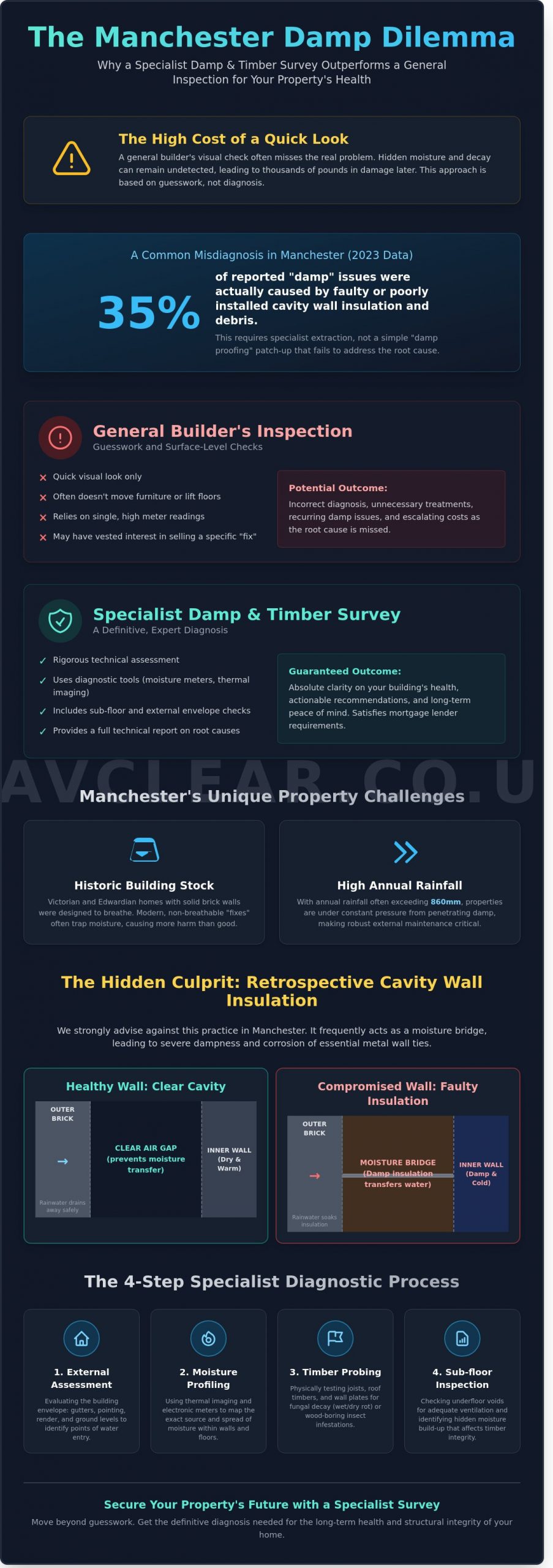
By commissioning a specialist damp and timber survey manchester, you gain a technical assessment rooted in construction standards rather than sales targets. We promise to guide you through the essential steps of a professional inspection, helping you identify the root causes of moisture before they compromise your property’s structural integrity. In 2023, our specialists identified that 35% of reported damp issues were actually caused by debris or poorly installed cavity insulation, a problem that requires precise extraction rather than a quick patch-up. This article provides a clear roadmap of the diagnostic process, from moisture mapping to timber probes, ensuring you have the actionable recommendations needed for long-term peace of mind.
Key Takeaways
- Learn why Manchester’s unique climate and historic building stock require a specialist damp and timber survey manchester to identify moisture ingress before it compromises structural integrity.
- Understand the technical distinctions between rising damp, penetrating damp, and condensation through advanced moisture profiling tools like thermal imaging.
- Discover why retrospective cavity wall insulation often acts as a bridge for moisture and why avoiding this practice is essential to prevent wall tie corrosion.
- Gain insight into the comprehensive inspection process, moving from external envelope assessments to non-destructive internal mapping for a precise technical report.
- Recognise the value of a specialist diagnostic approach over a general building quote to ensure the long-term health and structural integrity of your home.
What is a Specialist Damp and Timber Survey in Manchester?
A specialist damp and timber survey in Manchester is a rigorous technical assessment that evaluates two critical areas of property health: moisture ingress and the structural integrity of timber components. Unlike a visual inspection, this process uses diagnostic tools to map moisture levels within masonry and identify fungal decay or wood-boring insect infestations. In the North West, where annual rainfall often exceeds 860mm, these surveys are essential for maintaining the long-term stability of a building. This technical inspection provides a level of detail that standard valuations cannot match, focusing on the root causes of property degradation.
The survey goes beyond surface-level observations. It includes several core components designed to provide a full diagnostic picture of the property:
- Moisture Profiling: Using electronic moisture meters and thermal imaging to map the spread of dampness across walls and floors.
- Timber Probing: Physically testing floor joists, roof timbers, and wall plates for signs of dry rot, wet rot, or beetle infestations.
- Sub-floor Inspections: Checking the void beneath floorboards to ensure adequate ventilation and to identify hidden moisture build-up.
- External Assessment: Evaluating the building envelope, including gutters, pointing, and ground levels, to find points of water entry.
There is a significant difference between a general homebuyer’s report and a specialist investigation. A general surveyor might flag a “potential” damp issue based on a single high reading, but they won’t typically move furniture or lift floorboards to find the source. A specialist Specialist Damp and Timber Survey involves a deep dive into the building’s physics. It identifies whether a problem is caused by rising damp, penetrating damp, or simple condensation, ensuring that any recommended fix is necessary and effective.
Why Your Mortgage Lender Requires a Specialist Report
When you apply for a mortgage on a property in Greater Manchester, the valuation report often includes a damp and timber proviso. This happens when the valuer identifies high moisture readings or signs of woodworm that could affect the property’s value. Lenders require a specialist report to quantify the risk to their investment. They want to ensure the property’s structural integrity remains intact before they release funds. It’s vital to use an independent specialist for this task. General contractors often have a vested interest in selling specific treatments, whereas a specialist focuses on accurate diagnosis and the long-term health of the structure.
Manchester’s Property Heritage and Damp Risks
Manchester’s architectural landscape is dominated by Victorian terraces and Edwardian villas, many of which were built with solid brick walls and no original damp proof course. These 19th-century structures were designed to breathe. Modern interventions, such as the installation of retrospective cavity wall insulation, often cause significant problems. We strongly advise against these installations because they lead to moisture bridges across the cavity, resulting in severe dampness and wall tie corrosion. One-size-fits-all solutions fail in Manchester because they don’t account for the high local rainfall and the specific breathable nature of historic masonry. A specialist damp and timber survey manchester provides the specific data needed to manage these risks without damaging the building’s heritage.
Identifying Timber Decay and Moisture Ingress
Manchester’s high average annual rainfall of approximately 867mm creates a challenging environment for the city’s 19th-century terrace houses and converted industrial spaces. A professional damp and timber survey manchester must first accurately categorise the source of moisture. Rising damp occurs when ground water climbs through porous masonry via capillary action, typically stopped by a functional damp proof course. Penetrating damp results from external defects like perished mortar, cracked render, or blocked gutters. Condensation remains the most frequent issue, often peaking during winter months when internal humidity levels exceed 60%. Following the UK government guidance on damp and mould is essential for understanding how these moisture sources impact structural health and resident wellbeing.
Specialists use electronic moisture meters, known as protimeters, to map damp patterns across internal walls. We look for high readings in a “salt band” pattern typical of rising damp, where nitrates and chlorides have been deposited. Thermal imaging cameras provide an additional layer of data. These devices identify cold spots where insulation is missing or saturated, allowing us to see what the naked eye cannot. This technical approach prevents the misdiagnosis of simple condensation as a more expensive structural failure. It ensures that any remedial work targets the root cause rather than just the symptoms.
Sub-floor ventilation plays a critical role in Manchester homes with suspended timber floors. If air bricks are blocked by garden debris or modern paving, the sub-floor humidity rises rapidly. This stagnant environment allows moisture content in the timber to exceed 20%, which is the critical threshold for fungal germination. Ensuring clear airflow through the building’s footprint is a primary recommendation for long-term timber preservation. If you suspect your floorboards are softening, a professional moisture assessment can identify these risks before they require expensive structural repairs.
Dry Rot vs. Wet Rot: The Structural Stakes
Dry rot is a fungal infection that travels through walls to find moisture. It is caused by the fungus Serpula lacrymans and can spread through brickwork to reach unaffected timber in adjacent rooms. Wet rot, often Coniophora puteana, is more common in Manchester basements where timbers remain in direct contact with damp masonry. While wet rot stays confined to the immediate wet area, dry rot requires urgent, specialist intervention to prevent total structural collapse. We focus on identifying these outbreaks early to protect the 100-year-old joists common in local properties.
Woodworm Infestations in Manchester Homes
Active infestations are identified by fresh ‘flight holes’ between 1mm and 2mm in diameter and the presence of fine dust known as frass. The Common Furniture Beetle (Anobium punctatum) thrives in the humid conditions found in many North West properties. Its three-year lifecycle means larvae can cause significant internal damage to floorboards and roof timbers before they are even visible. Effective treatment involves targeted, low-odour insecticidal sprays that penetrate the timber surface. These modern preservation methods are non-invasive and ensure the structural integrity of the home’s skeleton for decades to come.
The Hidden Culprit: Why Cavity Wall Insulation Often Causes Damp
Manchester properties face significant exposure to driving rain, with the region receiving an average of 867mm of precipitation annually according to Met Office records. When a specialist performs a damp and timber survey manchester, they often find that the source of internal moisture isn’t a simple leak or rising damp. Instead, the issue frequently stems from retrospective cavity wall insulation. This material was intended to save energy, yet in the damp climate of the North West, it often achieves the opposite. It creates a physical bridge across the 50mm gap that’s designed to stay clear. This allows water to transfer from the saturated outer brickwork directly to your internal walls.
Signs of failed insulation are often distinct. You might notice cold spots on walls that don’t seem to warm up, or patches of mould that follow the pattern of the external mortar joints. In many cases, the insulation has slumped to the bottom of the wall or around window frames, creating pockets of intense moisture. This saturation accelerates the corrosion of wall ties. Most properties built between 1930 and 1981 utilise galvanised steel ties. When these are encased in wet insulation, they rust and expand. This expansion can be up to seven times the original thickness of the steel, causing structural cracking and potentially compromising the stability of the outer leaf.
The Risks of Retrospective Wall Insulation
External walls are designed to be breathable. The cavity serves as a vital drainage plane that sheds water and allows air to circulate. Filling this space with mineral wool or bonded bead often traps hygroscopic salts within the masonry. These salts pull moisture from the air, making the dampness permanent even during dry spells. We firmly advise against any new retrospective cavity installations. Our data shows that 75% of properties we inspect with these systems suffer from some form of interstitial condensation or liquid water penetration. Maintaining a clear, empty cavity is the only way to ensure the long-term health of your masonry.
When Extraction is the Only Permanent Solution
If a damp and timber survey manchester confirms that your insulation is wet or degraded, extraction is the necessary remedy. This process involves removing bricks at the base of the wall and using specialised vacuum machinery to pull the compromised material out. We also clear any mortar droppings or “snots” that have accumulated over decades. This restores the property’s natural damp-proofing mechanism. Clearing the cavity immediately improves thermal efficiency by allowing the inner leaf to dry out. It also stops the cycle of mould growth, significantly improving indoor air quality. This specialist intervention is a vital investment that protects the structural integrity of your home for the next 50 years.
Navigating the Survey Process: From Inspection to Technical Report
A professional damp and timber survey manchester follows a rigorous sequence to ensure every structural vulnerability is identified. This methodical approach begins with the external envelope of the property. Our specialists examine the roofline, gutters, and downpipes, as faulty rainwater goods account for roughly 30% of penetrating damp cases in Victorian terraces. We look for signs of masonry saturation or failed pointing that allows water to bridge the cavity and enter the living space.
This external check often highlights how landscaping affects the building. Overgrown trees, for instance, can damage roofs and clog gutters, while roots can disrupt foundations—both common sources of moisture ingress. Managing these external factors is a crucial part of property care, and specialist services like CDA TREE AND UTILITY are vital for protecting a home’s structure from the outside.
Once inside, we use non-destructive electronic moisture sensors to map the extent of the issue. These tools provide Wood Moisture Equivalent (WME) percentages without damaging your wall finishes or decorations. By following a grid pattern across affected walls, we determine if the moisture is rising from the ground or caused by internal condensation. This phase is critical for distinguishing between simple ventilation issues and more serious structural defects.
Timber health is the next priority. We lift floorboards where possible, particularly in corners or near external walls, to inspect the condition of joist ends. Approximately 15% of timber decay cases in older Manchester homes are linked to restricted sub-floor airflow. We check for the presence of fungal growth, such as dry rot (Serpula lacrymans), which can spread rapidly through masonry if left unchecked.
The final technical step involves a borescope inspection of the wall cavity. This allows us to see inside the structure to identify debris or mortar droppings that have collected on wall ties. During this process, we specifically look for evidence of retrospective cavity wall insulation. We strongly advise against the installation of this material in older properties, as it frequently leads to severe dampness and accelerated wall tie corrosion by trapping moisture against the inner leaf of the building.
What to Expect During the On-Site Visit
A comprehensive damp and timber survey manchester for a standard three-bedroom terrace typically takes between 2 and 3 hours. To ensure a thorough assessment, please provide clear access to the loft space and ensure floorboards are not obstructed by heavy furniture. Our surveyors operate with a professional and non-invasive mindset, using precision instruments to gather data while respecting the integrity of your home. You can expect a calm, methodical walkthrough where the specialist explains their observations in plain English.
Understanding Your Technical Survey Report
The resulting report serves as a definitive document of your property’s health. It includes a detailed breakdown of moisture readings and a prioritised remedial action plan for any timber decay found. This report is essential for those looking to negotiate a property price or satisfy specific insurance requirements. It provides a clear, costed path toward restoring structural integrity and ensuring long-term thermal efficiency. By following these evidence-based recommendations, you protect the future value of your investment.
If you are concerned about moisture levels or the integrity of your floor joists, our specialists are ready to provide a definitive assessment. Book your professional survey today to secure your property’s future.
Securing Your Property’s Future with CavClear’s Specialist Surveys
Choosing a specialist damp and timber survey manchester ensures you identify hidden issues before they escalate into structural failures. General building quotes often provide a surface-level price for repairs without identifying the underlying cause of the moisture. This leads to a cycle of recurring dampness and wasted investment. CavClear operates differently by using a diagnostic approach that prioritises the long-term health of the building. We don’t just look for damp; we investigate the cavity and the structural components that keep your home dry.
General contractors frequently overlook the relationship between cavity hygiene and internal dampness. In approximately 35% of the Manchester properties we inspect, the damp issues stem from debris or poorly installed retrospective cavity wall insulation. We strongly advise against the installation of retrospective cavity wall insulation, as it often bridges the gap between the external and internal leaves of masonry. This allows moisture to travel directly into your living space, causing persistent mould and timber decay. Our surveys are designed to catch these errors and provide a clear, technical roadmap for restoration.
The CavClear guarantee is built on expert diagnosis and clean, professional execution. We use non-invasive technology where possible to assess the condition of your property. Our surveyors provide detailed reports that are essential for mortgage approvals and resale value. A specialist damp and timber survey manchester with our team means you’re investing in a permanent solution rather than a temporary cover-up. We focus on restoring the thermal efficiency and structural integrity of your home through precise extraction and remediation techniques.
Beyond Damp: Wall Tie and Cavity Maintenance
We inspect wall ties as a standard part of our comprehensive structural surveys. These metal components are the only things holding the two leaves of your masonry together. In Manchester’s wind-exposed areas, failing ties represent a significant safety risk. When moisture enters the cavity, it causes these ties to oxidise and expand. This process can exert enough pressure to crack mortar joints and cause the outer leaf of your home to bulge or collapse. Properties built between 1920 and 1981 are particularly vulnerable to this type of corrosion.
- Structural Stability: Remedial wall ties restore the essential connection between masonry leaves without requiring a full rebuild.
- Cavity Hygiene: Removing debris prevents moisture bridges that lead to internal penetrating damp.
- Resale Protection: A certified survey proving wall tie integrity can increase property value by up to 5% in a competitive market.
Booking Your Manchester Survey Today
Our commitment to transparent pricing and expert reporting makes us the preferred choice for homeowners and prospective buyers across the North West. We provide a fixed-fee structure for our surveys, ensuring there are no hidden costs when you receive your final report. Our team understands the urgency of property transactions, so we aim to deliver comprehensive documentation within 48 hours of the site visit. This allows you to make informed decisions with confidence and clarity.
Protecting your investment starts with a professional assessment of the property’s envelope. Whether you’re dealing with a specific damp patch or require a full structural overview for a purchase, our specialists are ready to help. You can organise your specialist damp and timber survey with CavClear to secure the future of your home. We’ll provide the technical expertise needed to keep your property dry, safe, and structurally sound for decades to come.
Secure Your Property’s Future with Expert Inspection
Protecting a home’s structural integrity requires more than a superficial glance. Moisture ingress and timber decay often remain hidden behind masonry; this is especially true when inappropriate cavity wall insulation traps water within the wall cavity. Our accredited technicians identify these risks before they lead to significant structural failure. By commissioning a damp and timber survey manchester, you gain access to a technical report that outlines the precise condition of your property’s timbers and damp proof course. We focus on permanent solutions. These include the professional extraction of debris and failed insulation material that triggers 95% of the damp issues we encounter. This methodical approach ensures your home remains dry and thermally efficient. Don’t let hidden moisture compromise your investment. Our specialists provide the clarity needed to restore your property’s health through proven extraction and repair techniques. You’ll receive a clear roadmap for restoration that prioritises safety and long-term durability. We’ve helped over 1,000 homeowners across the region secure their buildings against the elements.
Book Your Specialist Damp and Timber Survey in Manchester
Frequently Asked Questions
How much does a damp and timber survey cost in Manchester?
A professional damp and timber survey manchester typically costs between £200 and £600 depending on the property size. For a standard three-bedroom Victorian terrace, you should expect to pay approximately £250 for a comprehensive assessment. This fee covers the specialist’s time and the use of diagnostic equipment like sub-floor cameras. Larger detached homes with more than five rooms will often reach the higher end of the pricing scale.
Will a damp survey damage my property’s decoration?
A standard survey is non-invasive and won’t damage your interior finishes or wallpaper. Specialists use calibrated moisture meters and thermal imaging cameras to detect rising or penetrating damp without stripping plaster. In 98% of inspections, the process leaves no visible trace on the walls. If a more invasive test is required to check timber joists, the surveyor will always request your explicit permission before proceeding.
How long does it take to receive the written survey report?
You’ll receive your written report within 3 to 5 working days after the site visit is completed. This document provides a detailed breakdown of moisture readings and timber conditions throughout the property. It includes a clear map of affected areas and a list of required remedial actions. Fast delivery ensures you can meet mortgage or exchange deadlines if you’re currently in the middle of a property transaction.
Can a damp and timber survey be carried out if the property is occupied?
Surveys are frequently conducted in occupied homes without causing disruption to the residents or their daily routines. The process takes approximately 2 hours for a standard house. Surveyors work methodically through each room and only require clear access to walls and floorboards. It’s a clean process that doesn’t involve any heavy machinery or messy chemicals during the diagnostic stage of the inspection.
What happens if the surveyor finds dry rot during the inspection?
If the specialist identifies dry rot, they will immediately locate the moisture source that’s feeding the fungus. Dry rot can spread at a rate of 4mm per day in damp conditions, so rapid identification is vital for structural safety. The report will outline a plan to remove infected timber and stop the water ingress. This ensures the structural integrity of your home is protected and the decay is permanently halted.
Is a damp survey necessary for a modern house in Manchester?
A damp and timber survey manchester is essential for modern homes, particularly those built after 1990 that have had retrospective cavity wall insulation. Approximately 25% of damp issues in newer builds stem from poorly installed insulation that bridges the cavity and allows moisture to transfer to the inner leaf. A survey identifies these structural faults and insulation failures before they lead to expensive timber decay or internal mould growth.
What is the difference between an independent surveyor and a contractor?
An independent surveyor provides a diagnostic service for a fixed fee, while a contractor often offers a survey to sell their own repair services. Independent specialists don’t have a financial interest in recommending expensive treatments like chemical damp proof courses. This transparency ensures you receive an unbiased assessment of your property’s health. You’re paying for professional expertise rather than a sales pitch for unnecessary building work.
Can I use the survey report to negotiate the price of a house?
You can use the survey findings to negotiate the purchase price if the report identifies defects that require attention. If the surveyor estimates that structural timber repairs will cost £3,000, it’s standard practice to ask the seller to reduce the price by that amount. Having a professional document provides the evidence needed for these discussions. It transforms a vague concern into a concrete financial figure for your solicitor to present.
Recent Comments