
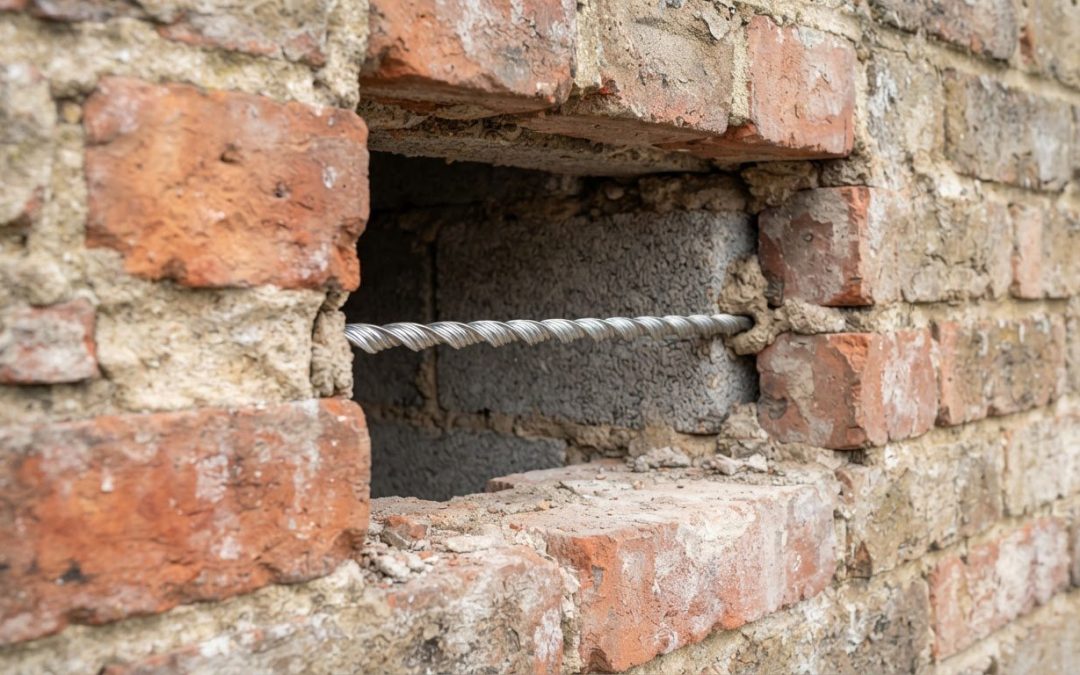
Choosing a remedial wall tie is about more than reconnecting the two leaves of brickwork: the replacement must also resist the conditions that caused the original tie to fail. The reason remedial wall ties are made from stainless steel is its corrosion resistance, which helps the tie maintain its role within the wall. For coastal locations and heavily polluted environments, Grade 316 stainless steel is recommended for remedial ties.
If you’re dealing with cracks or signs of movement, it’s understandable to want a repair that addresses the cause, not just the visible damage. The right tie and grade depend on the wall construction and its exposure to corrosive conditions. This article explains how remedial ties stabilise existing brickwork, how stainless steel compares with galvanised steel, and when Grade 316 may be appropriate. It also covers the checks involved in selecting a suitable replacement, so you can understand what a professional wall tie assessment considers.
Key Takeaways
- Grade 316 stainless steel is recommended for remedial wall ties in coastal areas and heavily polluted environments.
- Remedial ties reconnect the inner and outer leaves of masonry, helping stabilise brickwork when existing ties fail.
- Corrosion can make older galvanised mild-steel ties expand, putting pressure on surrounding masonry and contributing to cracking.
- The right replacement depends on the wall construction and the level of exposure to corrosive conditions.
- A wall tie survey can identify failing ties and inform whether replacement is needed; CavClear provides surveys and wall tie replacement across the UK.
Stainless-steel grade for coastal and polluted environments
Grade 316 is recommended for remedial wall ties in coastal areas and heavily polluted environments. Choosing the wrong material or grade risks corrosion, weakening the connection between masonry leaves and contributing to structural movement.
Choosing a Grade for Exposure Conditions
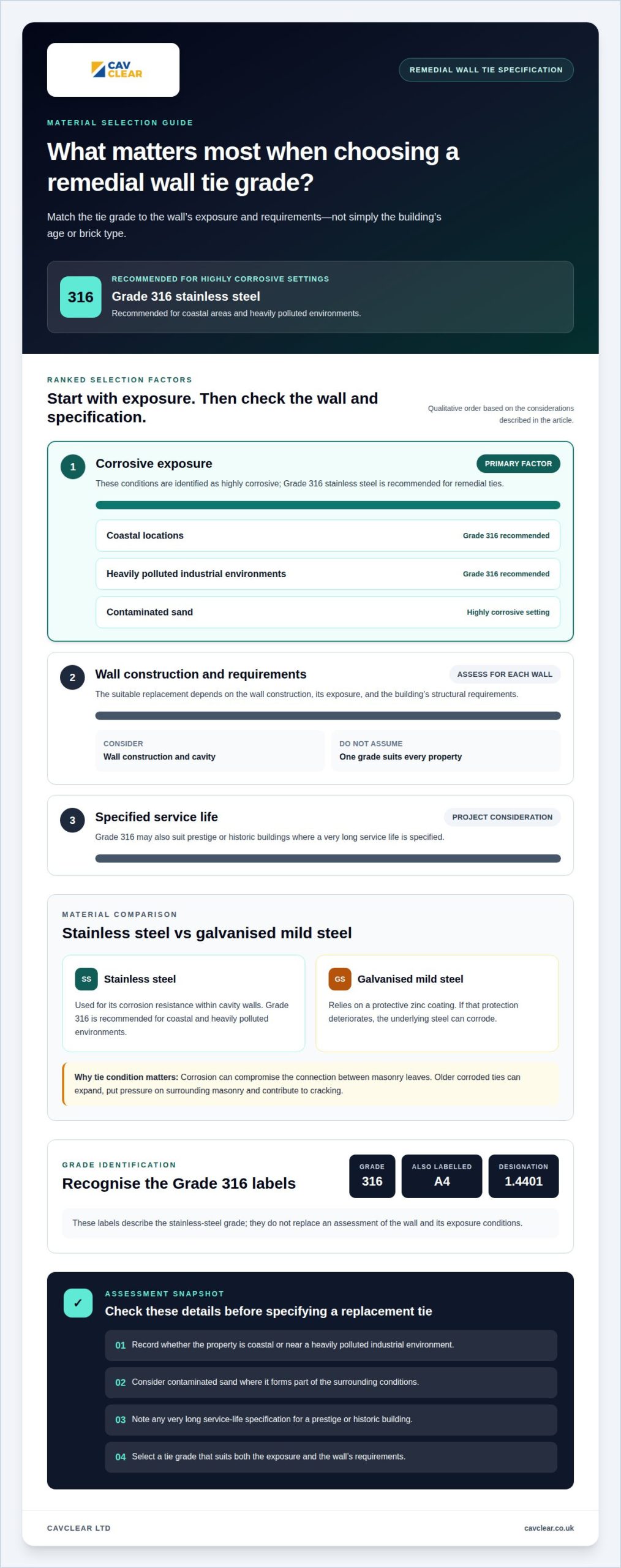
Grade selection considers the conditions around the building, not just its age or brick type. Coastal locations, contaminated sand and heavily polluted industrial environments are identified as highly corrosive settings. In these conditions, Grade 316 stainless steel is recommended for remedial helical wall ties. The same grade may suit prestige or historic buildings where a very long service life is specified.
Before selecting a tie, assess the wall’s exposure. A coastal property faces different conditions from one inland, and industrial pollution or contaminated sand can also increase corrosion risk. These factors explain why the same grade should not be assumed suitable for every property in the UK.
- Record whether the property is coastal or near a heavily polluted industrial environment.
- Consider contaminated sand where it forms part of the surrounding conditions.
- Note whether the project specifies a very long service life for a prestige or historic building.
This assessment distinguishes routine exposure from conditions that call for greater corrosion resistance. The tie grade should suit the environment and the wall’s requirements, rather than being chosen based on the building’s appearance alone.
Corrosion Resistance Compared with Galvanised Ties
Stainless steel remedial ties are used to resist corrosion within cavity walls. Grade 316 is recommended for coastal and heavily polluted environments because those conditions are highly corrosive. By comparison, galvanised mild-steel ties rely on a protective zinc coating. If that protection deteriorates, the underlying steel can corrode. Selecting stainless steel addresses the material’s exposure to corrosion as well as its structural role.
The distinction matters because a remedial tie must continue connecting the wall leaves. Corrosion can compromise that connection, so matching the material to the environment supports the repair’s intended function. Ferritic stainless steel is also corrosion-resistant, according to Brunel University, but the available recommendation for highly corrosive locations specifies Grade 316.
Grade 316 ties may also be identified as Grade 316 (A4), designated Grade 1.4401. These labels describe the stainless-steel grade; they do not replace assessment of the wall and its exposure. A suitable specification should account for coastal conditions, industrial pollution or contaminated sand, rather than relying on the word “stainless” alone.
In older brickwork, an unsuitable grade may allow corrosion to recur in the repaired wall. A corroded tie can lose its ability to restrain the outer leaf, leaving the masonry more vulnerable to movement and cracking. Grade selection should account for the environment, the tie specification and the building’s structural requirements.
When sourcing materials for your project through CavClear, you will often find options supplied as Grade 316 (A4). A typical installation kit contains 100 Grade 316 (A4) helical ties. Always confirm that this stated grade corresponds to the building’s exposure conditions, particularly where the surroundings are coastal or heavily polluted.
What remedial wall ties are used for
Remedial wall ties reconnect the inner and outer leaves of a cavity wall when existing ties have failed or need replacing. By linking the masonry leaves, they help restrain the outer leaf and reduce the risk of further movement. Their purpose is structural: they restore a connection within the wall, rather than simply covering visible cracks.
Installation begins with assessing the wall construction and selecting a tie suited to the cavity width and masonry. For helical mechanical ties, installers drill into the centre of sound bricks, not the mortar joints. Existing ties being replaced should be removed or isolated so the new connection can work as intended.
How many ties are needed per square metre? Replacement wall ties are used at approximately 2.5 ties per m² of wall surface. The actual layout can vary: a usual staggered pattern is 900 by 450 mm, with spacing as close as 450 by 450 mm in some situations.
The connection also depends on proper embedment. Wall ties should be embedded approximately 50-70 mm into the inner leaf. Tie length must account for the cavity and both masonry leaves, while the installer positions each tie in sound material. A tie that fails to reach the inner leaf cannot provide the intended connection.
How are remedial wall ties installed in cavity walls? Installers drill through the outer leaf and cavity, then secure each tie in the inner leaf according to its design. With helical mechanical ties, the pilot hole is drilled into the centre of a sound brick. Existing ties being replaced are removed or isolated.
Tie patterns and positions vary between walls. Brick condition, cavity width and the masonry layout all affect the work. A staggered layout, for example, distributes ties across the wall, while closer spacing may be appropriate in some situations. The aim is to reconnect the affected area, not just the masonry beside one visible crack.
How long do stainless-steel remedial wall ties last, and what maintenance do they need? Stainless steel is selected for its corrosion resistance, but there is no single service-life figure or fixed maintenance schedule that applies to every wall. Instead, monitor the wall’s condition, including any cracking or movement around repaired masonry.
A sound replacement connects the leaves through the cavity and into the inner masonry. The tie material, length, embedment and layout all matter. For example, a 900 by 450 mm staggered pattern describes spacing, but does not replace assessing the wall’s condition and construction before work begins.
What causes existing wall ties to corrode and fail?
In the UK, the age and material of a cavity wall tie can indicate its vulnerability. Ties made before 1978 were usually manufactured from galvanised mild steel. Properties built before 1980 were generally fitted with galvanised mild-steel ties. These dates are useful clues, but the wall’s actual condition still needs assessment.
Galvanised mild steel relies on a zinc coating to protect the underlying steel. If the coating is damaged or deteriorates, moisture and oxygen can reach the steel and corrosion can begin. Because ties sit behind visible brickwork, this may go unnoticed. An intact-looking outer face cannot confirm the condition of hidden metal ties.
Corrosion can reduce a tie’s cross-section and cause it to expand. A corroding wall tie can expand to seven times its original thickness, putting pressure on the surrounding masonry and damaging bricks or mortar joints. As corrosion progresses, the tie may lose the strength needed to connect the two leaves of the cavity wall.
Cracking in the brickwork can be one visible consequence. Rusting ties near a window opening, for example, may put pressure on the surrounding masonry, while movement can cause cracks elsewhere on the wall. Crack location and pattern can guide an inspection, but cracking alone does not prove wall ties have failed. Other causes of masonry movement can look similar.
Moisture within the cavity is an important condition to consider alongside tie age. Water reaching an unprotected area of galvanised steel can support corrosion, while persistent dampness can expose the same weakness over time. The key issue is the tie’s condition and its environment, not simply whether a property was built before 1978 or 1980.
A methodical investigation relates visible signs to the wall’s hidden construction. It should consider the property’s age, the type of ties present, the distribution of cracking and any evidence of corrosion. Where ties are accessible, their condition can be examined directly. Testing may also help establish whether they still provide an effective connection, rather than relying on appearance alone.
These factors explain why older galvanised ties can fail without a clear warning from the outside. A UK property built before 1980 may contain mild-steel ties, but age is a risk indicator, not a diagnosis. Corrosion, expansion up to seven times the original thickness, and cracking together provide reasons for a closer wall-tie assessment.
Testing results also need context: pass-or-fail figures for wall-tie tests can range from 1Kn to much more, depending on the application, so a single threshold should not be treated as universal. The author reports adding photographs of gauge readings and test positions to the existing recording practice for about 16 years, helping make the test location and recorded result easier to review. For remedial work in highly corrosive areas, including coastal locations and heavily polluted industrial environments, the supplier recommends Grade 316 stainless-steel helical remedial wall ties. Matching the replacement material to the exposure can help address the conditions that contributed to deterioration.
How do stainless steel remedial wall ties resist corrosion compared with galvanised steel ties?
Galvanised mild steel and stainless steel resist corrosion in different ways. Galvanised ties rely on a protective coating, while stainless steel is corrosion-resistant through its material properties. If the coating deteriorates, moisture can reach the steel beneath. Understanding why remedial wall ties are made from stainless steel helps explain the material choice in a cavity, where the ties remain concealed within the masonry.
A period of 15 or 20 years is not a set lifespan for galvanised mild-steel wall ties. Age alone cannot confirm a tie’s condition. The wall’s exposure and the state of its existing ties also matter when assessing whether the connection remains effective.
Remedial wall ties are commonly made from stainless steel because it resists corrosion. This avoids relying on the type of protective coating used on galvanised mild steel. The replacement tie must still connect the wall leaves effectively, while its corrosion resistance helps it maintain that function within the cavity.
Stainless steel includes different grades, so the word “stainless” alone does not identify a complete specification. Grade 316 (A4), designated Grade 1.4401, is used for remedial helical ties. The grade should be considered alongside the wall’s exposure. Coastal locations and heavily polluted environments are highly corrosive settings where Grade 316 is recommended.
Ferritic stainless steel is also corrosion-resistant, according to Brunel University. However, this does not mean every stainless-steel grade suits every remedial application. The specification should identify the tie type and grade, taking the wall and its exposure into account. For example, conditions at a coastal property are relevant when selecting a replacement tie material.
- Galvanised mild steel: relies on its protective coating to shield the underlying steel.
- Stainless steel: provides corrosion resistance through the material itself.
- Grade 316: recommended for highly corrosive coastal or polluted environments.
The practical answer to why remedial wall ties are made from stainless steel is that the replacement must resist corrosion while reconnecting the masonry leaves. Simply copying an older tie’s material could repeat its vulnerability if it depended on a coating that has deteriorated. The selected grade should suit the exposure and the remedial application, not just match the original tie.
For a coastal or heavily polluted building, Grade 316 is the stated recommendation. Elsewhere, the tie specification still needs to suit the particular wall and remedial work. Corrosion resistance supports the tie’s role, but it does not replace sound assessment, suitable placement or installation into the masonry.
CavClear
CavClear can help when cracking, movement or a property purchase raises questions about hidden wall ties. Its Wall Tie Surveys & Reports and Cavity Wall Insulation Surveys assess the wall system, while Wall Tie Replacement addresses ties identified as failing or corroded. The appropriate next step depends on the inspection findings, not simply on the presence of a visible crack.
A wall tie survey is useful when you need to know whether existing ties remain effective. For a buyer, a pre-purchase inspection can clarify the condition of cavity wall ties before a decision. For an owner who has noticed changes in the brickwork, a survey can investigate whether tie failure may be contributing to movement. CavClear provides surveys and clear reports with findings and recommended remedial solutions.
Cracks do not automatically mean wall ties have failed. Their location and pattern need to be considered alongside the property’s construction and cavity-wall condition. A cavity wall survey assesses the wider wall system, while a wall tie inspection focuses on the ties and how they connect the masonry leaves. This distinction helps identify the relevant structural issue.
If an inspection finds ties that need replacing, CavClear carries out Wall Tie Replacement. The work addresses the failed connection between the wall leaves, rather than treating a crack as the whole problem. Findings and recommended remedial solutions explain why replacement is proposed and how it relates to the observed condition.
An inspection-led approach is also useful when cavity wall insulation is part of the concern. CavClear provides Cavity Wall Insulation Removal when a professional survey confirms defective or incorrectly installed insulation needs to be removed. This service addresses an identified insulation issue, not a concern limited to wall ties. Keeping the two issues distinct helps avoid assuming one type of remedial work will resolve another.
For a property owner, buyer or surveyor, start with the concern: signs of movement, suspected tie corrosion, uncertainty before purchase or another cavity-wall problem. CavClear’s surveys and inspections provide findings and recommendations for the property assessed. If replacement is appropriate, Wall Tie Replacement is available as a remedial service. Recommendations and work should reflect the wall construction and survey findings, not a standard assumption about every building.
CavClear works across the UK, so homeowners and property buyers can access these cavity-wall services nationwide. A survey is the relevant route when the condition or cause remains unclear; replacement is relevant when failing ties have been identified. For help with a wall tie or cavity wall concern, contact CavClear.
Frequently Asked Questions
How to choose remedial wall ties for old brickwork?
Choose ties according to the wall’s construction, condition and exposure, not its age alone. A professional assessment should establish the cavity width, masonry condition and whether existing ties remain effective. A coastal property, for example, may need a different stainless-steel grade from a property in a less corrosive setting. The findings help determine the tie type, length, grade and placement for the particular brickwork.
What is a wall tie?
A wall tie is a metal connector linking the inner and outer leaves of a cavity wall. It helps the leaves act together and restrains the outer masonry. In a typical cavity wall, ties sit in the concealed gap, so their condition cannot be judged from the brick face alone. If a tie corrodes or fails, the connection may weaken and the wall may show signs of movement.
Why is stainless steel used for remedial wall ties?
Remedial wall ties are made from stainless steel because it resists corrosion within the cavity. This matters because each tie must keep connecting the masonry leaves after installation. Galvanised mild steel relies on a protective coating that can deteriorate, while stainless steel provides corrosion resistance through the material itself. The specified grade must still suit the wall’s exposure and the remedial work.
Which stainless steel grades are used for remedial wall ties in the UK?
Grade 316 stainless steel is recommended for remedial ties in coastal areas and heavily polluted environments. It may also be specified for prestige or historic buildings where a very long service life is required. Grade 316 may be labelled A4 and designated Grade 1.4401. The building’s exposure is a key consideration; the grade should be selected to suit the conditions and tie application.
Recent Comments