
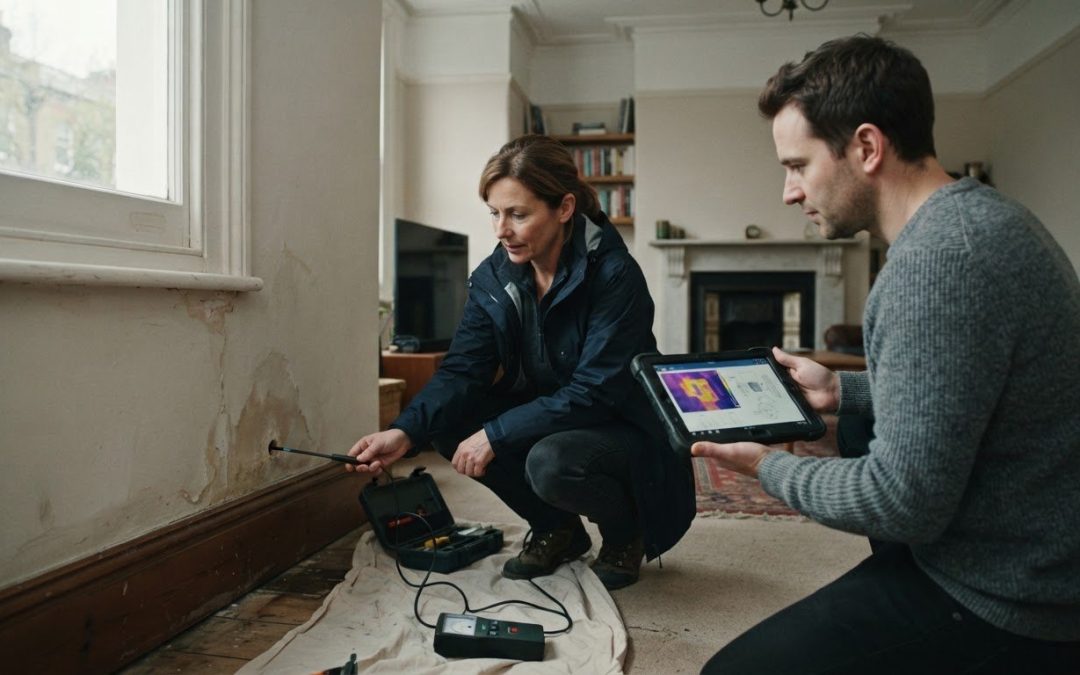
What if the biggest warning sign in a damp proofing quote is what it leaves out? If a recommended treatment appears before the report explains what was inspected and why, pause before treating it as a complete assessment. An unclear diagnosis or vague work description makes it difficult to judge whether the recommendation fits the property or compare it fairly with another quote.
Damp symptoms can have different causes. Peeling paint, musty smells and damp patches may relate to external ground levels, defective cavity wall insulation or failing wall ties, as well as other sources of moisture. A quote that jumps straight to a treatment without explaining what was investigated deserves closer scrutiny.
This checklist covers missing evidence, unclear work descriptions and unanswered questions about affected areas and materials. It also explains when a specialist cavity wall investigation may be relevant. Depending on the property and the findings, an inspection may include looking inside the cavity with a borescope, a small camera used to view a concealed space. The aim is to help you understand what a clear report and evidence-led recommendation should cover before you commit to remedial work.
Key Takeaways
- Look for red flags in a damp proofing quote, including conclusions that aren’t linked to specific observations or inspection findings.
- Check that the proposed work identifies the affected areas, its extent and any preparation or making-good required.
- Compare the reasoning, evidence, scope, exclusions and follow-up in each quote, not just the recommended treatment.
- Where cavity-wall issues remain unclear, a specialist survey can investigate potential causes and set out findings and recommended remedial solutions.
Red flags in a damp proofing quote: start with the diagnosis
Damp symptoms can have several possible causes, so the recommended work should follow an appropriate investigation, not just a quick reading of a stain. A quote should explain what was observed, which parts of the property were inspected and how those findings support its conclusion. Without that connection, it may be difficult to judge whether the proposed work fits the problem.
Staining, mould and salts on a wall are signs to investigate, not proof of one particular cause. On their own, they don’t establish that moisture is rising through the wall, entering from outside or travelling across a cavity. A quote can set out proposed work, but it cannot confirm a property-specific cause without an appropriate inspection. For background on damp proofing methods and definitions, see this general reference. The right approach still depends on the property and the evidence.
Does the quote explain what was inspected?
Check whether the report or quote identifies the affected rooms, walls and relevant external areas. It should distinguish visible observations, such as peeling paint or a damp patch, from confirmed findings about the source. Any limits to the inspection should be clear too. Concealed defects can’t always be assessed from a room’s surface. Questions about cavity wall insulation, cavity bridging or wall ties may need specialist investigation.
- Useful detail: the location and extent of the visible symptoms, along with what was examined.
- Warning sign: a broad diagnosis with no clear record of where the inspector looked or what they found.
- Point to note: whether an unresolved cavity-wall issue falls outside the inspection’s scope.
Does the proposed cause match the evidence?
A sound explanation links observations to a plausible cause and shows how that cause informed the recommendation. Be cautious if the wording sounds certain but gives no inspection findings or reasoning. Damp can relate to different factors, including condensation, water entering through the building fabric, high external ground levels or a cavity-wall defect. A symptom alone does not confirm any of these.
That doesn’t mean every damp problem involves a cavity wall, or that every low-level patch indicates rising damp. The warning sign is a fixed conclusion that skips the evidence. Before comparing treatments, look for a clear account of what supports the diagnosis and what remains uncertain. This gives you a firmer basis for assessing whether the proposed work addresses the issue described.
Check whether the damp proofing quote specifies exactly what work is proposed
A diagnosis only helps if the proposed work clearly addresses the findings. A phrase such as “damp treatment” doesn’t tell you what will happen, where it will happen or how much of the property is included. One of the red flags in a damp proofing quote is a list of treatments with no explanation of their purpose or link to an observed issue.
Check whether the scope names the affected rooms, walls or building elements and describes the work in practical terms. It should also explain relevant preparation, access needs and making-good, such as what happens to finishes disturbed during the work. Clear detail helps you understand the recommendation and compare it fairly with another quote. The health risks of dampness and mold are a reason to take moisture concerns seriously, but the proposed work still needs to fit the evidence in your property.
Is each recommended treatment tied to a finding?
Look for a written link between each observed issue and the remedial measure proposed. A list of treatments without that explanation leaves you guessing what each item is intended to resolve. Recommendations should reflect the building that was inspected, rather than apply the same package of work to every property with similar-looking symptoms.
| Quote wording | What it should clarify | Why vague wording matters |
|---|---|---|
| “Damp treatment” | The specific work, location and extent | You can’t tell what is included or which problem it addresses. |
| “Treat affected walls” | Which walls and how much of each area | The scope may be difficult to compare or assess. |
| “Make good” | Which disturbed finishes or areas will be reinstated | Responsibilities after the main work may be unclear. |
Are scope, exclusions and follow-up clear?
Read the scope for named rooms and wall areas, and note whether relevant parts of the property are excluded. Look for detail about access, preparation and associated making-good rather than assuming these are included. If further investigation may be needed, the quote should explain how that affects the proposed work and what the next step would be. These details help distinguish a defined job from an open-ended recommendation.
Where the uncertainty relates to a cavity wall, a specialist survey can investigate factors such as defective cavity wall insulation or wall tie issues. CavClear’s reports set out inspection findings and recommended remedial solutions, helping homeowners understand the evidence and possible next steps. Explore CavClear’s cavity wall surveys if a cavity-wall question remains unresolved.
Spot unsupported certainty, blanket recommendations and missing cavity-wall checks
Damp symptoms don’t identify their own cause. A patch, musty smell or mould growth may have several possible explanations, so it doesn’t automatically justify one standard treatment. Be cautious if a quote gives a definite diagnosis or promises a lasting outcome without describing the inspection findings that support it. Confidence in the wording is not a substitute for evidence.
A broad recommendation can also overlook factors that matter to the property. Depending on the inspection findings, these might include wet or defective cavity wall insulation, cavity bridging or corroded wall ties. Such issues can be relevant to moisture movement, but they aren’t the explanation for every damp problem. Their presence, condition and relevance need appropriate investigation. Symptoms alone cannot diagnose a property’s cavity.
When might a cavity-wall investigation be relevant?
A cavity-wall investigation may be relevant if the symptoms and inspection findings leave questions about moisture crossing the cavity, insulation condition or wall tie performance. For example, cracking in masonry alongside damp symptoms may warrant investigation of the wall ties. Evidence suggesting wet insulation may call for a closer assessment of the cavity. These are reasons to investigate, not proof that a defect is present.
Wall tie corrosion and insulation problems need specialist assessment rather than assumptions based on internal marks alone. Where cavity wall insulation is identified as a concern, read more about cavity wall insulation removal and how the issue may be investigated.
What should the quote say about uncertainty?
A clear report distinguishes what was directly observed from what remains a possible contributing factor. It should explain if part of the building wasn’t accessible or if further inspection is needed before a firm recommendation can be made. This helps you understand the limits of the assessment and prevents an unconfirmed possibility being presented as an established cause.
One of the red flags in a damp proofing quote is certainty that goes beyond the evidence, such as a fixed remedial plan despite unresolved questions about the cavity wall. Look for reasoning that links findings to each proposed step and explains what further investigation could establish. Appropriate next steps depend on what an inspection finds, not on assumptions or a one-size-fits-all package.
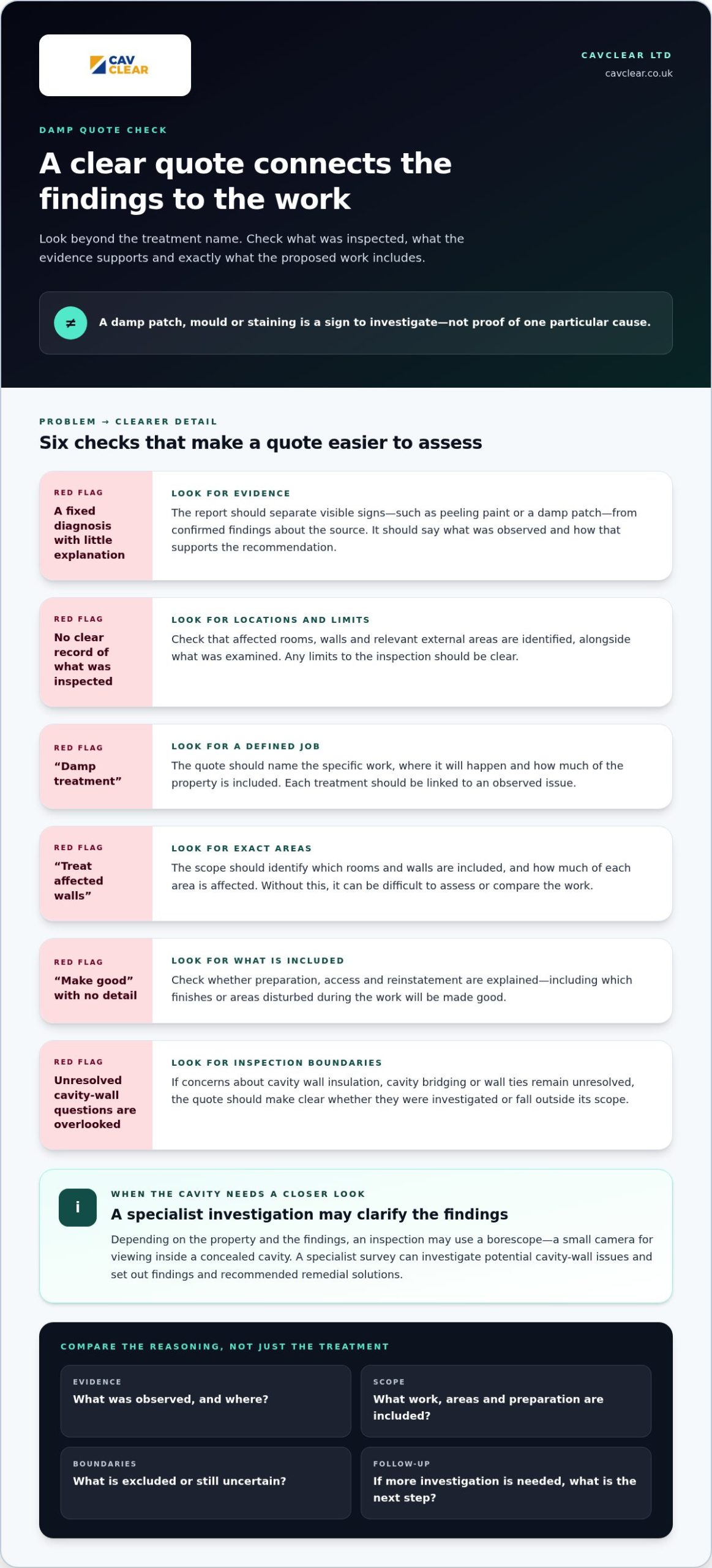
Use this checklist to compare damp proofing quotes fairly
Different quotes are easiest to compare when you look beyond the final recommendation. Check what was inspected, how the findings support the proposed work and what the written scope includes. This helps you spot red flags in a damp proofing quote without trying to diagnose the property yourself.
A practical five-point quote comparison
Set the documents side by side and compare what each one says about these five points:
- Diagnosis: What cause does the report identify, and does it explain the reasoning?
- Evidence: Which rooms, wall areas or external features were inspected, and what was observed?
- Scope: What specific work is proposed, where will it take place and what preparation or making-good is described?
- Exclusions: Which areas or tasks are outside the quoted work, and are access or other responsibilities explained?
- Follow-up: Does the quote describe further investigation needed, how findings will be reported or what the next step would be?
Compare each recommended action with its stated reason. A treatment named without a link to an inspection finding is harder to assess than work clearly tied to an identified issue. Note unclear wording, such as uncertainty about which wall areas are included or what finding supports a recommendation. This keeps your comparison factual. You don’t need to decide what is causing the damp.
What to do when quotes recommend different work
Different recommendations don’t necessarily mean one report is wrong. The inspections may have covered different areas, or one may have examined a building element that another left unresolved. Identify where the reports differ: the observed findings, the assumed cause, the inspection scope or the work proposed. If one refers to a possible cavity-wall issue and another doesn’t discuss the cavity, record that difference rather than treating it as proof of a defect.
For more context on what a professional damp survey may involve, read this guide to professional damp surveys. Where moisture concerns remain connected to an unanswered cavity-wall question, a specialist cavity wall survey can provide findings and recommended remedial solutions. Arrange a cavity wall survey with CavClear to help clarify what the evidence shows.
When a specialist survey can clarify a damp proofing recommendation
If a damp assessment leaves an unanswered question about the cavity wall, a specialist survey can help establish what is happening before you decide on remedial work. This may be relevant where there are signs that cavity wall insulation could be wet or bridging moisture, or where cracking raises questions about wall tie condition. These are possible lines of investigation, not a diagnosis of your property.
What can a specialist cavity-wall report help clarify?
A cavity-wall survey can investigate relevant insulation or wall-tie concerns. The report sets out inspection findings and recommended remedial solutions, helping you understand what the evidence supports and what the next steps may be. A survey does not automatically mean remedial work is needed. If wall tie concerns have been raised, read the guide to wall tie replacement for further background.
CavClear is a nationwide specialist in cavity-wall inspection and remedial work throughout the UK. The company is a member of the Wall Tie Installers Federation and is TrustMark registered for cavity wall insulation removal. These credentials relate to the stated areas of work; they do not replace an inspection or establish the cause of damp in an individual property.
How to take the next step without jumping to conclusions
Before arranging a survey, gather any existing inspection reports, photographs of the affected areas and the quotes you’re comparing. These documents can help focus attention on unresolved questions, such as whether insulation condition or wall ties have been examined. You don’t need to draw your own conclusions from them.
Inspection findings guide any remedial recommendation, which should be tailored to the property rather than assumed in advance. If cavity-wall factors remain unclear, a specialist survey can provide a more specific evidence base. Red flags in a damp proofing quote are reasons to seek clarity, not proof that a particular defect is present.
CavClear carries out cavity wall surveys, wall tie inspections and cavity wall insulation removal where the inspection findings support that work. Its nationwide team provides cavity-wall inspection and remedial services across the UK.
Make your next step evidence-led
A clear damp proofing recommendation should explain what was inspected, what the findings show and how each proposed task relates to them. Look closely at the work locations, scope, exclusions and any follow-up, rather than comparing recommendations by their wording alone. If reports reach different conclusions, check whether they examined the same areas and whether either leaves a cavity-wall question unresolved.
These checks help you recognise red flags in a damp proofing quote without diagnosing the cause yourself. Where cavity wall insulation or wall ties may be relevant, a specialist survey can provide property-specific findings and recommended remedial solutions. CavClear provides nationwide UK cavity-wall inspection and remedial services, is a member of the Wall Tie Installers Federation for wall-tie work, and is TrustMark registered for cavity wall insulation removal.
For clear next steps based on inspection findings, arrange a specialist survey or discuss a cavity-wall concern with CavClear. An evidence-led approach can help you make an informed decision about the appropriate work for your property.
Frequently Asked Questions
What should a damp proofing quote include?
A clear quote should explain the findings behind its recommendation and describe the work proposed. It should identify the areas inspected and affected, specify the location and extent of each task, and set out relevant preparation, access needs, exclusions, making-good and follow-up. Each recommended action should connect to an observation or finding. This detail helps you understand what the work is intended to address and compare quotes based on their scope and reasoning.
Is a damp proofing quote a diagnosis of the cause?
Not necessarily. A quote may describe a proposed remedy, but it isn’t a confirmed diagnosis unless it follows an appropriate inspection and explains the evidence. Staining, mould or salts alone don’t prove one cause. Damp can have different sources, and a property-specific conclusion should distinguish observed symptoms from confirmed findings and possible contributing factors. Treat certainty without supporting inspection details as a reason to look more closely at the evidence, not as proof of the cause.
Can a damp proofing quote recommend work without a survey?
A quote can outline proposed work based on the information available, but without an appropriate property inspection it can’t confirm the cause of damp at your home. A brief visit or visual assessment may not cover concealed issues, including defects within a cavity wall. Review what was examined and whether the recommendation relies on assumptions. If further investigation is needed, the quote should make that clear before setting out a property-specific remedial plan.
What are the warning signs of a vague damp proofing quote?
Warning signs include phrases such as “damp treatment” without details of the method, location or extent of the work. A quote is also difficult to assess if it gives a firm diagnosis without explaining the evidence, or leaves exclusions, preparation and making-good unclear. These are common red flags in a damp proofing quote. Note the gaps so you can compare the scope and reasoning accurately.
Should different damp proofing quotes recommend the same work?
No. Different recommendations may reflect different inspection areas, findings or assumptions, so identical work isn’t a reliable measure of quality. Compare what each assessment observed, which parts of the property it covered and how each proposed task follows from the evidence. If the reports disagree, record the specific differences, including any unresolved cavity-wall questions. This helps you compare the reasoning without trying to decide the diagnosis yourself.
Can cavity wall insulation cause damp?
Yes, defective or incorrectly installed cavity wall insulation can contribute to damp in some properties, for example if it becomes wet or allows moisture to bridge the cavity. That possibility doesn’t mean all insulated homes have a defect, or that insulation is the cause of damp in your property. An appropriate cavity wall survey can assess whether the insulation is relevant and whether cavity wall insulation removal or another next step is indicated by the findings.
When should I ask for a specialist cavity-wall survey?
Consider a specialist cavity-wall survey if damp remains unexplained and the existing assessment hasn’t examined the cavity, or if there are specific questions about insulation condition, cavity bridging or wall ties. Cracking alongside damp may also warrant further investigation, but it doesn’t prove wall tie failure. CavClear carries out cavity wall surveys and wall tie inspections, with reports that set out findings and recommended remedial solutions.
Recent Comments