

What should a mortgage lender see before deciding how a property defect will be addressed? Presenting a remedial works plan to a mortgage lender can feel difficult when a survey uses technical terms or the lender’s request is specific. A clear approach is to separate what the inspection found from the work proposed and the documents that support it.
It’s understandable to worry that a report might not answer the lender’s questions. A property-specific plan can explain the issue without overstating what’s known or promising an outcome the evidence can’t support. Start with the lender’s request, then organise the relevant survey findings, proposed remedial work and supporting documents around each point.
This guide explains how to structure that information, put technical findings into plain English and identify where further evidence may be needed. For cavity-wall concerns, such as possible wall tie failure or damp linked to defective cavity wall insulation, a specialist survey or report can document the inspected findings and recommended remedial solutions. CavClear provides cavity wall surveys, Wall Tie Surveys and Cavity Wall Insulation Surveys nationwide, helping property owners and professionals present a clearer account of the issue and proposed work.
Key Takeaways
- When presenting a remedial works plan to a mortgage lender, follow its instructions on format and detail rather than assuming one template suits every case.
- Identify the property and relevant survey, then summarise the issue using the report’s wording and stated inspection scope.
- Set out cavity-wall findings, recommended actions and supporting evidence separately. Treat cracking as an observation, not proof of wall tie failure.
- If the lender asks for more information, match each question to a report section or document, and make any information gap clear.
- A specialist cavity-wall survey can provide property-specific findings and recommendations to inform the plan, but it cannot guarantee a lender’s decision.
What Does a Remedial Works Plan for a Mortgage Lender Need to Explain?
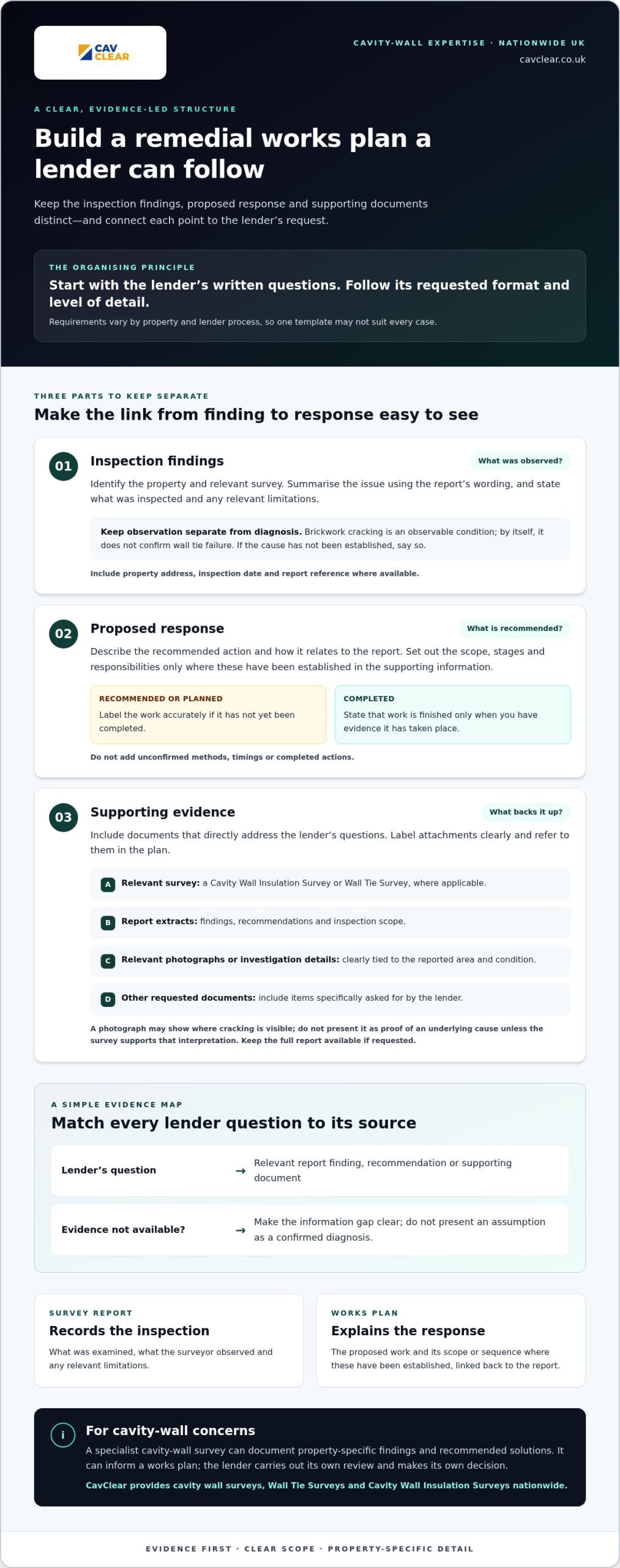
A remedial works plan brings together three things: the property issue identified, the work proposed in response and the evidence supporting that recommendation. Its purpose is to make the situation easier to understand and review, not to replace the survey or guarantee a particular lending decision.
Keep the evidence and proposed response distinct. For example, cracking in brickwork is an observable condition; by itself, it does not confirm wall tie failure. A specialist inspection may investigate whether wall ties are contributing to the cracking and set out any recommended remedial work. Understanding structural integrity and failure can help explain why it matters to identify the cause before proposing a remedy.
How Is a Remedial Works Plan Different from a Survey Report?
A survey report records the inspection: what was examined, what the surveyor observed and any relevant limitations. A works plan describes the proposed response, including the scope and sequence of work where these have been established. It should refer back to the report so the lender can follow how the recommendation relates to the findings.
Be precise about the status of the work. If a report recommends further investigation or remedial work, describe it as recommended or proposed, not completed. State that work has taken place only when you have evidence that it has.
Why Might a Mortgage Lender Request Remedial Information?
A lender may ask for more detail when information about a property issue needs clarification as part of its review. The issue could involve cracking, possible wall tie deterioration or signs that warrant investigation of cavity wall insulation. Requirements vary with the property and the lender’s process, so don’t assume every lender needs the same documents or format.
Start with the lender’s written questions. Organise your response around them, matching each point to the relevant report finding, recommendation or supporting document. If the inspection did not establish a cause, say so clearly rather than presenting an assumption as a confirmed diagnosis.
What Should the Plan Explain?
When presenting a remedial works plan to a mortgage lender, make the link between the evidence and the proposed response easy to follow. Identify the issue as described in the survey, explain the recommended action and show which report or document supports each point. Include the property details and report reference where available, and distinguish work that is planned from work that is finished.
For cavity-wall concerns, a specialist cavity wall survey or Wall Tie Survey can provide property-specific findings and recommended solutions. CavClear provides these surveys and reports for homeowners, buyers, surveyors and mortgage lenders. The report can inform a works plan, while the lender remains responsible for its own review and decision.
What Information Should You Include in a Mortgage Lender Remedial Works Plan?
Make the plan easy to match to the property, survey and lender’s request. Start with the property address, inspection date and report reference where available. If the lender has asked about a particular defect, identify that question clearly so the reviewer can locate the relevant evidence without having to infer which part of the report applies.
Summarise the issue using the surveyor’s wording and explain the inspection’s scope. For example, state that cracking was observed in a specified area if that is what the report records. Don’t turn that observation into a confirmed diagnosis of wall tie failure unless the inspection supports that conclusion. If further investigation is recommended, say so plainly.
How Should You Describe Survey Findings and Recommendations?
Use concise, factual language and separate what was seen from what it may indicate. If the report refers to wall ties, explain that these are metal components connecting the inner and outer leaves of a cavity wall. Keep the explanation consistent with the survey’s findings, and make clear whether remedial work is recommended, planned or already completed.
Where the scope of work has been established, outline its main stages and responsibilities as stated in the supporting information. Don’t add methods, timings or completed actions that haven’t been confirmed. This keeps the plan useful without making the evidence seem more conclusive than it is.
Which Supporting Documents Can Help Explain Cavity-Wall Work?
Include documents that directly address the lender’s questions. Depending on the issue and what’s available, these may include:
- A relevant Cavity Wall Insulation Survey or Wall Tie Survey.
- Report extracts that show the findings, recommendations and inspection scope.
- Photographs or investigation details that clearly relate to the reported area and condition.
- Any additional documents specifically requested by the lender.
Label attachments clearly and refer to them in the plan. A photograph can help locate visible cracking, for instance, but shouldn’t be presented as proof of an underlying cause unless the survey supports that interpretation. Keep the full report available if the lender asks for it, and avoid relying on an isolated extract that removes important context.
If the issue concerns defective cavity wall insulation, the cavity wall insulation removal guide provides background on the process. CavClear’s Cavity Wall Insulation Surveys and Wall Tie Surveys can document findings for the inspected property and set out recommended remedial solutions. Explore CavClear’s cavity wall surveys for a property-specific report that can help explain the evidence.
How Can You Make a Cavity-Wall Remedial Scope Clear and Credible?
A clear scope shows how each proposed action relates to an inspected finding. Keep observations, recommendations and planned work distinct, and use the survey report as the basis for technical statements. This gives the lender a straightforward way to follow the reasoning without turning a possible cause into a confirmed defect.
A simple four-part layout can help:
Observed issue: Record what the inspection found, such as cracking in a particular area or damp-related signs.
Recommendation: State the surveyor’s recommended next step or remedy, using the report’s wording.
Proposed action: Describe the work being considered or planned, where the scope has been established.
Supporting evidence: Refer to the relevant report section, photograph or investigation detail.
Include dates, costs, technical conclusions and expected outcomes only when they’re supported by the available information. Don’t promise a completion date or outcome that hasn’t been confirmed. If a detail hasn’t been established, identify it as pending or requiring further investigation rather than filling the gap with an assumption.
How Do Wall-Tie Findings Translate into a Proposed Work Scope?
Cracking can be a reason to investigate a cavity wall, but it doesn’t by itself confirm wall tie failure. A Wall Tie Survey can examine the ties and inform recommendations about suspected deterioration. Describe Wall Tie Replacement as a proposed response only where the survey findings support it. The wall tie replacement guide explains the process in more detail.
How Should You Present Damp, Cracking or Insulation Concerns?
Describe symptoms neutrally: note where damp or cracking is visible rather than assigning a cause without a suitable inspection. A Cavity Wall Tie Inspection or Cavity Wall Insulation Survey may help clarify relevant defects. Where a borescope inspection or opening-up investigation forms part of the inspection, state what it examined and what it showed. Don’t imply either method was used if it wasn’t.
For insulation concerns, separate evidence of a problem from any proposed cavity wall insulation removal. Explain what the inspection found and why removal is recommended, if that is the surveyor’s conclusion. Don’t imply that every insulated property has a defect or that proposed work has already happened.
When presenting a remedial works plan to a mortgage lender, this evidence-led structure helps keep the scope specific to the property. CavClear’s cavity-wall surveys can document findings and recommended remedial solutions. If a specialist inspection would help clarify the condition of a property’s cavity wall, explore CavClear’s survey services.
What Should You Do If the Lender Requests More Detail or Evidence?
A request for further information doesn’t necessarily mean the whole plan needs rewriting. First, identify exactly what the lender still needs to understand. Separate questions about survey findings from questions about the proposed work, documents or format. This makes it easier to provide a focused response rather than sending material that doesn’t address the point.
Create a simple response list. For each question, note the relevant report section or supporting document. If the information isn’t available, state that clearly rather than implying the report contains an answer it doesn’t. If the lender’s wording is unclear, ask it to clarify the evidence or format required before revising the pack.
What If the Survey Does Not Establish the Cause of a Defect?
Keep the limits of the report visible. A survey may record cracking, damp-related signs or another condition without establishing its cause. Explain what was observed, what the inspection covered and what it couldn’t conclude. If the survey recommends further investigation, say so directly. Don’t turn a possible link, such as cracking and suspected wall tie deterioration, into a confirmed technical finding.
This distinction keeps the lender’s questions separate from the surveyor’s conclusions. If further inspection takes place, use its findings to update the evidence rather than changing the meaning of the original report.
How Can You Respond to Questions About the Proposed Work?
Refer to the recommendation and scope already provided. If asked to explain a proposed action, clarify which finding it responds to and whether it is planned or completed. Don’t add technical methods, responsibilities or timings unless they’re established in the supporting information. Questions about a lender’s preferred format are separate from technical conclusions about the property.
Before resubmitting, compare the revised documents with the earlier version. Keep property details, report references and descriptions consistent. Mark updated documents clearly, and briefly identify what has changed, such as an added report extract or clarification of the proposed scope. This helps prevent outdated pages or conflicting descriptions from causing confusion.
Presenting a remedial works plan to a mortgage lender is clearer when each follow-up answer points to its source, whether that’s a survey finding, recommendation or document. If the outstanding question concerns cavity-wall condition, a specialist survey can provide property-specific findings and recommendations. Arrange a specialist cavity wall survey to help document the issue and inform the remedial plan.
How Can a Specialist Survey Support Your Remedial Works Plan?
A specialist survey can give a remedial works plan a factual foundation. It records what was inspected, what was found and what action is recommended for that property. This helps keep the proposed response connected to evidence rather than symptoms or assumptions. A survey report can support the lender’s review, but it can’t assure a particular lending decision.
CavClear provides cavity-wall surveys and reports for homeowners, buyers, surveyors and mortgage lenders across the UK. Its specialists investigate concerns involving cavity wall insulation or wall ties and set out findings and recommended remedial solutions. These findings apply to the inspected property; they shouldn’t be generalised to other homes or treated as proof that every cavity wall has a defect.
Which CavClear Survey May Be Relevant to the Property?
If concerns relate to existing cavity wall insulation, a Cavity Wall Insulation Survey can assess the cavity and document relevant findings. Where cracking or suspected wall tie deterioration is raised, a Wall Tie Survey or Cavity Wall Tie Inspection can examine the ties and inform recommendations. The appropriate survey depends on the reported concern and inspection findings, not symptoms alone.
Where the evidence supports it, a report may recommend cavity wall insulation removal or Wall Tie Replacement. CavClear is TrustMark registered for cavity wall insulation removal and a member of the Wall Tie Installers Federation (WTIF). These credentials describe relevant aspects of its work, but they don’t mean a lender will accept a specific plan.
What Is a Practical Next Step Before Sending the Plan?
Before submitting your documents, compare them with the lender’s specific request. Check that the property details and report references match, the relevant findings are easy to locate, and each proposed action is clearly distinguished from completed work. If the survey identifies a limitation or recommends further investigation, keep that qualification visible rather than presenting the matter as settled.
For presenting a remedial works plan to a mortgage lender, a property-specific survey can help explain the technical basis for proposed work without overstating what’s known. If cavity-wall concerns need specialist inspection, you can discuss a CavClear survey and the findings or recommendations relevant to the property. The resulting report can inform your documents, while the lender makes its own assessment.
Prepare a Clear, Evidence-Led Plan
Presenting a remedial works plan to a mortgage lender is clearer when the documents answer the lender’s specific questions and distinguish inspected findings from proposed work. Keep the survey’s scope and any limitations visible, and avoid presenting a suspected cause as a confirmed defect. A focused plan helps the reviewer understand the evidence without promising a particular decision.
Where cavity-wall concerns need investigation, a specialist survey can provide property-specific findings and recommended remedial solutions. CavClear provides specialist surveys and remedial services nationwide throughout the United Kingdom. The company is a member of the Wall Tie Installers Federation (WTIF) and TrustMark registered for cavity wall insulation removal.
If a cavity-wall issue is affecting your property paperwork, take the next step with clear, specialist information. Discuss a specialist cavity-wall survey with CavClear to help document the issue and inform your remedial plan.
Frequently Asked Questions
What should a remedial works plan include for a mortgage lender?
Include the property details, relevant survey findings, recommended work and supporting documents requested by the lender. Keep observed conditions separate from proposed actions and work already completed. For example, describe cracking as an observation unless the survey establishes its cause. Lenders may request different information or formats, so use their instructions to organise the plan. Don’t add technical conclusions that the inspection hasn’t reached.
Can a survey report be used as a remedial works plan?
A survey report can provide findings and recommendations for a works plan, but the documents may serve different purposes. The report records the inspection, its scope and conclusions. A plan organises the proposed response and supporting evidence. Check the lender’s request before deciding what to submit. A report may be relevant, but don’t assume it answers every question or includes all the information the lender needs.
Does a mortgage lender have to accept a contractor’s remedial plan?
A contractor’s report can explain inspection findings and recommended work, but it can’t guarantee a lender’s decision. Each lender may have its own review process and evidence requirements. Present the report accurately, respond to the lender’s stated questions and distinguish recommendations from completed work. Don’t describe proposed work as approved or finished unless that status is confirmed. A clear plan supports review, but doesn’t determine its outcome.
What if a survey cannot confirm the cause of cracking or damp?
State what the inspection observed and what remains uncertain. Cracking, damp or mould doesn’t by itself prove a particular cavity-wall defect or cause. If the report recommends further investigation, include that recommendation and explain the report’s limits. For instance, record the location of cracking without labelling it wall tie failure unless the survey supports that conclusion. This keeps the information accurate and makes any remaining evidence gap clear.
Can a wall-tie survey support a remedial works plan?
Yes. A Wall Tie Survey can document relevant findings and recommendations where wall-tie concerns are present. Its value depends on the property, inspection scope and lender’s request. Include the relevant report information, and distinguish any proposed Wall Tie Replacement from work already completed. Cracking alone doesn’t confirm wall-tie failure, so base the plan on the survey rather than assuming a cause from visible symptoms.
Should I include photographs with a remedial works plan?
Include photographs if they’re relevant, clear and requested or useful for explaining the findings. They may help show the location or appearance of an inspected area, such as visible cracking. Label each image accurately and make sure its description matches the survey documentation. Photographs can support a report, but they shouldn’t replace a specialist inspection or be used on their own to diagnose a cavity-wall defect.
What happens if the lender asks for more information?
Identify the lender’s exact question and match it to the relevant report section or supporting document. If the requested format or evidence is unclear, ask the lender to explain what it needs. Don’t guess at technical details that the survey hasn’t established. If further findings are needed, a specialist inspection may help clarify the issue. Keep revised documents consistent and make any additions or changes easy to identify.
Recent Comments