

What if the word “lifetime” tells you less than the small print? Is a lifetime guarantee for damp proofing real? A long-term promise may be offered, but its value depends on the written terms. A guarantee may cover a specific treatment, not every source of moisture or every part of the property. That distinction matters if damp returns for a reason unrelated to the work originally carried out.
It’s understandable to want reassurance that damp work will protect your home over the long term. This guide explains what a lifetime guarantee may mean, what to check in the documentation and how coverage can vary. It also explains why damp needs proper investigation before treatment: moisture may relate to a cavity-wall defect or problematic cavity wall insulation, rather than the issue addressed by a damp-proofing guarantee. Where the evidence points to a cavity-wall problem, a specialist survey can help identify a measured next step.
Key Takeaways
- Is a lifetime guarantee for damp proofing real? Its practical value depends on the written scope, not the label alone.
- Check which treatment and property areas the document names, how long the coverage lasts and what outcome it describes.
- Compare the stated coverage with the work carried out, and note any exclusions, conditions or insurance backing.
- A guarantee describes coverage; an investigation looks for possible causes. Visible damp alone can’t establish whether a cavity-wall defect is involved.
- If the signs point to a cavity-wall concern, a damp and mould survey, Cavity Wall Insulation Survey or Cavity Wall Tie Inspection can help guide the next step.
Is a Lifetime Guarantee for Damp Proofing a Clear Promise?
A long guarantee can sound reassuring when damp has affected your home. It suggests that the work is intended to provide lasting protection, but the word “lifetime” doesn’t explain exactly what has been promised. If you’re asking, is a lifetime guarantee for damp proofing real, the practical answer lies in the written terms: what work is covered, how long the commitment lasts and which conditions apply.
The phrase doesn’t have one self-explanatory meaning for every guarantee. The document needs to define whose lifetime, or what lifetime, it refers to. It may describe a period linked to a person, a property or specified work, but don’t assume which applies from the headline alone. Look for a clear definition in the guarantee itself.
Coverage matters as much as duration. A guarantee may relate to a particular damp-proof course or another defined treatment, rather than every wall or moisture problem in the home. For context, damp proofing can involve different methods, including damp-proof courses and membranes. The treatment and areas covered should be clearly identified in the written description.
A guarantee also can’t identify why damp has appeared. Staining, peeling finishes or a musty smell may raise concern, but these signs alone don’t confirm that a previous treatment has failed. Moisture can have different causes, including a cavity-wall defect or problematic cavity wall insulation. A suitable investigation considers the building and its symptoms before attributing the problem to one cause or treatment.
What does “lifetime” mean in a damp-proofing guarantee?
Read the document’s definition rather than relying on how the phrase sounds in an advert or conversation. Check whether it identifies the relevant person, property or work, and whether it sets out a specific duration or conditions that affect how long the commitment applies. If the wording isn’t clear, the headline alone can’t fill in the missing detail.
Does a guarantee mean damp cannot return?
No. A guarantee describes specified commitments for defined work; it isn’t a promise that every future damp issue will be prevented. If moisture reappears in a treated area, the terms determine whether that situation relates to the covered work. Damp from a separate or newly identified source, such as a cavity-wall problem, may fall outside that scope and needs its own investigation.
A guarantee’s value depends on the work and conditions it covers, not on the word “lifetime” alone. Keep the document with records of the treatment so you can compare its stated scope with any later signs of moisture. If the source is uncertain, investigate the damp rather than treating the guarantee as a diagnosis.
What Does a Damp-Proofing Guarantee Actually Cover?
A guarantee may sound like protection for the whole home, but its written scope can be narrower. It may relate to one treatment, a particular repair or a defined area of wall. To understand what it covers, compare the document with the invoice, specification or other record of the work completed. The key question is not simply “is a lifetime guarantee for damp proofing real?” but what, precisely, does this guarantee describe?
Look for a clear connection between the stated coverage and the work carried out. For example, a document might refer to a damp-proof course installed in a specific section of wall. That wording wouldn’t automatically include another room, a separate repair or every future source of moisture in the property.
Treatment, workmanship, and materials are not interchangeable
These terms refer to different things. Treatment means the damp-related work or method described in the document. Workmanship concerns how that specified work was carried out. Materials refers to products or components used as part of it. A guarantee may discuss one, two or all three, so don’t assume that coverage for one automatically includes the others.
Read each description against the actual job. A document might identify a repair to one wall rather than cover the entire property. If materials are mentioned, check whether the wording refers to the materials themselves or their installation too. Providers such as GPI Guarantees describe insurance-backed guarantees as a distinct form of protection, but the specific document still determines which work and terms are included.
Which details should homeowners find in writing?
Use the document as a record of the agreed scope. First identify the named work and property areas, then note the stated duration and any limits. Check for exclusions, maintenance responsibilities or conditions that may affect coverage. These details help distinguish a defined commitment from a broad headline, without assuming that every guarantee uses the same wording.
- Work and location: Identify the treatment or repair and the walls or areas it covers.
- Duration and outcome: Note how long the document says the cover lasts and what result or work it refers to.
- Exclusions and conditions: Look for separate damp causes, maintenance requirements or other stated limits.
- Transfer wording: If you may sell the property, check whether the document explains what happens to its coverage when ownership changes.
Transfer wording is another part of the document to understand. Don’t assume that a guarantee automatically follows a property, or that it can’t be transferred. Keep the guarantee with the paperwork describing the work. If damp appears in a different area or alongside signs of a cavity-wall issue, a focused cavity-wall inspection can help investigate whether that part of the building needs attention.
Lifetime Guarantee vs Damp Investigation: What Is the Difference?
A guarantee and a damp investigation answer different questions. The first sets out coverage for specified work; the second examines possible reasons moisture is present. A long guarantee can’t identify the source of damp, and a patch of discolouration alone can’t show that a covered treatment has failed. If you’re asking, “is a lifetime guarantee for damp proofing real?”, consider its stated coverage separately from the property’s current condition.
Guarantee: Describes the work, areas and conditions set out in its written terms. It helps you understand what the document covers.
Investigation: Considers the property and available evidence to assess possible causes of moisture and what further checks may be appropriate.
The distinction matters because the next step should follow the findings, not the duration printed on a guarantee. If damp appears near an area treated previously, review the treatment records, but remember that this doesn’t establish a failure. A separate source could be involved. For more context on what a survey may involve, see this professional damp survey guide.
Why identifying the source of damp matters
Moisture can have different causes, so one explanation or treatment won’t suit every situation. An investigation may consider signs inside the property alongside relevant external or cavity-wall conditions. Defective cavity components or problematic insulation can contribute to moisture concerns, but inspection is needed to assess whether they are relevant at a particular home. A mark is an observed symptom, not confirmation of its cause.
This distinction helps avoid treating a visible effect while overlooking a contributing defect. For example, damp staining on an internal wall doesn’t show by itself whether the source is within the wall, related to an external issue or associated with another moisture condition. A survey report can set out observations and recommended next steps without assuming the cause in advance.
When might a cavity-wall inspection be relevant?
Consider a specialist inspection if damp concerns occur alongside signs that may warrant checking the cavity, such as recurring moisture in particular locations, visible masonry cracking or concerns about existing cavity wall insulation. These signs aren’t proof of defective insulation or wall ties. They are reasons to investigate further, rather than infer a diagnosis from appearance alone.
A cavity-wall specialist can use inspection findings to guide a measured next step. Depending on what the inspection identifies, that may involve further assessment or remedial work specific to the findings. If existing insulation is a concern, the UK cavity wall insulation removal guide explains this specialist area. For background on separate backup arrangements, the Damp Proofing Association provides information about guarantees that may apply if a contractor ceases trading. Neither a guarantee nor a symptom replaces an investigation of the property itself.
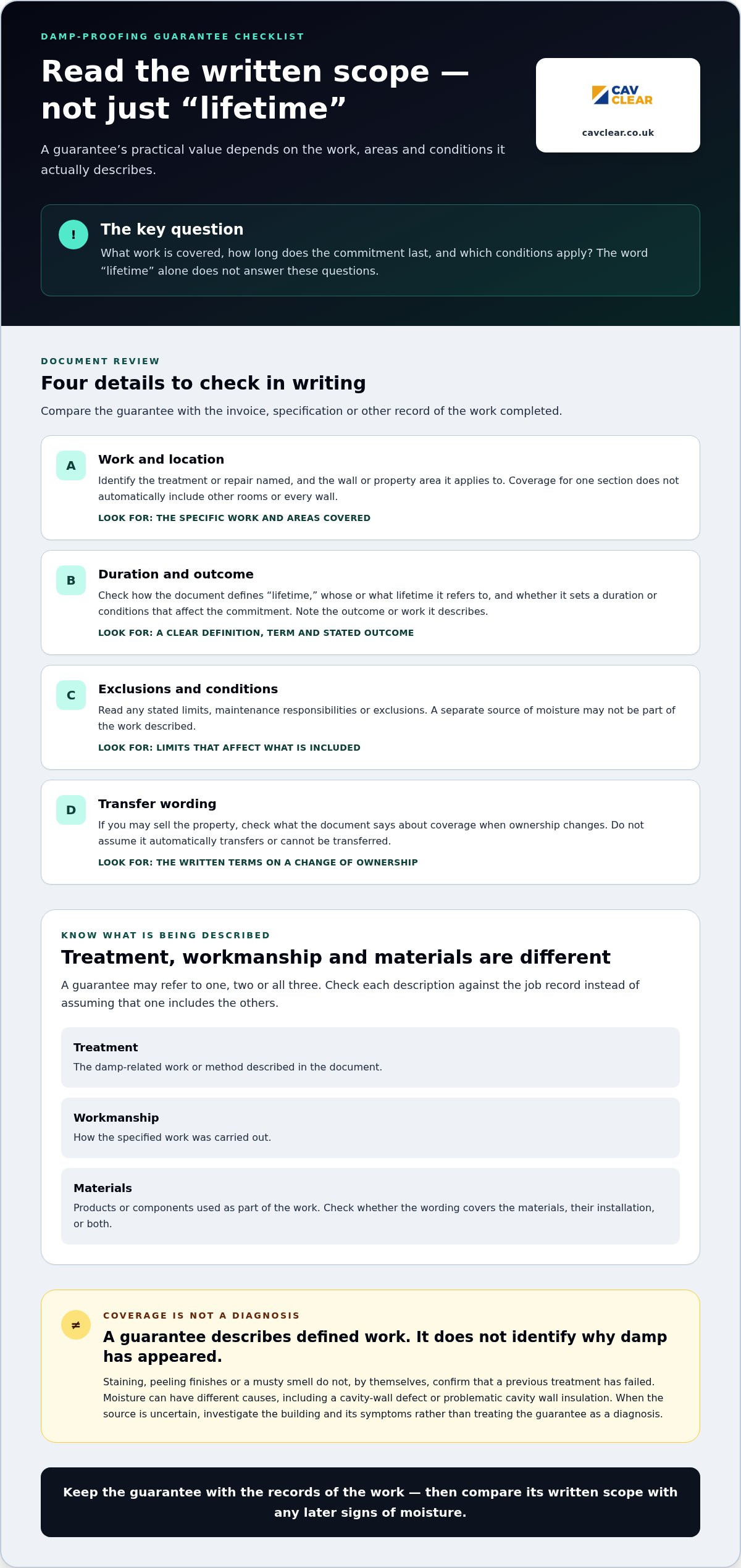
How to Read a Lifetime Damp-Proofing Guarantee Carefully
A guarantee is easier to understand when you read it alongside the records for the work, rather than relying on its title. So, is a lifetime guarantee for damp proofing real? Its practical meaning depends on the wording. Use the checklist below to identify what it describes and where clarification may be useful. Treat the document as one part of the property’s records, alongside the survey and completed-work details.
A practical checklist for checking the written scope
Work through the document in order. Note what it says, then compare each point with the survey findings and completed-work description.
- 1. Identify the property area. Check whether the document names the property and specifies the rooms, walls or other areas covered. A reference to one treated wall shouldn’t be read as automatically including every wall in the home.
- 2. Match the named work. Look for the treatment or repair described, then compare it with the invoice, work schedule or report. If the paperwork uses different terms, note the discrepancy rather than assuming they mean the same thing.
- 3. Find the duration. Read how the guarantee defines its term. If it uses “lifetime”, check whose or what lifetime the document refers to, and whether it sets out conditions or limits that affect the stated period.
- 4. Understand the covered outcome. See what the document says will happen if the specified work does not perform as described. Distinguish this from a broad expectation that all damp will be prevented throughout the property.
- 5. Check exclusions and conditions. Note any listed causes or areas that aren’t covered, plus maintenance responsibilities or other stated conditions. Keep these details with your work records so you can refer to the exact wording later.
- 6. Find the stated process. Check whether the document explains how and when to report a concern, and what information it asks you to provide. Note unclear technical terms so you can refer to them alongside the survey or work report.
- 7. Review transfer wording. If a property sale may be relevant, note whether the document describes what happens to the guarantee after a change of ownership. Treat this as a detail to understand, not an assumption about transfer.
When damp returns or remains visible
Persistent moisture doesn’t, by itself, prove that the original work failed. Record where it appears, when you notice it and whether its pattern changes. Dated photographs and notes can help you describe the issue accurately. Then compare the affected area with the guarantee and treatment records before arranging further investigation.
New findings may point to a separate source, including a cavity-wall concern, that needs its own assessment. Comparing the observed area, survey findings and completed work helps keep the next step focused instead of presuming the cause. If damp may relate to the cavity, a CavClear cavity-wall survey can provide a measured way to investigate the issue.
When a CavClear Survey Can Help with Cavity-Wall Damp Concerns
A guarantee document can explain the coverage attached to specified work, but it can’t establish why moisture is appearing in your home. If you’re still wondering, “is a lifetime guarantee for damp proofing real?”, keep the practical questions separate: what does the document cover, and what might be causing the damp now? Where cavity-wall conditions could be relevant, a specialist survey can assess the evidence before any remedial work is considered.
CavClear investigates cavity-wall issues that may be associated with damp or mould. The appropriate survey depends on the concern. A damp and mould survey can consider whether cavity-wall conditions may be involved; a Cavity Wall Insulation Survey focuses on insulation within the cavity; and a Cavity Wall Tie Inspection examines the ties connecting the masonry leaves. These are investigative options, not assumptions that every damp problem comes from the cavity.
What a cavity-wall survey can establish
An inspection assesses relevant conditions that can be observed or examined at the property. Depending on its scope, findings may relate to cavity wall insulation, wall ties or another visible cavity-wall defect. A written report can set out observations and recommendations based on the evidence gathered. Read it as specific to that inspection, not as a diagnosis of unrelated areas or conditions that weren’t assessed.
This matters if damp appears alongside other signs, such as localised staining or cracking to the external brickwork. These observations can help direct an investigation, but they don’t prove a particular fault. The survey’s role is to establish what the available evidence supports and identify a suitable next step, rather than prescribe the same treatment for every property.
Choosing the next step from the findings
Recommendations should respond to what the inspection identifies. If findings indicate problematic cavity wall insulation, cavity wall insulation removal may be relevant. If inspection identifies failed or corroded wall ties, wall tie replacement may be considered. Neither should be presumed from damp marks alone. Other findings may point towards a different assessment or show that the concern sits outside the cavity-wall system.
A measured report helps homeowners understand the observed issue and the reasoning behind any recommended remedial work. It also gives you a clearer basis for comparing findings with existing damp-treatment records, without treating a guarantee as proof of the cause.
CavClear is a nationwide UK specialist in cavity-wall inspection and remedial work. If damp or mould may involve the cavity, you can arrange a CavClear survey as a practical next step. The inspection findings guide recommendations, with the focus on the evidence from your property and its long-term condition.
Choose a Clear Next Step for Your Property
So, is a lifetime guarantee for damp proofing real? The label alone can’t tell you what protection applies or what is causing moisture in your home. Use the written terms to understand the work they cover, then base any further action on the condition of the property. If cavity-wall problems may be involved, a specialist assessment can help clarify the evidence before you consider remedial work.
CavClear focuses on cavity-wall inspection and remedial work. The company is a Wall Tie Installers Federation member and TrustMark registered for cavity wall insulation removal. Recommendations are guided by inspection findings, so the next step can address the issue observed rather than assume one treatment fits every home.
If you’re ready to investigate a cavity-wall concern, arrange a CavClear survey. A clear, evidence-led starting point can help you make informed decisions about your property’s long-term condition and comfort.
Frequently Asked Questions
What does a written lifetime guarantee tell me about the provider’s commitment?
The document describes the provider’s stated commitment, but the word “lifetime” alone doesn’t explain its practical scope. Check who issued it, which work it names and whether it identifies the property and areas covered. Keep the original document with the report and records of the completed work. If a key term or detail is unclear, note it and seek an explanation before relying on an assumption about what the guarantee includes.
Does a lifetime damp-proofing guarantee cover the whole house?
Not necessarily. The guarantee may identify only a particular treatment or area, such as one wall or a specified room. Don’t assume that coverage extends to other rooms, later alterations or parts of the building that aren’t named. Compare the document’s description with the work record, and note any areas that appear to be missing or unclear so you can distinguish covered work from the rest of the property.
Can damp return if the work has a lifetime guarantee?
Yes. When considering whether a lifetime guarantee for damp proofing is real, remember that new moisture may have a different source. For example, damp near a previously treated area could coincide with a separate issue, such as water entering through a building defect. Record where the signs occur and when they change, then use the written scope and fresh observations to guide further investigation.
What should a damp-proofing guarantee include?
Look for the provider’s name, the property details, a description of the completed treatment and the areas it covers. The document should also explain its stated duration, covered outcome, exclusions and any maintenance conditions or reporting process. Keep related paperwork together, including the survey report, work description and completion records. This makes it easier to see whether the guarantee refers to the same work described in the supporting documents.
Does a lifetime guarantee transfer when a property is sold?
That depends on the wording of the specific guarantee. Check whether it says the cover can pass to a new owner, whether any steps or records are mentioned, and whether the original document must be retained. Don’t assume transfer happens automatically or that it is impossible. If you’re buying a home, ask for the guarantee and work records as part of the property documents, then check that the named address and treated areas match.
Can a damp survey prove that a guarantee should apply?
A survey can record conditions observed during an inspection and may help clarify whether the affected area relates to work described in the guarantee. It doesn’t automatically determine how the document applies. Give the surveyor relevant records, including the guarantee and treatment details, and point out where and when moisture appears. This context can help the report distinguish observed evidence from information that still needs further investigation.
Should I arrange a survey before choosing damp-proofing work?
A survey is a sensible step if the cause of damp is uncertain, because treatment should respond to the conditions found rather than an assumption based on staining alone. Share the locations of visible moisture and any previous work records during the inspection. If cavity-wall concerns may be involved, a specialist assessment can consider insulation, wall ties or other relevant defects and help identify a proportionate next step.
Recent Comments