
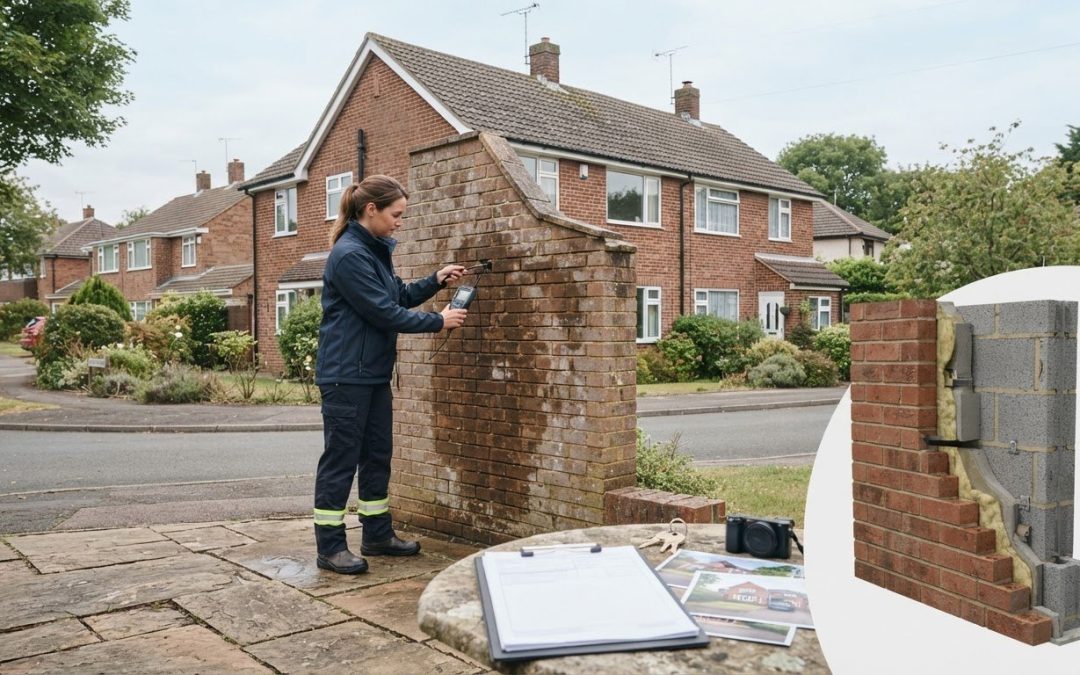
A cavity-wall defect doesn’t automatically mean higher home insurance premiums. The impact of failed cavity insulation on home insurance premiums depends on the property, the evidence available and the terms of the policy. If you’ve noticed damp or damage, it’s understandable to wonder whether the insulation is responsible and what your insurer will make of it.
Start by separating what you’ve observed from what has been confirmed. Damp can have several causes, and the presence of cavity wall insulation alone doesn’t prove it has failed. Clear information about the property and any investigations can help explain the situation to your insurer.
This article outlines what may matter in an insurance discussion, which records and survey findings can clarify the condition of your walls, and why you shouldn’t assume a cause before inspection. If you suspect a cavity-wall problem, a specialist survey can investigate the insulation and related defects, including wall ties. Where inspection findings support it, cavity wall insulation removal may be a suitable remedial step. CavClear provides specialist cavity-wall surveys and remedial services nationwide across the UK.
Key Takeaways
- The impact of failed cavity insulation on home insurance premiums depends on the insurer’s assessment and the details of your policy.
- Keep notes, photographs and relevant property documents together so you can clearly describe what you’ve observed.
- Distinguish suspected insulation problems from confirmed survey findings when discussing your property with your insurer.
- Use inspection findings and records of completed remedial work to explain the property’s current condition.
- A specialist cavity-wall survey can help identify what is happening inside the wall and inform appropriate next steps.
Can failed cavity wall insulation affect home insurance premiums?
A cavity-wall defect may raise questions about your cover or renewal, but it doesn’t automatically mean a premium increase. Insurers assess each property according to its circumstances and the policy terms. The presence of insulation alone doesn’t confirm a defect, and visible damp doesn’t prove that insulation is the cause.
It helps to distinguish a concern from a confirmed finding. A damp patch on an internal wall is an observation. A specialist inspection may establish whether there is a cavity-wall issue, identify other possible causes, or find no evidence of insulation failure. That distinction gives you clearer information to discuss with your insurer without treating a suspected cause as a diagnosis.
What does failed cavity wall insulation mean?
Concerns about performance may involve damp or moisture within the cavity, or the condition and distribution of the insulation material. However, mould or staining indoors can have other causes, such as condensation, a leak or defects in external masonry. The general Cavity Wall Insulation Overview describes the purpose of insulation, but it can’t establish what is happening in an individual property. Inspection is needed to identify any cavity-wall defect.
A survey can help distinguish visible symptoms from findings inside the wall. It may assess the insulation and relevant parts of the cavity-wall system, including wall ties where appropriate. Until an inspection takes place, describe damp, cracking or other signs as observations rather than stating that insulation has failed or caused damage.
Why might a property condition matter to an insurer?
An insurer may consider the property’s condition and the information available when assessing risk, cover or renewal. Confirmed damage, whether it has been addressed, and clear technical documentation may help explain the circumstances. A suspected problem and a documented defect are not the same evidence. Each insurer applies its own policy terms and assessment process, so an inspection or repair can’t guarantee a particular premium or outcome.
There is no single UK-wide premium rule for cavity-wall insulation problems. Insurers set their own underwriting criteria and policy terms, then consider the details of each property. One insurer may assess a documented defect differently from another, and the type and extent of confirmed damage can matter. Don’t assume a premium increase solely because a home has cavity wall insulation.
If you have a concern, gather the facts before drawing conclusions. Record what you’ve observed and keep relevant survey reports and details of remedial work. Then refer to your policy documents and discuss the specific circumstances with your insurer. A specialist cavity-wall survey can establish whether further investigation or remedial work, such as cavity wall insulation removal, is supported by the findings.
How insurers may assess cavity insulation problems and premium risk
An insurer may consider the evidence available about the property rather than treating the presence of cavity wall insulation as proof of a fault. Relevant details could include the type and extent of documented damage, whether investigations or remedial work have taken place, and what property-specific reports show. The impact of failed cavity insulation on home insurance premiums therefore depends on the circumstances presented and the insurer’s own assessment.
Technical findings and insurance decisions serve different purposes. A survey records what an inspection found, the areas it covered and any limitations. The insurer considers that information alongside its policy terms and assessment process. A report can clarify the property’s condition, but it cannot decide whether an insurer will alter a premium, offer particular cover or apply specific terms.
Suspected problem versus confirmed survey finding
Damp patches, mould or cracking are useful observations, but they don’t identify their own cause. A specialist inspection may examine the cavity and insulation, and consider other relevant elements such as wall ties. Findings should distinguish visible signs from evidence confirmed during the inspection, explain any limits to the assessment and set out suitable next steps. Damp or cracking alone doesn’t prove that insulation has failed.
For example, a homeowner might report recurring moisture on one wall. That gives an insurer context, but it is different from a survey documenting wet or poorly distributed insulation, or identifying another cavity-wall concern. A clear report can state what was observed and what remains uncertain, helping you avoid presenting a possible explanation as an established defect.
How repairs and records may inform an insurer discussion
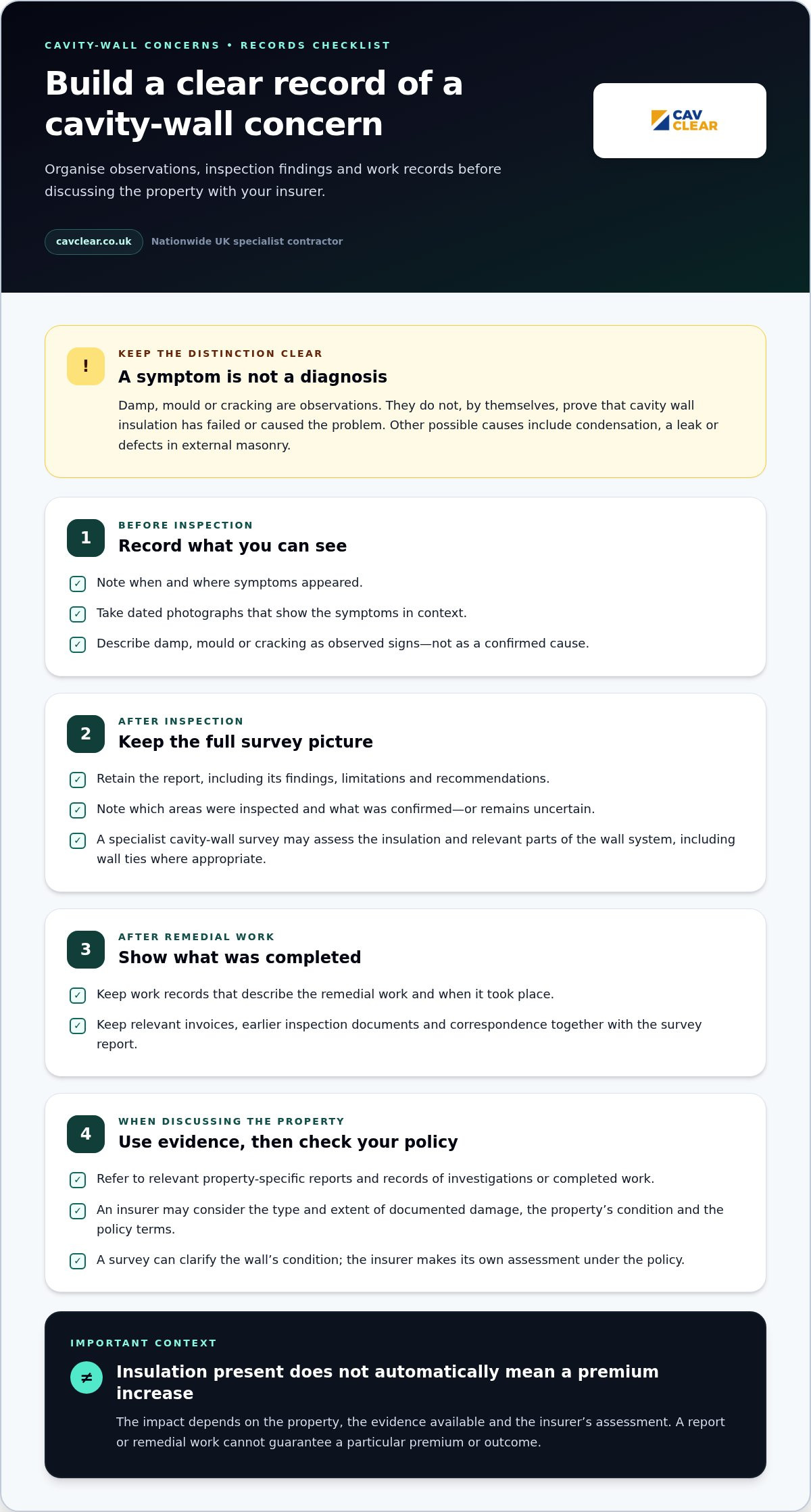
Keep property records together so the timeline is easy to follow. Dated photographs can show where symptoms appeared and whether they changed. Survey reports can record inspection findings, while invoices or other work records can show what remedial work was completed and when. Include relevant correspondence or earlier inspection documents if they help explain how the concern developed.
- Before inspection: note when and where symptoms appeared, and photograph them in context.
- After inspection: retain the report, including its findings, limitations and recommendations.
- After remedial work: keep records describing the work completed and its date.
Share relevant information accurately, separating what you have seen from what a report has established. A record of cavity wall insulation removal, for instance, may help explain work carried out, but it does not determine an insurer’s decision. UK insurers apply their own policy terms and consider the evidence and circumstances of each property.
If the cause remains unclear, a specialist cavity wall survey can document relevant findings and recommendations. This evidence can help you explain the property’s condition, while the insurer remains responsible for its own decision.
Compare common insurance scenarios without assuming a premium increase
A suspected problem, a confirmed defect and completed remedial work describe different stages, not guaranteed insurance outcomes. The comparison below shows what may be known at each stage, what remains uncertain and which records could help explain the property. These examples are prompts for organising information, not predictions about how an insurer will assess a home or set its premium.
| Scenario | What is known and what remains uncertain | Records that may help |
|---|---|---|
| Suspected issue | Symptoms such as staining, mould or cracking have been noticed. Their cause, whether the cavity is affected and whether insulation is involved remain unconfirmed. | Dated photographs, notes describing where and when symptoms appeared, and relevant property documents. Keep observations separate from possible explanations. |
| Confirmed finding | A specialist inspection has documented a cavity-wall defect and described its observed extent. The appropriate remedy and any other contributing factors may still need consideration. | The written survey report, including its findings, scope, limitations and recommendations, alongside relevant photographs or earlier inspection records. |
| Remedial work completed | Records show that specified work was carried out. The property’s condition after the work and the insurer’s assessment remain separate matters. | The survey findings, dated records of completed work and any follow-up inspection documentation available. |
If you have concerns but no specialist findings
Record what you can see without assigning a cause. Note the location and date, and take clear photographs if useful. A specialist inspection can assess the cavity and establish whether further investigation is appropriate. Suspicion alone does not establish that insulation has failed or that cavity wall insulation removal is needed. Avoid describing a possible explanation as a confirmed defect.
If a survey confirms a cavity-wall defect
A written report can clarify what was observed, where it was found and what the inspection could establish. Recommendations should reflect the particular property and findings. Cavity wall insulation removal may be considered where inspection supports it, while wall-tie concerns may call for separate investigation or remedial work. These are distinct issues, and one recommendation should not be assumed to resolve another.
Keep the technical record distinct from an insurer’s decision. The impact of failed cavity insulation on home insurance premiums cannot be inferred from a survey alone. The report describes property findings, while each insurer applies its own policy terms and assessment process. A documented repair may add useful context, but it doesn’t guarantee a premium change or a particular insurance outcome.
For background on the inspection-led approach and possible remedial steps, CavClear’s complete UK guide to cavity wall insulation removal explains how findings can inform decisions. The right next step depends on what an inspection establishes, not simply on the presence of insulation or visible symptoms.
What homeowners can do when insulation problems may affect insurance
If you’re concerned about how a cavity-wall issue may affect your insurance, take an evidence-led approach. Give your insurer an accurate account of what you know without assuming the cause of damp, cracking or other symptoms. These steps can help you organise relevant information before discussing your policy.
- Record what you’ve observed. Note the dates and locations of damp patches, mould, cracking or other visible changes. Take photographs where useful, and describe the symptoms without attributing them to insulation unless a technical assessment supports that conclusion.
- Review your policy documents. Check the wording and any documents about renewal or changes to your cover. Note anything you don’t understand so you can ask your insurer how it applies to your circumstances.
- Gather relevant technical findings. Collect previous survey reports and records of related remedial work. If the cause or condition of the cavity remains unclear, a specialist inspection may establish what was observed and what further steps are recommended.
- Discuss the specific facts with your insurer. Explain what you’ve seen, what has been inspected and any work completed. Ask how this information relates to your policy and what further details are needed. A survey cannot determine the impact of failed cavity insulation on home insurance premiums; the insurer assesses the information under its own terms and process.
Which property information is useful to organise?
Keep a simple record of dates, photographs, previous survey reports and documents describing relevant remedial work. Label each item clearly, and distinguish your own observations from a surveyor’s findings. For example, “moisture staining below the window, first noticed in October” is factual; “failed insulation caused the staining” is an unconfirmed conclusion unless supported by inspection. These records provide context, but aren’t a diagnosis by themselves.
When could a specialist cavity-wall survey help?
A specialist survey may help investigate insulation condition and related visible concerns, including whether further cavity-wall or wall-tie inspection is appropriate. The resulting report can document the findings, limits of the inspection and remedial options suited to the property. If damp symptoms need assessment, the professional damp survey guide explains what a survey may cover. Where wall ties are relevant, see the wall tie replacement guide.
Recommendations should follow the evidence, not be decided in advance. Cavity wall insulation removal may be appropriate where an inspection supports it, while wall-tie concerns require their own findings and recommendations. If you need a clearer picture of a suspected cavity-wall issue, arrange a specialist cavity-wall survey to document the property’s condition and possible next steps.
How a CavClear survey can clarify cavity-wall concerns
Uncertainty about damp, cracking or insulation within a cavity can make it difficult to understand what is happening in a property. An inspection examines the relevant cavity-wall concerns and records the findings, helping distinguish visible symptoms from evidence identified during the survey. This gives homeowners a clearer basis for considering appropriate next steps.
CavClear is TrustMark registered for cavity wall insulation removal and a member of the Wall Tie Installers Federation. Its survey reports document relevant findings and recommendations for the property. They describe technical evidence, but don’t determine how an insurer assesses a policy or whether a premium will change.
What a cavity wall insulation survey can establish
An inspection can assess the concerns identified for a property, including insulation condition and relevant signs of moisture or damage. The report can explain what was inspected, what evidence was observed and any limits to the assessment. Its conclusions relate to the inspected evidence and the property’s specific conditions, not to assumptions about areas or issues beyond the inspection scope.
These findings can help clarify whether further investigation or remedial work may be appropriate and why. A survey report can provide technical context for an insurance discussion, but it can’t guarantee a particular decision, cover outcome or premium. The insurer makes its own assessment under its policy terms.
When cavity wall insulation removal may be recommended
Cavity wall insulation removal is considered only where inspection findings support it. The appropriate response depends on the defect identified and the property’s condition. Not every home with cavity wall insulation has a problem, and visible damp alone doesn’t establish that removal is needed. If wall ties or another cavity-wall component are involved, their condition needs to be assessed on its own evidence.
A survey can help clarify whether the concern relates to insulation, wall ties or another factor, and what the findings support as a next step. The impact of failed cavity insulation on home insurance premiums remains for the insurer to assess. Technical information helps explain the property, but doesn’t set insurance terms.
If you want a clearer understanding of a suspected cavity-wall issue, arrange a specialist survey with CavClear. The inspection findings provide a practical starting point for deciding what, if anything, should happen next.
Make your next insurance discussion evidence-led
Before your next renewal conversation, keep a clear record of the property’s condition and any inspection or remedial work. Update it as new findings become available. This makes it easier to explain what has changed, what has been confirmed and what remains uncertain without overstating the cause of a problem.
The impact of failed cavity insulation on home insurance premiums can’t be judged from symptoms alone. A documented property history helps you discuss the facts, while a specialist survey can clarify cavity-wall concerns and identify suitable next steps. Recommendations should follow inspection findings, not assumptions about what work may be needed.
If you’d like to establish what is happening within your cavity wall, arrange a specialist cavity-wall survey with CavClear. A clearer understanding of the property can help you plan appropriate remedial action and approach future insurance conversations with greater confidence.
Frequently Asked Questions
Does failed cavity wall insulation always make home insurance more expensive?
No. There’s no universal premium outcome for a property with a cavity-wall concern. The impact of failed cavity insulation on home insurance premiums depends on the insurer’s assessment, the policy terms and the information available about the home. A reported concern without inspection findings is different from a documented defect. Ask your insurer how its terms apply to your circumstances, and arrange a specialist survey if the property condition needs investigating.
Can I arrange home insurance while a cavity-wall problem is being investigated?
Insurers set their own processes and terms, so there isn’t one answer for every application or renewal. Describe the known situation accurately, including whether an inspection has taken place and whether findings are pending. Ask the insurer how to handle an ongoing investigation and whether it needs further information. A survey report may help explain what has been established, but the insurer decides how to assess it.
Will a cavity wall survey guarantee a lower insurance premium?
No. A survey documents technical findings; it doesn’t set an insurer’s price or guarantee a change to your premium. Its value is that it can help you understand what has been inspected and what action, if any, is recommended. For instance, a report may distinguish a cavity-wall issue from another observed concern. Keep technical findings separate from expectations about price or cover, which only the insurer can assess.
Might an insurer ask for evidence that cavity wall remedial work is complete?
An insurer may ask for information relevant to its assessment, but the documents it needs can vary. Keep completion records, invoices and follow-up inspection reports together, and ask the insurer which details it requires for your policy. Check that the records identify the work and property clearly. Documentation can explain what has been done, but it doesn’t ensure a particular decision about cover, terms or premium.
Does damp in a home prove that cavity wall insulation has failed?
No. Damp can have several causes, so a patch on a bedroom wall or mould around a window doesn’t establish that cavity wall insulation is defective. Note where the symptoms occur and whether they change, but don’t diagnose the cause from appearance alone. An inspection can assess relevant cavity-wall conditions and consider the available evidence. The findings can guide whether further investigation or remedial work should be considered.
Could completed cavity wall insulation removal change my insurance terms?
It could be relevant to an insurer’s assessment, but removal doesn’t guarantee a change to your terms or premium. The outcome depends on the insurer, policy and property circumstances. If work has been completed, retain the report describing the original findings and records showing what was done. Ask your insurer how it wants this updated information provided. A specialist can document technical findings, but cannot decide the insurer’s policy terms.
Recent Comments