
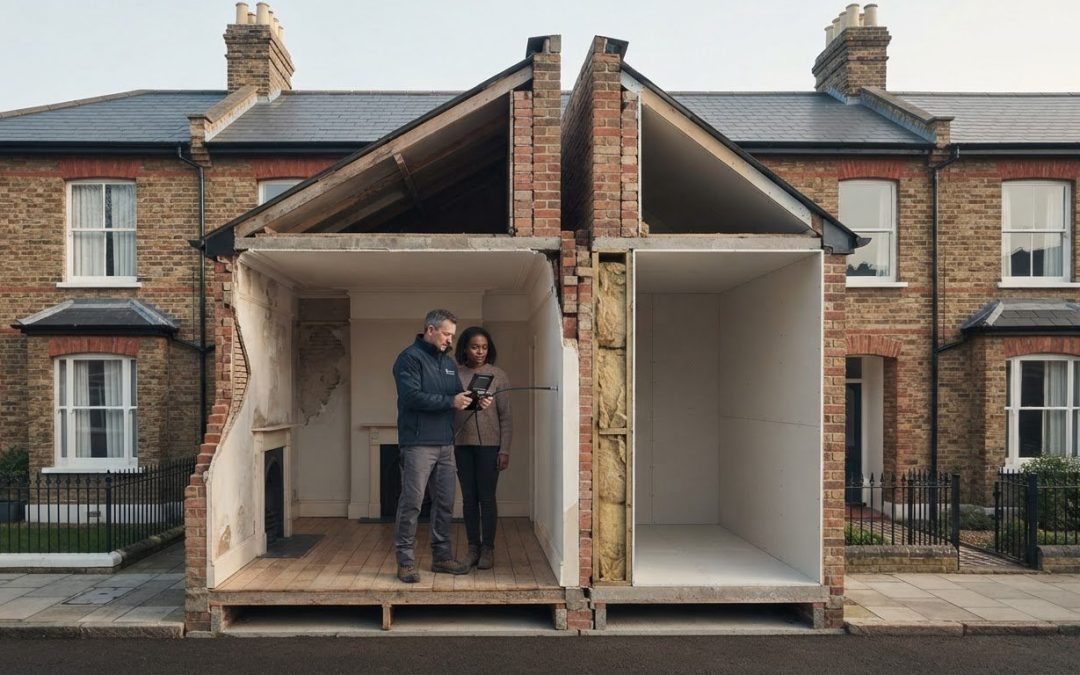
If you’re searching for a party wall agreement for cavity wall insulation extraction, you may first need to understand what is in the cavity and whether any work is appropriate. Concerns about an adjoining wall can raise practical questions about access, disruption and how to approach a neighbour.
Adjoining properties do not automatically have identical cavity conditions. A concern in one home is not proof of a defect in the other, and a suspected problem is not the same as a confirmed one. A specialist inspection can help establish what is present and whether cavity wall insulation removal is appropriate.
This guide explains what shared walls can mean for an investigation, what property information and access may help, and how to coordinate with an adjoining owner. It also covers how to review property-specific findings so decisions are based on evidence rather than assumption.
Key Takeaways
- A shared or connected wall does not mean adjoining homes have identical insulation or cavity conditions.
- Before arranging an investigation, gather property history, note your concerns and share relevant survey records or details of previous work.
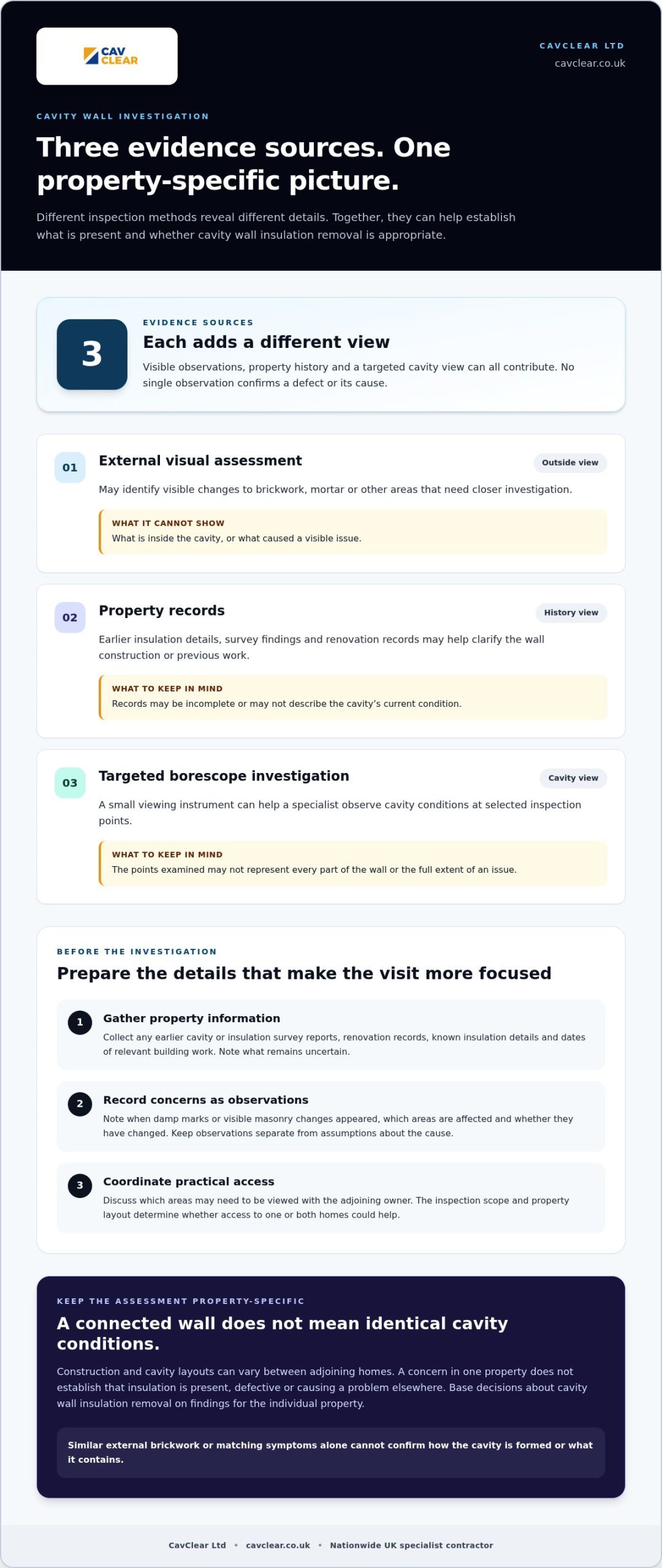
- External observations, property records and a targeted borescope inspection can each contribute useful information about the cavity.
- Clarify practical access and coordinate with the adjoining owner before planning work.
- Use inspection findings for the individual property to decide whether cavity wall insulation removal is appropriate. Do not assume every insulated home needs it.
What a shared cavity means for cavity wall insulation removal
A cavity wall has two masonry leaves, usually an inner and an outer wall, separated by a gap that may contain insulation. In adjoining homes, the walls meet at a boundary, but construction and cavity layouts can vary. A connected wall does not automatically mean the cavity or insulation is continuous or identical throughout.
This distinction matters when planning cavity wall insulation removal. A concern in one part of a building does not establish that insulation is present, defective or causing a problem elsewhere. The relevant area needs to be assessed using evidence from the individual property.
How adjoining cavity walls relate to an insulation investigation
An adjoining wall can affect where an inspection can be carried out and whether access to one or both homes may help. The visible brickwork and internal wall surfaces are not the cavity itself. The cavity lies between the masonry leaves and may not be visible without suitable investigation. Understanding the wall layout helps a specialist plan an inspection without assuming every connected area needs the same work.
The construction needs to be established through a property-specific assessment. Similar external brickwork or matching symptoms alone cannot confirm how the cavity is formed or what it contains.
When should a homeowner seek a specialist assessment?
Unexplained damp, changes to brickwork or other visible masonry concerns can be reasons to investigate. On their own, they are not proof of a cavity wall insulation defect. Different issues can produce similar signs, so identifying the cause requires evidence rather than assumption.
A specialist cavity wall survey can help establish what is present and whether further investigation or remedial work should be considered. Findings should relate to the individual property, not just observations in a neighbouring area. For a broader overview of the inspection and removal process, read the UK cavity wall insulation removal guide.
How to prepare adjoining properties for a cavity-wall investigation
Preparation can make an investigation more focused and help adjoining owners understand what it is intended to establish. Start with the property history, write down your concerns and discuss practical access. These steps support an informed assessment but do not determine in advance whether cavity wall insulation removal is needed.
What information helps a specialist understand the property?
Gather records that could clarify the wall construction or previous work. Useful information may include earlier cavity wall or insulation survey reports, renovation records, known insulation details and the dates of relevant building work. If you do not have documents, note what you know and identify anything that remains uncertain.
Make a simple timeline of your concerns. Record when damp marks or visible changes to the masonry first appeared, which areas are affected and whether the condition has changed. Keep observations separate from assumptions. For example, “a damp patch appeared below the window in winter” is more useful than concluding that insulation caused it. Similar symptoms can have different causes, so the investigation should assess the evidence rather than begin with a diagnosis.
How to coordinate practical access with an adjoining owner
Explain the inspection purpose calmly and factually. Tell the adjoining owner which parts of the property may need to be viewed and what information you already have. A clear conversation can reduce uncertainty, particularly if viewing an internal room, an external elevation or both homes could help the specialist understand the construction.
Agree access arrangements directly with the people involved. The areas needed depend on the inspection scope and the layout of the properties, so do not assume access will or will not be required. A specialist can explain what the proposed assessment is intended to examine, helping both households plan for the visit.
Before the inspection, prepare relevant records and observations, and clarify which areas may be involved. CavClear’s nationwide cavity wall survey service can investigate concerns and provide findings with recommended next steps. Clear records and practical coordination give the assessment a more useful starting point.
What inspection methods can reveal about insulation in a shared cavity
No single observation can confirm that cavity wall insulation has failed or identify the cause of damp or masonry changes. A specialist considers the visible condition of the property, relevant records and, where appropriate, a targeted view inside the cavity. Each method provides different evidence and has its own limits.
| Method | Possible observations | Limitations |
|---|---|---|
| External visual assessment | Visible changes to brickwork, mortar or other areas that may need closer investigation. | Does not show what is inside the cavity or establish the cause of a visible issue. |
| Property records | Past insulation details, survey findings or records of renovation work. | Records may be incomplete or may not describe the cavity’s current condition. |
| Targeted borescope investigation | A view of cavity conditions at selected inspection points. | Those points may not represent every part of the wall or the full extent of an issue. |
What a borescope inspection can and cannot establish
A borescope is a small viewing instrument used to inspect an opening into a cavity. It can help a specialist observe conditions at the points examined, alongside information about the wall construction and the concern being investigated.
The view is limited to those inspection points. Conditions elsewhere in the wall may differ, so a borescope inspection should not be treated as proof that every part of the cavity is clear or defective. Findings need to be interpreted in context, and further assessment may be appropriate if questions remain.
Why damp or cracking needs careful interpretation
Damp and cracking can have multiple causes, including cavity-wall defects. A specialist considers the location and appearance of the concern alongside construction details, property history and inspection findings. This helps distinguish what has been observed from possible explanations and recommended next steps.
For homeowners searching for a party wall agreement for cavity wall insulation extraction, inspection evidence can help clarify the physical condition of the cavity before remedial work is considered. It does not, by itself, establish that removal is necessary. Read the wall cavity structure guide for more context on how cavity walls are constructed.
How to understand findings and decide whether removal is appropriate
An inspection report should explain what was observed, what those observations might indicate and what action, if any, is recommended. These are separate stages of assessment. A visible damp patch is an observation; a possible connection to the cavity is an interpretation; further investigation or remedial work may be a proposed next step.
The presence of insulation does not automatically mean it has failed or should be removed. Recommendations should reflect the evidence gathered and the construction and condition of the individual property. This is particularly important in adjoining homes, where similar-looking walls do not guarantee identical cavity conditions.
Questions to consider when reviewing an inspection report
Check what was assessed and how the conclusions relate to the concern that prompted the investigation. A practical review should cover:
- Location: Which elevations, rooms or parts of the cavity were inspected?
- Evidence: What conditions were directly observed, and how were they recorded?
- Limitations: Were any areas inaccessible or not examined? Does the report explain any uncertainty?
- Proposed scope: What remedial work is recommended, and how does it address the evidence and reported concern?
Keep observed facts separate from possible explanations. If the report identifies more than one potential cause, its next steps should explain how those possibilities will be assessed. Recommendations are easier to understand when they connect clearly to findings rather than relying on symptoms alone.
When cavity wall insulation removal may be recommended
A specialist may recommend cavity wall insulation removal when inspection findings for the property support that approach. The report should explain the relevant observations and why removal is considered suitable for the issue identified. If the evidence does not establish a defect, removal should not be treated as a routine response simply because insulation is present.
An inspection may also identify separate concerns, such as possible wall-tie deterioration. These need their own assessment and should be distinguished from insulation findings. If the report raises wall ties, the wall tie replacement guide explains more about that remedial work.
For anyone considering a party wall agreement for cavity wall insulation extraction, inspection findings can help clarify the proposed remedial scope before work is planned. Arrange a specialist cavity wall assessment with CavClear to investigate concerns and receive findings with recommended next steps.
How CavClear supports cavity wall insulation removal across the UK
Shared-wall concerns can be difficult to assess from visible symptoms alone. CavClear Ltd is a specialist contractor supporting homeowners and property professionals throughout the UK with cavity-wall inspections and remedial services, including Cavity Wall Insulation Surveys and Cavity Wall Insulation Removal.
Questions about a party wall agreement for cavity wall insulation extraction may arise while owners are planning an investigation. A practical starting point is to understand the property-specific findings, then consider any recommended work in light of the cavity’s condition and the access arrangements involved. Insulation being present does not, on its own, mean removal is required.
What a specialist survey and report can contribute
A specialist inspection helps establish relevant conditions within the cavity before remedial recommendations are made. CavClear’s reports set out inspection findings and recommended solutions, helping property owners and professionals understand what was observed and what steps may be appropriate. Recommendations depend on the evidence and the individual property, not on an assumption that adjoining homes have matching conditions.
CavClear is TrustMark registered for cavity wall insulation removal and is a member of the Wall Tie Installers Federation. A survey can help clarify whether concerns relate to insulation, wall ties or another aspect of the cavity-wall system, so next steps can be considered on an informed basis.
Practical next steps for property owners
Before arranging a survey, gather relevant property records, such as previous inspection reports, known insulation details and records of renovation work. Note where you have seen damp or masonry changes and when you first noticed them. These details can help focus the investigation, but they should not be treated as a diagnosis.
If the property adjoins another home, explain the purpose of the inspection clearly and discuss practical access with the people involved. The areas needed depend on the property layout and inspection scope. Clear communication helps everyone understand what may be examined without presuming that the same findings or remedial work apply to both homes.
CavClear provides specialist support nationwide throughout the UK for cavity-wall concerns, from investigation to cavity wall insulation removal where inspection findings support it. To discuss a survey or remedial service, contact CavClear about your property’s cavity-wall concerns.
Take the next step with clear property-specific findings
Approach shared-wall concerns with evidence, not assumptions. Adjoining homes may have different cavity conditions, and damp or visible masonry changes do not confirm that insulation is defective. A specialist assessment can help establish what is present and whether cavity wall insulation removal is appropriate for the individual property.
Preparing relevant records and discussing practical access can help focus an investigation. If you are considering a party wall agreement for cavity wall insulation extraction, first understand the inspection findings and the remedial work being considered.
CavClear is TrustMark registered for cavity wall insulation removal, a member of the Wall Tie Installers Federation, and provides specialist support nationwide throughout the United Kingdom. For findings and recommendations tailored to your property, arrange a specialist cavity-wall survey with CavClear.
Frequently Asked Questions
What does cavity wall insulation removal involve?
Cavity wall insulation removal is specialist remedial work to take existing insulation out of a cavity wall when an assessment indicates that removal is appropriate. The method and scope depend on the property and the material present. A survey can help establish the relevant conditions and inform recommendations. Insulation should not be assumed defective simply because it is present. A property-specific inspection is needed before deciding whether removal is suitable.
Can cavity wall insulation affect adjoining properties?
Adjoining construction may be relevant when investigating a cavity-wall concern, but the relationship depends on how the properties were built and what an inspection finds. A shared or connected wall does not prove that insulation is defective or that work is needed in both homes. A specialist assessment can clarify which areas were inspected and what conclusions the evidence supports, helping owners avoid assumptions based only on neighbouring symptoms.
How is insulation in a cavity wall inspected?
A specialist may consider the visible masonry, available property information and targeted investigation, such as a borescope inspection. A borescope is a small viewing instrument that provides a view into selected parts of a cavity. It may not show every section of the wall. The approach depends on the property and concern, and findings should explain what was observed, where it was observed and any limits to the investigation.
Does damp mean cavity wall insulation needs to be removed?
No. Damp can have different causes, and its presence alone does not establish that cavity wall insulation is responsible. A property-specific investigation should consider the building, visible conditions and relevant cavity-wall evidence before recommending remedial work. If findings support an insulation-related issue, cavity wall insulation removal may be considered. If evidence points elsewhere, recommendations should reflect those findings rather than assume insulation is the cause.
Do both adjoining homeowners need to arrange an inspection?
Not necessarily. The properties, construction and reported concerns determine which areas need assessment. Information or practical access relating to an adjoining home may help clarify some investigations, but it is not automatically required. Owners can start by sharing relevant property records and describing what they have observed. A specialist can explain the proposed inspection scope and what the available evidence can reasonably establish for each property.
What should a cavity wall insulation survey report include?
A useful report should identify the areas inspected, describe recorded observations and explain any limits to the investigation. It should distinguish findings from possible causes, then set out recommendations that relate to the evidence. For adjoining homes, clear notes about which areas were assessed help readers understand the scope. A report should not diagnose areas that were not inspected or suggest that every insulated wall needs remedial work.
When might cavity wall insulation removal be recommended?
Cavity wall insulation removal may be recommended when a specialist assessment finds property-specific evidence to support it. The recommendation should explain the relevant observations and how the proposed work relates to them. Insulation, damp or cracking on its own does not determine the right response. The cavity’s condition, the building and any related defects need consideration. Inspection findings can help inform discussion of proposed work where adjoining properties are involved.
Recent Comments