
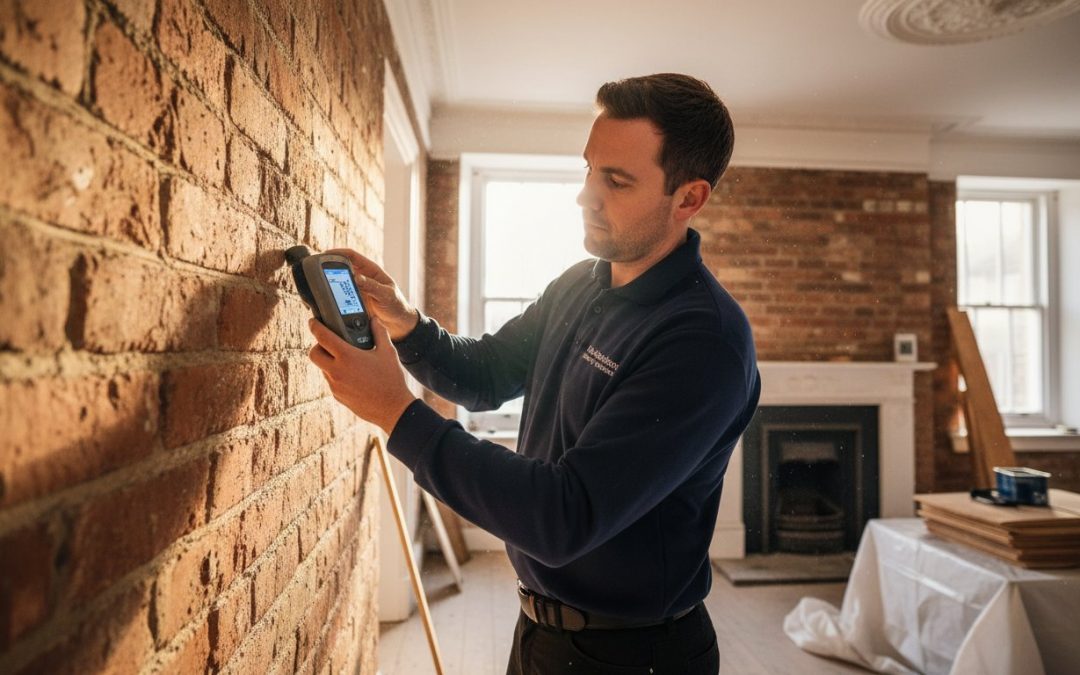
A 2024 survey by the Royal Institution of Chartered Surveyors revealed a critical fact: up to 70% of damp issues in Manchester’s terraced homes are initially misdiagnosed, leading to ineffective and costly repeat treatments. It’s a deeply frustrating cycle for anyone seeking effective damp proofing in Manchester. You’ve scrubbed away recurring black mould, paid for chemical injections, and yet the damp smell and cold spots always return, putting your family’s health and your property’s value at genuine risk.
This specialist guide cuts through that confusion. We will explain precisely why conventional treatments often fail in our city’s unique housing stock and demonstrate how modern structural repairs provide the only guaranteed, permanent solution for your home. We’ll cover the critical difference between surface-level fixes and true property preservation, equipping you with the knowledge to secure an accredited survey report and achieve lasting structural peace of mind.
Key Takeaways
-
Understand the key symptoms to correctly identify the specific type of damp affecting your property, from condensation to penetrating damp.
-
Discover the critical link between failed cavity wall insulation and structural damp, a common but often misdiagnosed issue in North West homes.
-
Learn why effective damp proofing Manchester requires addressing the root structural cause, not just applying temporary surface treatments.
-
Know what a specialist damp survey involves, empowering you to distinguish a genuine technical assessment from a simple sales quote.
Table of Contents
-
The Manchester Damp Crisis: Why North West Homes are Uniquely at Risk
-
Identifying the Root Cause: Rising, Penetrating, and Condensation
-
Specialist Remedial Solutions: Restoring Your Manchester Home
The Manchester Damp Crisis: Why North West Homes are Uniquely at Risk
Manchester’s identity is built on its industrial heritage and iconic red brick architecture. Yet, these same characteristics create a unique set of challenges for homeowners. The combination of persistent rainfall and the physical properties of Victorian and Edwardian buildings has created a perfect storm for moisture ingress. Addressing this requires more than a simple fix; it demands a specialist understanding of how these homes were built and how they interact with our modern climate. The issue isn’t just one type of damp; it’s a complex interplay between several different types of structural damp, from penetrating and rising damp to condensation.
As weather patterns shift, with climate models projecting increased rainfall intensity for the UK by 2026, traditional damp prevention methods are proving insufficient. Homeowners are now moving away from short-term treatments and towards a more robust strategy known as "Property Preservation." This approach views the house as a complete system, focusing on restoring its original ability to manage moisture rather than just blocking a single symptom. It’s a vital shift in mindset for protecting the long-term structural integrity and value of your property.
Manchester’s Rainfall and Porous Masonry
Greater Manchester receives over 800mm of rainfall annually, a figure that places consistent stress on building exteriors. This moisture isn’t just falling downwards; it’s driven sideways by prevailing winds. This "wind-driven rain" is particularly aggressive against the long, exposed walls of the region’s terraced houses, forcing water deep into the porous brickwork and ageing mortar. This constant saturation bypasses degraded mortar joints and travels through the brick, leading to interstitial condensation, the breakdown of internal plaster, and the decay of structural timbers.
The Legacy of Victorian and Edwardian Construction
Many of Manchester’s homes were built between 1890 and 1930. The early cavity walls in these properties were not designed for thermal insulation but as a barrier to stop wind-driven rain from reaching the inner wall. Over a century, this defence system often fails. Effective damp proofing Manchester properties requires a deep understanding of these architectural quirks and their common points of failure, which include:
-
Degraded Damp Proof Course (DPC): Original slate or bitumen DPCs can fracture over 100+ years, allowing groundwater to rise through capillary action.
-
Cavity Wall Debris: Mortar droppings left by the original builders can accumulate at the base of the cavity, bridging the gap and transferring moisture directly from the outer to the inner wall.
-
Incompatible Materials: The use of modern, non-breathable cement pointing or gypsum plaster on traditional lime-based structures traps moisture inside the wall, preventing it from evaporating naturally and accelerating decay.
These legacy issues mean that a "one-size-fits-all" solution often makes the problem worse. A successful damp proofing manchester strategy must respect the original construction of the building, working with its materials to restore performance rather than fighting against them.
Identifying the Root Cause: Rising, Penetrating, and Condensation
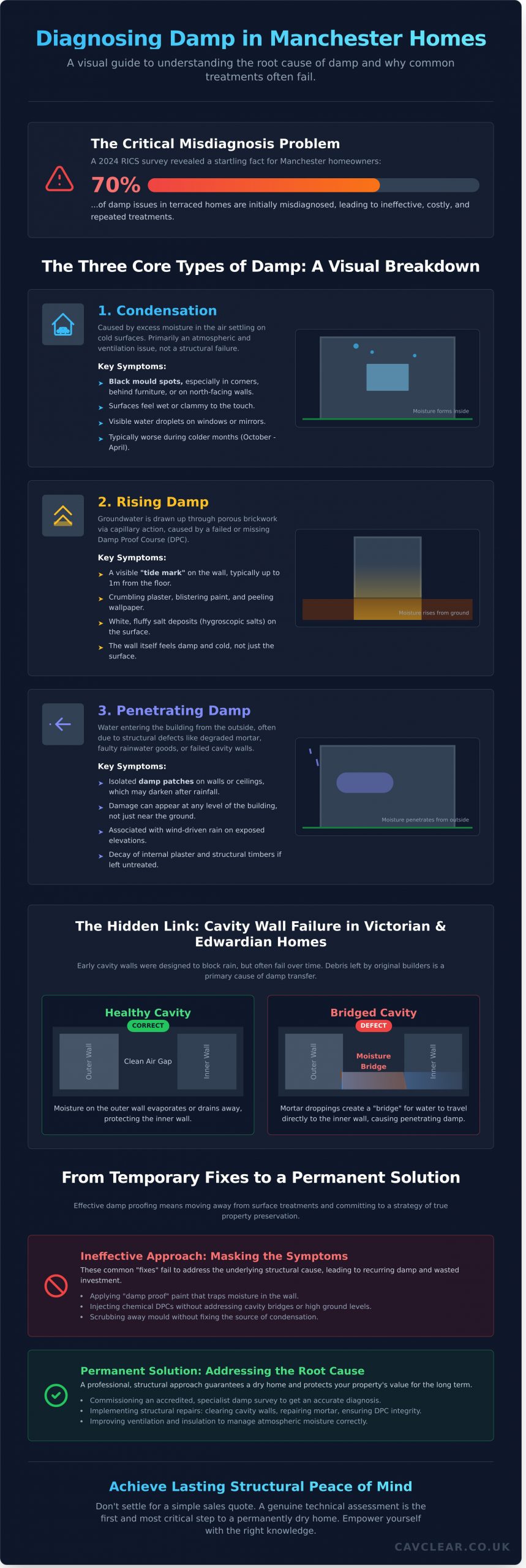
Effective damp proofing Manchester properties begins not with a treatment, but with an accurate diagnosis. A damp patch on a wall is a symptom, not the disease. Applying the wrong remedy is the single biggest reason why treatments fail, with industry data showing over 60% of failed damp proofing jobs are traced back to an initial misdiagnosis. Understanding the three distinct types of damp is the first critical step toward a permanent solution.
Damp manifests in different ways. Homeowners are often faced with telling the difference between damp caused by atmospheric moisture and damp caused by structural failure. Use this checklist as a starting point:
-
Condensation: Look for black mould spots, often in corners, behind wardrobes, or on north-facing walls. The surfaces may feel wet to the touch, and you’ll often see water droplets on windows. This issue is typically worse between October and April.
-
Rising or Penetrating Damp: This feels different. The wall itself is damp, not just the surface. You may see a distinct "tide mark" rising from the floor, crumbling plaster, or blistering paint. A key indicator is the presence of white, fluffy deposits on the plasterwork. These are hygroscopic salts drawn from the ground, which continue to attract moisture from the air, creating a persistent damp patch even if the original water source is managed.
Ignoring the root cause or misidentifying it leads to wasted money and recurring problems. The health implications are also significant, which is why there is official Government guidance on damp and mould risks that outlines the serious nature of these issues. A professional survey is designed to prevent this costly diagnostic error.
Rising Damp and the Failure of the DPC
Rising damp occurs when groundwater travels up through porous brickwork. Most homes have a Damp Proof Course (DPC), a physical barrier installed during construction to stop this. When this DPC fails or is "bridged," damp appears. A bridge is created when external ground levels, such as a new patio or raised flower bed, are built higher than the DPC, allowing moisture a path over the barrier. Debris within a wall cavity can do the same. Chemical injection DPCs are only effective when the original DPC has genuinely failed; they are a waste of money if the problem is a simple bridge.
Penetrating Damp: The External Threat
This type of damp is caused by water making its way through the external fabric of the building. In Manchester’s older housing stock, common culprits include defective pointing in brickwork, cracked render, and failing rainwater goods like blocked gutters or cracked downpipes. The type of wall construction matters. Solid walls have no gap, so moisture that enters the brickwork can travel directly to the internal plaster. Cavity walls offer more protection, but if the cavity is filled with debris or rubble, it forms a bridge for water to cross to the inner wall. Investigating the state of your wall cavity is a critical diagnostic step; our specialist cavity wall surveys can identify these hidden pathways for moisture before they cause major structural damage.
The Hidden Link: Cavity Wall Failures and Structural Damp
Many homeowners assume damp problems originate from the ground. While rising damp is a valid concern, a significant number of cases, particularly in Manchester’s housing stock, stem from a hidden source: the wall cavity. Your home’s cavity wall is designed as a protective barrier, with a clear air gap to stop rainwater penetrating from the outer brickwork to your internal walls. When this barrier is compromised, it creates a direct bridge for moisture, leading to persistent damp that standard treatments cannot fix.
Understanding what is a cavity wall and how its dual-leaf construction works is essential for diagnosing these hidden moisture pathways. Defective cavity wall insulation (CWI) is a primary culprit. Installed years ago, materials like mineral wool can degrade, slump, and absorb moisture. Instead of insulating, this saturated material acts like a sponge, transferring cold and damp directly across the cavity. This is why you may feel cold spots on your internal walls or see mould developing, even in rooms without obvious leaks. The resulting black mould growth isn’t just unsightly; it poses a significant health risk, as detailed in the official government guidance on damp and mould. In a city with over 860mm of annual rainfall, a compromised cavity is a guaranteed route for damp problems.
Consider this common scenario: A homeowner notices isolated damp patches halfway up a wall. A damp proof course injection is installed, but the problem persists. A specialist investigation reveals the true cause is not rising damp, but debris within the cavity. Mortar droppings left during the original construction have collected in one spot, creating a solid bridge for rainwater to track across. This "spot damp" can only be cured by physically removing the blockage from inside the cavity.
Failed Cavity Wall Insulation (CWI) Extraction
If your home feels cold and damp despite having CWI, the insulation itself is likely the problem. Our technical extraction process is the definitive solution. Using specialist industrial vacuums, our teams remove all the failed, wet material through small, carefully drilled holes in the mortar joints. The process is clean, non-invasive, and restores your cavity to its original, effective state. Under the PAS 2035 framework for property retrofitting, complete removal of saturated insulation is mandatory before any new energy efficiency upgrades can be made.
Wall Tie Replacement as a Damp Solution
The structural integrity of your walls is directly linked to damp prevention. Wall ties are the small metal components that hold your home’s inner and outer walls together. In properties built before 1981, these were often made from galvanised steel which is prone to corrosion. As they rust, they can expand to over five times their original thickness, cracking the mortar beds and forcing open pathways for water. A specialist borescope survey allows us to inspect the condition of these ties. Replacing them with modern stainless steel ties not only secures your property’s structure but also provides a permanent cure for this specific type of penetrating damp. Effective damp proofing Manchester homes requires looking beyond the surface and assessing these critical structural elements.
Navigating the Damp Survey: What Homeowners Should Expect
A damp survey is the critical first step in diagnosing and treating moisture problems in your home. However, not all surveys are created equal. Understanding the difference between a expert assessment and a professional technical inspection can save you thousands of pounds and protect your property’s structural integrity. A "expert" survey is often conducted by a contractor with a vested interest in selling a specific remedial product, like a chemical damp-proof course. A professional survey, in contrast, is a diagnostic service designed to find the true source of the problem.
The surveyor’s toolkit has evolved significantly. For a comprehensive survey in 2026, a specialist must use more than just a moisture meter. Key diagnostic tools now include:
-
Thermal Imaging Cameras: These devices detect temperature differences across surfaces, instantly highlighting cold spots caused by moisture evaporation or failing insulation. This non-invasive technology helps pinpoint problem areas without drilling a single hole.
-
Professional Moisture Meters: A surveyor will use both deep-probe and surface-level (capacitance) meters to build a complete moisture profile of a wall. It’s crucial to understand that high readings can be caused by harmless salts, not just damp, which is why expert interpretation is essential.
-
Borescopes: A small, flexible camera allows the surveyor to see inside wall cavities, beneath floorboards, and into other inaccessible areas. This is the only way to definitively identify issues like degraded or saturated cavity wall insulation, which is a frequent cause of damp in UK homes built after 1920.
The Anatomy of a Professional Survey
A thorough survey begins outside, assessing the entire building envelope from the roofline and chimney stacks down to the ground-level drainage. The specialist looks for defects like faulty guttering, cracked rendering, or high ground levels bridging the damp-proof course. Internally, they systematically map moisture readings to differentiate between rising damp, penetrating damp, and condensation. Adherence to independent, accredited surveying standards, ensures the report is objective and technically sound.
For mortgage lenders, a comprehensive damp and timber report is non-negotiable. It must include a detailed floor plan marking all readings, photographic evidence of defects, and a clear diagnosis of the root cause of moisture ingress. Most importantly, the remedial recommendations should be proportionate. A trustworthy report will often suggest simple building maintenance, such as clearing a blocked gutter for £200, before recommending extensive chemical treatments costing over £3,000. It’s about finding the right solution, not the most expensive one.
Understanding Survey Costs and Value
Investing in a paid survey, typically costing between £250 and £500 for an average property, is one of the wisest financial decisions a homeowner can make. This initial outlay provides an unbiased diagnosis that can prevent expenditure on unnecessary work. In the competitive Manchester property market, a reliable survey provides buyers with crucial leverage and sellers with peace of mind. At Cav Clear Ltd, we provide detailed, actionable reports that form the basis for effective damp proofing in Manchester homes, ensuring you only pay for the work you truly need.
Don’t leave your home’s health to guesswork or a sales pitch. Arrange a specialist damp and cavity survey with our accredited team today.
Specialist Remedial Solutions: Restoring Your Manchester Home
A correct diagnosis is the critical first step, but the true value lies in the permanent structural repair that follows. Moving beyond temporary fixes, our specialist remedial solutions are designed to restore your home’s integrity from the inside out. This isn’t about masking a symptom; it’s about eliminating the root cause of damp to protect your property for decades. At CavClear, we focus on the building’s core structure, ensuring the solution is not only effective but also enduring.
Our approach often begins where the problem does: inside the wall cavity. Many damp issues in Manchester properties are caused or worsened by saturated cavity wall insulation or construction debris. This material acts as a bridge, allowing moisture to travel from the outer wall to your internal living spaces. By extracting this failed material, we remove the pathway for damp, a fundamental step that many general builders overlook. This focus on clearing the cavity is central to providing effective, long-term damp proofing manchester homes require.
Lasting protection is only possible with expert application and robust guarantees. Our technicians are fully accredited, ensuring every procedure meets stringent industry standards. This expertise allows us to provide long-term, insurance-backed guarantees of up to 20 years. This is your assurance that the work is completed correctly, providing you with genuine peace of mind and a structurally sound home.
Beyond the Injection: A Holistic Repair Strategy
A successful damp proofing strategy is a multi-stage process that addresses every affected component of your property’s structure. It goes far beyond a simple chemical injection. Our comprehensive remedial work includes:
-
Cavity Clearance and Wall Tie Replacement: We begin by extracting all damp-retaining debris and failed insulation. During this process, we inspect the structural wall ties, often replacing corroded ones in pre-1980s homes to restore the building’s stability.
-
Specialist Replastering: After the walls have dried, we apply a salt-retardant render and specialist plaster. This is crucial for preventing hygroscopic salts, left behind by rising damp, from drawing ambient moisture and causing further damage.
-
Controlled Ventilation: We assess and improve your home’s ventilation to manage atmospheric moisture, preventing secondary condensation issues which are common in our local climate.
Our commitment is to a clean and non-invasive process, using modern techniques to minimise disruption to your daily life while we secure your home’s future.
Protecting Your Investment
Effective damp proofing is one of the most important investments you can make in your property. Surveys from the HomeOwners Alliance have shown that evidence of damp can reduce a property’s value by as much as 20%. By commissioning a professional damp proofing manchester service, you are not just repairing damage; you are actively protecting your home’s market value. A property with a certified, guaranteed damp proof course is a significantly more attractive asset to future buyers.
While protecting the value of your home is a primary financial goal, many are also exploring alternative tangible assets for long-term growth. For those interested in this area of investment, you can learn more about Whisky Cask Club and the potential of single malt Scotch casks.
Ultimately, this is about restoring your home to a safe, dry, and comfortable environment. A permanent, structural fix eliminates the recurring stress and health concerns associated with damp and mould. Take the definitive step to resolve your property’s damp issues and safeguard its structural health for years to come.
Book your professional damp survey with CavClear today.
Secure Your Property’s Future: Your Next Step
You now understand why Manchester’s unique climate and housing stock present a significant damp risk, and how issues like failed cavity wall insulation can lead to serious structural problems. The key takeaway is that effective treatment always begins with an accurate diagnosis. Guesswork leads to costly, ineffective repairs. True damp proofing manchester requires a specialist’s eye to distinguish between rising damp, condensation, and penetrating damp, ensuring the remedial work targets the true source of the issue.
Our accredited specialist technicians are trained to provide this precision. We deliver detailed technical reporting for homeowners and insurers, offering complete transparency. As specialists in non-invasive insulation extraction, we can rectify underlying faults without major disruption. Don’t let uncertainty compromise your home’s health. Take the definitive step towards a dry, secure, and comfortable property.
Protect your most valuable asset. Book a Professional Damp and Structural Survey today.
Frequently Asked Questions
How much does damp proofing cost in Manchester in 2026?
The average cost for a chemical damp proof course in Manchester is projected to be between £80 and £130 per linear metre in 2026. For a typical terraced house, the total project cost, including specialist replastering, can range from £2,500 to £5,000. The final price depends on the wall thickness and the extent of the damage. A professional survey is essential to get an accurate quotation for any damp proofing Manchester project.
Is a damp proof course always necessary for Victorian houses?
No, a new damp proof course (DPC) is not always required for a Victorian property. Many of these homes have original slate DPCs that remain effective. Damp issues are frequently caused by other factors, such as high external ground levels or debris in the wall cavity "bridging" the original DPC. A professional survey is vital to correctly diagnose the root cause, as industry data from 2023 shows over 60% of damp issues are initially misdiagnosed.
Can cavity wall insulation really cause damp problems?
Yes, incorrectly installed or unsuitable cavity wall insulation can directly cause damp. If the material slumps, gets wet, or obstructs the cavity, it prevents moisture from draining and creates a pathway for water to travel from the outer to the inner wall. This is a significant risk in areas with high wind-driven rain. Specialist extraction of the failed insulation is often the only way to permanently resolve the resulting penetrating damp.
How long does a professional damp survey take to complete?
A professional damp survey for a standard three-bedroom house typically takes between 90 minutes and three hours. The exact time depends on the property’s size and the complexity of the issues found. The surveyor will conduct a thorough assessment, including internal moisture readings, a full external inspection of brickwork and drainage, and an evaluation of ventilation to ensure an accurate diagnosis is delivered.
What is the difference between rising damp and penetrating damp?
Rising damp is groundwater that soaks upwards through masonry due to a failed damp proof course, and it will not rise above 1.2 metres from the ground. Penetrating damp, however, is moisture that enters a building horizontally from an external defect. This can be caused by leaking gutters, cracked render, or porous brickwork, and it can appear at any height on a wall, often presenting as isolated damp patches.
Do I need to move out of my house during damp proofing work?
It is generally not necessary to move out during damp proofing treatment. Professional technicians work to minimise disruption by containing the work area, often focusing on one room at a time. While removing plaster does create some dust, the injection of a new chemical DPC is a low-odour and controlled process. Most residential projects are completed within two to four working days, allowing you to stay in your home.
Will my building insurance cover the cost of damp proofing?
Standard building insurance policies typically do not cover costs for treating damp that results from gradual deterioration or poor maintenance. Insurers usually classify a failed DPC as a wear-and-tear issue, which is a standard policy exclusion. Coverage may only apply if the damp is a direct result of a specific insured event, like storm damage to the roof or a sudden escape of water from a pipe.
How do I know if my wall ties need replacing?
The clearest sign of failing wall ties is the appearance of horizontal cracks in the external mortar beds, typically spaced every five to six brick courses apart. You may also see bulging or bowing in the exterior brickwork. Because the ties are hidden within the wall cavity, a specialist must use a diagnostic tool like a borescope to visually confirm the level of corrosion and determine if replacement is structurally necessary.
Recent Comments