
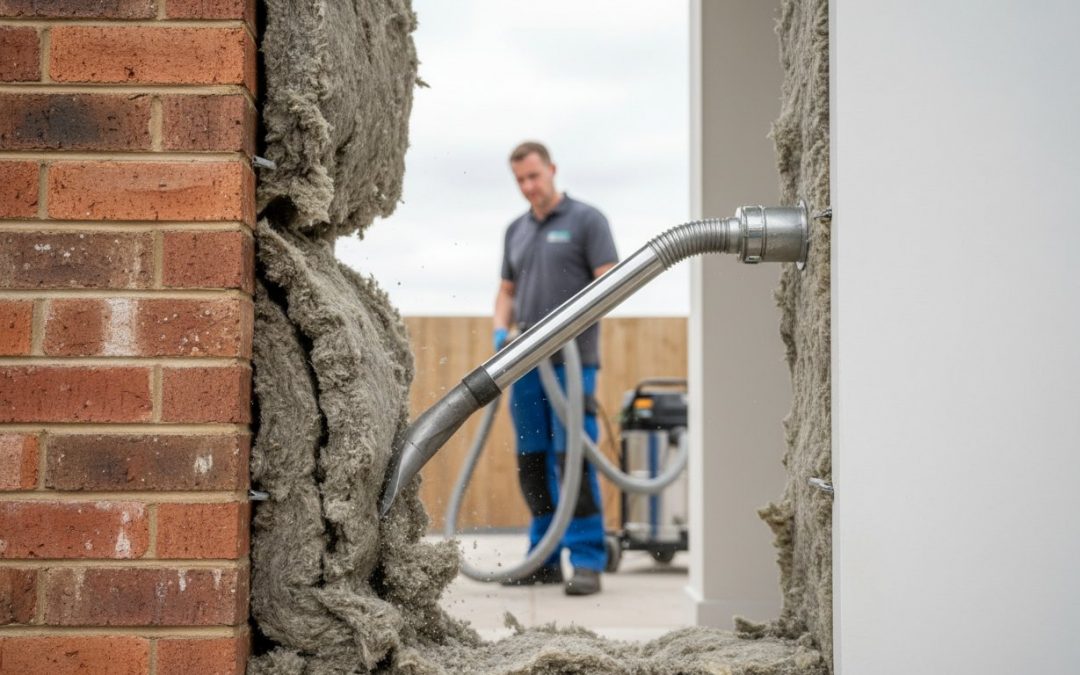
Receiving quotes for cavity wall insulation removal that vary from £1,500 to over £10,000 can be deeply unsettling for any homeowner. This vast difference in pricing creates confusion and anxiety, particularly when you are already dealing with the serious consequences of failed insulation, such as persistent damp, mould, and concerns about your property’s structural integrity. Understanding the legitimate cavity wall insulation removal cost 2026 is the first critical step towards finding a safe, permanent solution and restoring your peace of mind.
This complete UK price guide is designed to provide that clarity. We will break down the real-world costs you can expect, explaining the factors that influence the final price, from specialist labour rates to the type of insulation material requiring extraction. You will learn what a professional, non-invasive removal process entails and gain the confidence to hire an accredited specialist over a general builder. Our goal is to equip you with the essential knowledge to protect your investment, eradicate damp issues, and ensure your home is restored correctly.
Key Takeaways
- Understand the typical cavity wall insulation removal cost 2026, with baseline figures for UK properties and the key reasons behind recent price adjustments.
- Learn how the condition of your insulation and property accessibility can significantly increase or decrease your final extraction quote.
- Discover why a specialist extraction is crucial and how techniques like borescope inspections ensure your cavity is 100% clear, preventing future damp issues.
- Identify potential hidden costs beyond the initial quote, such as essential wall tie replacement and brickwork repairs caused by damp insulation.
Understanding Cavity Wall Insulation Removal Costs in 2026
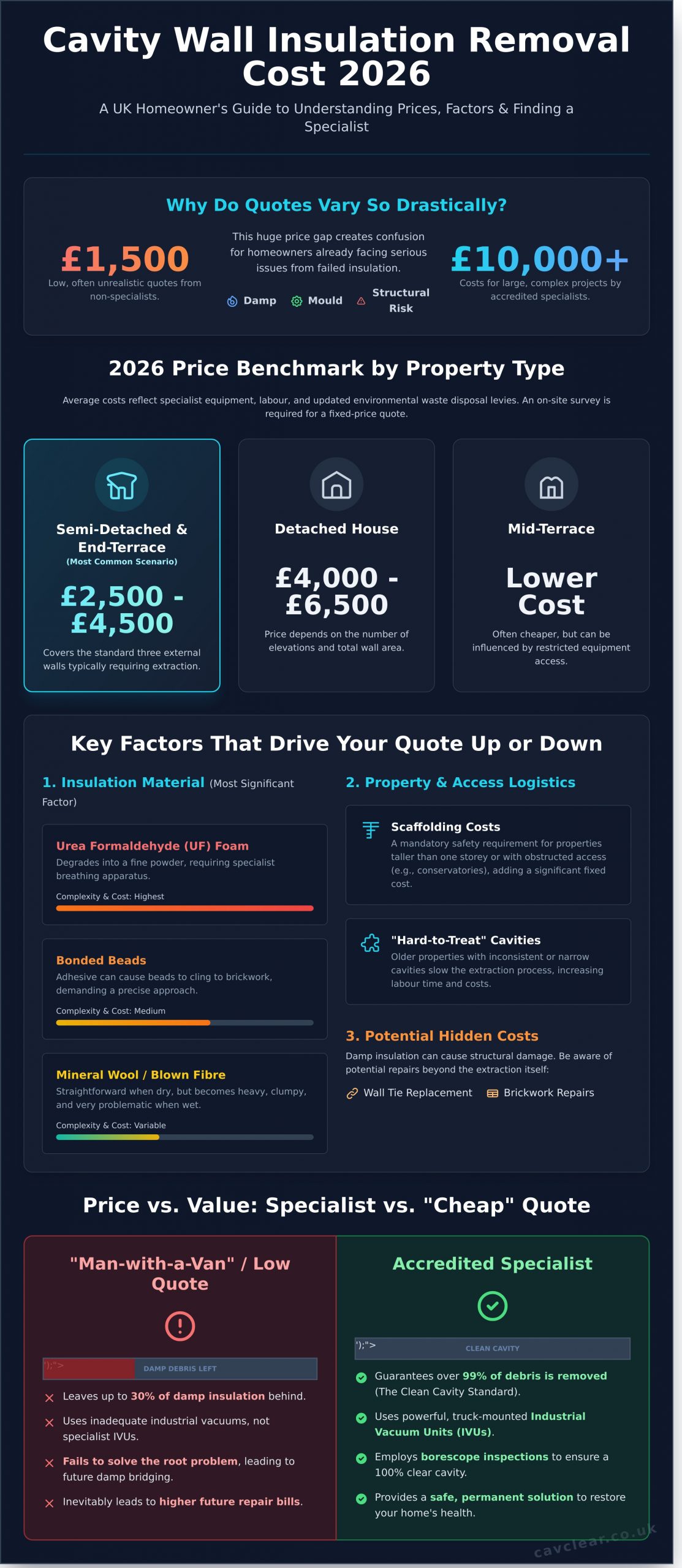
Determining the cavity wall insulation removal cost 2026 requires a clear understanding of several key factors. For a standard UK semi-detached property, homeowners can expect the average cost to range from £2,500 to £4,500. These figures reflect updated environmental waste disposal levies and the significant maintenance costs for the specialist industrial extraction equipment required to perform the work to a guaranteed standard. The price is not arbitrary; it is a direct calculation of the resources needed to restore your property’s health.
The final price is directly influenced by the scale of the task: the total wall area, the width of the cavity, and the type of failed insulation all determine the volume of debris for extraction. Variations in construction methods over the history of cavity walls mean that these dimensions can differ significantly from one property to another. For this reason, a professional on-site survey conducted by an accredited specialist is the only way to obtain a guaranteed, fixed-price remedial contract, protecting you from unexpected charges.
The 2026 Price Benchmark by Property Type
While a survey provides an exact figure, the following estimates offer a reliable budget guide based on property size and configuration:
- Detached House: Expect costs between £4,000 and £6,500. The price depends on the number of elevations and the total square meterage requiring a complete extraction.
- Semi-Detached & End-Terrace: The typical range of £2,500 to £4,500 covers the standard three external walls, which is the most common extraction scenario for these property types.
- Mid-Terrace Properties: Costs are often lower but can be influenced by challenges such as restricted access for equipment and the need for careful work on shared party walls.
Why “no-obligation” or “Cheap” Quotes Can Be Costly
Extremely low quotes are a significant red flag in this specialist industry. Unaccredited “man-with-a-van” services often use inadequate industrial vacuums that can leave up to 30% of the damp and degraded insulation behind in the cavity. This incomplete extraction fails to solve the root problem and inevitably leads to localised damp bridging, creating future repair bills that far exceed the initial savings. The Clean Cavity Standard is the 2026 industry benchmark, guaranteeing that over 99% of debris is removed to restore your property’s structural integrity and thermal performance.
Key Factors That Drive Your Extraction Quote Up or Down
Understanding the final cavity wall insulation removal cost 2026 requires a clear picture of the specific challenges your property presents. A professional on-site survey is the only way to get a fixed quote, as several critical variables determine the labour, equipment, and time needed to restore your home’s structural integrity. Below, we outline the primary factors that our accredited technicians assess.
Material Matters: Foam vs. Bead vs. Wool
The type of insulation filling your cavity is the single most significant cost factor. Urea Formaldehyde (UF) foam, an early material now known for degradation, is the most complex and expensive to remove. It breaks down into a fine powder that requires specialist breathing apparatus and meticulous extraction techniques. Bonded beads present a different challenge; the adhesive used can cause them to cling to brickwork, demanding a precise approach to avoid damaging wall ties. Mineral wool or blown fibre is typically straightforward when dry, but becomes extremely problematic when saturated with moisture-a common reason for removal. This waterlogged material becomes heavy, clumpy, and significantly increases extraction time, a problem acknowledged in official government guidance which details the risks of damp CWI.
Property Height and Access Logistics
The physical characteristics of your property directly influence labour and equipment costs. Safe and thorough extraction depends on complete access to the entire cavity wall.
- Scaffolding: For properties taller than a single storey, or where access is obstructed by conservatories or narrow alleys, scaffolding is a mandatory safety requirement. This adds a significant fixed cost to the project.
- “Hard-to-Treat” Cavities: Older properties may have inconsistent or narrow cavities. These “hard-to-treat” walls slow the extraction process, requiring more technician time and increasing the daily labour rate.
- Equipment: We use powerful, truck-mounted industrial vacuum units (IVUs) to ensure a clean and efficient extraction. While this specialist equipment reduces the time spent on-site, its operational costs are factored into your quote.
Regional Labour Variations
Finally, your geographical location plays a role. Labour rates for accredited CWI extraction specialists vary across the UK. For example, the average day rate for a technician in Manchester and the North West is typically lower than the rates charged in London and the South East, where business overheads are higher. This regional difference will be reflected in the labour portion of your final quotation.
Specialist Extraction vs. General Building Labor: Price vs. Value
When comparing quotes for cavity wall insulation removal, the lower price from a general builder can seem appealing. However, this is a highly technical procedure, not a simple clearance job. An incorrect or incomplete removal process often leaves behind damp debris, creating new cold spots and moisture paths that cause the very problems you are trying to solve. The true value lies not in the initial price, but in a guaranteed, permanent solution that restores your property’s structural integrity and thermal performance.
A specialist contractor follows a meticulous, proven process. This begins by strategically removing bricks at the base of the walls, allowing gravity and powerful equipment to work effectively. Using high-pressure compressed air lances, our technicians systematically dislodge all insulation material, including stubborn, damp-heavy clumps that have slumped and compacted over time. The final, critical step is a comprehensive borescope inspection. We use high-definition cameras to visually verify that the cavity is 100% clear, from top to bottom. This verifiable evidence is what allows a specialist to offer a long-term, insurance-backed guarantee-a promise a general builder simply cannot make.
The Specialist Equipment Factor
The difference in the cavity wall insulation removal cost 2026 often comes down to the required investment in equipment. Specialists utilise industrial-grade vacuum units (IVUs) with advanced filtration and localized dust suppression systems to ensure a clean, contained, and non-invasive process. Our quotes always include the cost of transporting and disposing of the extracted material at licensed waste facilities, adhering to all environmental regulations. This work is performed by an accredited technician who understands how to eliminate thermal bridging by ensuring a completely empty cavity, a detail that is often overlooked in general building work.
Verification and Reporting Costs
A key part of the specialist service is the final documentation provided. A professional post-extraction report, complete with photographic evidence and borescope footage, provides undeniable proof for insurers, mortgage lenders, and future buyers that the issue has been permanently resolved. While organizations like the Energy Saving Trust highlight the benefits of correctly installed insulation, a detailed report is vital to prove that failed material has been fully removed. This process often begins after a professional Damp Survey identifies saturated insulation as the root cause of the problem. The “before and after” footage provides peace of mind and directly supports your property’s resale value.
Once such a critical repair is complete, especially when preparing a property for sale, the next step is often planning the move itself. For those in the London area looking for support with the logistics of relocation, you can check out VP Smart Removals for comprehensive moving and storage solutions.
Hidden Costs and Associated Structural Repairs
The initial quote for extraction is a primary factor, but a comprehensive cavity wall insulation removal cost 2026 budget must account for necessary structural repairs. Failed insulation often masks or directly causes underlying issues like damp penetration and wall tie corrosion. Addressing these problems is not an optional extra; it is essential for restoring your property’s structural integrity and long-term health.
Wall Tie Surveys and Replacement
Damp insulation creates a persistent wet environment within your cavity, accelerating the corrosion of the steel wall ties that connect the inner and outer leafs of your brickwork. For this reason, Cav Clear Ltd strongly recommends a professional Wall Tie Survey is conducted alongside every extraction. Failing ties can compromise the stability of the wall, making the extraction process itself unsafe due to vibrations from our specialist equipment. Remedial wall tie installation typically costs between £8 and £12 per tie when combined with an extraction project, securing your home for decades to come.
Restoring Thermal Efficiency Post-Removal
Once the cavity is clear, the focus shifts to internal and external restoration. Externally, our technicians will expertly repoint the small drill holes used for the extraction, ensuring a seamless and weatherproof finish, which is usually factored into our primary quote. Internally, you should budget for redecoration and specialist anti-mould treatments to eradicate any lingering damp issues caused by the failed insulation. A dry, empty cavity provides significantly better thermal resistance than a cavity filled with cold, wet insulation material.
Navigating the financial side of major home repairs, from budgeting for unexpected costs to understanding potential tax implications, can be as challenging as the physical work itself. For those seeking professional guidance on managing such expenses, financial advisory services can be invaluable. As an example of a firm that provides comprehensive financial oversight, CTC Tax & Accounting offers services like bookkeeping and tax compliance that are essential for any large project.
Finally, it is important to understand the financial implications of these associated repairs. While certain energy-saving installations currently benefit from a reduced VAT rate in the UK, repair work may be standard-rated. As we approach 2026, homeowners should remain aware of potential government tax incentives for energy efficiency repairs, which could influence the final project cost. Ensuring all work is completed to a high standard by an accredited specialist is the best investment in your property’s future. For guaranteed peace of mind, contact the experts at cavclear.co.uk.
How to Get an Accurate Quote and Start Your Project
Securing a precise and transparent quote is the most critical step in resolving issues caused by failed cavity wall insulation. A reliable assessment ensures you understand the full scope of work and the investment required to protect your property’s long-term health. The final cavity wall insulation removal cost 2026 should never be an estimate; it must be based on a detailed, professional survey.
The CavClear Survey and Reporting Process
Our process begins with a comprehensive diagnostic survey conducted by our specialist team. Using non-invasive tools such as boroscopes, we inspect the cavity to determine the type of insulation, its condition, and the extent of any damp or debris. Following the inspection, we provide a transparent, itemized breakdown of the required work and associated costs. This report contains no hidden extras, ensuring you have complete clarity before committing. Our commitment is to restore your property’s structural integrity and thermal performance, safeguarding it for the future.
When you receive a remedial contract in 2026, it is essential to verify its integrity. A reputable specialist will always provide:
- A long-term guarantee: Look for an independent, insurance-backed guarantee that protects your investment.
- Comprehensive insurance: The contractor must hold valid public liability insurance to cover any unforeseen incidents.
- Official accreditation: Certifications from bodies like the British Board of Agrément (BBA) confirm that the technicians are trained to the highest industry standards.
CavClear’s nationwide coverage ensures that every homeowner in the UK receives competitive pricing and the same high standard of service. By operating without regional franchising, we maintain quality control and pass on operational efficiencies to you, delivering a fair and accurate cavity wall insulation removal cost 2026 regardless of your location.
To ensure a smooth and efficient extraction day, we ask homeowners to make a few simple preparations:
- Clear access around the property’s external walls, moving plant pots, vehicles, or garden furniture.
- Ensure our team has access to an external power supply and water source.
- Secure any pets indoors to ensure their safety and prevent interference with the equipment.
Next Steps: Restoring Your Peace of Mind
Taking the first step towards a dry, healthy home is straightforward. Contact our specialist team to arrange a site-specific inspection at your convenience. For a standard UK semi-detached house, the entire process from the initial survey to the completion of the extraction typically takes between two to four days. We manage every stage with minimal disruption, leaving your property clean and its cavity clear. Ready to restore your home’s health? Contact CavClear for a professional cavity wall insulation removal quote.
Finalising Your Extraction Project: From Cost to Completion
As we have detailed, calculating your final cavity wall insulation removal cost 2026 requires more than a simple estimate. The price is directly influenced by factors like your property’s size, the type of failed insulation, and the accessibility of the walls. Remember, choosing a certified specialist over a general builder is a critical decision that protects your home from future damp and structural issues, ensuring the job is done correctly the first time.
The only way to receive a truly accurate quote is through a professional assessment. Our accredited technicians offer nationwide UK coverage, using specialist borescope cameras to guarantee a 100% clean cavity. We provide comprehensive structural reports for both homeowners and insurers, giving you complete clarity and peace of mind. To move forward with confidence, Book a Specialist Cavity Wall Survey Today.
Taking decisive action now is an investment in your property’s long-term health and the comfort of your family.
Frequently Asked Questions About Cavity Wall Insulation Removal
How long does cavity wall insulation removal take for a standard house?
For a typical three-bedroom semi-detached house, the complete extraction process usually takes one to two days. Our specialist teams work methodically by drilling small access holes in the external mortar joints and using powerful, industrial-grade vacuums to remove all insulation debris. We ensure the process is managed efficiently and cleanly, causing minimal disruption to your home and restoring the cavity to its original state, ready for assessment.
Will my home insurance cover the cost of insulation removal in 2026?
In most cases, standard home insurance policies do not cover insulation removal, as it is often viewed as a consequence of poor workmanship or gradual deterioration rather than a single insurable event. However, if the defective insulation has caused subsequent, definable damage like a severe damp problem, you may have grounds for a claim. We advise you to review your policy wording carefully and consult directly with your insurer for clarification.
Is it worth removing cavity wall insulation if I have damp?
Yes, it is essential. If damp, mould, or condensation issues began after the insulation was installed, the material is likely saturated and creating a ‘bridge’ for moisture to travel from the outer to the inner wall. Removing this failed insulation is the only way to halt this process and allow your property’s structure to dry out properly. It is a crucial investment in protecting your home’s structural integrity and restoring a healthy indoor environment.
What happens if I don’t remove defective cavity wall insulation?
Ignoring defective cavity wall insulation allows underlying problems to worsen significantly. Persistent dampness will continue to damage internal plaster and decorations, leading to recurring mould growth which can pose health risks. More seriously, prolonged moisture in the cavity can corrode steel wall ties, potentially compromising the structural stability of your brickwork. Prompt action prevents these issues from escalating into far more costly and complex repairs.
Does removing insulation make the house colder immediately?
Your home may feel temporarily cooler because the material being removed was already failing to provide thermal benefit. Wet or slumped insulation is ineffective and can actually contribute to heat loss by making walls damp and cold. The extraction process is a necessary step to restore your property’s health. Once the cavity is clear and dry, it can be refilled with modern, high-performance insulation that will function correctly and improve your home’s energy efficiency.
Can I get a grant for cavity wall insulation removal in 2026?
Currently, there are no direct government grants available for the removal of cavity wall insulation. Schemes such as the Great British Insulation Scheme are focused on installation, not extraction. Therefore, the cavity wall insulation removal cost 2026 is typically a private expense for the homeowner. If your original installation is covered by a CIGA (Cavity Insulation Guarantee Agency) guarantee that is still valid, you may be eligible for assistance through them.
What is the difference between extraction and “sucking out” insulation?
While “sucking it out” is a common phrase, professional “extraction” is a highly controlled and technical procedure. Accredited specialists use industrial-grade vacuum equipment with specific nozzles and advanced filtration systems to ensure every part of the cavity is cleared of insulation and debris. This guarantees a thorough, clean, and safe process, unlike non-specialist methods that can be incomplete, messy, and leave harmful material behind in the cavity.
How do I know if my cavity wall insulation was installed incorrectly?
Common signs of a faulty installation include the appearance of damp patches on internal walls, persistent condensation on windows, or black mould growth, particularly in corners or on north-facing walls. You may also notice your home is not retaining heat as it should. The definitive way to confirm the problem is with a professional borescope inspection, where a specialist drills a small hole to visually assess the condition of the insulation inside the cavity.
Recent Comments