
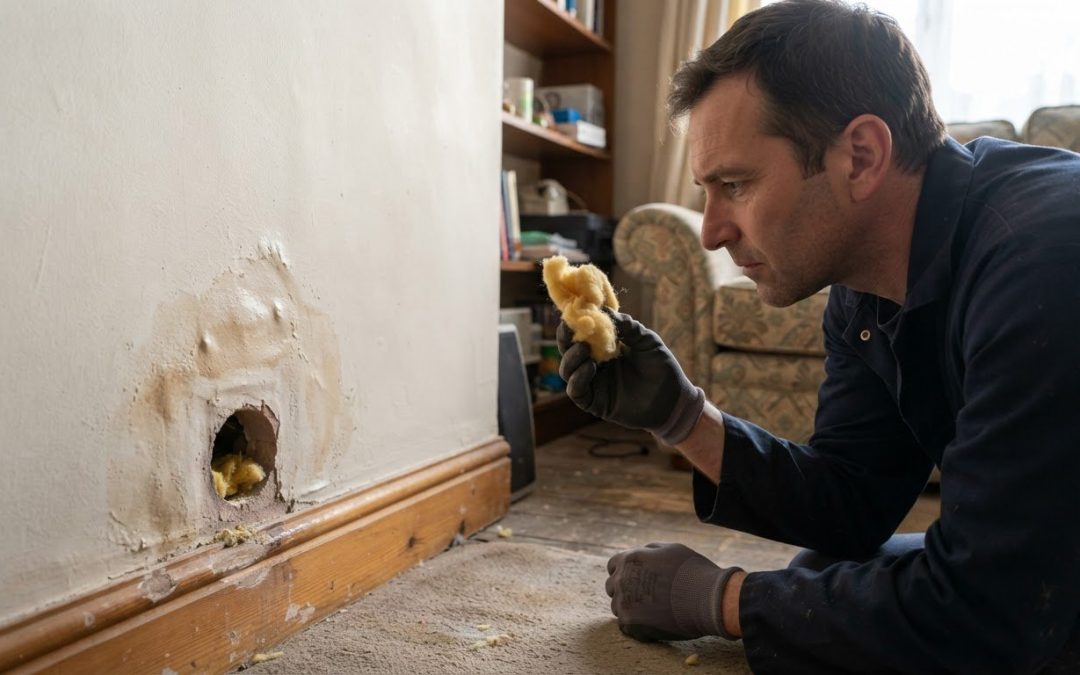
Damp beside an insulated cavity does not, by itself, prove the insulation is at fault. Signs that existing cavity wall insulation may need removal include recurring damp patches, staining or peeling paint, particularly when a specialist finds moisture, debris or unsuitable insulation inside the cavity. These clues call for investigation, not automatic removal.
It is understandable to worry when damp affects your home or a survey raises concerns. A cold room or patched drill holes can have other explanations, so the wall, symptoms and insulation need to be assessed together. This article explains the retrofit clues to look for, what a survey concern does and does not establish, and how a specialist investigates possible links between damp and cavity wall insulation before recommending whether removal is appropriate.
Key Takeaways
- Separate clues that justify investigation from evidence that supports removal; a cold room or patched drill holes alone is not proof.
- Understand how a cavity wall survey can record visible concerns and identify where further inspection may be useful.
- See why damp patterns, building condition and cavity findings need to be considered together before attributing moisture to insulation.
- Learn how a specialist assessment can help determine whether removal is appropriate or another cavity-wall issue needs attention.
- Discover when cavity wall insulation removal, a cavity wall survey or wall tie work may be a relevant next step.
Distinguishing suspected defects from confirmed cavity wall insulation removal needs
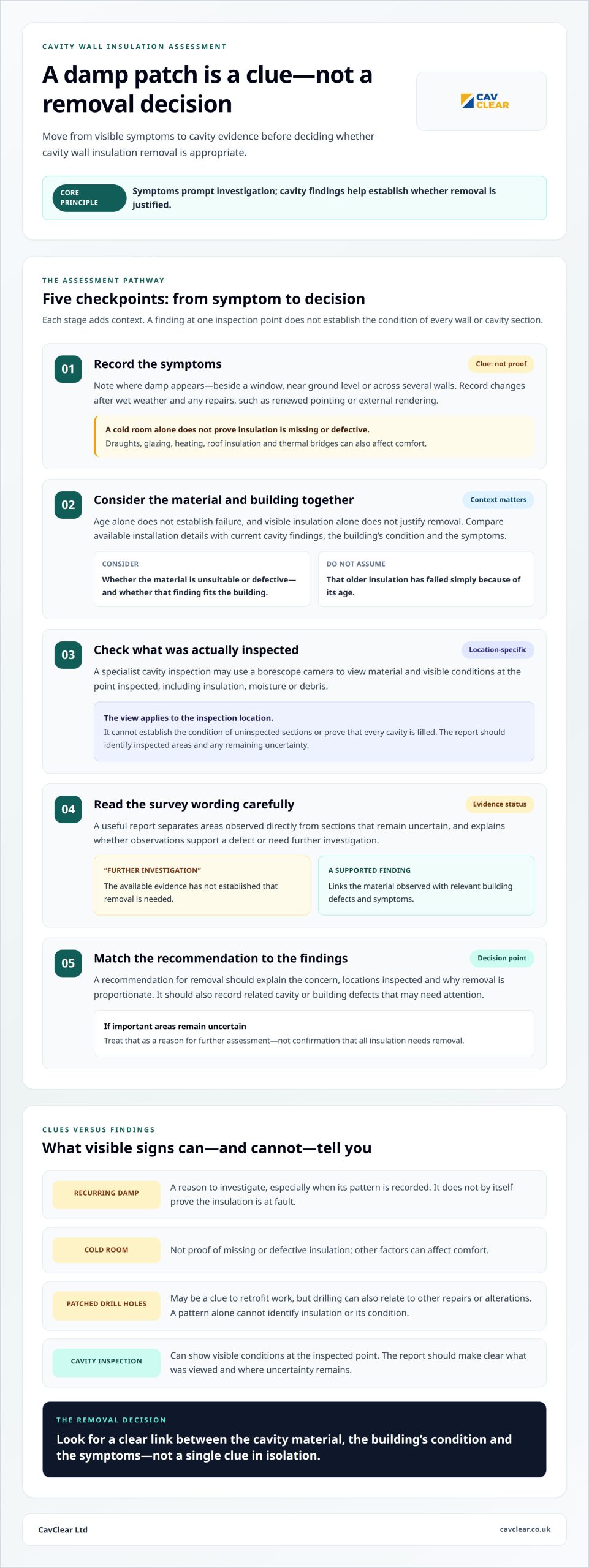
- Record each symptom before deciding what it means. Note whether damp appears beside a window, near ground level or across several walls. Include changes after wet weather and any repairs, such as renewed pointing or external rendering. Recurring moisture can be a sign that existing cavity wall insulation may need removal, but its pattern needs assessment. A cold room alone does not prove that insulation is missing or defective. Draughts, glazing, heating, roof insulation and thermal bridges can also affect comfort.
- Consider the insulation’s condition rather than relying on its age. Older material does not automatically mean failure, and visible insulation does not automatically justify removal. Record any available installation details and compare them with current findings inside the cavity. The key question is whether the material is unsuitable or defective, and whether that finding fits the building’s symptoms and condition. Signs that existing cavity wall insulation may need removal are more meaningful when supported by evidence from the cavity.
- Ask the surveyor to identify the inspection locations and evidence. A useful report distinguishes areas observed directly from walls or cavity sections that remain uncertain. For example, a concern at one inspection point cannot establish the condition of every external wall. The report should explain whether the observations support a defect or whether further investigation is needed before reaching a conclusion.
- Read recommendations carefully. “Further investigation” means the available evidence has not established that removal is needed. It is not the same as finding that the insulation is defective. Look for a clear link between the material observed, relevant building defects and the symptoms. A single cold area or damp patch, without supporting cavity findings, does not show that removal is proportionate.
- A recommendation to remove insulation should explain its reasoning. The findings should identify the concern, describe the locations inspected and explain why removal is proportionate. They should also record any other work that may be needed to address related cavity or building defects. If important areas remain uncertain, treat that as a reason for further assessment, not confirmation that all insulation needs removal.
Injection holes as clues to retrofit insulation
- Treat patched drill holes as clues, not proof. Retrofit installers may have drilled through external masonry to introduce insulation into a cavity. A row of filled holes across brickwork can therefore prompt questions about previous work. However, builders may also drill masonry for other repairs or alterations. The pattern alone cannot establish that insulation is present, identify its material or show its condition.
- Record where the patches appear and how they relate to the wall. For example, note whether filled holes form a regular pattern across one elevation or appear only around a repaired window. Scattered patches may relate to separate work. This context helps a specialist distinguish possible insulation work from other masonry repairs. Do not treat a neat-looking pattern as confirmation without an inspection.
- Bring existing property records into the assessment. Installation documents, previous surveys or records of building work may help explain patched holes on a particular wall. Compare the stated location with the visible masonry, because a record for one elevation does not establish coverage elsewhere. Missing paperwork does not prove insulation is absent either. A physical inspection is needed to assess what is present.
- A specialist cavity inspection can investigate the clue. A borescope camera can show material and visible conditions at the specific point inspected, such as insulation, moisture or debris. That view applies only to the inspection location. It cannot establish the condition of uninspected sections or prove that every cavity is filled. The report should make clear which areas were viewed and where uncertainty remains.
- Avoid disturbing the wall until a specialist has assessed it. Do not pull material through an air brick, socket or gap around a pipe, and do not drill masonry to collect a sample. If fibres or fragments appear during unrelated work, stop disturbing them and seek professional advice before continuing. Combining records, hole patterns and cavity findings gives a sounder basis for deciding whether further assessment is needed.
Patched drill holes can be clues to cavity insulation, but they can also result from other work and do not prove that insulation is present. When describing the wall to an owner, buyer or professional, report the visible patches without presenting an explanation as established. If the reason for the work is unknown, say so plainly. Records or an assessment may clarify matters, rather than allowing an assumption to influence later decisions.
Treat the observation as a question to resolve, not a conclusion on its own. Any account of the property should separate what is directly visible from what remains uncertain, and avoid implying that a particular wall has been insulated without supporting evidence. If further checks are needed, pass on the location and appearance of the patches and ensure any conclusion is tied to what was actually examined. This keeps the next step focused and avoids conclusions beyond what the masonry shows.
Interpreting survey concerns about cavity insulation
- Read an Energy Performance Certificate (EPC) as an energy record, not a cavity inspection. An EPC does not provide a detailed assessment of insulation coverage or condition. If it mentions cavity insulation, treat that entry as background information. A specialist survey is needed to examine the wall and investigate whether material is present, its visible condition and any associated concerns.
- Separate the survey’s observations from its recommendations. A report might record staining on an internal wall, patched masonry outside and insulation visible through an inspection point. These details are observations. A recommendation for further investigation means more evidence is needed before deciding what remedial work is appropriate. It does not, on its own, establish that removal is necessary.
- Check which walls and locations the survey actually assessed. A finding from one inspection point cannot describe every elevation, particularly where an extension or different construction period changes the building. For example, one homeowner reported insulation appearing dry, or drier, about 1 metre above ground. That observation describes a particular location, not the condition of every cavity or the cause of damp elsewhere.
- Look for a clear connection between cavity findings and the concern raised. A report should explain whether visible moisture, debris or unsuitable material was found, and where. It should also distinguish these findings from areas not inspected. A damp patch or an unanswered question in a survey can justify further investigation, but neither alone confirms that existing insulation is defective.
- Use the report’s evidence to decide whether further assessment is needed, rather than removing insulation as a precaution. Sound cavity wall insulation should not be removed solely to avoid hypothetical questions in a survey. Where findings identify a specific concern, further cavity investigation can establish whether removal is proportionate and what other work may be needed. The written recommendation should explain its reasoning and the areas it applies to.
A recommendation for further investigation is not confirmation that cavity wall insulation needs removal. Read it as a request to resolve an evidence gap, not as a finding that removal is already justified. The next step is to understand what prompted the recommendation, which part of the wall it concerns and what further inspection would clarify. Keep the stated finding separate from any eventual decision about remedial work. This helps prevent a provisional concern from being treated as a settled diagnosis.
Likewise, avoid transferring conclusions from one building element to another: advice about foam sprayed onto roof timbers should not automatically be applied to foam installed in a masonry cavity; the product and construction should be considered. The relevant question is what material is in the cavity and what the evidence shows about it. Keeping those distinctions clear supports a proportionate investigation and avoids treating a recommendation or advice about a different installation as proof that extraction is required.
Investigating damp linked to cavity wall insulation
Assess moisture patterns alongside cavity findings and the external wall’s condition. Signs that existing cavity wall insulation may need removal should be considered alongside other possible sources of water entry.
-
Investigating signs of damp
Map affected areas and record how the pattern changes. Note whether staining appears beside a window, below a roofline or across one section of an external wall. Record peeling paint, salt deposits and damp plaster, as well as any changes after wet weather. These details help the specialist compare symptoms with cavity findings. A single moisture reading cannot establish the cause.
-
Considering possible causes
Assess the surrounding masonry before linking damp to insulation. Record defects such as damaged pointing, gaps around openings or decayed mortar above a window. For example, damp beside a window may coincide with a defect in the mortar above its frame. Signs that existing cavity wall insulation may need removal carry more weight when cavity evidence and the building’s condition support that connection.
- Compare the moisture pattern with inspection results from relevant locations. A borescope camera can show insulation, debris or moisture where the specialist looks, but cannot establish conditions in uninspected areas. One low-level inspection point cannot represent every wall, especially if an extension or later building work has different construction. The report should identify the locations inspected and any areas not examined.
- Use thermal imaging as supporting evidence, not a standalone diagnosis. It may reveal temperature patterns across an external wall, but a cold patch cannot prove insulation is missing or explain why the area feels cold. Compare the image with cavity observations, room conditions and the building’s construction. Signs that existing cavity wall insulation may need removal should be assessed using all relevant findings.
- The assessment should connect its evidence to the proposed next step. If wet material or debris appears at an inspection point, the report should record its location and relevance to the symptoms. It should also consider other building defects and explain whether further investigation or removal is proportionate. This gives property owners a clear reason for the recommendation, rather than relying on damp alone.
Moisture risks from defective cavity wall insulation
Assess moisture risks by connecting the wall’s condition with cavity findings. Damp alone does not show that insulation is responsible.
- Consider how moisture could move through the wall. Displaced or unsuitable insulation may bridge parts of the cavity, while wet material or debris can affect the separation between the masonry leaves. For example, insulation touching damp masonry needs assessment alongside the wall’s external condition. These possibilities are reasons to investigate, not proof that insulation caused the problem.
- Compare the symptoms with the cavity inspection. If a borescope camera shows wet insulation or debris, record the exact inspection location and compare it with nearby damp patches. A finding at one point does not establish conditions across every wall. The assessment should account for extensions or different construction periods, which may create separate cavity conditions within the same property.
- Consider building defects before recommending removal. Damaged pointing, gaps around openings or defects above a window can provide other routes for moisture. For example, damp beside a window and decayed mortar above its frame may need consideration alongside wet insulation. A report should explain how each observed issue relates to the affected area, rather than assigning a single cause prematurely.
- Require a clear explanation of why removal is proportionate. The specialist should connect observed insulation conditions, moisture patterns and relevant building defects, then state what further work may be needed. Removal changes the wall build-up and can affect thermal performance, so the decision should reflect the property’s findings. Do not assume any guarantee; check the written terms for the specific work.
- Choose a UK cavity wall insulation removal specialist whose assessment records the locations inspected, direct observations and areas that remain uncertain. The report should explain why removal is recommended and identify related remedial work. This evidence-led approach helps distinguish a genuine moisture concern from a symptom with another cause. It also gives you a clear basis for understanding the proposed work and its scope.
CavClear: Cavity Wall Insulation Removal
CavClear can help when cavity findings and property symptoms point to a concern with existing insulation. Its Cavity Wall Insulation Surveys and Cavity Wall Insulation Removal address the next steps: assess the wall, record findings and recommend relevant remedial work. This keeps the decision focused on evidence from the property, rather than relying on patched masonry, a cold room or damp symptoms alone.
Where a survey identifies defective or incorrectly installed insulation, cavity wall insulation removal may be appropriate. The assessment should explain what was observed, where it was found and how it relates to the reported concern. Clear findings and recommended remedial solutions help property owners understand why removal is proposed and whether other cavity-wall work may also be needed. Removal is not an automatic response to the presence or age of insulation.
A cavity wall survey can help investigate concerns about the cavity and its existing insulation. It is relevant when a property survey raises questions, visible signs suggest previous retrofit work, or moisture problems appear alongside possible cavity defects. A written report can set out the findings and recommended next steps, helping owners, buyers and surveyors understand what the inspection observed and which areas may need further attention.
Wall concerns can also involve ties connecting the masonry leaves. CavClear carries out Wall Tie Surveys and Wall Tie Replacement, which may be relevant when survey findings identify possible failing or corroded ties alongside insulation concerns. These are distinct issues, so recommended work should follow the specific findings for the wall. Addressing the relevant cavity-wall problem supports a considered approach to the property’s condition.
For a property with signs of defective insulation, a cavity wall survey can clarify the concern before remedial work is considered. If the findings support removal, CavClear’s cavity wall insulation removal service is a relevant next step. Contact CavClear to discuss your property’s cavity wall concerns.
Frequently Asked Questions
What are the common signs cavity wall insulation has failed or needs removal?
Recurring damp, staining, peeling paint or unexplained moisture near an external wall can warrant investigation. The pattern matters: note which rooms and wall sections are affected, and whether symptoms change after wet weather or repairs. These signs do not establish that insulation has failed. A specialist needs to assess the cavity and surrounding masonry before recommending removal.
Can damp patches, mould or musty smells indicate cavity wall insulation problems?
Yes, they can indicate a moisture problem that deserves attention, but they do not identify its cause. A musty smell or mould around a window, for example, does not prove that cavity insulation is defective. A specialist assesses the affected area alongside the external wall and cavity, looking for evidence that links the symptoms to insulation rather than another building defect.
How do specialists assess whether cavity wall insulation may be causing penetrating damp?
Specialists compare the location and pattern of moisture with the wall’s condition and cavity findings. They may use a borescope camera to view insulation at selected points, while considering weather history and defects around openings or masonry. Thermal images can show temperature patterns, but cannot establish the cause by themselves. The assessment should explain how the evidence supports its conclusions.
What are the risks of leaving damaged or unsuitable cavity wall insulation in place?
If defective insulation is contributing to moisture, leaving the underlying problem unaddressed may allow damp and damage to internal finishes to persist. Moisture can also affect cavity-wall components, including wall ties, depending on the property’s condition. These outcomes are not inevitable in every insulated home. The relevant risk depends on the material, cavity findings and any other building defects identified during assessment.
How do professionals inspect cavity wall insulation and confirm whether it needs removal?
A professional inspection records where the cavity was examined and what was visible at each location. A borescope camera can reveal insulation, debris or moisture at the inspection point, but cannot show every unexamined section. The report should distinguish direct observations from remaining uncertainties, then explain whether the findings justify removal or further investigation. That gives property owners a clear basis for the next step.
Recent Comments