

Does an “urgent” survey recommendation mean you must approve work straight away? If you’re feeling pressured by a surveyor’s urgent recommendations, it’s understandable to worry about safety, damage and the consequences of waiting. But urgency in a report isn’t, by itself, a full explanation of the defect or the work needed. A Condition Rating 3 indicates a serious issue or one requiring urgent repair, replacement or further investigation. The right next step depends on the evidence and the surveyor’s findings.
You’re entitled to understand what the report establishes before deciding how to proceed. This guide explains how to separate observed defects from suspected causes, what to ask about the evidence and timing, and when a specialist inspection may help clarify the position. For cavity-wall concerns, such as possible wall-tie failure or problems linked to cavity wall insulation, a focused survey can provide more detail. CavClear carries out nationwide cavity-wall surveys and inspections, with written reports that include photographs and wall-tie condition grading. The findings can help you consider practical next steps without assuming remedial work is automatically required.
Key Takeaways
- If you’re feeling pressured by a surveyor’s urgent recommendations, identify what the report directly observed before deciding what work to approve.
- Separate the recorded condition from the surveyor’s interpretation and the proposed remedy. Each should have a clear connection to the evidence.
- Compare each option by its supporting evidence, proposed action and timing. Ask what further inspection could establish.
- Reread the report, note what remains unclear, then ask focused questions about the evidence and which areas were inspected.
- For cavity-wall concerns, specialist surveys use inspection equipment to investigate findings and document practical next steps.
Feeling pressured by a surveyor’s urgent recommendations? Start with the evidence
Alarming wording can make it hard to think clearly, especially when a report mentions safety, structural movement or urgent repairs. If you’re feeling pressured by a surveyor’s urgent recommendations, first identify what the report actually supports. “Urgent” signals that the surveyor considers an issue important, but the word alone doesn’t explain what was seen, how serious it is or what action is justified.
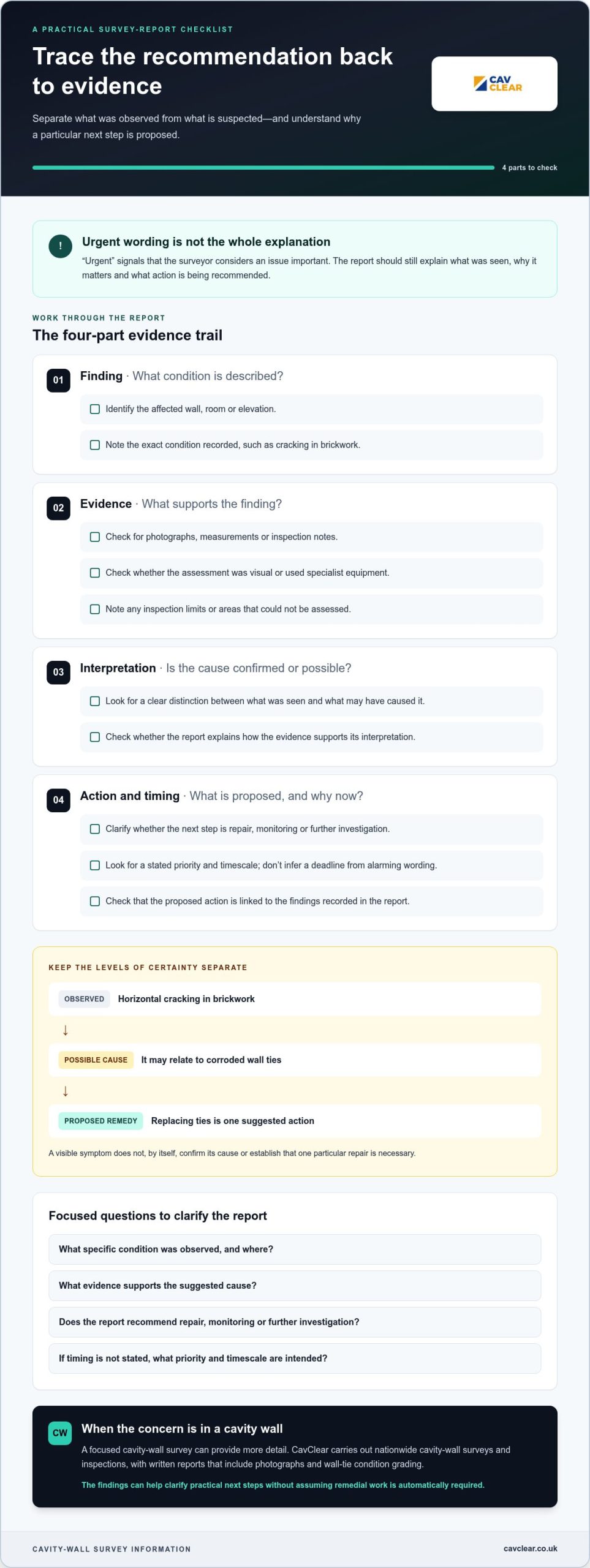
Read the finding, the surveyor’s interpretation and the proposed work as separate parts. A note describing horizontal cracking in brickwork records an observation. An explanation that the cracking may relate to corroded wall ties is an interpretation. Replacing ties is a proposed remedy. These steps should connect, but a visible symptom doesn’t automatically confirm its cause or prove that one particular repair is necessary.
A well-supported recommendation links the proposed action to specific findings recorded in the report. Look for the location and extent of a defect, photographs, inspection limitations and the reasoning behind the suggested work. If the recommendation refers to a technical standard or building code, ask which part applies to the observed condition and how it informs the proposed action. A reference provides context, but it doesn’t replace an explanation of the evidence.
What does ‘urgent’ mean in a property survey?
The report should explain what needs attention and why. A time-sensitive concern is different from a general recommendation for remedial work: the first should have a clearly stated priority, while the second may describe advised work without an immediate timescale. Don’t infer a deadline from an alarming phrase. If the report doesn’t specify timing, ask the surveyor or relevant specialist to clarify it.
Pause and identify what the report actually says
Before agreeing to work, note the exact finding, its location and the action recommended. Then distinguish what the surveyor saw from what they think may have caused it. For example, check whether the report describes cracking or confirms a particular wall defect. A survey records findings from the inspection carried out; it doesn’t necessarily confirm every suspected issue.
- Finding: What condition does the report describe, and where?
- Evidence: Does it include photographs, measurements or inspection notes?
- Interpretation: Is the cause confirmed, or described as possible?
- Action: Is the recommendation a repair, monitoring or further investigation?
This separation helps you see what is established and what remains uncertain. It also gives you focused points to clarify, without dismissing a genuine concern or committing to work before you understand its purpose and scope.
Separate survey findings, technical interpretation and recommended work
A report is easier to assess when you can follow the reasoning from what the surveyor recorded to the action they propose. The observed condition is the physical feature noted during inspection, such as a crack, staining or movement in masonry. The technical interpretation explains what might account for it. The recommended work is the proposed response. These are connected stages, but they aren’t interchangeable statements.
For example, a report might record cracking near a window, suggest that movement could be associated with a cavity-wall defect, then recommend further investigation before repair. Each step has a different level of certainty. A clear report shows what was observed, what remains a possibility and why the next action follows. It should also state when an area couldn’t be inspected or the surveyor couldn’t reach a firm conclusion.
A sound recommendation connects its proposed action to documented evidence and explains how that action addresses the recorded findings. If you’re feeling pressured by a surveyor’s urgent recommendations, check whether that connection is clear before deciding what the advice means for your property.
Which details help explain a surveyor’s conclusion?
Look for the affected area, the condition described and how the surveyor inspected it. Photographs or diagrams should identify the relevant part of the building, rather than show an unlabelled detail that’s difficult to place. Note whether the report records a direct observation or says an area needs further investigation. The RICS Home Surveys guidance can help explain what to expect from different types of home survey and their reports.
Use a simple evidence trail to check whether the proposed work has a clear basis:
- Location: Which wall, room or elevation is affected?
- Observation: What condition does the report describe?
- Inspection: Was the assessment visual, or did it use specialist equipment?
- Next step: Is the recommendation a repair, or an investigation to establish more?
A photograph of cracking can help you identify its location and compare it with the written description. It doesn’t, by itself, establish why the cracking occurred. Ask how the report moves from the visible evidence to its interpretation, and what information supports the proposed response.
Why can further investigation come before remedial work?
Some cavity-wall concerns can’t be clarified by viewing the external surface alone. A borescope or endoscope camera can show part of the cavity, while other inspection equipment may help assess wall ties. Each method has limits: an image or reading adds evidence, but doesn’t automatically establish every cause or determine the full remedy.
A specialist cavity-wall survey can document relevant findings and help distinguish a suspected defect from one supported by inspection. CavClear’s trained technicians use calibrated metal detectors, borescope or endoscope cameras and wall-tie locators. Reports include photographs and wall-tie condition grading. If the concern involves cavity walls, a specialist cavity-wall survey can provide a focused assessment of the property’s findings.
Compare the urgency, evidence and scope of each proposed option
A recommendation is easier to assess when you compare what the report records with what it proposes and when it says action is needed. This isn’t about dismissing professional advice. Clarifying the evidence or arranging further inspection can be part of acting on a recommendation, particularly when the cause is unresolved.
Use a simple comparison to organise the information. Fill in each row using the report or a clear explanation of its findings. If a detail is missing, mark it for clarification rather than guessing.
Compare options only when the findings give a sound basis for doing so. If the report recommends investigation because the cause is uncertain, comparing repair methods may be premature. First establish what the investigation could clarify. If the evidence supports more than one response, compare how each addresses the stated condition, what work it involves and what assumptions it relies on. Don’t treat a symptom alone as proof that a particular repair is required.
Asking questions doesn’t mean rejecting the recommendation. It can help identify the right next step and avoid approving work that goes beyond the findings. If the report describes a time-sensitive concern, take that wording seriously and seek clarification promptly. Don’t let a comparison exercise delay action the surveyor has said is needed without delay. Ask what the risk is, what needs attention first and whether further investigation can happen alongside any immediate precautions they’ve advised.
How to assess whether the proposed scope follows the findings
Check each proposed item against a specific finding: what condition does it address, and where? Note any assumed cause, inaccessible area or unresolved question. If work is recommended for a wall, for example, but the report describes only cracking and doesn’t establish its cause, ask what evidence connects the proposed repair to that cracking. Keep the comparison factual and don’t infer a defect from a visible symptom alone.
When cavity-wall concerns need specialist context
Damp, cracking and movement can have different possible explanations. A visual sign alone can’t confirm wall-tie condition or establish whether cavity wall insulation is contributing to a problem. Those questions need relevant inspection evidence. For suspected wall-tie issues, a specialist survey can assess tie condition before replacement is considered. Cavity wall insulation removal should likewise follow evidence that removal is appropriate for the property, rather than being treated as a routine response.
Questions to ask before acting on urgent survey advice
A clear explanation can help you decide what to do without losing sight of a genuine time-sensitive concern. If you’re feeling pressured by a surveyor’s urgent recommendations, use a short, orderly process: return to the report, identify what you don’t understand, ask focused questions and keep a record of the answers. This clarifies the recommendation; it isn’t a reason to ignore it.
- Reread the relevant section. Note the exact finding, location, stated level of urgency and recommended action.
- List the uncertainties. Separate questions about the evidence, suspected cause, scope of work and timing.
- Request an explanation. Ask the surveyor to connect the recommendation to the recorded observations.
- Record the response. Keep written clarifications and note any next steps or unanswered questions.
Questions that make an urgent recommendation clearer
Ask which specific findings make the work urgent and what evidence supports that assessment. Clarify whether the report identifies a confirmed defect or recommends investigation because the cause is uncertain. Ask which areas were inspected, which could not be accessed and which parts of the proposed work directly address the stated finding. The answers can help distinguish an immediate concern from a recommendation that needs more investigation first.
If timing isn’t stated, ask what could happen if action is delayed and whether the surveyor recommends interim precautions. Don’t assume a particular timescale or risk. Ask for the basis of the advice and explain if circumstances have changed since the inspection. Where the report describes a concern as time-sensitive, seek clarification promptly so questions don’t become a reason to postpone appropriate action.
Keep a clear record of explanations and next steps
Save the report, photographs and any written clarifications together. Record who answered each question, what they said and whether they recommended further investigation, remedial work or another step. Before deciding on a repair, list anything that remains unanswered, such as the exact area affected or how the proposed scope relates to the findings. If damp is noted, keep that observation separate from an assumed cause until the evidence supports a conclusion.
This record gives you a practical basis for discussing the recommendation and considering next steps. If the concern relates to a cavity wall, a specialist inspection can clarify relevant findings without assuming remedial work is automatically required. CavClear’s specialist cavity-wall inspections use appropriate equipment and produce documented findings, including photographs and wall-tie condition grading where relevant. Explore specialist cavity-wall inspections when the report raises a cavity-wall question.
How a specialist cavity-wall survey can clarify the next step
A general property survey may flag a cavity-wall concern without resolving what is happening within the wall. A specialist cavity-wall survey focuses on the issue raised and helps determine whether the available evidence supports a particular next step. It isn’t an automatic endorsement of remedial work. Its purpose is to investigate the reported concern and provide property-specific information to inform your decision.
The inspection is guided by the question that needs answering. For example, a report might raise uncertainty about wall ties or the condition of cavity-wall insulation. A focused assessment can examine the relevant system and distinguish findings from matters that remain uncertain. Results depend on the areas accessible and the evidence gathered, so an inspection shouldn’t be treated as a guaranteed diagnosis of every suspected defect.
What a specialist cavity-wall inspection can examine
If the report raises a concern about wall ties, an inspection can assess their condition and help establish whether further action is supported. If the question relates to cavity-wall insulation, the assessment can investigate whether there is evidence of a problem. Damp, cracking or movement alone doesn’t confirm the cause. Cavity wall insulation removal should only be considered when inspection indicates that the insulation is defective, damp or causing issues, not as a routine response.
A useful outcome may be a clearer understanding of what is established, what needs further investigation and whether remedial work is appropriate. The specialist’s findings should inform recommendations, rather than assume the same solution suits every property. This helps you discuss the scope of any proposed work in relation to the concern that prompted the inspection.
A clear report before deciding on remedial work
After the survey, use the written findings to consider whether the reported concern has been clarified and what action, if any, is supported. Where recommendations are made, look for a clear connection between the inspection results and the proposed response. If an important question remains unresolved, ask what further evidence would be needed before proceeding. This gives you a practical basis for deciding without treating remedial work as automatic.
If remedial work is recommended after the survey, CavClear can provide a property-specific quotation where required. The survey scope depends on the concern being investigated and the property. If you need a focused assessment of a cavity-wall concern, book a specialist survey with CavClear to get clearer information about the property before deciding what to do.
Take the next step with confidence
Feeling pressured by a surveyor’s urgent recommendations can make a property decision feel immediate. A useful next step addresses the uncertainty in the report and helps you understand what action the evidence supports. If cavity-wall concerns remain unclear, a specialist survey can provide a focused assessment before you decide whether remedial work is appropriate.
CavClear is a member of the Wall Tie Installers Federation and provides specialist cavity-wall inspections nationwide across the UK. The inspection can help you understand the condition of relevant systems and consider the options that follow, with the long-term care of your property in view.
If you’d like to investigate a cavity-wall concern, arrange a specialist cavity-wall survey with CavClear. The findings can help you decide on a practical next step.
Frequently Asked Questions
Can I ask a surveyor to explain why a recommendation is urgent?
Yes. Ask which recorded findings support the urgency, what areas were inspected and what action the report recommends. If it uses unfamiliar terms, ask for a plain-English explanation and whether the conclusion is based on a direct observation or a possible cause. For example, ask what “further investigation” is intended to establish. Keep the reply with the report so you can refer to it when considering the advice or discussing the next step.
Does an urgent recommendation prove that a property has a serious defect?
No, not by itself. Urgent wording describes the recommendation, but the report’s evidence and reasoning explain what was observed and why action is suggested. Read the relevant text alongside photographs and notes about inspection limits. If you’re feeling pressured by a surveyor’s urgent recommendations, check whether the report confirms a defect or describes a possibility. A visible symptom, such as a patch of damp, doesn’t alone prove a particular underlying cause.
What should I do if a survey report gives no evidence for urgent work?
Ask the surveyor to point to the specific observations that support the proposed work and explain how they relate. Check whether the report identifies the inspection method, relevant locations and any areas that couldn’t be inspected. For example, a recommendation about one elevation should make clear which finding there it addresses. An explanation missing from the report doesn’t automatically make the recommendation incorrect, but it’s sensible to resolve the gap before deciding on the work.
Can a cavity-wall inspection help explain cracking or damp mentioned in a survey?
It can help if the reported concern may involve wall ties or cavity-wall insulation. A specialist can examine relevant parts of the cavity using suitable equipment and document what the inspection shows. This may add detail that a visual survey couldn’t establish, such as whether a concern warrants further investigation. Cracking and damp have different possible causes, however, so inspection findings should guide any explanation rather than treating either symptom as proof of a cavity-wall defect.
Should I agree to cavity wall insulation removal because a report recommends it urgently?
Consider the recommendation alongside the evidence and its stated reason for urgency. Cavity wall insulation removal isn’t routine for every insulated property. It’s considered where inspection indicates the insulation is defective, damp or causing issues. Ask what property-specific findings support removal and whether the report has established the condition of the insulation. If the cause remains uncertain, further cavity inspection may help clarify whether removal is appropriate before you decide on remedial work.
How quickly must wall-tie replacement be carried out after a survey?
There’s no single timeframe that applies to every property. The reported tie condition, survey evidence and work required all matter. If the report gives a timescale, ask what findings support it and whether any interim action is advised. Where the report identifies possible wall-tie deterioration but doesn’t establish its extent, a specialist wall-tie survey can provide more property-specific information to inform the decision and proposed scope of replacement.
Can I get a specialist survey before deciding on the recommended work?
Yes. A specialist cavity-wall survey can be arranged before you decide whether to proceed with remedial work. When booking, share the relevant survey extract and identify the wall or concern it refers to, such as suspected wall-tie deterioration or insulation-related damp. This helps define the question the inspection needs to address. CavClear carries out specialist cavity-wall inspections, and the findings can help you consider an appropriate next step for the property.
Recent Comments