
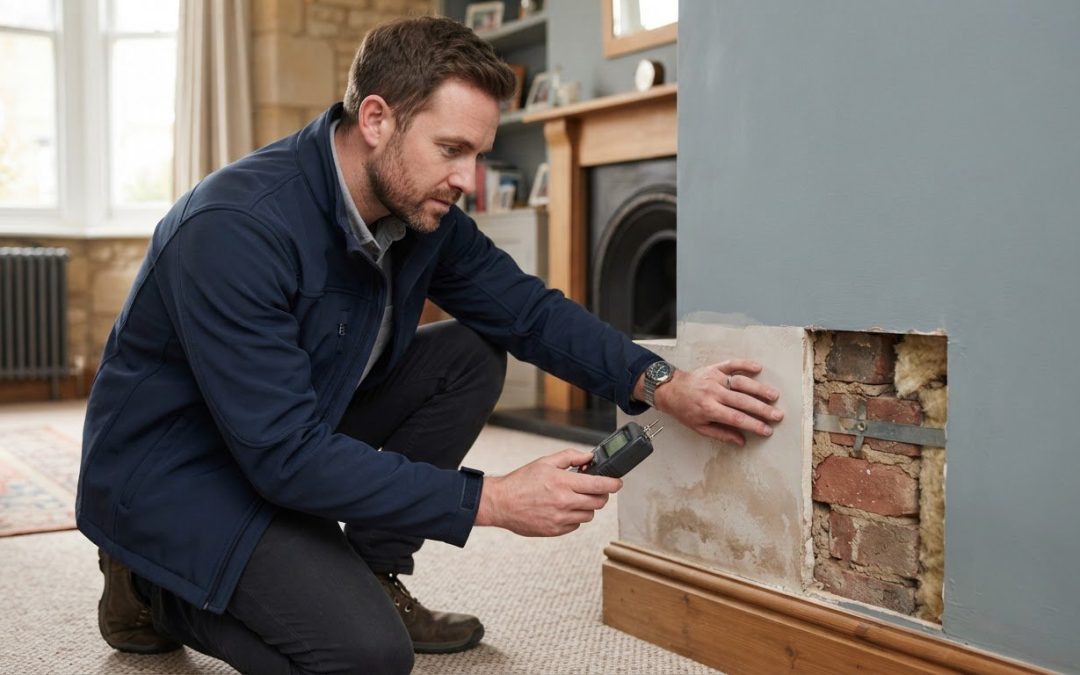
What if damp described as rising damp is coming from a defect in the cavity wall instead? Low-level patches and damaged plaster can be worrying, especially when you’re being asked to commit to remedial work before the cause is clear. A second opinion on a rising damp diagnosis can help test whether the explanation fits the evidence.
It’s reasonable to want more than a damp-meter reading or a label before deciding what your property needs. A sound assessment should explain the visible symptoms, consider other possible moisture sources and show how the recommended remedy addresses the identified cause, not just the damage.
This guide explains what evidence to review and what information to gather before arranging another assessment. It also outlines how condensation, leaks, external defects and cavity-wall problems can produce similar signs. Where damp may be linked to wet or defective cavity wall insulation, or corroded wall ties, a specialist cavity-wall investigation can help establish what is happening before remedial work is chosen.
Key Takeaways
- A second opinion on a rising damp diagnosis should review how the evidence supports the explanation, not simply revisit the suggested treatment.
- Look for an assessment that connects several observations and findings to the moisture symptoms, rather than relying on one sign or instrument reading.
- Use the location and pattern of damp as clues when comparing possible causes, not as proof of a diagnosis.
- Gather the original report, photographs and a timeline of changes to help make another assessment more informed.
- When observations point to the cavity wall, a specialist survey can investigate whether insulation or wall ties may be relevant.
Why seek a second opinion on a rising damp diagnosis?
Being told that damp is rising from the ground can leave you unsure what to do next, particularly if the recommended work is substantial or the explanation doesn’t fit what you can see. Wanting a clearer account is reasonable. A second opinion on a rising damp diagnosis isn’t an accusation that the first assessor was wrong. It’s an opportunity to review how the observations support the diagnosis and whether other possible moisture sources have been considered.
A diagnosis should connect the building’s symptoms to a plausible cause. That means recording where damp appears, what was observed inside and outside, and how those findings led to the recommendation. Background on Damp (structural) can help explain the different forms moisture may take, but general information can’t establish what’s happening in an individual property.
When is another assessment worth considering?
Consider a further assessment if the explanation is unclear, the inspection findings seem inconsistent with the visible symptoms, or important parts of the building weren’t examined. For example, a report may identify rising damp without explaining why moisture is concentrated in one area or how the observed pattern supports that conclusion. These are reasons to ask how the assessor reached their view, not proof that it is incorrect.
The proposed treatment should address an identified moisture source. If a recommendation focuses on the wall but the report doesn’t explain how the cause was established, it’s sensible to seek clarification before deciding what work to proceed with. A fresh review may also be useful if symptoms have changed since the inspection or the records don’t show what was checked. Another assessor can consider whether the available evidence explains the property’s current condition.
What a second opinion can and cannot establish
A fresh assessment can review the original observations, examine areas where symptoms are present and consider other plausible sources of moisture. These might include water entering through an external defect, condensation, a plumbing leak or a cavity-wall issue. Which possibilities are relevant depends on the property and the evidence. The aim is to test explanations methodically, not to replace one assumption with another.
No article can determine the cause in a property that hasn’t been inspected, and a further assessment doesn’t have to contradict the first. It may support the original conclusion, identify unanswered questions or indicate that another source needs investigation. In each case, the useful outcome is a clearer link between the evidence, the likely cause and any proposed next step.
A second opinion shouldn’t be used to put off necessary investigation, especially if damp is worsening or there are signs of an active leak. Instead, it can help you make a better-informed decision about what needs attention and why. If the findings point towards the cavity, a specialist cavity-wall survey can provide a focused investigation of that part of the building.
What evidence should support a rising damp diagnosis?
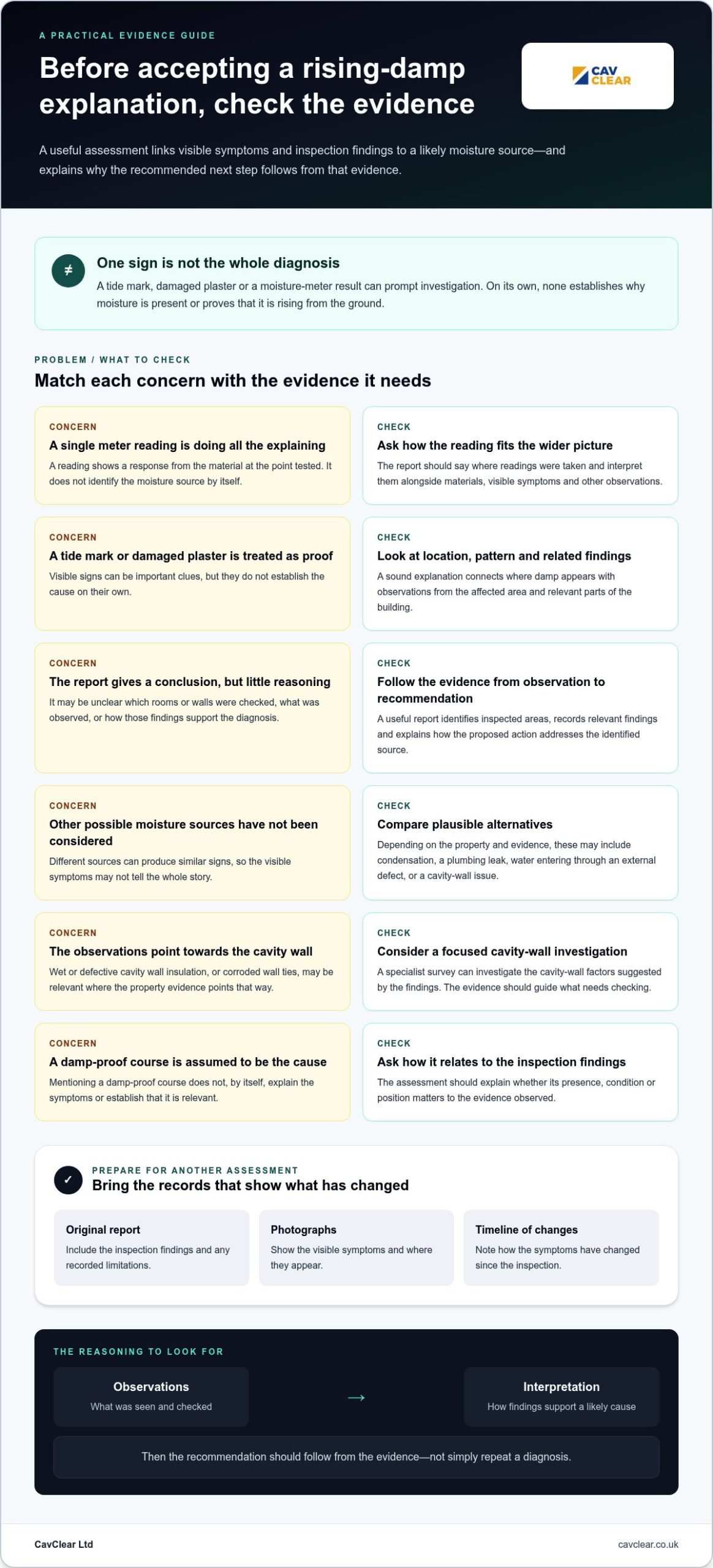
A diagnosis should be based on the combined observations and findings used to explain moisture in a building. These may include the location and pattern of damp, the condition of relevant surfaces, external features and moisture readings. A visible tide mark or a single meter result can prompt further investigation, but neither should be treated on its own as a complete explanation of the cause.
Damp diagnosis should consider the building evidence as a whole, not rely on one symptom or reading. This matters before remedial work is selected. The assessment should connect what was observed to why those findings point to rising damp, then explain how the recommended action addresses the identified source.
What should an inspection record explain?
A useful report should identify the areas inspected and describe relevant observations clearly enough for you to understand how the conclusion was reached. Check whether it states which walls or rooms were examined, where damp or damage was seen, and whether relevant external features were considered. The findings should support or challenge the proposed diagnosis, rather than simply repeat its name.
Look for clear notes about limitations. If an area couldn’t be accessed or a particular check wasn’t carried out, the report should say so and explain how this affects the assessment. Missing information doesn’t automatically make a diagnosis incorrect, but it can show where questions remain.
Why moisture readings need context
Moisture readings can add useful information, but they need to be interpreted alongside the building’s materials, condition and visible symptoms. A meter reading shows a response from the material at the point tested. By itself, it doesn’t establish why moisture is present or prove that it is rising from the ground. The assessor should explain where readings were taken and how they relate to other observations.
If the explanation refers to a damp-proof course, it should clarify what this means. A damp-proof course, often shortened to DPC, is a layer in a wall intended to limit moisture moving upwards from the ground. The report should explain whether its presence, condition or position is relevant to the findings, rather than assuming that a problem with it is the cause.
As you review the evidence, look for a logical sequence: observations first, interpretation next, then a recommendation that follows from both. If the report recommends treatment but doesn’t show how the source was identified, ask for the reasoning to be explained. If damp may involve a cavity-wall problem, a specialist cavity-wall survey can provide a focused investigation of that part of the building.
How to compare rising damp with other possible moisture sources
Damp patches can look similar even when their underlying causes differ. Their position and pattern can help guide an investigation, but appearance alone can’t confirm a diagnosis. Use the comparison below to organise questions for a second opinion on a rising damp diagnosis, not as a substitute for inspecting the property.
| Possible source | Clues to investigate | What needs explaining |
|---|---|---|
| Rising damp | Moisture or deterioration concentrated near the base of a wall may prompt investigation. | Whether the evidence is consistent with moisture moving upwards from the ground, and whether other sources have been considered. |
| Penetrating damp | Damp that appears after wet weather, or near an external wall defect, may warrant checks to the building fabric. | Whether water could be entering through defects such as damaged pointing, cracks, or faulty gutters and downpipes. |
| Condensation | Moisture on cooler surfaces, such as windows or external walls, may be associated with humid indoor air. | Whether indoor moisture, ventilation and colder surfaces help explain where and when the symptoms appear. |
How do common moisture sources differ?
Rising damp is a diagnosis that needs findings consistent with moisture movement from below. Penetrating damp involves water entering through or across the building fabric, while condensation forms when humid indoor air meets a cooler surface. These descriptions point to different lines of investigation. None of the clues in the table proves a cause on its own.
More than one source may affect a property at the same time. For instance, a leak could cause localised damp while condensation develops elsewhere. A sound assessment should consider whether one explanation accounts for all the observations or whether separate areas need to be understood independently.
When might a cavity-wall issue be relevant?
A cavity-wall investigation may be appropriate if inspection findings point towards moisture crossing the wall cavity, or if there are signs consistent with wet or defective cavity wall insulation. Wall tie deterioration may also warrant investigation where relevant evidence, such as cracking to external mortar joints, indicates a possible cavity-wall concern. These are prompts for further checks, not a diagnosis.
Damp symptoms alone do not establish a cavity-wall defect. A specialist cavity-wall survey can be a focused next step when the evidence makes that part of the building relevant. Depending on the findings, further investigation may consider cavity bridging, insulation condition or wall ties before remedial action is selected.
How to prepare for a second opinion on rising damp
A little preparation can make another assessment more focused. Bring together what has already been observed, when symptoms appeared and how they have changed. This gives the assessor a clearer picture of the property’s history without asking you to diagnose the cause yourself. It also makes it easier to compare the original reasoning with new findings.
Use this short sequence to organise the information:
- Collect existing documents. Include the original survey report, earlier damp assessments, relevant repair records and any property plans you have. Keep them together so the assessor can review what was inspected and recommended.
- Gather dated photographs. Photograph visible marks, damaged plaster or mould, and note the room and wall shown. Images taken over time can help record whether a symptom has spread, faded or reappeared.
- Write a brief timeline. Note when you first noticed the issue and any changes since then. Record relevant events such as a leak, repair or alteration, but don’t assume that an event caused the damp.
- Describe the pattern. Record where symptoms occur and when they’re most noticeable. For example, note whether a patch appears after wet weather or whether condensation is present on a particular surface. Treat these as observations, not conclusions.
Keep the original report, photographs and timeline in one place. If you’re also reviewing other survey documents, a professional damp survey guide can help explain the types of information a report may contain. The key is to give the assessor the underlying records rather than relying on your memory of what was said.
Questions that help clarify the findings
Use clear, open questions to understand how the assessment was reached. Ask which observations support the diagnosis, what other possible moisture sources were considered, and which areas were inspected. If any locations couldn’t be accessed, ask how that limitation affects the findings. You can also ask how each recommended action relates to the moisture source identified in the report.
These questions keep the discussion centred on evidence and reasoning. They don’t imply that an earlier assessment was wrong. They help you understand its basis and identify any gaps that another inspection should address. A useful report should distinguish observed facts from interpretation and explain how the proposed next steps follow from the findings.
If the evidence raises a cavity-wall concern, a specialist survey can focus on that part of the building. CavClear carries out damp and mould surveys where cavity-wall problems may be relevant, along with cavity-wall inspections. Arrange a specialist cavity-wall survey when the observations indicate that further investigation of the cavity is appropriate.
When CavClear can investigate cavity-wall factors
A cavity-wall investigation is relevant when observations point towards that part of the building, not simply because a property has damp. For example, inspection findings may raise questions about moisture crossing the cavity, the condition of cavity wall insulation or cracking that could warrant a wall tie assessment. These signs are prompts for focused checks, not proof of a defect.
CavClear undertakes damp and mould surveys where cavity-wall problems may be relevant. A cavity-wall inspection can help assess reported symptoms in the context of the wall construction and the available evidence. The purpose is to establish whether a cavity-wall factor warrants attention, rather than assume it explains every damp patch.
What a cavity-wall-focused survey can consider
Where insulation is present and concerns about its condition are supported by the observations, an inspection can help assess whether it may be contributing to moisture issues. If findings indicate that insulation is defective, cavity wall insulation removal may be considered as a remedial option. The appropriate response depends on the property and the inspection findings. A guide to cavity wall insulation removal explains the service when insulation concerns form part of the investigation.
Wall ties are another distinct consideration. These components connect the inner and outer parts of a cavity wall. If relevant evidence points to deterioration, a Wall Tie Survey can assess the concern, with Wall Tie Replacement considered only where findings support it. Damp symptoms alone don’t establish that insulation or wall ties are defective, and no specific property can be diagnosed without inspection.
Survey findings should guide recommendations. They may indicate that a cavity-wall factor is relevant, that another source needs attention, or that further checks are appropriate. This evidence-led approach helps avoid assuming that a cavity-wall issue is the cause, while ensuring it isn’t overlooked when observations point in that direction.
How CavClear can support the next step
CavClear provides specialist cavity-wall inspections and remedial services nationwide throughout the UK. The company is a member of the Wall Tie Installers Federation and is TrustMark registered for cavity wall insulation removal. These credentials relate to its cavity-wall work; they don’t replace an inspection of the specific property or predetermine what work may be suitable.
If your second opinion on a rising damp diagnosis raises a cavity-wall question, a focused survey can help assess that part of the building before you decide on remedial action. Arrange a relevant CavClear survey when the available observations make cavity-wall investigation a reasonable next step.
Take the next step with confidence
Deciding what to do about damp is easier when the next step is proportionate to what the building’s evidence shows. You don’t need to settle on a cause before seeking further investigation. If cavity-wall factors remain a possibility, a focused inspection can help establish whether they warrant attention and what the findings support.
CavClear’s specialist work focuses on cavity-wall issues, including inspections and relevant remedial services. The aim is to give property owners a clearer basis for decisions about their home. A second opinion on a rising damp diagnosis can be a practical step towards understanding whether cavity-wall investigation is relevant to your property.
Discuss a cavity-wall survey with CavClear to explore that next step. With a clearer understanding of the building, you can make a more informed decision about what to do next.
Frequently Asked Questions
Can a damp meter prove that a property has rising damp?
No. A meter reading alone can’t establish the source of moisture. The result may be affected by the material tested and conditions at that location, so it needs careful interpretation. If a report relies heavily on readings, check whether it explains where they were taken and how they relate to other observations. A single high result shouldn’t be treated as proof that moisture is rising from the ground.
How do I know whether a rising damp diagnosis is correct?
You can’t confirm a diagnosis from a photograph or description alone. Review whether the assessment explains the reasoning behind its conclusion and whether that reasoning fits the property’s condition. A second opinion on a rising damp diagnosis can help clarify unanswered points, particularly if the suggested work seems disconnected from the findings. A fresh assessment may support the original view or identify questions that need further investigation.
Can condensation be mistaken for rising damp?
Yes, damp-related marks can have different causes, and condensation may be confused with other forms of moisture. For instance, recurring water on a window or a cold surface may be linked to indoor humidity, but that clue isn’t conclusive. Consider whether symptoms vary with room use, ventilation or colder conditions, and share those observations during an assessment so they can be weighed against other evidence.
What should I do if two damp assessments reach different conclusions?
Compare the reasoning in each report rather than treating disagreement as proof that either assessment is wrong. Note which observations each assessor relied on and whether they examined the same areas. If a report leaves a question unanswered, ask for its basis to be explained. You can then decide whether another focused investigation is needed, especially if the assessments differ on the likely source or recommended next step.
Can cavity wall insulation cause damp problems in every property?
No. Cavity wall insulation doesn’t cause damp in every property, and its presence alone isn’t evidence of a defect. If symptoms coincide with signs of water entering the external wall, an inspection may consider whether moisture could be crossing the cavity or whether insulation condition is relevant. Any decision about cavity wall insulation removal should follow findings from the specific property, not a general assumption.
Should I start remedial work before getting a second opinion?
If the proposed work is significant and the cause remains unclear, it can be sensible to understand the evidence before committing. However, don’t ignore an active leak or rapidly worsening damage while waiting for another assessment. Keep records of any urgent repairs and tell the assessor what was done and when. This context can help distinguish the current condition from earlier symptoms.
How can I get a second opinion on a damp diagnosis across the UK?
Start by preparing the property postcode, the existing report and a short description of the issue. Include photographs and note when symptoms first appeared or changed. This information helps focus the assessment and makes it easier to discuss what remains uncertain. If the report raises cavity-wall concerns, state that clearly so the survey can focus on those findings.
Recent Comments