
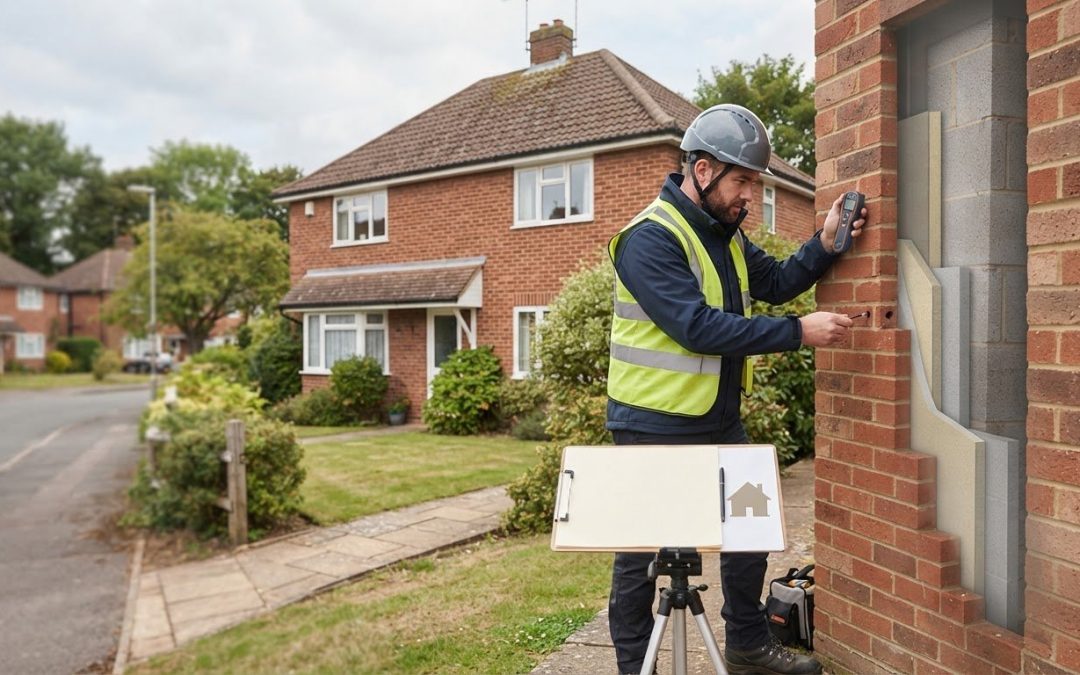
What if a refusal linked to cavity wall insulation means the property evidence needs clarification, rather than that your home cannot qualify? If you’re wondering whether equity release refused cavity wall insulation means the property can’t qualify, the answer depends on what the valuer identified, not simply on the presence of insulation.
It’s understandable to feel uncertain when a lender raises concerns about damp, the wall condition or construction. A valuation may prompt questions about insulation if there are signs of moisture, deterioration or another issue affecting the property. However, the cause needs proper assessment, and removal isn’t automatically the right answer.
This guide explains why cavity wall insulation may prompt further questions, what records and inspection findings can help clarify the concern, and when a specialist cavity wall survey or remedial work may be appropriate. CavClear Ltd carries out nationwide cavity wall inspections, cavity wall insulation surveys and wall tie surveys, with reports setting out findings and recommended next steps. The aim is to help you understand the property evidence and the options that follow.
Key Takeaways
- An equity release refusal linked to cavity wall insulation may reflect findings about a particular property, not a universal rule about insulated homes.
- Understand what the valuer or lender recorded before deciding whether more evidence or remedial work is needed.
- Damp, cracking and movement can have different causes. Visible symptoms alone don’t confirm an insulation defect or failing wall ties.
- If equity release refused cavity wall insulation is the concern, a specialist cavity wall survey can help establish what is happening within the wall.
- Use inspection findings to decide whether cavity wall insulation removal, a wall tie survey or another next step is appropriate for your property.
Why might equity release be refused because of cavity wall insulation?
A refusal that mentions cavity wall insulation can be difficult to interpret. An application may be paused or refused because of findings about the individual property, such as concerns about damp, wall condition or construction. The reference to insulation may point to something that needs clarification. It doesn’t, by itself, prove that the insulation is defective or that every insulated home is unsuitable.
A cavity wall has two masonry leaves separated by a gap, or cavity. For a basic explanation, see What is a cavity wall? During an equity release assessment, the property’s condition matters because the lender needs to understand the home’s value and whether an issue could affect its future sale. The outcome depends on the assessment and the lender’s criteria for that case.
An insulation-related property concern is a question raised by an observation or assessment finding. A confirmed defect is a problem supported by inspection evidence. A note about possible moisture or insulation condition is not, on its own, a diagnosis.
What might a property assessment raise about cavity wall insulation?
An assessment might record damp, mould, cracking or another concern, then ask whether the cavity or insulation is relevant. These signs can have different causes, so they don’t establish that insulation is responsible. The reason given for a refusal or pause should guide what evidence is needed. For example, a general note about damp may need further investigation before anyone can determine whether the cavity wall is involved.
The condition of the insulation or cavity may also prompt questions. A specialist inspection can help establish what is present and whether the findings support a remedial recommendation. The appropriate response should follow the evidence, not an assumption based only on the presence of insulation.
Does cavity wall insulation automatically prevent equity release?
No. The presence of insulation doesn’t, by itself, prove a defect or determine whether an application will be accepted. Decisions are case-specific and depend on the assessment findings, including any confirmed damp or structural concerns.
If you’re facing an equity release refused cavity wall insulation decision, first understand exactly what the assessment recorded. A specialist cavity wall survey may clarify the property evidence, but neither a survey nor remedial work guarantees a different lending decision. Removal isn’t automatic. Any recommendation, including cavity wall insulation removal, should be based on inspection findings for your property.
How cavity wall insulation concerns can affect a property assessment
A property assessment brings together observations about the home’s condition and any concerns that may affect its value or future sale. If cavity wall insulation is mentioned, the key questions are what the assessor observed and whether further evidence is needed. The approach varies by case. Insulation alone doesn’t establish a defect or dictate an outcome.
Damp, mould, cracking or movement may prompt questions, but these are observations, not diagnoses. Moisture might relate to the cavity, but it can also have other causes. Cracking may need investigation before anyone can determine whether it relates to wall ties, another structural issue or something else. A visible symptom is a reason to investigate, not proof of a cavity-wall defect.
What can damp, mould, or cracking indicate, and what can’t they prove?
These signs can help identify where further checks may be useful, but no single symptom confirms failed or wet insulation. An assessment may note the location and appearance of a concern. A suitable specialist inspection considers the wall construction and other relevant evidence. Conclusions about insulation, wall ties or structural movement should follow investigation, not assumption.
For example, a patch of internal damp doesn’t show by itself that moisture has travelled through the cavity. Likewise, a crack in brickwork doesn’t confirm wall tie corrosion. Clear findings distinguish what has been observed from what has been established.
Why might wall ties be considered during a cavity-wall investigation?
Wall ties connect the inner and outer leaves of a cavity wall. If inspection evidence or signs such as cracking make them relevant, their condition may be investigated. Corrosion or deterioration can affect their performance, but an assessment must establish whether this is present at the property. A wall tie survey can clarify the findings and whether wall tie replacement is recommended. Further background is available in a wall tie replacement guide.
A cavity-wall investigation may consider the insulation, the condition of the cavity and, where relevant, the wall ties. These checks help avoid treating different problems as if they had the same cause or remedy. If equity release refused cavity wall insulation concerns have been raised, use the assessment wording to identify what evidence would address the specific question.
A specialist cavity wall inspection can provide findings and recommended next steps for the property. CavClear’s cavity wall inspections are available nationwide across the UK, with reports setting out inspection findings and remedial recommendations where appropriate.
Cavity wall insulation issue or another property concern: what evidence matters?
Damp, cracking or a note about insulation can point to a question that needs investigating, but none identifies the cause on its own. Useful evidence is specific to the property: what was observed, where it occurs and what a suitable inspection finds within the wall. The table below can help organise questions for investigation. It’s a guide, not a diagnosis.
| Observation | Possible explanations | Evidence that may help |
|---|---|---|
| Internal damp or mould near an external wall | A cavity or insulation concern, penetrating moisture, or another source | Location and pattern of the affected area, property history, and relevant inspection findings |
| Cracking to external brickwork | Wall-tie deterioration, movement, or another cause | Crack pattern and condition of the masonry, with a wall-tie survey where indicated |
| Concern about insulation or the cavity | Insulation condition, cavity condition, or a concern not caused by either | Cavity wall survey findings, including observations of the insulation and cavity where accessible |
| Moisture on or around an external wall | Penetrating damp or another moisture source | Assessment of the affected area and relevant external and internal conditions |
How can an inspection clarify the cause of a concern?
A cavity wall survey examines relevant wall and cavity conditions to establish what is present. Depending on the property and the question being investigated, a specialist may consider a borescope inspection through a small access point or a local opening. The appropriate method depends on the circumstances and should be explained in the inspection findings.
Evidence can distinguish a suspected issue from a confirmed one. For example, a report might record a visible symptom separately from what was found in the cavity. If damp is the concern, guidance on cavity wall insulation and concerns about damp offers further context, but it cannot diagnose an individual property. A cavity wall insulation removal guide can explain the specialist service. Removal should only be considered when findings support it.
When might a wall-tie survey be relevant?
A wall-tie survey may be appropriate when cracking or signs of movement make the condition of the ties relevant. It assesses the wall ties without assuming they have failed. Findings can establish whether deterioration is present and whether wall tie replacement is recommended. A wall tie replacement guide can provide more background on this remedial work.
If equity release refused cavity wall insulation is the recorded concern, use the assessment wording to focus the investigation. A clear report should set out what was inspected, what was found and any recommended remedial solution. This helps keep the next decision grounded in property evidence rather than guesswork.
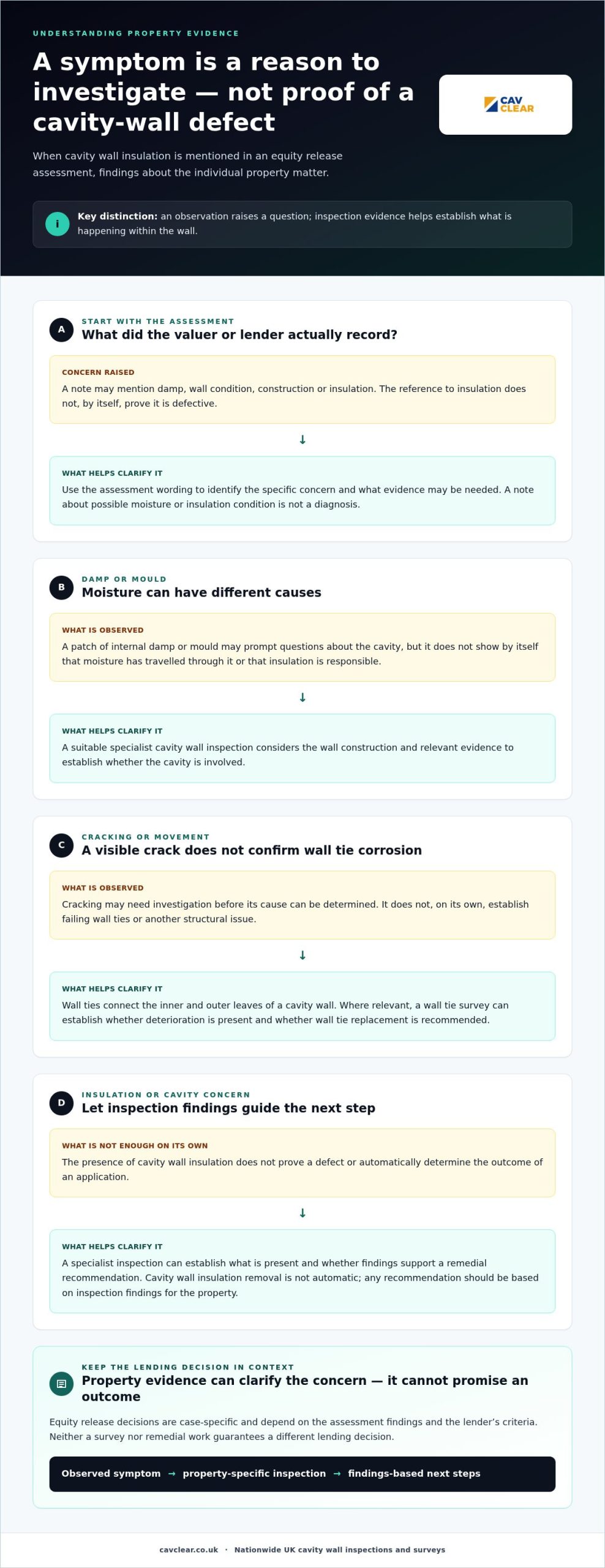
Handling Equity Release Refusal for Cavity Wall Insulation
If you’re facing an equity release refused cavity wall insulation decision, start by finding out exactly what concern was recorded. A refusal or pause can feel final, but it may leave a specific property question unanswered. A clear sequence can help you gather relevant evidence without assuming the insulation is defective or needs removal.
- Read the decision or assessment carefully. Identify whether it refers to damp, insulation condition, the cavity, cracking, construction or another issue. Note whether the wording describes an observed symptom, requests further information or identifies a confirmed concern. If the reason is unclear, ask the person handling the application what property evidence needs clarification.
- Gather the information you already have. Collect available valuation or survey reports, details of the stated concern and relevant photographs. Note where damp, mould or cracking is visible and when you first noticed it. Stick to what you have observed rather than labelling the cause.
- Consider a specialist cavity wall survey. This may help when the assessment raises a question about insulation or cavity condition that existing reports don’t resolve. The inspection should focus on the property and the stated concern. A wall-tie survey may also be relevant if the evidence includes cracking or signs of movement, but wall ties shouldn’t be assumed to have failed without inspection.
- Review the findings before deciding on remedial work. A specialist report should set out what was inspected, what was found and any recommended remedial solutions. Cavity wall insulation removal or other work should follow relevant findings for the individual property, not a general assumption that insulation is the cause.
- Share relevant evidence with the application team. Provide the people handling the application with relevant specialist findings and recommendations. They can consider this information alongside the original assessment. A report can clarify the property issue, but it can’t guarantee that a lender will change its decision.
What information should you gather before arranging an inspection?
Keep the relevant material together so the investigation can address the right question. Include the precise wording used in the assessment, earlier property reports, relevant photographs and a simple record of where symptoms appear and when they began. This context helps separate the reported observation from assumptions about its cause.
How can a specialist report support the next discussion?
Clear findings can help explain whether an insulation concern is supported by inspection evidence, whether another cavity-wall issue needs attention or whether further investigation is recommended. CavClear provides nationwide cavity wall inspections and reports setting out findings and recommended remedial solutions. Arrange a specialist cavity wall survey to investigate the property concern and establish evidence-led next steps.
How CavClear can investigate cavity wall insulation concerns
A useful investigation starts with the concern recorded in the property assessment, then considers whether the available evidence supports it. Visible damp, cracking or mould can help guide where to look, but none confirms an insulation defect by itself. The inspection should focus on relevant cavity-wall conditions and establish findings before remedial work is considered.
CavClear provides cavity wall inspections across the UK, with reports setting out findings and recommended remedial solutions. A property-specific survey can help clarify whether a concern relates to insulation, the cavity, wall ties or another observed condition. This evidence may help explain the property issue to the people handling your equity release application, although it can’t guarantee a particular lending decision.
What can a CavClear cavity wall survey help establish?
A cavity wall survey investigates relevant conditions within the wall and considers the concern identified in the assessment. A cavity wall insulation survey may help clarify an insulation-related question. If the property evidence includes cracking or signs of movement, a wall-tie survey may also be relevant to assess whether the ties need attention.
The scope and recommendations depend on the individual property and inspection findings. A survey isn’t a default instruction to remove insulation. It should distinguish observations from confirmed findings and explain whether further investigation or remedial work is recommended.
When may cavity wall insulation removal or related work be considered?
Cavity wall insulation removal may be considered if the inspection findings support it. If evidence instead identifies a wall-tie concern, wall tie replacement may be recommended. Where damp or mould is observed, further investigation may be appropriate to establish the cause before deciding on a remedy. Not every insulated property has a defect, and a recommendation for one property shouldn’t automatically be applied to another.
CavClear is TrustMark registered for cavity wall insulation removal and a member of the Wall Tie Installers Federation. These credentials sit alongside an inspection-led process: findings for the property should guide any recommendation, rather than the presence of insulation alone.
If an assessment has raised concerns about your cavity wall, a CavClear survey can help establish what is present and what next steps may be appropriate. Arrange a property-specific inspection and receive a report outlining the findings and recommended remedial solutions. This gives you clear information to share with the relevant parties, without assuming removal is necessary or that the application outcome will change.
Take the Next Step with Clear Property Evidence
A refusal linked to cavity wall insulation doesn’t automatically mean the insulation is defective or must be removed. Start by understanding what the property assessment recorded and whether a specialist inspection can clarify it. Damp, cracking and other visible signs need investigation before their cause can be established.
If equity release refused cavity wall insulation is the concern, focus on evidence for your individual property. A cavity wall survey can identify relevant findings and outline suitable next steps. Any recommendation for cavity wall insulation removal or wall tie work should follow the inspection.
CavClear provides cavity-wall services nationwide throughout the United Kingdom. The company is TrustMark registered for cavity wall insulation removal and a member of the Wall Tie Installers Federation. To arrange a specialist cavity wall survey, speak to CavClear about your property concerns.
Clear findings can help you approach the next decision with a better understanding of the property and its options.
Frequently Asked Questions
Can equity release be refused because of cavity wall insulation?
Yes, a lender may pause or refuse an application if a property assessment raises concerns connected with cavity wall insulation. The issue may relate to specific findings, such as damp or the condition of the cavity, rather than insulation simply being present. The assessment wording matters because it can show whether the concern is confirmed or whether further evidence is needed. Lender decisions depend on the individual property and application.
Does cavity wall insulation automatically make a property unsuitable for equity release?
No, the presence of cavity wall insulation alone doesn’t establish a defect or determine whether a property is suitable. The relevant consideration is what the property assessment finds and whether an issue affects its condition or value. If the assessment identifies a concern, further inspection may clarify it. A survey or remedial work can provide evidence, but neither guarantees that a lender will approve an application.
What should I do if an equity release valuation raises concerns about cavity wall insulation?
Start by identifying the exact concern recorded in the valuation or application decision. Gather relevant property reports and photographs, and note where and when you’ve observed symptoms such as damp or cracking. Don’t assume their cause. If the assessment leaves questions about the cavity or insulation condition, a specialist cavity wall survey may help establish what is present and provide findings to share with the people handling the application.
Can a cavity wall survey help after an equity release refusal?
Yes, a cavity wall survey can investigate conditions relevant to the concern raised and provide a report of findings and recommended remedial solutions. For an equity release refused cavity wall insulation decision, this evidence may clarify whether an insulation-related defect is present or whether another issue needs attention. A survey can support a clearer discussion, but it can’t ensure a lender will change its decision.
Does damp prove that cavity wall insulation is defective?
No, damp doesn’t prove that cavity wall insulation is defective. Moisture can have different causes, and its location or appearance alone can’t confirm what is happening inside a cavity wall. A suitable inspection considers the property evidence and relevant wall conditions before reaching a conclusion. If an assessment links damp with insulation, specialist findings can help establish whether that connection is supported and what next steps may be appropriate.
When might cavity wall insulation removal be recommended?
Cavity wall insulation removal may be recommended when inspection findings show that it is an appropriate remedy for the property. It isn’t a default response to insulation being present or to a lender raising a question. A specialist report should explain what was found and why remedial work is proposed. If the evidence points to another cavity-wall issue, a different response may be more appropriate.
Can wall tie problems be mistaken for cavity wall insulation problems?
Cracking or signs of movement can prompt questions about both the cavity and its components, but they don’t confirm insulation failure or wall-tie deterioration. Wall ties connect the inner and outer leaves of a cavity wall. If the property evidence makes their condition relevant, a wall-tie survey can assess them. The findings help distinguish a confirmed wall-tie issue from a suspected insulation concern and guide any recommended remedial work.
Recent Comments