

A structural defect is a documentation and remediation challenge, not an automatic mortgage rejection. Many homeowners believe that flagging issues like wall tie corrosion or failing insulation during a survey will immediately halt their financial plans. However, remortgaging a property with known structural defects is entirely possible when you approach the process with technical precision and professional evidence. With the average two-year fixed mortgage rate currently sitting at 5.68% as of September 2026, securing a new deal is a priority for many households looking to move away from expensive Standard Variable Rates.
It’s understandable to feel overwhelmed by technical survey jargon or the fear of property devaluation. You’re likely concerned about whether a lender will accept your application or if the cost of repairs will outweigh the benefits of a new rate. This guide provides a clear path to satisfying a lender’s valuation criteria by using specialist inspections and accredited remedial solutions. You’ll discover how to restore the structural integrity of your asset, move past the uncertainty of repair costs, and ultimately secure a competitive remortgage rate that protects your long-term financial health.
Key Takeaways
- Understand how lenders evaluate structural risks to avoid potential mortgage rejections or zero valuations during the application process.
- Learn the specific steps for remortgaging a property with known structural defects by providing the technical evidence and specialist reports lenders require.
- Discover why accredited technical property inspections are essential for identifying faults that standard homebuyer reports often overlook.
- Identify how wall tie replacement and cavity wall insulation extraction serve as vital investments that restore structural integrity and asset value.
- Prepare a robust documentation pack including professional remedial action plans to satisfy strict valuation criteria and secure competitive interest rates.
Understanding Lender Risk: Why Structural Defects Impact Remortgaging
Lenders prioritize the security of their investment above all else. When you apply for a new mortgage, the property acts as the primary collateral for the loan. If significant faults exist, the lender’s risk increases because the asset’s value could plummet or the building could become unsafe. This is exactly why remortgaging a property with known structural defects requires a strategic approach. If a defect is already documented-perhaps through a previous survey or visible external damage-it must be addressed before you submit a formal application. Ignoring these issues often leads to a “zero valuation,” where the lender refuses to provide any funds until the property is made mortgageable through professional remediation.
RICS surveyors act as the primary gatekeepers in this process. During a standard valuation, they look for specific red flags that indicate deeper trouble within the building’s fabric. They aren’t structural engineers, but they are trained to spot signs of movement or moisture that suggest a breach in the property’s safety standards. Once a surveyor identifies a potential fault, the lender will typically place a “retention” on the mortgage. This means they withhold a portion of the loan-sometimes the entire amount-until you provide proof from an accredited technician that the fault has been rectified. Failing to secure a deal due to a retention can leave homeowners trapped on expensive Standard Variable Rates.
The Link Between Structural Integrity and Property Value
A property’s market value is fundamentally tied to its structural integrity and long-term stability. Failing wall ties or chronic dampness don’t just affect the living environment; they cause significant devaluation by compromising the core strength of the building. Lenders require long-term assurances that the asset is a safe bet for the duration of the mortgage term. Without professional evidence of repair, you may also find that building insurance premiums rise sharply. Insurers view structural instability as a high-probability risk, which adds another layer of financial strain to the remortgaging process.
Common Structural Red Flags in UK Properties
Identifying defects early allows for proactive remediation before the valuation stage. In UK housing stock, several common issues frequently trigger lender concerns:
- Horizontal cracking: Cracks appearing in mortar joints often indicate wall tie expansion, where rusting ties force the brickwork apart and weaken the elevations.
- Bulging brickwork: This suggests a loss of connection between the inner and outer leaf of a cavity wall, posing a serious safety risk that lenders cannot ignore.
- Severe dampness: Often caused by defective or degraded cavity wall insulation, this can lead to internal decay, mould growth, and the eventual failure of wall ties.
Specialist Property Inspections: Providing the Evidence Lenders Require
Lenders aren’t satisfied with general observations. While a standard RICS Level 2 or Level 3 survey identifies visible red flags, it often lacks the technical depth required to quantify structural risk. This usually leads to a mortgage retention, where the lender pauses the application until you provide expert clarification. When you’re remortgaging a property with known structural defects, the burden of proof shifts to you. You must provide a specialist technical inspection that moves beyond surface-level symptoms to diagnose the underlying cause and determine the extent of the damage.
An accredited technical report serves as a professional roadmap for remediation. It doesn’t just state that a problem exists; it defines the specific scope of work needed to restore the property’s value. Underwriters use these documents to assess the viability of the loan and ensure the asset remains secure. By presenting a clear, evidence-based plan from a nationwide specialist, you can often negotiate the release of funds or reduce the severity of a retention. This documentation transforms an abstract risk into a manageable project with a defined resolution.
The Process of a Specialist Wall Tie Survey
A specialist wall tie survey is a non-destructive diagnostic tool that looks inside the fabric of your home. Technicians use high-definition boroscopes to peer into the cavity, allowing them to inspect the physical condition of the metal ties that hold your walls together. This process is vital for identifying the specific grade of corrosion, which ranges from minor surface rusting to complete structural failure. Knowing the urgency of the repair allows you to present a factual timeline and a fixed-cost solution to your lender. You can read more about the technical process in our wall tie replacement guide.
Damp and Cavity Wall Surveys
Moisture ingress is another common trigger for mortgage rejections. A specialist damp survey investigates the root cause of water penetration, which is frequently linked to defective or degraded insulation within the cavity. Unlike general surveys, these technical inspections use precise diagnostic tools to pinpoint exactly where the structure is failing. Understanding the role of damp surveys is essential for identifying whether insulation extraction is necessary to prevent long-term masonry decay. Professional recommendations carry significant weight with mortgage underwriters because they focus on permanent fixes that protect the long-term health of the asset. If you’re facing a survey flag, arranging a professional cavity wall survey is the first step toward satisfying lender requirements and securing your new mortgage rate.
Remedial Solutions to Restore Structural Stability
While some property advisers suggest selling a damaged home at auction, this often results in a significant loss of equity as cash buyers demand heavy discounts. Professional remediation is a more sustainable and cost-effective path to restoring asset value. When you’re remortgaging a property with known structural defects, the lender’s primary concern is the permanence of the fix. By implementing accredited remedial solutions, you transform a compromised building back into a secure, mortgageable asset. Our methodology focuses on a clean and non-disruptive approach, ensuring that the property’s aesthetics are maintained while its core structure is reinforced.
It is vital to understand that we never recommend the installation of retrospective cavity wall insulation. This practice frequently creates a thermal bridge that allows moisture to cross the cavity, leading to the very dampness and wall tie corrosion that lenders flag as high-risk. Instead, the focus must remain on restoring the building’s original design and structural integrity through specialist intervention.
Wall Tie Replacement as a Permanent Solution
Technicians address failing elevations by installing remedial cavity wall ties. This process involves drilling small, precise holes into the masonry and inserting high-grade stainless steel ties that reconnect the inner and outer leaves of the building. These ties are designed to withstand the stresses of thermal movement and corrosion, providing a permanent fix that far exceeds the lifespan of the original components. This methodology ensures the structural integrity of the outer leaf of masonry, preventing further cracking or bulging. Providing these long-term assurances is often exactly what is needed to satisfy strict lender criteria and release a mortgage retention.
Extracting Defective Cavity Wall Insulation
If your property suffers from dampness, the culprit is often wet or slumped insulation trapped within the walls. This material must be removed to stop the cycle of moisture ingress and internal decay. The process of cavity wall insulation removal involves vacuuming out the defective material through small external ports, leaving the cavity clean and clear. Restoring the original wall cavity allows the building to breathe as it was intended to, preventing interstitial condensation and protecting the new wall ties from moisture-accelerated corrosion. This investment in long-term asset health is a proactive step that demonstrates to lenders that the property is well-maintained and structurally sound.
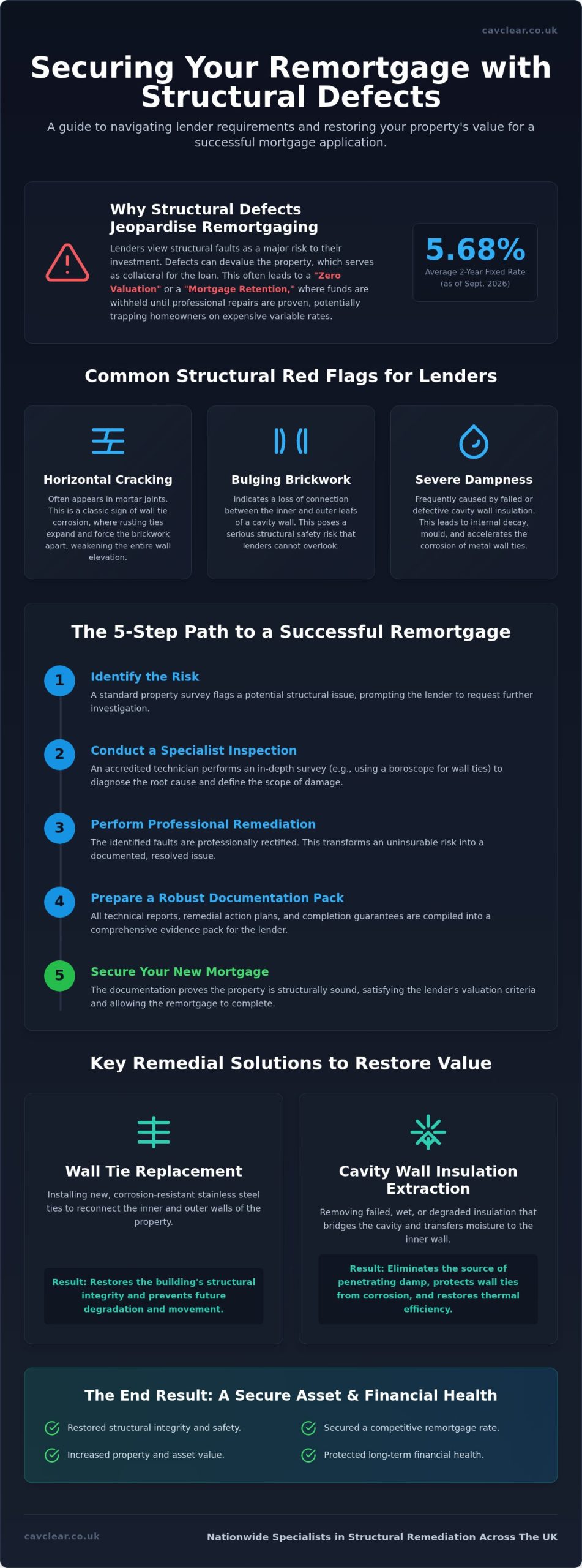
Preparing Your Documentation for a Successful Remortgage
Success in remortgaging a property with known structural defects depends on the quality of your evidence. Lenders require a comprehensive audit trail that proves a fault has been correctly diagnosed and permanently resolved. You should compile a property health pack that includes the initial specialist survey, the detailed remedial action plan, and the final completion certificate. This pack acts as a professional rebuttal to any flags raised in a standard valuation report. It shows the bank that the property is no longer a liability, but a well-managed asset. By providing this documentation upfront, you reduce the likelihood of a surveyor recommending a full retention on your loan.
It’s essential that all works are carried out by accredited technicians who specialize in cavity wall maintenance. Lenders often reject documentation from general builders who lack the specific credentials for structural remediation. Formal completion certificates provide the long-term assurances underwriters need to sign off on a loan. These documents confirm that the wall ties or insulation issues have been addressed according to technical standards, effectively restoring the property’s status as a secure investment. This methodical approach ensures that the asset meets the RICS Home Survey Standard, which is the benchmark for property condition reports in the UK.
Satisfying Mortgage Underwriters
Underwriters look for fact-based reporting rather than general observations. Clear documentation from a dampness specialist identifies the specific cause of moisture ingress and confirms its total mitigation. Once you’ve completed the repairs, you can request a final valuation. Presenting your technical reports at this stage helps ensure the surveyor understands the scope of the improvements. This is vital for removing any remaining retentions on your mortgage funds, especially in a market where lenders are tightening their criteria due to inflationary pressures.
Long-Term Asset Health and Efficiency
View these structural repairs as a vital investment in your property’s future health. A clean survey doesn’t just help with your current remortgage; it protects your resale value for years to come. By restoring the building’s integrity, you ensure it remains a safe and comfortable environment for your family. Framing these works as proactive maintenance rather than emergency repair builds trust with financial institutions and future buyers alike. If you need to gather the necessary evidence for your lender, you can book an accredited technical inspection to begin the documentation process.
CavClear: Nationwide Specialists in Structural Remediation
CavClear provides professional, nationwide coverage across the entire United Kingdom, ensuring that homeowners have access to specialist expertise regardless of their location. We specialize in resolving the complex issues that often halt financial applications. When you’re remortgaging a property with known structural defects, you need more than a general builder; you need a specialist who understands the technical requirements of mortgage underwriters and surveyors. Our expertise in wall tie replacement and cavity wall maintenance ensures that your property’s structural integrity is not just restored, but documented with the precision lenders demand.
Our team focuses on reliability, transparency, and the restoration of structural integrity. We don’t just perform repairs; we provide the technical evidence required to satisfy strict valuation criteria. Our accredited technicians deliver clear, actionable property reports that serve as definitive evidence of remediation. We understand that property damage causes significant stress, but our role is to provide a calm, expert solution that restores comfort and security to your home. This no-nonsense approach is why we’re trusted by property owners across the country to rectify poor workmanship and ensure long-term asset health.
Why Choose a Specialist Contractor?
Technical rigor is the foundation of every structural inspection we perform. We don’t rely on surface-level guesswork; we use advanced diagnostic tools to identify the exact cause of failure within the cavity. Our methodology is designed to be clean and non-disruptive, protecting your home’s aesthetics while reinforcing its core fabric. This professional approach restores confidence for both homeowners and mortgage lenders alike. It frames remedial work as a vital investment in the property’s future rather than a simple repair, ensuring long-term asset health and efficiency for years to come.
Getting Started with Your Property Assessment
Booking a comprehensive survey is the first step toward remortgaging a property with known structural defects. Our process begins with a thorough onsite inspection where we assess wall tie condition and cavity health with meticulous detail. You can expect a detailed report that outlines specific recommendations and fixed-cost solutions. This transparency allows you to plan your finances with certainty and present a clear remedial path to your lender. By addressing structural faults proactively with a specialist, you remove the barriers to a competitive mortgage rate and secure the permanent fix your home deserves.
Securing Your Property’s Future and Financial Stability
Remortgaging a property with known structural defects doesn’t have to result in a rejected application or a zero valuation. When you provide lenders with technical certainty through accredited evidence, you transform a compromised building back into a secure investment. The key to success lies in moving beyond general observations and presenting a clear, professional roadmap for remediation. By addressing issues like wall tie corrosion or moisture ingress with specialist methodology, you restore the structural integrity that underwriters demand.
CavClear offers the nationwide service coverage and technical expertise required to navigate these challenges. Our accredited technical property inspections provide the fact-based reporting needed to satisfy RICS standards and remove mortgage retentions. We focus on long-term asset health, ensuring that your home remains a safe, comfortable, and mortgageable asset for years to come. Taking this proactive step allows you to secure a competitive rate and protect your equity in any market condition.
Book a Specialist Survey with CavClear Today to receive a comprehensive assessment of your property. You can take the first step toward a successful remortgage by choosing a permanent fix from a trusted specialist.
Frequently Asked Questions
Can I remortgage a house with failing wall ties?
Yes, you can remortgage a house with failing wall ties, but most lenders will require a specialist technical inspection first. If the wall ties are corroded, a surveyor will likely flag this as a risk to the building’s stability. By commissioning a specialist wall tie survey and implementing a replacement plan using stainless steel ties, you provide the evidence needed to satisfy the lender. This proactive approach ensures the property remains a secure asset for the loan.
Will a lender approve a mortgage if cavity wall insulation is defective?
Lenders are often hesitant to approve a mortgage if defective cavity wall insulation is causing damp or mould issues. Wet or slumped insulation creates a thermal bridge that compromises the structure. To satisfy valuation requirements, you’ll likely need to arrange for cavity wall insulation extraction. Removing the defective material restores the cavity’s function and stops moisture ingress. Providing a completion certificate for this work demonstrates that the structural risk has been fully mitigated.
What is a mortgage retention for structural issues?
A mortgage retention occurs when a lender withholds a portion of the loan until specific structural repairs are completed. This is common when remortgaging a property with known structural defects like wall tie corrosion or severe damp. The lender identifies a risk that could affect the property’s value and requires proof of remediation before releasing the full amount. Once you provide a completion certificate from an accredited technician, the retention is typically lifted and the funds are released.
How much does a specialist wall tie survey cost?
The cost of a specialist wall tie survey depends on the size of the property and the complexity of the inspection. These technical assessments involve using boroscopes to look inside the cavity and identify the grade of corrosion. While prices vary across the UK, this professional survey is a vital investment in your property’s future. It provides the detailed reporting and remedial action plans that mortgage underwriters require to approve applications for properties with suspected structural issues.
Do structural repairs increase the value of my property?
Structural repairs don’t necessarily add value in the same way a new kitchen does, but they are essential for restoring and protecting the property’s market value. A house with failing wall ties or defective insulation is often devalued by surveyors due to the perceived risk. By completing accredited repairs, you remove these red flags and ensure the property meets the RICS Home Survey Standard. This restoration of structural integrity is vital for securing competitive remortgage rates.
How long does it take to get a completion certificate for structural work?
Completion certificates are typically issued shortly after the remedial works have been inspected and signed off by an accredited technician. For projects like wall tie replacement or insulation extraction, this usually happens within a few days of the job’s conclusion. This document is a critical piece of evidence for your lender, as it confirms that the structural faults have been professionally rectified according to industry standards. Having this documentation ready helps speed up the final valuation process.
Can I remortgage a property with black mould issues?
You can remortgage a property with black mould, but you must first identify and resolve the underlying cause of the dampness. Lenders view persistent mould as a sign of poor maintenance or structural failure, which can lead to a mortgage retention. Often, the root cause is defective cavity wall insulation that needs extraction. Once the moisture source is removed and the property is dry, providing a specialist report will help satisfy the lender’s safety and valuation criteria.
Is it better to sell a house with structural defects at auction?
Selling at auction is an option, but it often results in a lower sale price as buyers expect heavy discounts for structural risks. For most homeowners, it’s more cost-effective to fix the issues before remortgaging or selling. Professional remediation restores the property’s status as a mortgageable asset, allowing you to access better interest rates or a wider pool of buyers. Investing in a permanent fix preserves your equity and protects the long-term health of your property asset.
Recent Comments