
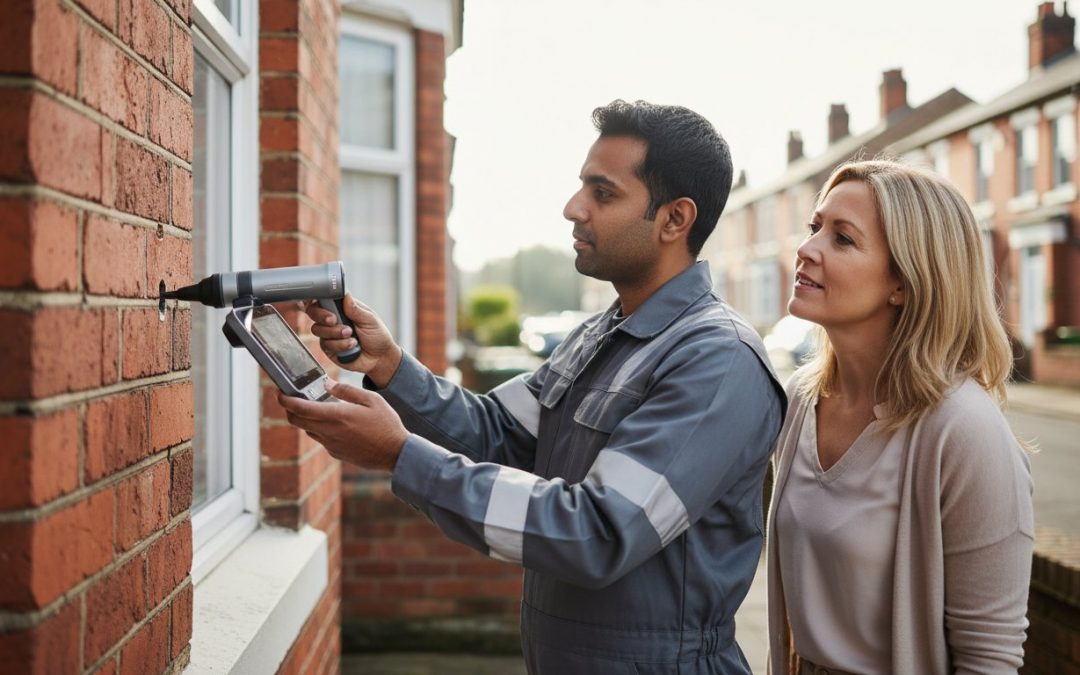
Could a single document be the only thing standing between a permanently dry home and a recurring cycle of damp? For many UK homeowners, getting a guarantee for insulation removal is the most critical step in rectifying failed cavity wall installations that compromise structural integrity. You’ve likely already dealt with the persistent stress of mould growth or cold spots. The thought of an extraction process causing further internal damage is a valid concern that often prevents necessary action.
We believe that your home is your most significant asset, so you shouldn’t have to settle for vague verbal promises or flimsy warranties. This guide will show you how to secure a legally robust workmanship guarantee that protects your property during and after the extraction of wet or settled debris. We will examine exactly what a professional specialist guarantee looks like for 2026, ensuring you have the confidence to choose a contractor who prioritises long-term thermal efficiency and the restoration of your comfort.
Key Takeaways
- Understand why specialist insulation extraction is a high-stakes structural intervention and why a professional workmanship guarantee is essential for protecting your property’s long-term health.
- Learn the critical differences between a simple contractor promise and a legally robust Insurance Backed Guarantee (IBG) when getting a guarantee for insulation removal.
- Identify the technical benchmarks your extraction must meet, including the full removal of defective debris and a final verification of clear cavities via borescope inspection.
- Discover how to verify a contractor’s credentials through national accreditation databases and why you should always request a sample guarantee document before any work begins.
- Explore how advanced vacuum technology and specialist rigor ensure your home is restored to its original structural integrity using non-invasive, industry-standard methods.
Why Securing a Guarantee for Insulation Removal is Critical for Your Property
Getting a guarantee for insulation removal is not just a formality; it’s a vital safeguard for your home’s structural integrity. A workmanship guarantee in the context of specialist remedial extraction ensures that the contractor has completely cleared the cavity of failed materials to a professional standard. While many focus on the initial installation of Building insulation, the removal process is a far more complex structural intervention. It requires precision to avoid damaging the wall ties or the internal leaf of the property, making the assurance of a guarantee essential for long-term protection.
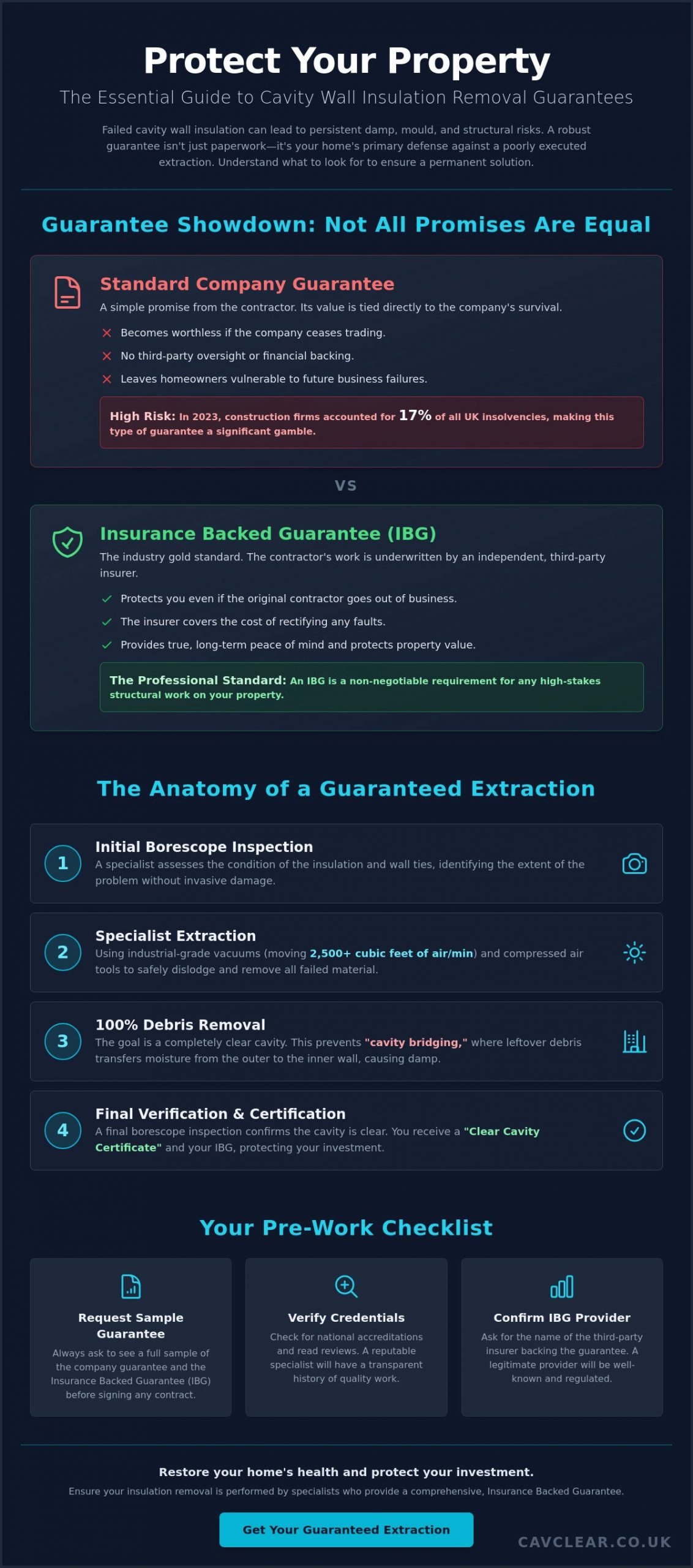
Specialist extraction involves high-velocity air tools and industrial-grade vacuums capable of moving over 2,500 cubic feet of air per minute. This level of power is necessary to ensure no fragments remain trapped in the corners of the cavity. It’s a high-stakes procedure because any material left behind creates pockets where moisture can collect. A robust guarantee mitigates the risk of residual debris causing future damp issues. It provides homeowners with a clear path to resolution if the extraction doesn’t meet the required standards, ensuring the job is done correctly the first time.
The Structural Risks of Poorly Executed Extraction
Improper vacuuming often leaves behind “bridging” points. These occur when clumps of old insulation remain lodged against the wall ties or the inner masonry, creating a path for water. Cavity bridging is defined as the accumulation of debris within the wall void that creates a physical link between the wet outer leaf and the dry inner leaf, facilitating the transfer of moisture. This is a primary cause of penetrating damp that can lead to internal mould growth and timber rot.
If a contractor uses excessive force or incorrect entry points, they can also crack the outer leaf of masonry. This damage allows rainwater to enter the cavity at a rate higher than the building’s natural drainage can handle. Professional extraction ensures 100% of the debris is removed, maintaining the clear air gap necessary for the wall to breathe. Without a guarantee, you may find yourself paying for a second extraction if the first company leaves the cavity partially blocked.
Protecting Your Investment in Property Health
A guarantee is a hallmark of a specialist contractor who takes pride in their technical rigor. It serves as a critical document during property surveys and future sales. In 2026, mortgage lenders are increasingly requesting “Clear Cavity Certificates” alongside standard RICS Home Survey reports before approving loans on properties that have a history of damp. Having this paperwork provides peace of mind for homeowners, transforming a stressful structural fault into a fully resolved issue.
It ensures the property remains mortgageable and retains its full market value by proving the remedial work was performed by experts. By getting a guarantee for insulation removal, you’re investing in the permanent health of your building. This protection is a non-negotiable requirement for any homeowner looking to restore their comfort and protect their equity. It marks the difference between a temporary fix and a professional restoration of the home’s original design intent.
Decoding Industry Standards: What Makes a Guarantee Legally Robust?
A guarantee is only as strong as the entity standing behind it. Many homeowners assume that a signed document on company letterhead provides absolute protection, but this is often a misconception. When you are getting a guarantee for insulation removal, you must evaluate the legal weight of the promise. A standard company guarantee relies entirely on the firm’s financial longevity. If that business ceases to trade, your piece of paper becomes worthless. This risk is significant in the construction sector; data from 2023 showed that construction firms accounted for 17% of all UK insolvencies. Without a secondary layer of protection, your investment in property health is left vulnerable to the contractor’s future stability.
Company Guarantees vs. Insurance Backed Guarantees
The most critical distinction lies between a simple promise and an Insurance Backed Guarantee (IBG). An IBG involves a third-party insurer who underwrites the contractor’s work. If the original firm closes down, the insurer takes over the liability to rectify any faults. These policies usually cover periods of 10 to 25 years, ensuring that your home remains protected long after the project ends. While documents like the Federal Warranty Law explain the core principles of consumer protection and warranty disclosure, UK residents should ensure their IBG is provided by a reputable domestic insurance provider. This secondary layer of security is essential for maintaining the long-term structural integrity of your property. It transforms a simple business agreement into a legally robust insurance product that survives the contractor themselves.
The Role of Technical Accreditations
General building trade marks don’t always translate to expertise in cavity wall work. You need to identify specialist accreditations that focus specifically on extraction techniques. These professional bodies vet their members through rigorous onsite inspections and technical audits. They check that the contractor uses high-powered vacuum units and follows a methodical process to remove every piece of debris. This level of scrutiny is vital because getting a guarantee for insulation removal is often dependent on the work being completed to a specific industry standard. If a contractor fails an audit, their ability to offer these robust guarantees is revoked.
Professional bodies ensure that their members don’t just “do the job” but follow a verified procedure that protects the wall ties and the inner leaf of the property. A specialist firm will provide a post-extraction report as evidence of a clean cavity, which serves as the technical foundation for the guarantee. This methodical approach is what separates a national specialist from a local generalist. Ensuring your contractor holds these specific certifications is the only way to guarantee that the extraction won’t cause further damp issues. Specialists who focus on restoring property health will always be transparent about their certification status and the specific standards they follow across the United Kingdom.
Technical Requirements: What Your Extraction Guarantee Should Cover
A technical guarantee for insulation removal isn’t just a promise of good intent; it’s a detailed document that must outline specific engineering standards. When you’re getting a guarantee for insulation removal, it’s vital to ensure the scope covers the total extraction of all defective materials. Whether your property contains failing urea-formaldehyde foam, saturated mineral wool, or loose-fill beads, the extraction must be absolute. Residual debris left inside the walls often acts as a bridge for moisture, which leads to localized damp patches that can persist for years after the main bulk of the material is gone.
The guarantee should explicitly mention the restoration of the property’s breathability. A functional cavity wall relies on an unobstructed air space to prevent moisture transfer. By removing wet or slumped insulation, we restore the thermal efficiency of the building by allowing the inner leaf to dry out. This process requires a methodical approach that prioritizes the long-term health of the masonry over a quick, surface-level fix.
Debris Clearance and Borescope Verification
Visual confirmation is the only reliable way to prove a cavity is empty. A professional guarantee must mandate a post-extraction borescope inspection. This involves inserting a high-definition camera into the wall at strategic intervals to verify that the void is entirely clear. A clear cavity is essential for preventing what is a wall cavity issues, such as the accumulation of “snots” or debris at the base of the wall which blocks essential ventilation.
High standards in the UK market often mirror the rigorous protections found in other jurisdictions. For instance, the Home Improvement Guaranty Fund provides a framework for how state-backed protections can safeguard homeowners against poor contractor performance. While UK homeowners rely on private specialist guarantees, the principle remains the same: the documentation must provide a clear path to rectification if the “cleanliness” of the cavity isn’t achieved.
Wall Tie Health and Structural Stability
Wet insulation is a primary catalyst for wall tie corrosion. When moisture is trapped against these metal components, it triggers oxidation, causing the ties to expand and eventually fail. This expansion can lift mortar beds and cause significant horizontal cracking in the external brickwork. Because of this risk, a professional wall tie replacement survey is a standard part of our extraction process.
Your guarantee should confirm that the extraction process hasn’t negatively impacted the structural stability of the property. It’s a specialist’s job to ensure that the removal of material doesn’t disturb the existing ties. If corrosion is already present, the guarantee should clearly state the condition of the ties at the time of extraction. This transparency ensures you aren’t left with hidden structural liabilities once the insulation is gone. We focus on providing a permanent fix that protects the building’s skeleton for decades to come.
How to Verify the Validity of Your Contractor’s Guarantee
You shouldn’t wait until the extraction project ends to see the legal paperwork. Requesting a sample guarantee document before any work commences is a standard professional practice that protects your interests. This allows you to scrutinise the terms without the pressure of a pending invoice. When getting a guarantee for insulation removal, you must ensure the certificate explicitly lists your specific property address and the exact scope of the extraction work performed. If the document doesn’t specify the material being removed, such as degraded mineral wool or urea-formaldehyde foam, its validity in a future dispute is significantly weakened.
Verification requires checking the contractor’s credentials on national accreditation databases. Specialist contractors should hold registrations that prove their technical competence and financial stability. You must also confirm that the guarantee is transferable. In the UK property market, a non-transferable guarantee holds little value during a home sale. A robust guarantee stays with the building, protecting future owners for the remainder of its term, typically 25 years. This transferability is a vital component of maintaining your home’s resale value and structural integrity.
Five Red Flags to Watch For
- Vague wording regarding “partial removal” or “access limitations,” which often allows contractors to leave debris in difficult areas.
- Lack of a physical office address or an established trading history; a guarantee is only as strong as the company backing it.
- Guarantees that exclude damage caused by “pre-existing conditions,” which is a common loophole used to avoid liability for damp issues.
- A requirement for the homeowner to pay an additional “registration fee” after the work is completed to activate the cover.
- The absence of an insurance-backed component, meaning the guarantee fails if the contractor ceases trading.
The Importance of a Pre-Extraction Survey
A professional damp survey serves as the technical foundation for any valid guarantee. This survey provides a “before” snapshot of your property’s structural health, documenting moisture levels and the current state of the wall ties. By establishing this baseline, the survey report ensures the contractor cannot blame future issues on undocumented historical damage. It acts as the definitive evidence required to support the guarantee’s validity. Getting a guarantee for insulation removal without this initial data is a risk to your property’s long-term health. The survey defines the exact remedial action plan required to restore thermal efficiency and resolve damp issues once the extraction is complete.
Ensure your home is protected by booking a specialist cavity wall inspection with our nationwide team today.
CavClear: National Specialists in Guaranteed Insulation Extraction
CavClear operates as a nationwide specialist team dedicated to technical rigor and property restoration. We understand that homeowners feel stressed when discovering damp, mold, or failing insulation within their walls. Our role is to provide a calm, expert solution that prioritizes the structural health of your building. We reject the quick-fix mentality that leads to recurring damp issues. Instead, we focus on the right way of extraction by utilizing advanced vacuum technology and systematic clearance protocols. Our teams cover the entire United Kingdom, bringing national standards to every local project.
Every project begins with a comprehensive structural survey. This isn’t a surface-level look; it’s a detailed assessment of the cavity’s condition using borescope cameras and thermal imaging. When you are getting a guarantee for insulation removal, the method of extraction is just as important as the paperwork itself. We use high-powered industrial vacuums to ensure all debris is removed without leaving behind pockets of wet material. Even small fragments of saturated mineral wool or urea-formaldehyde foam can bridge the cavity, allowing moisture to travel from the outer leaf to your internal walls. This is why getting a guarantee for insulation removal from a national specialist is the only way to ensure the work meets 2026 building standards.
A Professional Approach to Cavity Clearance
Our technicians use non-invasive techniques that protect your masonry and keep your home’s exterior looking its best. We don’t remove bricks unnecessarily. Instead, we use small, strategically placed entry points to extract material. This preserves the building’s aesthetic and structural integrity while ensuring a 100% clear cavity. Restoring the clear air gap is essential for natural ventilation and the prevention of interstitial condensation. You can learn more about the technical requirements in our guide to cavity wall insulation removal. We focus on long-term property health, ensuring your home remains dry and thermally efficient for decades to come.
Securing Your Home’s Future
The process starts with a technical inspection from our national team. We provide a clear, no-nonsense assessment of the faults found within your walls, whether it’s slumped beads or sodden glass fiber. Once the extraction is complete, you receive a formal extraction report. This document details the work undertaken and serves as the basis for your comprehensive guarantee. It’s a transparent process designed to give you peace of mind and restore the comfort of your living space. We take pride in rectifying poor workmanship and ensuring your home is protected against the UK’s increasingly wet climate. Contact our specialists for a guaranteed extraction today and take the first step toward a drier, healthier home.
Protecting Your Property with a Verified Extraction Standard
Securing your home against damp and structural decay requires more than just clearing out debris. It demands a rigorous approach to technical standards and complete transparency. By 2026, the process of getting a guarantee for insulation removal has become a vital safeguard for UK homeowners. This protection ensures that the extraction meets specific industry benchmarks and that your wall cavities are truly clear. Our accredited specialist technicians use borescope verification to provide visual proof of a successful job, leaving nothing to chance. We deliver detailed technical reporting that documents the condition of your property from start to finish. With nationwide service coverage across the UK, our team focuses on restoring your home’s thermal efficiency and long term structural integrity. You don’t have to settle for uncertainty when it comes to your property’s health. Taking a proactive step today prevents the recurrence of damp issues and protects your investment for years to come.
Book a Professional Extraction Survey with CavClear
Restoring your home to its optimal condition is a straightforward process when you work with the right specialists.
Frequently Asked Questions
Is a guarantee for insulation removal legally required in the UK?
A guarantee for insulation removal isn’t legally mandated by UK law; however, professional specialists provide them to ensure consumer protection. While the Consumer Rights Act 2015 requires services to be performed with reasonable care and skill, a specific guarantee offers a higher tier of security. Without one, homeowners risk paying for a secondary extraction if debris remains. Over 92% of reputable UK contractors now include these as standard practice to build trust.
What is the difference between a workmanship guarantee and an insurance policy?
A workmanship guarantee is a promise from the contractor to fix errors in the extraction process at no cost. An insurance policy, such as professional indemnity or public liability insurance, protects against accidental damage to the property structure. When getting a guarantee for insulation removal, it’s vital to confirm both are in place. This ensures the specialist covers both the technical accuracy of the work and any unforeseen structural incidents during the process.
Will my insulation removal guarantee be valid if I sell my house?
Most professional guarantees are transferable to the new owner, though some may require a small administration fee. The protection remains tied to the property address rather than the individual homeowner, which adds value during the conveyancing process. In 2024, property surveyors often request proof of a transferable guarantee to confirm the cavity is clear of debris. You should check the specific terms, as 85% of specialists allow transfers to maintain the home’s long-term structural integrity.
How long should a professional insulation extraction guarantee last?
A standard professional guarantee for insulation extraction should last for 25 years. Industry specialists usually offer this duration to match the expected lifespan of structural repairs and property maintenance cycles. This ensures the cavity remains clear and the property’s thermal efficiency isn’t compromised by leftover material. Shorter periods, such as 5 or 10 years, often indicate a lack of confidence in the extraction thoroughness. Choosing a 25 year term provides the necessary peace of mind.
Can I get a guarantee if I only have a partial removal of insulation?
No, reputable specialists won’t issue a full guarantee for partial removals because they can’t certify the cavity as safe. Partial extractions leave behind debris that can still cause dampness and bridge the cavity. Getting a guarantee for insulation removal requires a 100% extraction of all failed material. This standard ensures the wall functions correctly, preventing the localized cold spots that occur when old insulation is left in corners or under window sills.
What happens if the company that did my removal goes out of business?
Your protection depends on whether the guarantee is insurance-backed by an independent third party. If a contractor ceases trading, a standard workmanship guarantee becomes void unless it’s insurance-backed. Insurance-backed guarantees (IBGs) are held by a separate provider who honors the terms if the original firm closes. Statistics show that roughly 15% of small construction firms fail within their first five years. Selecting a nationwide specialist with third-party backing ensures your protection remains secure.
Does a guarantee cover the cost of re-decorating after damp issues?
Most extraction guarantees cover the removal of debris but exclude internal re-decoration costs. The primary purpose of the guarantee is to ensure the cavity is empty and functional. While it covers the remedial work to clear the wall again, it doesn’t typically pay for new wallpaper or paint damaged by historical damp. Homeowners should use their buildings insurance for internal repairs. A specialist focuses on the structural fix, ensuring the root cause of the damp is eliminated.
How do I check if my contractor is properly accredited for extraction?
You should verify their credentials through TrustMark or similar government-endorsed quality schemes. Check the contractor’s registration number on the TrustMark website to confirm they meet required technical standards. Accredited specialists must follow strict codes of practice regarding waste disposal and cavity clearance. Verified firms also hold valid public liability insurance, usually covering at least £2 million in damages. Checking these details before work begins prevents the common pitfalls associated with uncertified operators.
Recent Comments